John Sawin banjo clock CA 1840

John Sawin was a prolific 1840s Boston clockmaker and many of his clocks have survived to this day.

The Key features of the Sawin timepiece share many of the attributes of the original Simon Willard Patented Timepiece. They are:

  • No striking parts reducing the number of wheels to a minimum for simplicity,
  • Making the distance between the plates wider allowing sufficient cord on the barrel allowing it run 8 days,
  • The push-pin catches on the bezel and lower access doors,
  • Placing the pendulum in front of the weight to ease repair and regulation,
  • The weight is reduced and made longer and wider,
  • The pendulum and guide are placed in front of the movement,
  • An oblong space in the pendulum so that it swings clear of the centre pinions and hour and minute collars,
  • The method of mounting the movement to the case. Works are fastened by two “ears”, the top right and bottom left backplate,
  • The calculation of the train in consequence of shortening the pendulum,
  • No method of securing the pendulum when transporting the clock,
  • Acorn top finial and wood dial bezel
  • The shape of the case,

The earliest timepieces from Roxbury had long screws from the front plate into the case in the upper right and lower left. Beginning about 1820 in Boston a single bolt from the back of the case into the movement was used as per Howard & Davis and E. Howard. North Attleboro movements had holes in the backplate in the upper right and lower left for screws into the case.

Upper right mounting “ear”

A John Sawin movement is distinguished by brass ears attached to the movement back plate in the upper right and lower left. Other Boston area clockmakers might have used the same casemakers so their cases probably would look similar to his.

As found

Cases came from one of several casemakers in the Boston area. Case construction is helpful in identifying where the clock was probably made and movement for the maker, however by the 1830’s movement construction had become so generic that was really difficult to identify the maker. It is probable that were many small workshops run by former apprentices and/or journeyman clockmakers that supplied movements to the trade as needed by the existing makers in the various cities so it makes things even more complicated.

The real differences were how the movement was attached to the case and that gives us information on where it was manufactured.

The John Sawin Banjo headpiece is carved out. With the dial off, the headpiece of the case looks like two crescent moons facing each other, thin at the top and bottom and thick in the middle. There is a piece of cloth glued to the inside top of the case to hold the 2 crescent moons together.

Two crescent moons make up the headpiece

Unfortunately this clock has no identifying markings which means that it is quite possible that while it may not have been made by John Sawin himself but one of his associates or one of his apprentices. Still in all, it is a nice-looking clock and looks great on any wall.

Yard sale find – a 181-year-old weight driven banjo clock for less than you think

Seller’s photo

Yes, a weight-driven banjo clock for a surprisingly low price!

There are essentially three types of mechanical banjo clocks. Those with lever escapements are usually in the $75 to $100 range, spring driven ones are $100 to around $200 and up but weight-driven banjo clocks occupy the higher end of the range and normally cost between $300-$500 in fair condition to upwards of thousands for Simon Willard or E. Howard clocks.

My wife discovered this particular clock on Facebook Marketplace for $100. I suggested she offer the seller $75 and the seller immediately accepted. I think they just wanted to get rid of it. However, it is always a risk buying a clock sight unseen but this looked like an excellent prospect and for $75, why not take a chance!

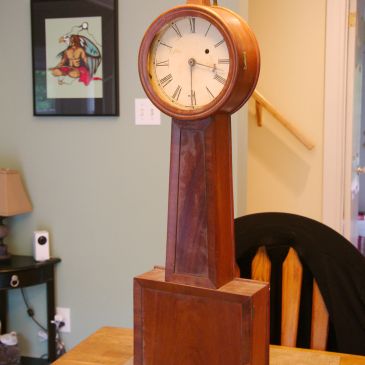
From the photos provided it is a weight-driven federal style mahogany-cased banjo clock from the 1800s. The movement is intact because the seller sent a video showing the pendulum bob moving from side to side.

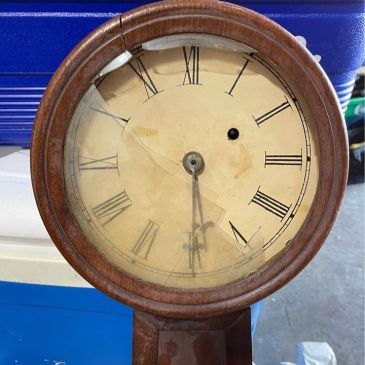
Looks like the original dial and original hands

It has a top acorn finial which appears to be original to the clock. I thought it was missing the carved reverse scrolled side arms and the bottom base piece but not all of these clocks had bottoms or side arms. 

The original banjo styled steel hands and the painted face appear to be in good condition. The broken glass bezel can be easily replaced. The case is dirty and requires a small amount of veneer work. I also see the winding crank in the bottom of the case.

Could be a diamond in the rough

I picked it up in late June 2021.

The day of the pickup

We arrived at the garage sale and met the sellers. My wife was curious as to the provenance of the clock and we were told that it had been in the family for more than 60 years having spent most of its life in Wolfville, Nova Scotia.

The clock was heavy which meant the weight was inside the case. Had the weight been missing, sourcing one would have been a problem but it is best to have the original weight.

We had few errands to run in the city and did not return home till late in the evening. Minutes after coming through the door I had the clock on the kitchen table and a screwdriver in hand taking it apart.

A Boston made banjo clock

After studying it further and comparing the clock to others online and through my inquires with members of a clock forum site I learned that the clock was very likely made in 1840 in Boston by John Sawin who apprenticed under Simon Willard and was a journeyman under Aaron Willard, famous clockmakers of the day and inventors of the original patent timepiece.

Later, I will profile the clock with detailed images of the movement, dial face and aspects of the case and more information on clockmaker John Sawin.

Is this the find of the year? I certainly believe so!

Website Powered by WordPress.com.

Up ↑