Gustav Becker Vienna Regulator Braunau factory circa 1902

RS GB movement in no weights (5)
Gustav Becker Vienna Regulator

This is a Gustav Becker 2 weight “Vienna Regulator” made at the Braunau factory in 1902. The serial number is a confirmed match for the numbered series built during that period. The clock was made in the Gustav Becker Braunau works in Bohemia (now Broumov, Czech Repulic), in mid-1902. The Braunau operation started up in February 1888 and would have been producing clocks up until 1925. Bohemia is a province in the Habsburg Austrian Empire hence the reference to clocks during that period referred to as Vienna Regulator style. The definition of a Vienna Regulator is a debatable point and I will leave that up to the reader to decide.

Some notable features are the inverted keyhole movement mount, rod gong and a wood pendulum rod with brass covered zinc. There are intricately carved trim pieces, certainly a common feature of the craftsmanship found in higher end clocks of that period. The clock is 51 inches tall and is a commanding presence on any wall and certainly a great addition to our living room.

What is missing in the photo are the two weights which at this point are not attached; the condition of the cables are suspect. Replacement cables are on the list. There is also a small part of the right bottom finial which has to be reattached (glued).

The bottom middle finial is also not attached. The bottom middle finial is in the freezer right now because I noticed that it was the only part of the clock with woodworm holes. I inspected the finial carefully, banged it on white paper and not a bit of dust or dead insects. This is a good sign and one indication that the worms and their larvae have been long gone but as an extra precaution a few days in the freezer won’t hurt and once it gets to -30C here in Nova Scotia a little time outside won’t do any harm either. I am not at the point where I will introduce it to chemicals as my best guess is that the problem insects have simply left their mark and have since departed. There is no indication of any worm holes on the clock itself which leads me to believe that the bottom middle finial may not be original. Chemical eradication appears to be the only course of action it seems as freezing does nothing.

RS the case (5)
some pieces had to be reattached

At the moment this clock is not working. The clock needs a very good cleaning and possible bushing work. I have not opened it up yet to investigate further but my first inspection of the moment is that it has not seen maintenance in some time. This will be one of my first steps.

This is a good project and from time to time I will detail my progress on this fine European clock.

Gustav Becker 2-weight regulator wall clock

3Clock Cake1 [3086218]
This takes the cake
My wife bought me a Gustav Becker 2-weight regulator at a popular auction site and while I haven’t received it just yet she had to show me what it looked like in a most unusual way.  She thought that a photo would not do so she had someone make a cake from the auction site photo so that I could enjoy it before it came. That someone has a cake making business and as you can see she is very talented. It was awful hard to cut into it though.

The Gustav Becker clock which should be here in the next few days was advertised as a “project” clock so I am not expecting a perfect clock. According to the seller the strike hammer is missing although the crown, movement, weights, base, dial and pendulum are said to be original. We’ll see what else is missing when it arrives.

You can see the real clock in the following images.

$_57
Seller’s photo of Gustav Becker wall clock
$_57e
Regulator weights
$_57a
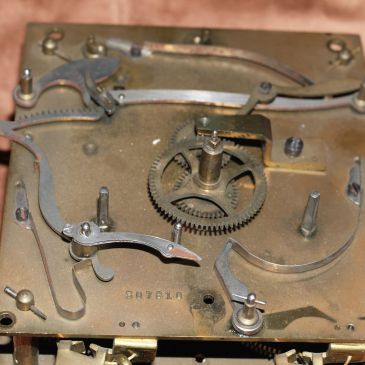
Movement and cables

Clock collectors usually pride themselves in having at least one Gustav Becker (GB) clock in their collection with earlier clocks commanding high prices. Indeed, Gustav Becker is one of the better known clock companies of the mid 1800s to 1930. In 1850 Gustav Becker opened workshops in Freiburg and Silesia, Germany.  At first, Becker struggled with untrained help, but won the “Medaille d’Or” for design at the 1852 Silesia Trade Exposition. Becker incorporated that first medal and his initials, G.B., into his trademark and into many components of his clocks, from movement, mounts to wall standoffs to beat-plates and pulleys.

Once he received the award he was able to attract skilled craftsmen to his various workshops. Until 1880 most Becker clocks were weight driven regulators but spring driven clocks followed.

Becker clocks are not too difficult to identify. Serial numbers on the clocks identify the year of manufacture. The cases of these clocks reflect the ornate furniture trends of the day and range from very simple to elaborately constructed. The casework is extraordinarily well done and often incorporates hand carving. Germany has never lacked for skilled carvers and the talent of the region’s artisans is evidenced in the Becker clock cases.

In 1926 the brand as well as the later acquisitions of Lenzkirch and Thomas Haller were absorbed by Junghans. Junghans continued to produce clocks under the Gustav Becker name until the early 1930s. While GB clocks are relatively easy to identify by their serial numbers, one way to identify a GB under the Junghans name is the serial number which was restarted at 0001 after the take over.

Does frustration await me? We`ll see. I will be posting updates on this fine timepiece as I progress through the restoration process.

Arthur Pequegnat Regulator #1

One of the clocks that I would like to add to my collection is the Arthur Pequegnat Regulator #1, single weight 8-day time only clock. A rare clock indeed and prices of the few I have seen are on the high side. Too rich for me at his time.

The company distinguished itself as a competitor for some of the better American wall clocks such as those made by Seth Thomas. Their wall clocks often looked like models made by Seth Thomas but some of their designs were unique. For their wooden cases, they favored the heart wood of quarter-sawn white oak that showed off beautiful ray flecks.

The regulator #1 is often compared to the Seth Thomas Regulator #2. Thousands of Seth Thomas Regulator #2s found their way into offices and rail stations all across America. The Arthur Pequegnat Regulator #1, though not as prolific, served the needs of many businesses in Canada. The clock is highly collectible in Canada and will command twice the price of similarly styled clocks by well-known American counterparts.

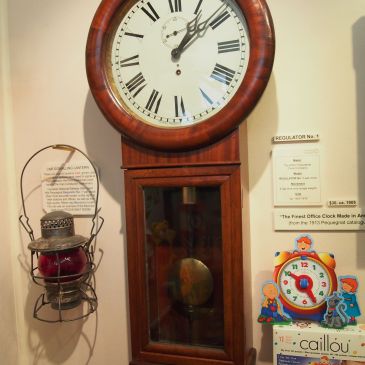
This photo of the Regulator #1 was taken at the Canadian Clock Museum in Deep River Ontario in 2013.

The Arthur Pequegnat clock company had an illustrious albeit short life. Watchmaker Arthur Pequegnat was born in Switzerland in 1851. Arthur immigrated to Berlin, Ontario Canada in 1874 with his wife, parents, brothers and sisters; a grand total of 18 family members.

By the late 1870’s Arthur was operating a jewelry store and watch repair in Southern Ontario. By the middle 1880’s Arthur and his brother Paul were operating a shop in Berlin, Ontario. After about ten years the brothers went their own way, both operating successful jewelry shops in Southern Ontario.

In 1897 Arthur expanded his Berlin Jewelry shop to include the manufacture of Bicycles. However, By 1904, with the decrease in the demand for Bicycles, Arthur began to re-focus on the clock industry, by manufacturing his own clock movements at his Berlin Bicycle Manufacturing plant. At first the wooden clock cases were made by local Furniture Makers, however in time he manufactured his own clock cases.

Berlin, Ontario was re-named Kitchener Ontario in 1916, due to anti-German backlash during WW I. The date becomes a useful tool when determining the age of Pequegnat clocks, Movements or Dials marked “Berlin” date the clock to 1916 or earlier and those marked “Kitchener” are 1916 or later. Since many clocks had a long production life it is difficult to date any Arthur Pequegnat clock with precision.

Regulator #1, hanging in the Macdonald Museum in Middleton, Nova Scotia, Canada

Arthur died in 1927, however, with family members in control, the company continued to operate until 1941. The war effort meant that brass became difficult to obtain and the company shut its doors. The factory never produced another clock, and was demolished in 1964. All that remains in Kitchener today is a plaque commemorating this great clock manufacturer.

MacDonald Museum main exhibit area

The Canadian Clock museum contains the largest collection of Arthur Pequegnat clocks in Canada and it is certainly worth a visit. The Macdonald Museum in Middleton, Nova Scotia has a modest collection of Pequegnat and is worth visiting if you are traveling through the province of Nova Scotia.

Website Powered by WordPress.com.

Up ↑