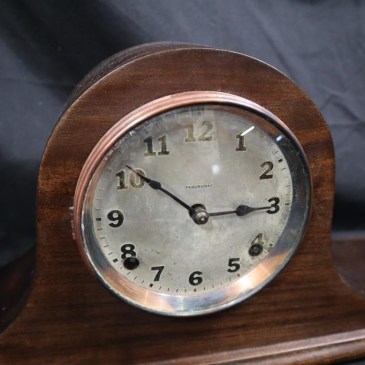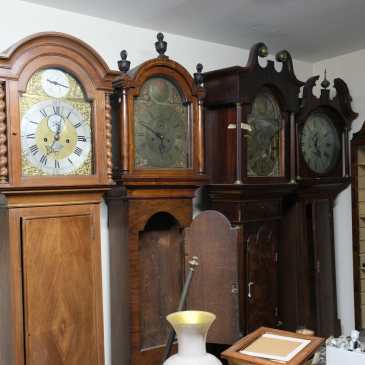
My daughter asked ChatGPT for the most popular antique clock websites, and it provided a top ten list. Antiquevintageclock.com ranked number 9.
I found the description of the site description interesting and accurate, so I’ll quote ChatGPT’s findings.
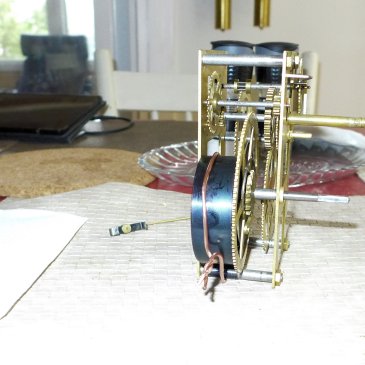
The author at work on a clock movement
The Antique and Vintage Clocks Blog (found at [antiquevintageclock.com](http://antiquevintageclock.com)) is a dedicated resource for enthusiasts interested in the history, restoration, and maintenance of antique and vintage clocks. This blog is run by a passionate collector and restorer who shares detailed insights into various clock models, repair techniques, and the historical significance of different timepieces.
Key Features of the Blog:
1. Restoration Projects: – The blog frequently features detailed posts about clock restoration projects, showing before-and-after photos, and explaining the processes involved in bringing an old clock back to life. These posts are valuable for anyone interested in learning how to restore their own clocks.
Repairing a clock dial
2. Historical Context: – In addition to technical advice, the blog provides historical background on various clockmakers, styles, and movements. This context helps readers appreciate the cultural and technological significance of the clocks they own or wish to purchase.
3. Step-by-Step Guides: – The author often publishes step-by-step guides on topics such as cleaning, oiling, and repairing clock mechanisms. These guides are written in a clear and accessible manner, making them useful for both beginners and more experienced collectors.
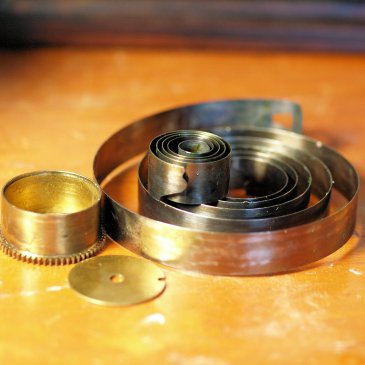
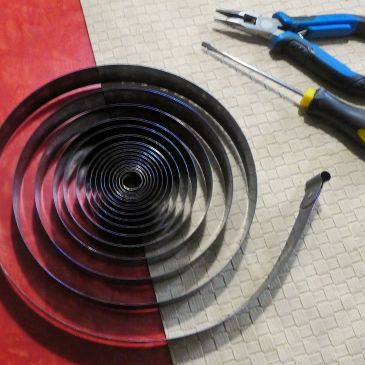
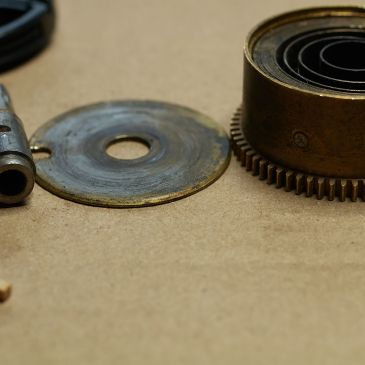
A barrel is opened up to prepare for mainspring maintenance
4. Clock Reviews: – The blog includes reviews and analyses of specific clock models, highlighting their unique features, historical value, and what to look for when buying similar pieces.
5. Reader Engagement: – The blog encourages interaction with its readers through comments and questions, creating a community of clock enthusiasts who share tips, advice, and experiences.
The Antique and Vintage Clocks Blog is particularly useful for individuals looking to deepen their understanding of antique and vintage clocks and how to care for them, offering a blend of technical knowledge and historical appreciation.
I was delighted to see how accurate and thorough the description was. It perfectly captures the essence of my blog and the dedication I put into each post. The detailed breakdown of the site’s features truly reflects my passion and knowledge that make it such a valuable resource for antique and vintage clock enthusiasts.
Tick-Talk Tuesday is a special time when I respond to readers’ letters and comments about clock issues, challenges, and recommendations for specific clocks. When the comments and questions are especially complex, I consult with fellow clock enthusiasts within my circle to ensure I offer the most precise and helpful answers possible.
RK writes:
I am working on an almost identical clock movement as the one shown on your website above. It was made by Frederick Mauthe. I have restored the movement, inserted many bushings, etc., and during testing have realized that the movement is gaining an hour a day. I don’t think the pendulum is original and I suppose I am on a quest for a replacement.
Mauthe wall clock
Here is the case. The finial has been re-glued and altered at the top, and that is another story. Here is the current pendulum: it weighs 0.139 kilos; the distance from the top hook to the bottom of nut under the pendulum is 220 mm. The diameter of the bob 100 mm. I believe this is too light and too short, but there is no more room in the case.
Mauthe movement showing 2 critical numbers
Do you know what the correct dimensions are for the original pendulum? (Weight and length)
This movement is now working so well and it would be a pity not to be to use it just because I cannot find a replacement pendulum.
Front of Mauthe movement
Thanks for your time.
RK
My reply:
Hi and thanks for your email, RK. On the back of the movement, on the lower left of the last photo, are two numbers. 34 refers to the measurement in centimeters from the top of the suspension spring post to the bottom of the pendulum regulating nut. The second number refers to the beats per minute. Measure the pendulum you have and compare it to the first number.
Regarding the pendulum’s bob weight, I won’t have access to the clock until mid-September. However, I can get the measurements you need at that time if they’re still required.
A museum is an institution dedicated to the display of objects of lasting interest and historical value. While museums can showcase a wide variety of items, The Canadian Clock Museum, located in Deep River, Ontario, (Canada) focuses specifically on Canadian clocks and clocks with a Canadian connection.
I first visited the museum in 2013, and this year marked my eighth visit. Each visit has offered a new learning experience, and this one was no different.
Despite its modest size, the museum offers a relaxing experience, with a well-organized flow that guides visitors through displays of various manufacturers and themes.
The informational cards beside each clock provide just enough detail to captivate visitors without overwhelming them. Many of the clocks have fascinating stories, which Curator Allan Symons is more than happy to share, although, sadly, some histories have been lost over time as clocks change hands.
Proof I was there!
A charming feature is the check-in and check-out punch clock cards, done on a Blick Time Recorder clock, that every guest gets to experience to record their visit. Blick Time Recorders was a London, England-based company but they had a Canadian branch that sold them for factories in Ontario, and elsewhere. The reproduction card was created by a summer student about fifteen years ago from card design options in the Blick Canadian catalog.
Blick Time Recorder
The collection primarily features mechanical clocks, but the museum also boasts the most extensive collection of Snider electric and battery-operated wall and shelf clocks (in the world?), manufactured in Toronto. Harry Snider’s two business names in Toronto covered the periods 1950-1957 and 1957-1976. His pink and turquoise wall and TV lamp clock designs date to the 1950s (when those colours were popular for fridges, stoves, and bathtubs in homes).
A fraction of the Snider clocks on display
During my visit, a couple arrived at the museum to donate a Snider starburst wall clock with a brass and walnut finish. Curator Symons was grateful for the donation and gave them a personal tour of the museum as a gesture of appreciation.
Although many items are acquired through auction sites and online sales, the museum also receives some pieces as gifts. For items that align with the museum’s theme, shipping costs are covered.
Extensive collection of research material
Though some exhibits remain unchanged over the years, Curator Allan Symons continues to expand and refresh the collection with new and intriguing clocks of all kinds.
So, what’s new this year?
Notably, in the past two years, the museum has acquired a large tall case clock, a wall clock with special historical significance, and IBM time recorder punch clock in addition to other interesting pieces.
Martin Cheney, Montreal Clockmaker
The clock that captured my attention most was a time-only, weight-driven tavern-style wall clock made by Martin Cheney in the 1820s.
Martin Cheney wall clock with “Montreal” printed on the dial
In 1809, Martin Cheney relocated to Montreal from Vermont, where he lived for about twenty-one years. In 1817, he partnered with J. A. Dwight, and together they operated under the name Cheney & Dwight at 104 St. Paul Street, Montreal. The business produced movements, cases, wall and tall case clocks, and banjo clocks. Their partnership lasted until 1830.
This remarkable piece was donated to the museum and stands as a testament to early Canadian craftsmanship. In my view, no serious Canadian clock collection would be complete without a Cheney clock.
IBM Time Recorder
Another notable and unusual piece is the IBM time recorder, which was commonly used in factories and workplaces from the 1920s onward. The employees’ time recorder was made by IBM around 1930 in their Toronto factory. According to the donor, his late father acquired it when he retired from the General Electric factory in Peterborough, Ontario.
This departmental clock was designed to handle up to 100 employees, so large factories would typically have several of these clocks. It is a large and imposing piece, with a robust design that reflects its practical role and the industrial era in which it was used.
IBM time recorder used up until the 1960s
It immediately brought to mind my days as a part-time clerk in an Ottawa department store, where starting the workday was marked by the ritual of clocking in. In my case, it was an electric punch clock, unlike the mechanical one now on display at the museum.
IBM dial
Pequegnat Hall clock
Most Pequegnat clock enthusiasts do not realize that the Arthur Pequegnat Clock Company of Kitchener, Ontario, sold kits containing the movement, hands, dial numerals, weights, chains, and pendulums, allowing customers to build custom-sized cases to fit them. And so it is, with a special Pequegnat tall case (hall) clock.
This tall and imposing hall clock case stands out as far more ornate than what you’d typically see on a Pequegnat clock. Its design evokes a strong love-it-or-hate-it reaction, but there’s no denying the intricate craftsmanship of the case.
The clock was donated in October 2023 by a woman in the Montreal area when she was preparing to relocate.
Pequegnat hall clock with an unusual feature
There is more to offer at the museum
For those with a casual interest in clocks, the museum offers a variety of intriguing displays, including an antique phonograph from the Victor Talking Machine Company of Camden, New Jersey, a clockmakers/watchmakers workbenchs, alarm clocks, several fascinating Tramp clocks, a choice of “fun in time” teaching clocks for children, clock radios, and a small collection of Girotti wall clocks (St. Catharines, Ontario) that were popular in the 1960s and ’70s.
The Girotti clocks are not my cup of tea, but they are an interesting interpretation of the 1970s modernistic sculptured style and provide a glimpse into the culture of the late 20th century.
Whether you are a clock enthusiast or just curious about the allure of any museum this one is well worth a visit. Returning visitors will always find something new and fascinating to enjoy. And if you can’t make it in person, Allan offers a virtual tour that will inspire a future visit.
Martin Cheney is not typically the first name that comes to mind when considering the impact of clockmakers on Canadian horology.
Martin Cheney, born in 1778, was part of a prominent American clock-making family. He was one of four sons of Benjamin Cheney (1725-1815) and Elizabeth Long Cheney, who hailed from East Hartford, Connecticut. Benjamin likely trained all his sons in clock-making. The oldest, Asahel, born in 1759, later moved to Vermont. Elisha, born in 1770 and passing in 1847, settled in Berlin, Connecticut.
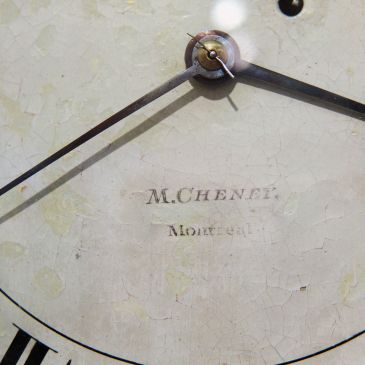
Dial face, M. Cheney, Montreal
The youngest, Russell, eventually relocated to Putney, Vermont. Martin’s uncle, Timothy Cheney (1731-1795), was also a notable clock-maker in East Hartford, working closely with Benjamin.
By 1803, Martin had moved up the Connecticut River to Windsor, Vermont, where he advertised fine English watches, watch keys, chains, and seals for sale. The majority of the tall case clocks I’ve found online come from his shop in Windsor, Vermont. Based on my research, most of his clocks show a Boston influence.
In the early 1800s, political events in the United States prompted several families to migrate to the British colony of Lower Canada, now known as Canada. In 1809, Martin relocated to Montreal, where he lived for about twenty years. In 1817, he partnered with J. A. Dwight, and together they operated under the name Cheney & Dwight at 104 St. Paul Street, Montreal. The business produced movements, cases, wall and tall case clocks, and banjo clocks. Their partnership lasted until 1830.
In 1827, Martin advertised in a Burlington, Vermont newspaper seeking a journeyman clock-maker to join him in Montreal. Although Cheney continued to craft clocks into the 1830s, little is known about his life beyond that decade. He spent his remaining years in Montreal till his death in 1855 (unconfirmed).
Martin Cheney wall clock
Cheney clocks are highly sought after and command high prices at auction. Their exceptional craftsmanship and meticulous attention to detail are evident in every piece.
Adjustable pendulum bob
Until August 2024, I had never seen a Cheney clock in person but, during a recent visit to TheCanadian Clock Museum, curator Allan Symons proudly introduced me to one of his most prized acquisitions: a Martin Cheney time-only weight-driven wall clock, crafted in Montreal, Canada in the 1820s.
I didn’t get a chance to examine the movement, but I’m assuming it’s a banjo-style similar to the one in the photo below.
Banjo style movement
Encountering a Martin Cheney clock in person was an experience that deepened my appreciation for the craftsmanship and historical significance of his work particularly during the time he spent in Canada.
The rarity and value of Cheney clocks, combined with their intricate details and the story they tell of early North American clock-making, make them treasures for any horology enthusiast.
While owning such a piece may be well out of reach, the opportunity to see one firsthand was an unforgettable reminder of the skill and character of early Canadian clockmaking.
The Science Museum in London, England, is one of the city’s most iconic and popular museums, dedicated to inspiring a passion for science in visitors of all ages. Located in the South Kensington area, it is part of the Science Museum Group, which also includes other major museums in the UK.
The museum was founded in 1857 and has since grown into one of the world’s foremost institutions for the collection, preservation, and display of scientific, technological, and medical achievements. It boasts a vast collection of over 300,000 objects that chart the history of innovation and exploration in science and technology.
The Science Museum houses some of the most famous scientific artifacts in the world, including Stephenson’s Rocket (a pioneering early steam locomotive), the first jet engine, and a model of DNA.
Early steam engine (not the Rocket)
The museum is organized into several galleries, each focusing on a specific theme, and while it offers a wealth of experiences to its visitors, the area that captivated me the most was the horology section.
Horology Section | Measuring Time
The horology exhibit at the Science Museum in London, known as the “Measuring Time” gallery, is a fascinating display that showcases the evolution of timekeeping technology and the intricate craftsmanship of clocks and watches.
View of the gallery
The exhibit features an extensive collection of timepieces ranging from early mechanical clocks to modern wristwatches.
George Stratford, left, John May on the right
Among the highlights are medieval astronomical clocks, early pocket watches, and marine chronometers used for navigation.
Atmos clock 1955
A standout section is dedicated to the work of John Harrison, a self-taught clockmaker who solved the problem of longitude at sea with his marine chronometers. These are considered some of the most important timekeeping devices ever created, crucial for safe and accurate navigation.
John Harrison watch
The exhibit includes several ornate astronomical clocks that not only tell time but also track celestial events such as the phases of the moon and the positions of the stars. These clocks are masterpieces of both art and science.
Christopher Pinchbeck
The Clockmakers’ Company collection, one of the oldest in the world, is on display within the museum. It features a range of exquisite clocks and watches, many of which are beautifully decorated and demonstrate the high level of craftsmanship involved in horology.
Original desk from the Clockmakers’ Company
Throughout the exhibit, there are explanations of the technological advancements in timekeeping, from the invention of the pendulum clock by Christiaan Huygens to the development of quartz and atomic clocks. The exhibit explores how these innovations have impacted society, science, and industry.
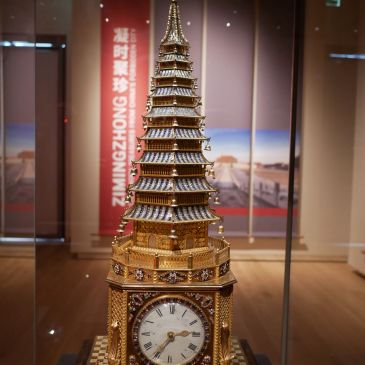
Zimingzhong exhibit
The museum occasionally hosts temporary exhibits within the horology section that delve deeper into specific aspects of timekeeping, such as the influence of time on culture or the future of time measurement.
In the spring of this year (2024) a special exhibit of Zimingzhong clocks grabbed our attention. What is a Zimingzhong clock? It’s a clock that tells the time; moves, makes a musical sound, and has symbolic significance.
These clocks feature elaborate decorations and are typically made from materials like bronze, jade, or lacquered wood.
They reflect the rich artistic traditions and horological expertise of China.
Zimingzhong clocks are not just timekeeping devices but also serve as symbols of status and wealth. They are often considered art pieces, showcasing the skill of Chinese craftsmen.
From the mesmerizing horology section, where intricate timepieces and historic clocks showcase the artistry and precision of timekeeping, to the interactive exhibits that ignite curiosity and wonder, the British Science Museum offers an enriching experience for all.
Tower or Turret clock
Whether you’re exploring the evolution of scientific discoveries or marveling at the ingenuity behind groundbreaking inventions, the Science Museum provides a unique opportunity to appreciate the impact of science on our world and its role in shaping our future.
Thomas Tompion (baptized July 25, 1639– died, November 20th, 1713) was an English clockmaker and watchmaker, often referred to as the “Father of English Clockmaking.” He is renowned for his exceptional craftsmanship and significant contributions to the development of clockmaking during the late 17th and early 18th centuries.
In fact, Tompion is the most celebrated of all English clockmakers.
Thomas Tompion
Born in Bedfordshire from a family of blacksmiths he moved to London in 1671 and was soon employed by the physicist Robert Hooke. Hooke was credited as one of the first scientists to investigate living organisms at the microscopic level. Hooke introduced him to leading scientists and royalty and as a result, Tompion received commisssions from Charles II, William III, and Queen Anne.
His business was based on Water Lane, Fleet Street, and he built a reputation for quality and ingenuity across Europe.
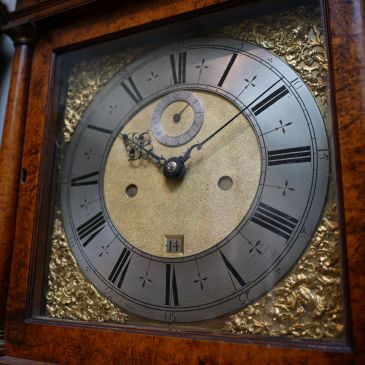
Tompion tall case clock at the Britsh Science museum
Tompion’s clocks and watches were known for their accuracy, elegance, and innovative design. He played a key role in advancing the precision of timekeeping, particularly through his work on escapements and the introduction of the balance spring in watches, which greatly improved their accuracy.
Thomas Tompion time and strike tall case clock – the British Museum
Tompion produced a wide range of timepieces, including table clocks, longcase clocks, bracket clocks, and pocket watches.
His clocks were often highly decorative, featuring intricate engravings and fine materials.
Table or bracket clock made by Tompion for Queen Anne, British Science Museum
He was also a mentor to several important clockmakers, including George Graham, who later became a prominent figure in the field. Graham invented the deadbeat escapement, a crucial improvement over previous escapement designs, allowing for greater accuracy in clocks. Two clocks in my collection, an Arthur Pequegnat Moncton and a Seth Thomas #2have Graham deadbeat escapments.
Tompion was also Master of the Clockmakers’ Company from 1703 to 1704 (London). He made regulators for Greenwich Royal Observatory – one of the most prestigious commissions of his career.
While visiting the UK this spring, I stopped by Westminster Abbey, where Tompion is laid to rest.
Westminster Abbey
It is fitting that Graham is also buried in the same place.
Located at Westminster Cathedral
Tompion’s work is highly prized by collectors, and many of his clocks are now housed in museums and private collections around the world.
Having a Tompion clock would be a real treasure, but it’s far beyond my budget. The nearest I’ll get to a Tompion clock is seeing one in a museum.
The dashboard that forms part of the WordPress blog package offers a fascinating array of statistical information. It empowers me to track the viewership of my articles and gain insights into readers’ interests, as indicated by the number of clicks, which serves as a valuable measure of engagement.
So far in the year 2024, antiquevintageclock.com has received an impressive total of 67,495 visitors, who collectively generated 122,065 page views. On average, each visitor explored the site with 1.83 views, which tells me that there is a significant level of interest in antique and vintage clocks.
Visitors came from a diverse range of 162 countries. So, let’s take a closer look at the top ten countries that contributed to the website’s viewership:
USA
United Kingdom
Canada
Australia
New Zealand
South Africa
India
Ireland
Netherlands
France
Google “Key Events” is a concise and organized summary of significant events related to a blog site or any other website. It enables me to monitor real-time activity. For example, in a snapshot taken as this article was being written, there were visitors from America, France, Kazakhstan, and Australia.
English-speaking countriesare my principle audience
I am located in the beautiful province of Nova Scotia, Canada, write in English and as such I have attracted a significant portion of visitors from predominantly English-speaking countries. My blog’s antique clock content is attracting traffic from English-speaking countries largely because the history and tradition of clockmaking in those countries are well-established.
Many antique clocks originate from English-speaking countries, especially the UK and the USA, where clockmaking has a long history. Antique clocks are a niche, and those who are passionate about it actively seek out detailed and well-researched content like my blog, which attracts dedicated collectors and enthusiasts from these countries.
A word about ads and monetization
Creating high-quality content, engaging with readers, and maintaining a blog requires significant time and effort. Monetization through ad content allows me to be compensated for my work, motivating me to continue producing valuable content for my audience.
Monetization provides me with a steady income stream, enabling me to cover the costs associated with running my blog, such as hosting fees, server space, domain registration, email, and content creation. This financial support allows me to reinvest in my blog, improve its quality, and expand my reach, leading to long-term sustainability and growth.
Translation Applet
To encourage a global audience, this blog features a convenient language translation applet on the front page, enabling visitors to explore its content in the language of their choice.
This user-friendly feature fosters a more inclusive and enjoyable experience for readers from diverse linguistic backgrounds.
Most mechanical clocks even those over a hundred years old or more are repairable. On rare occasions, a major part may be broken, but with the right tools and skills, it can still be fixed.
With a bit of knowledge and a few basic tools, the family clock could be repaired without needing to send it back to the manufacturer.
Time and strike clock movement
In today’s world, any mechanical device that lasts even a few years would be considered a rarity.
Common tools
It’s a fact that we live in a very different world today!
Some time ago, my wife and I had an issue with our dishwasher. Believing it was a simple fix, we called a service technician. It turned out that the main circuit board was shot. I suggested we replace it, but the technician advised that the repair cost would be several hundred dollars. However, he advised us for just a few more dollars, we could get a brand-new dishwasher. We were aghast!
Appliance makers have devised innovative tactics to make repairs costly and inconvenient, while simultaneously offering replacement programs at significantly reduced prices. Repairing items today is often impossible or more expensive than buying new ones, a frustrating and expensive dilemma for the consumer.
Moreover, in today’s throwaway society, repair is often not an option. “Honey, this is broken”; “Just throw it away, it can’t be fixed”. And we complain that our landfill sites are full!
Clock manufacturers years ago designed their clocks to be fixable and did not employ underhanded strategies to make them impossible to repair. I’m convinced that clock companies didn’t see these challenges as obstacles and instead chose to take the moral high ground. A clock that could be repaired with just a few tools was a true mark of a quality company.
The fact that fewer people are fixing their personal possessions today places an environmental and economic burden on our society. We need to shift our thinking, or we are all doomed.
TheRight to Repair
Owners of products should have a right to repair them as a matter of “moral justice”. Wikipedia covers this topic extensively under the term “Right to Repair,” and the concept is gaining momentum.
It will take time to make the shift but in the meantime, the situation appears to be worsening rather than improving.
I recently read an article describing how manufacturers are designing digital locks into their products. For example, using a third-party ink cartridge can render your printer inoperable, and attempting to use a third-party battery in your new electric trimmer can result in a battery error.
The same article described a farmer who replaced a filter in his tractor. A company representative had to inspect the part to verify its authenticity and activate the software so that the tractor could operate, causing the farmer to lose productive use of the machinery for some time.
A certain phone manufacturer, who shall remain unnamed, refuses to allow third-party repairs or places strict limits on the type of repair. Such repairs void the warranty, it says. The alternative is a costly repair using genuine parts, a situation that not everyone can afford.
In reflecting on the current state of product repair, it’s clear that we’ve moved away from the principles of repairability that characterized earlier times. Historically, clock manufacturers designed their products with repair in mind, avoiding deliberate strategies to hinder fixes.
When a clock finally comes to the end of its life wouldn’t you want another Seth Thomas, Waterbury, or Ingraham?
Unfortunately, the landscape has shifted dramatically. My own experience with a dishwasher underscores this change. In today’s throwaway culture, the default response is often to discard broken items rather than seek repair.
This change not only devalues durable craftsmanship but also fuels a growing culture of waste. And that’s too bad.
In a previous article on servicing this clock, I mentioned the challenge I faced with the mainspring. With only minimal tools at my disposal and no spring winder, I was determined to find a solution and successfully service the mainspring.
This clock was manufactured by New Haven and boasts a classic design with a twelve-inch Roman Numeral dial and a distinctive short drop style.
The softwood case is veneered in Rosewood veneer accents. The clock’s case must have been quite elegant at one time, but now it is showing much wear and tear.
Given the condition of the case, I anticipated that the movement would be just as well-worn. It was in better condition than I thought.
New Haven 8-day time-only movement
Let me point out that the servicing is being done under less-than-ideal conditions. I am at our summer cottage with only the basic tools for clock repair, so I must either improvise or skip certain procedures.
No spring winder | no problem
The movement had already been restrained with a heavy copper wire.
A heavy copper wire contains the mainspring
First, partially reassemble the movement with only the main wheel and second wheels. Reattach the front plate and secure the movement with the 4 pillar nuts.
Attaching the second wheel allows the main wheel to be stabilized while the spring is wound using the ratchet.
Safety first
I strongly recommend wearing leather work gloves and eye protection. Handling mainsprings under tension can be hazardous, so prioritizing safety is crucial. Precautions are essential to protect yourself from potential injuries.
Next steps
The key is to hold onto the second wheel while winding the clock. Once fully wound the copper restraining wire can be removed. In the photo below the screwdriver is arresting the wheel while I take the photo.
Then, using a letdown tool, release the click by popping out the click spring from the rachet and allowing the mainspring to unwind. The main wheel with the relaxed spring can now be safely removed from the movement.
The letdown tool is on the right
Servicing involves carefully removing the main wheel from the spring, manually inspecting and cleaning the spring, re-oiling it, and reconnecting it with the main wheel.
The mainspring is removed from the main wheel for cleaning
Reassembly
After cleaning the main wheel and the spring, simply reverse the procedure. Reattach the click spring, join the main wheel and the mainspring, place them back in the movement along with the second wheel, wind the spring, and secure it again with the copper restraining wire. Once this is done, you can continue to reassemble the movement.
May not be suitable for all applications
This approach allows the main wheel to be cleaned in the ultrasonic cleaner along with all the other movement parts.
While this method may not be suitable for all open mainspring designs, it might be the solution for you.
Servicing a mainspring without a spring winder isn’t ideal, it can still be done safely and effectively.
Servicing this movement is reminiscent of days gone by when Dad (or Mom) would gather tools from the shed to fix the family clock. The repair might not have been perfect, but the goal was always to keep the clock running reliably until the next time it needed attention.
My collection of wall clocks includes several schoolhouse models and I am continually impressed by their resilience despite their age.
While many of these clocks spent their lives in school rooms, some ended up in commercial establishments and offices, often neglected until they stopped working. I’ve seen clocks with bushing holes so enlarged it’s a miracle they still ran at all.
This particular clock, manufactured by New Haven, boasts a classic design with a twelve-inch Roman Numeral dial and a distinctive short drop style.
The softwood case is veneered in Rosewood veneer accents. The clock’s case must have been quite elegant at one time, but now it is showing much wear and tear.
Given the condition of the case, I anticipated that the movement would be just as well-worn.
Let me point out that the servicing is being done under less-than-ideal conditions. I am at our summer cottage with only the basic tools for clock repair, so I must either improvise or skip certain procedures.
Removing the movement
After removing the hour and minute hands, you will find that three screws hold the dial in place. Once these screws are removed, the next step is to take out two movement blocks that secure the movement. This is done by unscrewing the blocks (each held by two wood screws) and then pulling out the movement. Once out the blocks can be removed.
The movement is held by movement blocks
Disassembly and inspection
The first step is to contain the power of the mainspring. Since I did not have access to my standard equipment, I had to improvise. I would normally use a C-clamp to restrain the mainspring, but with none available, I used a stiff piece of copper wire and wrapped it around the mainspring. Not ideal but it works.
Safely restrained mainspring
The movement is in surprisingly good condition.
The top (front) plate is removed
Once the wheels are out it is time to visually inspect the components including the gear teeth, pivots, escape wheel pallets, the condition of the manispring, and lantern pinions.
The parts are laid out for inspection
Before placing the parts into the ultrasonic cleaner, I clean the pivot holes with toothpicks and wipe off any excess dirt and oil. Since I plan to reuse the ultrasonic cleaner several times, putting excessively dirty parts into the cleaning solution can shorten its lifespan.
Opinions vary on whether mainsprings should be cleaned in an ultrasonic cleaner. I believe it’s a matter of judgment. If I am not planning to reuse the cleaning solution (mainspring oil can render the solution unusable) and can thoroughly dry the springs, I have had good results by placing them in the ultrasonic cleaner.
In this situation, I have opted not to clean the mainspring in a solution.
Next is the reassembly of the movement leaving out the main wheel and mainspring. Without tension on the wheels, this is a simple way of determining wear.
Wheels that move laterally suggest enlarged pivot holes. Lateral movement affects the meshing of the gears and with enough wear the gears do not mesh properly and the clock will stop.
Checking for lateral movement
In this movement, the third-wheel front plate shows the most wear. However, it is not worn enough to require a new bushing at this time. If I were in the clock repair business and this was a customer’s clock, I would definitely address the need for a new bushing. This is compounded by the fact that I do not have bushing tools with me.
The pivots exhibit no significant wear, as confirmed by the fingernail test, which revealed no ridges. If you feel any ridges, grooves, or irregularities, it indicates wear on the pivot. A smooth pivot suggests minimal or no wear. Although I had to use a portable power drill for cleaning/polishing, the cleaning process was satisfactory despite it not being the ideal method.
My main challenge is the mainspring. I’m currently working with minimal tools and would like to service the mainspring, but I don’t have a spring winder.
Mainspring and first wheel
I am determined to service the mainspring and will find a solution within the next day or so, reporting on the procedures as I go. In the meantime, this is as far as I can proceed with this movement.
Accepting the schoolhouse clock as a restoration project, I was prepared for the inevitable wear and tear it had endured over time. Despite its condition, I wondered what it would look like if the case was rejuvenated.
Decisions, decisions.
My collection of wall clocks includes several schoolhouse models and I am continually impressed by their resilience despite their age.
These clocks, renowned for their durability, keep time reliably, even in well-worn condition.
While many of these clocks spent their lives in school rooms, some ended up in commercial establishments and offices, often neglected until they stopped working. I’ve seen clocks with bushing holes so enlarged it’s a wonder they still ran.
This particular clock, manufactured by New Haven, boasts a classic design with a twelve-inch Roman Numeral dial and a distinctive short drop style. Its standout feature is the reverse painted glass on the access door, allowing the decorative pendulum bob to be seen in motion.
The softwood case is veneered in Rosewood veneer accents. The clock’s case must have been quite elegant at one time, but now it is showing much wear and tear.
Is it even worth fixing? However, let’s look at the movement.
The movement
I am impressed by the size and construction of the movement. The plate measures 5 inches tall and 3 inches wide, but it extends to 5 1/2 inches wide when including the main wheel and the third wheel. It is one of the larger time-only movements I have seen in an antique clock. Two wood blocks secure the movement to the case.
Movement in the case
It has been challenging to determine the date of manufacture of the movement, even though the trademark design should provide some clues. Despite searching through antique clock forums, the best match I found was an identical movement in a Cambria wall clock, which had no trademark but featured pins instead of nuts to hold the plates together.
Cambria wall clock
According to this siteNew Haven began using this trademark style in 1890.
New Haven trademark, 9 3/4 refers to the pendulum length
Although it looks clean, my plan is to take it apart and assess what needs to be done. Join me in my next article as I guide you through servicing the movement.
It’s time to inspect the movement on this mid-thirties German box clock. Purchased at an antique mall in Peterborough, Ontario, in May of 2017, it was serviced in 2020.
Mauthe time and strike box clock
This clock is part of a small collection at our family cottage and runs for about three months each year. However, the cottage environment can be harsh. Before we converted the screened-in porch to an enclosed sunroom, the clock was exposed to the elements for three years, so I expect some dust, dirt, and debris.
Mauthe movement back-plate
One hint tells me this clock is made by Mauthe of Germany, even though there is no trademark stamp on the movement plates. The gong block is made by Divina, a subsidiary parts maker for Mauthe.
In the 1930s and 1940s, the clock was sold in Canada under the Forestville or Solar name in department stores from coast to coast. An appliqué of a maple leaf on the crown of the case suggests it was made for the Canadian market.
Divina gong block
Removing the movement
Removing the movement from its case is a relatively simple procedure. Open the front door and release the two thumbscrews under the movement seatboard, then slide the movement forward from its side channels.
Both plates are a robust 1.8 mm brass. The backplate is solid while the front plate is open. It is a robust movement that was evidently designed to last.
Removing the movement from the case is the best way to check the condition of the movement. Once out all you see is the back plate with the dial concealing the front of the movement. To inspect the front of the movement, the dial and hands must be removed. The hands come off easily by pulling the center cannon pin that attaches the minute hand. The hour hand is a friction fit and can be pulled out with minimal effort. Remove four brass pins on pillars to detach the face from the movement.
Once the dial face is detached both the front and back of the movement can be inspected.
Movement with attached seatboard
There is also no need to remove the seatboard to inspect the movement.
Of course, the only true measure of the condition of any movement is to take it apart, but in this case, I saw no need.
The clock has been working well, keeping good time and striking as it should.
What to look for
I always look for dirty oil around the pivots, which indicates possible wear. As oil ages, it gradually interacts with worn brass, creating a black abrasive paste. Here the pivots looked good but I did notice that some bearings had dried up. While at it I inspected the barrels for bulges and cracks, finding none. The lantern pinions, gear teeth, and levers looked clean. The suspension spring also looked good. In fact, I saw nothing that would cause me to take the next step: disassembly.
The movement is in excellent condition and will need no attention since its last servicing in 2020.
Oiling
All that is required is an oiling before it is returned to the case. Periodic inspections ensure that the oil is clean and appropriately applied, preventing friction and wear. In this case, the oil was clean but some pivots required additional oil.
Oil and applicatorwhich has a spooned end
I keep it simple as far as my oiler and dipper container are concerned.
Periodic inspections
Periodically inspecting a mechanical clock movement is important. Regular inspections can identify potential issues before they become serious problems, helping to prevent major repairs or damage.
Over time, the movement parts can wear down, and identifying and addressing wear ensures the clock runs smoothly.
Dust, dirt, and other debris can accumulate in the movement, affecting performance. Regular inspections {and disassembly and cleaning if needed} can keep the clock running accurately.
Clocks exposed to varying environmental conditions, such as humidity or temperature changes at our cottage, may require more frequent inspections to prevent damage. My fears that this movement was dirty because it was in a harsh environment proved unfounded.
Mauthe movement front plate
If the clock starts losing or gaining time, an inspection can identify the cause and allow for adjustments. Inspecting the movement helps to ensure that all components, such as springs and gears, are in good condition and properly aligned.
Finally, by addressing these aspects through regular inspections, you can extend the life of your mechanical clock and ensure it continues to function properly.
Like a car engine, oil is the lifeblood of a clock, and correct lubrication is essential for ensuring a long life for the timepiece. Lubrication is crucial for the efficient operation of any mechanical clock movement.
A dirty movement about to be disassembled
However, it’s important to note that oiling a movement without first disassembling and cleaning it is not usually recommended.
If the movement has been serviced within the past two years, there is no black oil present around the pivots and the pivot holes are merely dry, oiling without disassembly is acceptable. Otherwise, if the clock has not been serviced in several years, adding new lubricant to old oil can mix with dirt and grime, forming a grinding paste that acts as an abrasive, and will accelerate wear on the pivots and pivot holes.
Using a spray lubricant is a no-no
Never use a lubricant spray like WD-40 on a mechanical clock. WD-40 is a water dispersant and displacement agent, not a suitable lubricant for clocks. In fact, you should avoid spraying any type of lubricant on your mechanical clock, as some parts, such as wheel teeth and levers/springs, must remain dry. Instead, use a lubricant specifically designed for clocks, such as Keystone clock oil.
Clock pivot oil
As an alternative to clock-designed lubricant, some clockmakers have had good success with synthetic oil similar to the type used in car engines.
The application of clock oil
When applying oil, use a small amount—about the size of a pinhead—for each lubrication point. You can apply the oil with a toothpick, a small wire, a needle dipper designed for clock oiling, or a clock oiler. Avoid over-oiling, as excess oil can attract dust and dirt which will bind with the oil to create a paste, and increase wear.
I have never had much success with a hypodermic-style oiler but your mileage may vary.
clock oiler
While they are handy at first, the plastic vial or chamber eventually cracks with repeated use and renders the oiler useless.
Clock movement oiler and dipper
Instead, I use a simple cup-type oiler and dipper.
What to lubricate
Be sure to oil the pivots of all wheels, the crutch loop where it touches the pendulum rod, the escapement pallets, the clicks, and the mainspring arbours. For weight-driven clocks, remember to oil the pulley axles as well. While servicing a spring-driven clock, also oil the mainsprings with a special mainspring oil. keystone makes an oil specifically designed for all mainsprings.
Drizzle the oil along the side of the coiled spring, allowing it to wick between the coils, and wipe away any excess.
Avoid dipping an applicator directly from the oil bottle to avoid contamination; instead, pour a small amount into an oil cup for application.
In sum By following these guidelines, you can ensure that your mechanical clock remains in excellent condition and continues to run smoothly for years to come.
Proper lubrication not only enhances the performance of your clock but also extends its lifespan by preventing unnecessary wear and tear. Use the right type of oil and applicator, avoid over-oiling, and never use inappropriate lubricants. With regular maintenance and careful attention to lubrication, your clock will keep perfect time and remain a cherished piece for generations.
Mechanical clocks, especially older or larger ones, can pose various dangers during operation and maintenance. In this post, we will cover some of the risks and hazards.
Mainsprings
Do not underestimate the power of a clock with mainsprings. Mechanical clocks often use powerful mainsprings to drive their mechanisms. If these components are mishandled, they can release a significant amount of stored energy suddenly (potential energy), with the risk of causing serious injury.
Mainsprings restrained with “C” clamps
Without the right knowledge and tools, attempting to disassemble or reassemble a mechanical clock can result in damage to the clock and potential injury. When working on a clock and particularly when disassembling clock movements ensure that the mainsprings are safely secured. The best way is to use a specially designed mainspring clamp.
“C” clamps or a strong wire are considered safe methods in clock repair.
Even the simple act of winding a clock can produce a nasty surprise since the sudden release of tension in a mainspring can be dangerous.
I almost lost my thumb when the click let go on the strike side of a Mauthe wall clock while winding it.
Damaged thumbnail but I survived
If I am unsure of the mechanical condition of a clock particularly one that I have recently acquired, I always wind it with my letdown key set. That way I can control it if the click lets go. If I follow that simple rule I don’t get hurt.
A letdown set used to safely wind a newly acquired clock
Gears and sharp components
The gears, escapements, and other moving parts can cause pinching injuries. These parts may also be sharp or have pointed edges, increasing the risk of cuts.
The delicate nature of some clock components, such as thin gears or escapement wheels, can break easily. Working on them without proper knowledge or tools can damage the clock and possible injury from sharp, broken pieces may result.
Mercury
Some antique clocks may contain materials known to be hazardous, such as mercury in pendulums or lead-based solder. Exposure to these materials can pose health risks. For example, most American-made crystal regulator clocks have nickel slugs in glass vials for the pendulum that resembles mercury at first glance. They are completely safe to handle.
Note the pendulum bob in this clock
In contrast, French-made four-glass clocks often contain actual mercury pendulums, which if handled can pose a poisoning risk. The purpose of mercury is to maintain accurate timekeeping despite temperature variations.
The degree of mercury toxicity depends on how much contact one has with it. Here is an excellent article I found on the risks involved and precautions when handling mercury.
Electric clocks
Early electric clocks can pose a significant risk of electric shock if not properly handled or if the wiring is faulty. These clocks are often improperly grounded, and may have worn cords with exposed wire. Those that run hot to the touch when operating are particularly dangerous. Switches and knobs and other components are designed according to past standards and lack the safety protocols of today’s designs.
The danger of electric shock may increase during maintenance or operation.
Sessions 3W electric table clock C.1930
Electric clocks are best handled by individuals knowledgeable about electrical components and their operation.
Radium
Clocks, especially older alarm clocks with luminous dials can pose a significant risk. The culprit is radium. Even a clock that has lost its luminescence may still have traces of radium on its dial or particulate matter that has fallen from the clock-face making them equally dangerous.
As much as you may be curious about how these clocks work, leave them alone and appreciate them as decorations or alternatively, safely dispose of them.
Baby Ben, made in China(a later design with safe luminous material)
It must be emphasized that Inhalation or ingestion of flakes or dust containing radioactive materials is extremely dangerous.
Clock tools and equipment
When working on clock springs or components when there is a potential risk of injury or with tools like a lathe, consider wearing leather gloves, and an apron, along with face/eye protection as needed.
Gloves and safety goggles are an important consideration when working with mainsprings. A winding arbor breaking in a mainspring winder or a mainspring letting go while winding it up might result in the spring, wheel, and arbor flying around the room and possibly toward the repair person.
Thick leather gloves used for spring maintenance
Using a Dremel machine without proper eye protection, especially with wire brushes that rotate at high speeds, can easily lead to serious eye injuries if a piece of wire breaks off.
In sum
To mitigate all risks, it is important to have a good understanding of the clock’s mechanism, use appropriate tools, follow safety procedures, and possibly seek training or assistance from an experienced clockmaker. If you ignore common sense, accidents are sure to follow.
A dirty clock movement ready to be serviced
Those new to clock repair may be eager to dive in and take things apart. However, a slow and cautious approach with a focus on safety will reap benefits in the long term.
My collection of clocks is divided between my home in Nova Scotia and our cottage in Central Canada. Part of my collection is there because I am not the type of person who abandons a hobby; I make it a part of my everyday life.
Although not an even split, about 15% of the collection is at our summer cottage in central Canada. The clocks at the cottage, though not particularly special, add a charming ambiance to the space. They often serve as great conversation starters when guests are over, contributing to the cozy and inviting atmosphere.
Let’s begin in the sunroom, the focal centre of our cottage. In this room are two German box clocks, a Mauthe and a Kienzle, which has been a recent acquisition. Joining the two box clocks is a 30-hour Ansonia cottage clock.
Mauthe time and strike box clock(the wall to the left is under construction)Kienzle time and strike box clock
Check out this recently posted article for more information on the Kienzle clock.
Ansonia 30-hour cottage clock
Inside the main part of the cottage which comprises the kitchen, dining, and living area are 3 clocks, a Hemle time and strike weight-driven wall clock, passed on by my wife’s uncle, known as a wag-on-a-wall clock, an Empire time-only gallery-style clock from England, and a 30-hour New Haven miniature ogee.
This New Haven clock might look good from a distance, but closer inspection reveals that the front veneer has been stripped, likely due to significant loss or damage. This condition is not common with old veneered cases but unfortunately, it is what it is.
New Haven mini ogee clock
In our bedroom is one clock, and one clock only, and it is placed there for a reason. It is a time-only GIlbert gallery clock. Gallery clocks, in other parts of the world, may be known pub-clocks, canteen clocks, or office clocks.
Gilbert gallery clock
This time-only gallery-style clock made by the Gilbert Company of USA is nondescript and quite ordinary looking. There is nothing special or distinctive about it but it is in excellent condition.
Check out this articleon how having a clock in the bedroom can aid in getting a restful night’s sleep. The article describes how providing a gentle reminder of the time helps regulate your sleep patterns and creates a more restful environment.
So, there you have it—time flies at my summer cottage with these clocks. They may not be particularly special, but they surely tick all the boxes to enhance my summer experience!
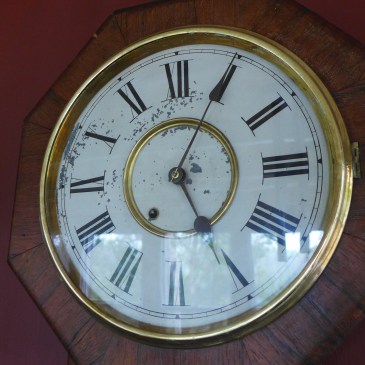
Occasionally I have clocks gifted to me as in the case of this lovely Art Deco-style German round-top wall clock made by Kienzle. The gift was greatly appreciated, although there was a small condition attached, which I will explain later.
Kienzle box clock in classic oak
There are times when people consider gifting me a clock but hesitate because of the high shipping expenses. When I tell them I’m willing to accept the clock, they often balk upon discovering how much it would cost to send it to me. Consequently, I have missed out on some interesting clocks due to shipping constraints.
Earlier this year, DN from central Canada was researching his grandfather’s vintage clock online and found a similar one, which led him to my blog. We exchanged emails about the history and condition of his grandfather’s clock and he asked about its resale potential. Based on the current market, I provided him with an estimated value.
I suggested several methods for selling the clock and offered to consider purchasing it myself if he could not find a buyer. Unaware that I would hear from DN again, it was four months later when he reached out and offered to gift me the clock, confident it would be cherished by a collector like myself. The condition was that I make a donation to a charity.
A well-protected clock
While traveling to central Canada to spend the summer, I had the opportunity to meet DN. With military precision, we arranged to meet in a small village 1/2 hour from our summer cottage. The well-packaged clock went from one car to the next. Afterward, we talked on the roadside, discussing the clock and, of course, sharing our cottage experiences. I said my thanks and drove off.
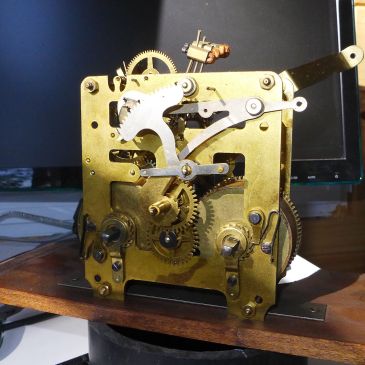
I know more about this clock than almost anything in my collection thanks to DN and the well-preserved clock owned by his grandfather and carefully stored for approximately 25 years following his passing. DN‘s grandfather, an engineer, appreciated the intricacy of the German-made clock and kept all the documentation. Nothing is missing from the clock; all the parts are intact.
Raised relief applique
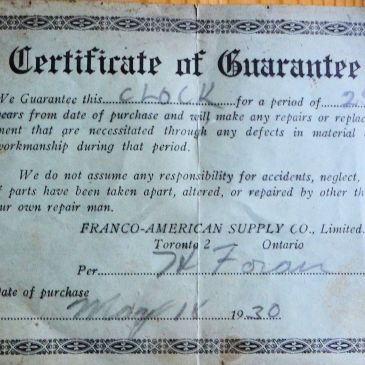
There is a “certificate of guarantee” from the Franco-American Supply Co. with a purchase date of May 18, 1930. The Franco-American Clock Co. became the Franco-American Supply Co. in 1918/1919. Their business eventually expanded to musical instruments, including gramophones. They operated as a distributor rather than a manufacturer, specializing in supplying clocks at a mid-level scale to retailers.
Franco-American Supply Co.
In addition, there is a factory control slip and instructions for the gong protector. There are two stand-offs (upper right, photo below), but I could not find the screw holes in the back of the case to accommodate them. Perhaps they were offered as optional at the time, otherwise, why were they kept? And of course, the original key.
It is rare to buy a clock with any documentation
Overall, it is in exceptional condition for a 96-year-old clock. I could not see any tell-tale signs that the movement had been worked on, and in its assembled state, I did not observe any appreciable wear. Of course, once disassembled and cleaned, I will have a clearer understanding of any wear issues.
My immediate task is to determine if the clock can run and strike as it should. I removed the movement from its case, applied a drop of oil to the pivots, reinstalled the movement, and gave the pendulum a push. It runs well. Next, I will prioritize thorough cleaning and attend to any signs of wear.
Finally, I am making my donation to the St. Vincent de Paul Society in memory of my mother-in-law, who passed away this spring. The Society of Saint Vincent de Paul is a lay “Catholic organization whose mission is to help shape a more just and compassionate society by providing food assistance, material help for the needy, emergency relief, and addressing housing challenges across Canada”.
This is very good news for clock lovers in Canada.
I have not ordered clock supplies in some months and reported in an earlier post that W. H. Perrin and company had ceased operations as a clock parts supplier to Canadians. The company has been reborn as Perrin Supply Ltd (new owners). Instead of Toronto as a longtime base, they will move to Vancouver, BC (Canada), and resume operations on July 1, 2024.
They intend to carry out the same level of service and delivery of products as the old company.
Steady rest clock tool, available at a clock supply store
This is certainly good news to myself and clock enthusiasts and repair specialists across Canada. Given that they are now on the west coast of Canada the only difference I can foresee is slightly higher delivery costs and perhaps price increases on selected products otherwise it should be business as usual.
Clock supply services provide replacement mainsprings
Although they are in the process of moving online servicesare unaffected and should you have any clock and watch supply needs they are there to help.
It’s time to relax and slow down. For my wife and me, that means a change of scenery as we travel to our cottage in central Canada to spend the summer season with friends and family. Our summer getaway plan includes relaxing with a few good books, fishing, swimming, hiking, and sharing stories with friends and neighbors over a glass (or more) of wine.
Photo by Zukiman Mohamad on Pexels.com, a reminder that it is important to slow down and recharge
This blog profiles my clock collection, the challenges of maintaining and repairing clocks, the joys of finding new and interesting vintage and antique clocks, and many articles of horological interest.
Since many of my posts have been written well in advance, there will be NO interruption in blog posts throughout the summer months. I will continue to maintain a steady output of articles per month. You will continue to read my posts on Tuesdays and Fridays at 6:00 am AST.
Inspecting an Ansonia cottage clock
As 1960s TV variety host, lounge singer, and actor, Dean Martin used to say, “Keep those cards and letters coming.” There may be a slight delay in returning your email inquiries or responding to blog post comments, but rest assured that your questions about clocks or comments regarding any of my posts are important to me and will be answered.
As my wife and I explore central Canada, we will no doubt find interesting clocks while scouring antique stores, flea markets, and junk shops. New clock stories, new repair challenges, and perhaps the next major restoration project will be part of my journey this summer.
A fresh-water lakein central Canada, our oasis
Our plans include a trip to The Canadian Clock Museum in Deep River, Ontario, to discover new and interesting clocks added to their collection and chat with curator Allan Symons.
Use the search box to browse past articles and/or click “follow” to have clock articles delivered to your mailbox every three to four days. I hope you enjoy reading them as much as I enjoy researching each and every article.
When my wife’s parents sold their home in a small town in Nova Scotia in 1996, they passed on a wall clock, which had been given to my father-in-law by a patient and had hung on the wall in the main hallway of their home, to his son, my wife’s brother. It has been in storage ever since then.
I hadn’t seen the clock in nearly 30 years though I have vivid memories. In the 1980s and 1990s, my wife and I would bring the kids to visit their grandparents on weekends. The clock would resonate throughout the house. It was unforgettable, by its loud ticking and the four-hammer strike marking the hour and half-hour.
Made by Mauthe, it is a 1930s-style German box clock, dark in color, reminiscent of one in my own collection. In fact, except for minor details on the case, it’s almost identical to mine.
German “box” clock by Mauthe, in my collection
My father-in-law loved the clock and had it for years, winding it without fail once a week. When it stopped, he would have someone local service it for him. He cherished it deeply, though I’m not entirely sure why. Perhaps, as a doctor, he valued it as a thank-you gift from one of his patients, or maybe he simply had a passion for clocks.
Sadly, my father-in-law passed away in 2012, and my mother-in-law passed away this year. While settling the estate, my wife and her brother started communicating on a deeper level, and the subject of the clock came up. Would I fix it?
Not this clock but a similarMauthe movement
The clock has now been passed to me for repair. I picked it up in mid-June, and my first impression was that the case was in excellent shape for its age. While the case has minor nicks and scratches that can be easily addressed, the dial is rough. Otherwise, the movement appears intact with no missing or damaged parts.
Overall, I believe the clock is definitely worth restoring. Once I evaluate the clock further I can determine what needs to be done, make any necessary repairs to the movement, and the case, test the movement, and return it to my wife’s brother. To have it displayed prominently on a wall and running again would be a testament to my father-in-law’s memory.
Although I have other projects on the go and cannot tackle this project until the fall, I am pretty excited about working on this clock. It is a perfect candidate for restoration but more importantly, it has great sentimental value.
In future posts, I will describe a step-by-step process of revitalizing the case and another on servicing the movement.
Kienzle might not ring a bell for many clock enthusiasts, but it was a major German producer of clocks for the general public.
Kienzle Uhren GmbH, was founded in 1822 by Johannes Schlenker in Schwenningen, in Black Forest region. Jakob Kienzle joined the family by marriage in 1883 and became the sole owner in 1897. He revolutionized clock production through mass production, leading to significant expansion. By 1939, the company employed over 3,500 people and produced around 5 million clocks annually. Kienzle eventually transitioned to wristwatch production and continues to operate as a watchmaker.
Kienzle wall clock C. 1930
This Kienzle wall clock was bought at auction in 2021. It was my second Kienzle, the first, an attractive desk clock from the early 1950s. But in general, I was unfamiliar with the maker. I later learned that the clock was missing some details: a case decoration above the number 12, both standoffs and the pendulum rod retainer was broken. However, the case itself is in relatively good condition.
The time and strike movement in this round top box clock is compact, with a 43 cm pendulum length and a beat rate of 104 per minute.
Kienzle movement
I serviced this movement in 2021 shortly after acquiring it. At the time I found It exhibited typical wear for its age, with the time side running relatively freely and the strike side being somewhat sluggish. After disassembly, an assessment revealed that the movement required 10 bushings: 6 on the backplate and 4 on the front. The work was completed without issues, the movement was reassembled and tested and the clock ran reliably until this year.
Front of movement
Now it has stopped. In short, I’m not entirely sure what caused it to stop.
Suspecting a power issue, I removed the movement from its case and took off the hands and dial face. I also let the mainsprings down but left enough tension to supply power. I unscrewed the crutch bridge to remove the pallets which allowed the escape wheel to run freely. So, not a power issue. I continued to inspect the wheels and pinions and found nothing amiss. While out of the case, I re-oiled the movement.
The issue seems to be with the time-side mainspring. Looking back at my notes, I serviced both mainsprings in 2021 and didn’t observe anything unusual about them at the time. However, I’ve noticed that if I fully wind the time side, the clock is reluctant to start. This issue has happened more than once. Releasing the tension of the time-side mainspring with a wind-down key allows the movement to start running again. If I don’t wind the time side mainspring completely, the clock seems to run without any problems.
I can only conclude that I did not clean the mainsprings as thoroughly as I should have. Residual dirt and grime on the inner part of the coil seem to cause the spring to seize when wound tightly. In the meantime, the solution is not to wind the time-side mainspring fully.
Unfortunately, the mainspring barrels cannot be removed separately as in the case of some German movements, necessitating the complete disassembly of the movement to replace/inspect the mainsprings in case of an issue. If it were feasible to remove the mainspring barrel independently, I would have taken the opportunity to remove the mainspring from the barrel and clean it more thoroughly.
Kienzle movement on the test stand
I am not about to disassemble the clock again as I have more pressing projects on the go but in the meantime, it will run as long as I do not wind the time-side spring too tightly.
In Part I, I explained the importance of bushing to mitigate wear on a mechanical clock movement.
In summary, bushing involves replacing worn brass around a pivot by drilling a new hole and inserting a new bushing, either using a bushing machine or hand tools. Severely worn pivots may need re-pivoting, which involves installing new pivots using a lathe. Minor wear can be managed with filing, polishing, and burnishing. Proper bushing and pivot work are crucial for maintaining clock movements, extending their lifespan, and ensuring reliable operation.
Now that we understand bushing wear, it is time to proceed with the bushing process.
The process of bushing a mechanical clock plate involves several steps to restore the worn pivot holes to their original condition. Here’s a detailed description of the process:
Disassembly: The clock movement is carefully disassembled, and the clock plates are removed to access the worn pivot holes. Resist the temptation to immerse the entire movement in a cleaning solution. Although this might offer a temporary fix, it prevents proper assessment of the pivots and pivot holes for wear.
Wood picks identify where bushings will be installed
Cleaning of all parts: While manual cleaning with a solution is satisfactory, using an ultrasonic cleaner and a solution specifically designed for such a machine, yields better results by ensuring all dirt and grime are thoroughly removed from the brass and steel parts. The cleaning process also includes thoroughly drying all the parts.
Ultrasonic cleaner by L&R
Identifying Worn Holes: Each pivot hole is inspected for wear. Worn holes are typically oval-shaped due to the pivot’s repeated movement. I use a marking pen to identify those pivot holes that require a new bushing. I generally work on one train at a time, leaving the main wheels out during this process. I reassemble all the wheels of one train between the two plates, checking for wear by turning and pushing on the wheels. This allows me to observe any lateral movement and see how the gears mesh with each other.
A marking pen identifies a worn bushing hole
Centering and Drilling: A bushing machine with a centering tool is used to precisely center the worn pivot hole.
Centering tool Centering is used to center the pivot hole
A new, round hole is then drilled into the clock plate. This hole must be accurately positioned to ensure the clock’s gears will mesh correctly.
Using a cutter to enlarge a hole in the plate
Selecting the Bushing: An appropriately sized bushing is chosen to fit the newly drilled hole. The bushing is usually made of brass and should match the original hole dimensions but is made larger than the hole to ensure a tight fit. For the Bergeon Bushing Machine, Bergeon brass bushings are used.
Pressing or punching the Bushing: The selected bushing is pressed or punched into the newly drilled hole. This can be done using a bushing machine, which ensures the bushing is inserted straight and flush with the plate. If done by hand, reamers and smoothing broaches are used to achieve a similar result. A chamfering bit, which does not come with the Bergeon Machine, is used to gently cut the edge of the bushing hole to ensure that the bushing is punched or pressed in neatly.
Positioning the bushing prior to punching the bushing home
Reaming the Bushing: Once the bushing is in place, it is reamed to the correct internal diameter to fit the pivot. Reaming is achieved by using a five-sided reaming broach sized to fit the hole. Following the reaming process, a smoothing broach is used to smooth the walls of the bushing hole. A toothpick is then used to clean the hole and remove any debris left behind by the broaches. This entire process ensures that the pivot will rotate smoothly without excessive play.
Swiss-made smoothing broaches
Polishing and Burnishing: The pivot that will run in the new bushing is polished and burnished to reduce friction and wear. A metal lathe is an indispensable tool for this procedure. This step is crucial for the longevity of the repair.
Taig lathe with 1/4 hp motor
Reassembly: The clock movement is reassembled, with the newly bushed pivot holes ensuring proper alignment and smooth operation of the gears. Clock oil is applied before the testing phase.
Testing: The reassembled clock is tested to ensure that it runs accurately and reliably. Any final adjustments are made to fine-tune the movement.
The process of bushing a mechanical clock plate involves disassembly, identification of worn bushing holes, precise centering and drilling, selection and insertion of appropriately sized bushings, followed by reaming, polishing, and burnishing of the pivot. Finally, the clock movement is reassembled and thoroughly tested to ensure accurate and reliable operation.
By following these steps, the worn pivot holes are restored, improving the clock’s performance and extending its lifespan.
Is your mechanical clock experiencing issues such as intermittent stopping or simply not running at all? This might be due to several issues with the movement, one of which could be pivot wear.
This is a two-part series. In Part I, I will explain why it is necessary to bush a clock movement, and in Part II, I will describe my method for bushing.
What are pivots?
Pivots are the ends of the axles, known as “arbours” in horology, that rotate in small holes drilled into the clock plates as the clock runs. They are the turned-down ends of the arbour. These, along with the holes they rotate in, can wear down over time causing enlarged holes that will contribute to poor running or stopping. The pivot hole must be perfectly round, and the pivots need a mirror-like polish to minimize friction within the train of gears. To protect the surfaces and reduce friction, approved clock oil acts as a barrier between the pivot and the pivot hole.
Worn pivots or pivot holes can cause the wheel to drift away from the pinion, eventually stopping the clock as the gears fail to mesh properly. Clocks in need of bushings may run erratically or stop altogether.
A very worn pivot hole
Oiling a dirty or worn movement
If a clock movement isn’t routinely serviced (cleaned and oiled), the plates of the movement will experience wear at the pivot points. Applying new oil over old oil can free abrasive dirt and provide a temporary solution but accelerate wear on the steel pivot and brass bushing holes because the contaminated oil acts like a grinding paste.
Worn pivots are often found in clocks repeatedly oiled without proper cleaning. Proper servicing requires disassembling the movement, cleaning the parts, addressing wear issues, reassembling, and testing.
Punch marks
From time to time, there is evidence of punch marks located around the pivot hole which is an attempt to close worn pivot holes. While a common practice in the past, this is no longer considered an acceptable repair practice.
A pivot– in this photo, the pivot is slightly bentPunch marks on a movement
Pivots need periodic cleaning and polishing to turn freely in the clock movement plate hole. Worn pivot holes are easy to identify as they appear oval-shaped rather than round.
Bushing wear – the left portion of the hole is elongated
What is bushing?
“Bushing” is the process of replacing worn brass around the pivot so that the hole is round again. A new hole is drilled into the plate, and a new, appropriately sized bushing is pressed into place using a bushing machine like the Bergeon Bushing Machine.
Bergeon Bushing Machine
Some clockmakers prefer to hand-bush using reamers and smoothing broaches, producing satisfactory results, though a machine simplifies the task and is more accurate.
Severely worn steel pivots must be replaced with new ones, a process called re-pivoting. This involves using a watch or clock lathe to drill into the end of the wheel arbor to install a new pivot made from pivot wire.
Minor wear is expected over a clock’s life and can be managed with careful filing, polishing, and burnishing.
In summary, bushing is an integral part of movement servicing. Well-maintained clocks may show minimal wear and may not require new bushings, while others, due to neglect or improper servicing, may require many bushings.
Proper pivot and bushing work can extend a clock movement’s lifespan, ensuring reliable operation for years.
In Part II of this two-part series, I will describe my method for bushing a clock movement
My wife and I recently returned from a three-week vacation in the UK. Although the trip wasn’t specifically focused on clock museums and similar attractions, I still managed to gather a significant amount of information/photos about clocks.
Big Ben, perhaps the most famous tower clock in the world
Unfortunately, during our visit, a family member passed away, and I couldn’t keep up with my regular blog posts. I plan to catch up on those in the coming weeks.
An impressive display of clocks at the Science Museum in London
In the meantime, I plan to catch up on the emails that have accumulated during my absence and to add many more blog articles about my travels. Please be patient, and I will respond as soon as possible.
Tick-Talk Tuesday is a special time when I respond to readers’ letters and comments about clock issues, challenges, and recommendations for specific clocks. When the comments and questions are especially complex, I consult with fellow clock enthusiasts within my circle to ensure I offer the most precise and helpful answers possible.
Clock-maker’s shopfrom days gone by
BC writes:
I stumbled across your blog in a search for reputable clock repair in Nova Scotia. A lifetime clock lover, I am fascinated by your posts, and I will most certainly be following along (and perusing older posts!).
I am hoping to have a much-loved, but very old family clocks repaired. I went to the NAWCC website as advised on your blog, but wasn’t able to find any businesses in Canada. You did, however, mention that you knew of two reputable clock repair shops in the province. I was wondering if you would be willing to share with me who they are so that I could be in touch with them about my clocks?
My response:
Hi and thanks for your email, BC. There are two reputable clock repair specialists in Nova Scotia. The first is located in Halifax and the second is in Bridgetown, Nova Scotia not to be confused with Bridgewater which is on the Atlantic side. I have had personal dealings with both, and they are both very capable. Expect your clock to be with them for several weeks if not months.
Clock repair service can be expensive, and you may find the cost of repair to be more than your clock is worth, however, sentimental value always trumps a repair cost.
Thank you very much for your reply! I really appreciate it.
My clocks, from my grandparents’ families, hold much sentimental value and have both been in the family since the 1800s, and so I hope to be able to budget for the repairs, but I also imagine that the gut strings on the long case grandfather clock, and likely somewhat haphazard repairs to the hall clock after damage from a break-in in the 70s will add to the challenge! On the plus side, they have both worked during my lifetime, so I will hold out hope!
I will check in with both shops to see what they suggest. Thank you again for the speedy reply!
Retirement certainly offers its perks. In the coming weeks, I plan to delve into some of my clock-related adventures, which will involve traveling to the UK. I’ve always been captivated by the world around us, and I’m excited to explore as much as I can during this journey.
Unwanted or unloved long-case clocks in an antique shop
I believe travel can expand one’s outlook on life. I’ve always been intrigued by how others live and the places they call home. Travel has the power to expand one’s perspective because it exposes us to new cultures, ideas, and ways of life. Experiencing different environments and observing how others live can lead to a deeper understanding of the world and challenge our own assumptions and beliefs. It broadens our horizons and allows us to appreciate the diversity and richness of human experience.
The author is assisting with clock-winding duties at an old country inn
Britain holds great importance in horology, and I look forward to viewing clocks in museums and other places of interest. Britain also holds personal significance for me because my roots trace back there.
My upcoming trip to the UK offers a chance to explore not only my passion for horology but also my own heritage. I am excited to delve into the country’s rich history and culture while reconnecting with my roots.
The journey promises to be enriching and fulfilling, and I look forward to gaining a deeper understanding of horology. Stay tuned for more adventures ahead!
You must be logged in to post a comment.