The Day I Found an Ingraham Huron Balloon Clock—and the Story That Came With It

Some time ago, I came across an ad on Facebook Marketplace for a clock owned by an older couple who lived about forty-five minutes from our home on the East Coast. When I first saw the photo, something about the clock caught my eye—it had character, a quiet dignity, and I had a feeling it might be special. I reached out to the seller through Facebook, and after a brief phone conversation, we agreed on a price that he felt was fair.

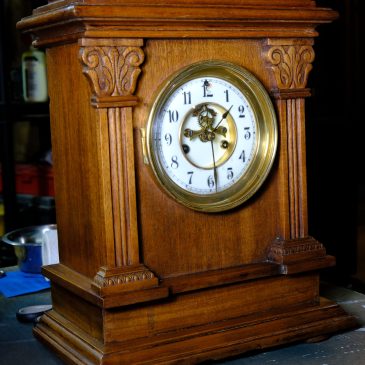
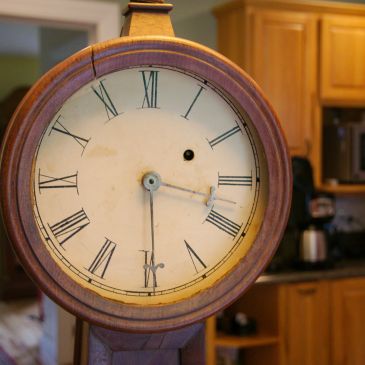
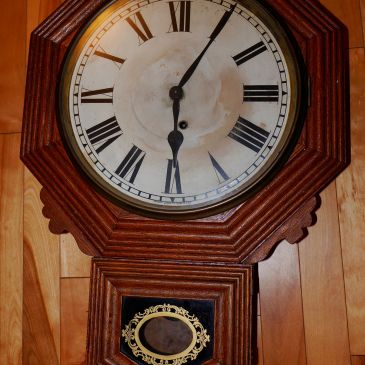
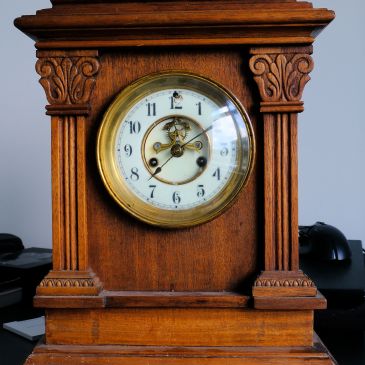
Rare Ingraham Huron found on a local online for-sale site
E Ingraham Huron Circa 1878

Finding their home wasn’t straightforward. We took a few wrong turns, but eventually found our way to a modest single-wide house nestled in the woods about twenty minutes from a larger coastal town. It was the kind of home that had clearly been lived in for decades.

A man in his early seventies greeted us at the door with a polite smile tinged with sadness. As we stepped inside, he excused himself and disappeared for a moment, returning with the clock in his hands. I asked him why he had decided to sell it, especially since he mentioned it had belonged to his grandmother and had been in his family for as long as he could remember.

He paused before answering, his eyes drifting toward the window. “My wife and I have decided to go our separate ways,” he said softly. “She wants to live in town, but I can’t bring myself to leave this place. Everything I care about is here—my shop (which was larger than his house!), my tools, my memories, but we have to get rid of some stuff”.

As he spoke, it became clear that the clock was more than just an heirloom—it was a piece of his past, a witness to the life he had built in that home. Letting it go wasn’t just about making space; it was about closing a chapter.

I examined the clock carefully, noting that it was complete and in good condition. “I’ll take it,” I said with a smile. Just inside the case, I noticed a penciled marking that read “Hebb and 1944.” The seller recalled a Hebb family who once lived in the Bridgewater area of Nova Scotia, near where I purchased the clock — perhaps a clock tinkerer.

“Okay,” he replied, then hesitated for a moment before adding, “Would you happen to be interested in Elvis Presley memorabilia?”

I glanced over at my wife, who was already trying not to laugh. The question caught us both off guard—we couldn’t have been less interested in that sort of thing, but his earnestness made the moment oddly endearing.

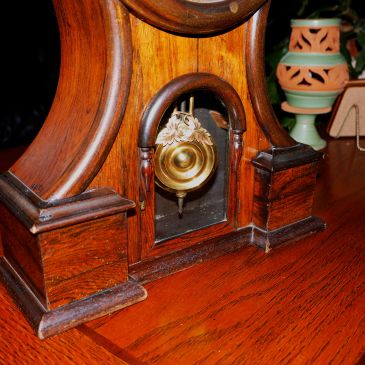
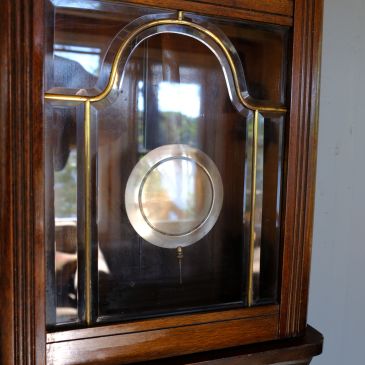
Huron shelf clock by E. Ingraham & Co.

It is a rosewood-veneered Huron shelf clock by E. Ingraham & Co., Bristol, Connecticut. It features a paper-on-zinc dial with a round glazed door and a lower glass access panel. The Huron is one of the less commonly found Ingraham models of the period, having been manufactured briefly between 1878 and 1880. The maker’s label remains intact on the inside of the backboard. The clock has a brass, eight-day, spring-powered movement and stands 16 inches tall.

The veneers are in excellent condition, with no splitting or cracking. The clock face shows a build-up of grime, which I chose to leave as is. The base corner pieces show slight wear, but both door catches are sound. The glass is perfect, the door hinges are in excellent condition, and both the upper and lower doors still fit with precision. The pendulum retains its original lacquer and presents well. Before examining the movement, a gentle push of the pendulum suggested that something was amiss.

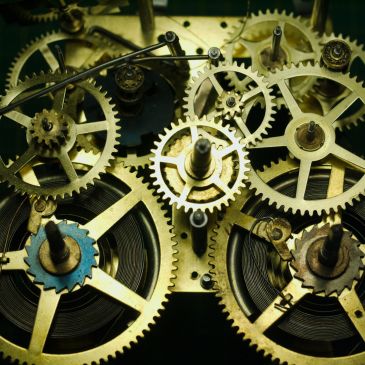
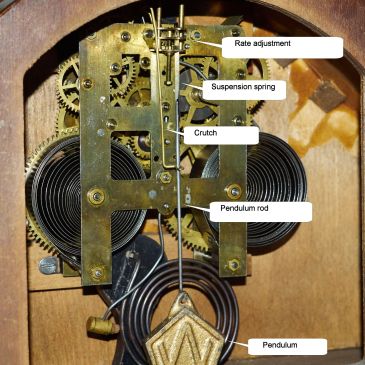
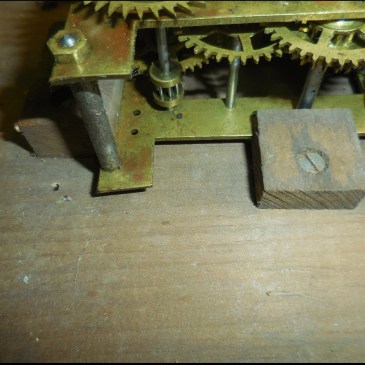
Once I extracted the movement from its case, it was certainly not without its issues. There was plenty of solder applied here and there—evidently, a past repairer believed that the more solder, the better. During restoration, all traces of it were carefully removed, and the movement was thoroughly cleaned and brought back to full working order.

The movement was not without its issues

I’ve often said that if the day ever comes when I’m compelled to downsize my collection, this would be one I’d keep. Not for its rarity or provenance, but because it embodies everything I admire in a clock—the craftsmanship, the quiet dignity, and the enduring beauty of something well made and lovingly preserved, and the story that became part of it.

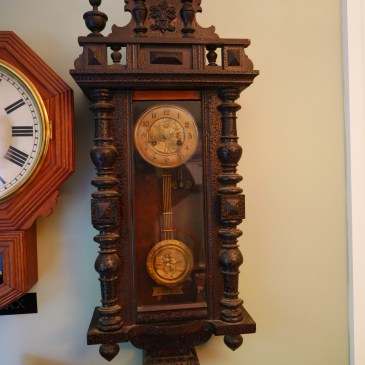
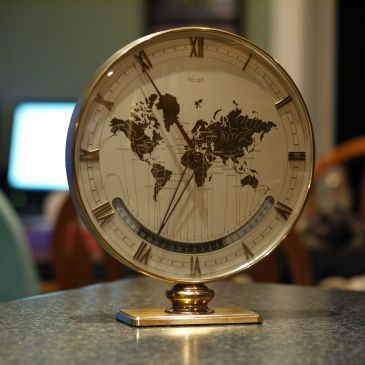
Kienzle clock on display with Ingraham Huron
Ingraham Huron shelf clock

In the end, it’s pieces like this that remind me why I collect—not to own more clocks, but to honour the skill and spirit of those who built them, one tick at a time.

A Box of Parts, and a Special Clock That Journeyed Through Time

Every old clock has a story to tell — where it came from, who owned it, and the moments in time it quietly witnessed. Unfortunately, as clocks are sold, traded, or passed down, those stories often get lost along the way. The clock may keep ticking, but the people and places behind it fade into mystery. Every so often, though, one comes along with its story still intact, and that’s always special — it connects you not just to the clock, but to the lives that once revolved around it.

The clock I’m about to write about came with a story; in fact, it came in pieces, and that’s where the adventure begins. Piecing it back together wasn’t just a repair job; it was a bit of detective work, trying to uncover what happened to it and how repairs were addressed along the way. Every screw, every bit of wear, had something to say — and that’s what makes this hobby so fascinating.

One of the most remarkable clocks in my collection is a Junghans Crispi wall clock that survived the 1917 Halifax Explosion. I know this because the previous owner told me their family had kept it for more than a century, passing it down from one generation to the next. When it finally came to me, it wasn’t much to look at — just a box of parts and fragments of what once had been. After all those years, I suspect the family decided it was time to let it go, perhaps hoping someone would bring it back to life.

And that’s exactly what I set out to do. Piece by piece, gear by gear, I restored the Crispi to its former dignity. During the restoration process, I discovered that not everything about the clock was original. Most of the case components had survived — including the top crown, crown base, and bottom section, finials, beat plate, many case decorations, the movement, dial and hands, and pendulum — but the frame had been rebuilt. I knew it immediately when I observed Robertson screws on the backboard.

A catalog image from the Junghans website was extremely helpful

The frame was skillfully and carefully crafted from solid oak, suggesting that when the clock fell from the wall during the Halifax Explosion, the original frame must have shattered beyond repair. Despite the excellent woodworking skills, the previous owner knew very little about clock repair, so it was left as an incomplete project and sat in a box for decades, gathering a thick blanket of dust and grime.

Junghans clock in pieces
A box of parts

Restoration included new glass panels, re-staining the case, sourcing a few case parts, and servicing the movement.

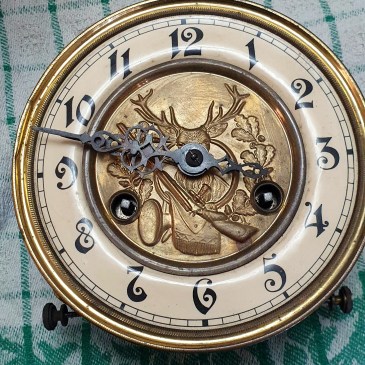
Junghans Crispi dial face
Junghans Crispi dial face and hands

When the case was restored and the movement was finally ticking again, I sent a photo of the finished clock to the family who had sold it. They never replied, and I can only imagine they felt a pang of seller’s remorse seeing it whole and beautiful once more.

Junghans Crispi time and strike wall clock

Even now, every time I walk past it, I can’t help but picture that December morning in 1917 — the moment when the blast shook the city and sent the clock crashing from its wall in a small North Halifax home. It must have lain broken for decades, silent witness to one of the darkest days in Canadian history. Today, it keeps perfect time once again, a survivor with a story that still speaks through its steady, patient tick.

Safely Using Brasso: Polishing Tips for Antique And Vintage Clock Collectors

After retiring from active duty, my father continued to serve in a reserve unit for several years. As a child, I still remember the formal occasions that called for his ceremonial uniform, when every detail had to be perfect. Before heading out, he would sit down with a tin of Brasso and a soft cotton cloth, patiently polishing each brass button and his service medals until they gleamed. The smell of the polish and the steady rhythm of his work became part of the ritual, a quiet reminder of the pride he carried in his service to Canada.

Brasso metal polish

My father trusted Brasso, and so did many who regarded it as a reliable metal polish, valued for its ability to restore the shine to brass and copper.

Yet, as effective as it is, using Brasso without care can do more harm than good. Antique clock collectors, in particular, should be cautious since many valuable parts can lose their patina or protective finish if polished too aggressively.

Read The Instructions

When using Brasso, it is important to start with restraint. Less is more! Always read the instructions on the label and, if possible, test it on a small hidden section before committing to polishing the entire surface. Apply it sparingly with a soft cloth, working in gentle circular motions. Ensure you are in a well-ventilated space, as the fumes can be strong for some. Once the polish has done its job, buff thoroughly with a clean cloth to remove any residue and bring up the shine.

For detailed work, I use cotton swabs, which are excellent for accessing tight spaces.

A Word Of Warning

What you should not do is just as important. Brasso should never be applied to lacquered, painted, or plated surfaces, as it will strip away the finish and expose the bare metal. Special caution is needed with brass bezels around painted dials—Brasso will eat through the paint very quickly (yes, I know from experience). It should also be avoided on plastics, wood, and gemstones, as it can permanently scratch or stain them.

Some time ago, I purchased an U. M. Muller box clock. Everything about it was perfect except for the dial. A small section of paint was missing, likely the result of someone attempting to clean it with an abrasive cleaner (photo below). This is exactly the kind of damage Brasso can cause on a dial.

Irreversible damage to a clock dial

Immersing objects in Brasso is also not recommended—the product is made for surface polishing, not soaking. If you are working with thin layers of gold or silver plating, Brasso is too aggressive and will wear them away over time. Finally, don’t leave residue behind; always wipe the parts clean to prevent streaks or uneven tarnish from developing later.

Clock cases, dials, and movement parts often have lacquer, plating, or original patinas that Brasso can irreversibly damage. The very character of an old clock—its aged glow or mellow surface tone—can be lost with a single overzealous polishing. In horology, a gentle hand is usually best. Cleaning and preservation are preferable to aggressive polishing, especially if the clock has historic or sentimental value.

Tarnished weight on the left, polished weight on the right

Using Brasso brings back the shine, but it’s only temporary. No matter how well it’s polished, brass will eventually react with its surroundings and tarnish again.

Brass weights and pendulum polished on a 1970s Hermle wall clock

Since Brasso contains ammonia, avoid skin contact, and rinse thoroughly with water if it gets into your eyes.

Safer Alternatives

If you are hesitant about using Brasso, there are safer alternatives. Mild soap and warm water can often remove surface grime without damaging the finish. I often used diluted Murphy’s Soap as an effective general cleaner. A simple mixture of vinegar, salt, and flour is a time-honored homemade polish that is less abrasive. For light cleaning, microfiber cloths can work wonders, often restoring a soft luster without the need for any chemicals at all.

A Wide Variety Of Cleaners

Commercial products such as Maas, Wright’s Brass Polish, Flitz, Twinkle, or Simichrome are also designed to clean metals while being gentler on delicate surfaces. I have not used these products myself, but I know several clock repairers who vouch for them. Personally, Brasso has always worked as expected.

The Science Of Brasso

When you apply Brasso, you’re essentially removing oxidation, dirt, and surface tarnish with abrasives and solvents. The surface looks bright afterward, but it isn’t “sealed.” Over time, the copper in the brass reacts with oxygen, moisture, and even substances in the air like sulfur compounds. This leads to the gradual formation of oxides and sulfides — the brownish tarnish we recognize.

Unless you coat the polished brass with a protective barrier such as lacquer, wax, or a clear sealant, this reaction is inevitable. Most brass weights in vintage tall-case clocks are coated with lacquer, but handling them over time allows sweat to eat through the lacquer, causing the weights to tarnish. Use cotton gloves when handling lacquered weights.

Within my circle of clock enthusiasts, there is plenty of debate about the use of Brasso, with both positive and negative claims. For me, however, Brasso remains the preferred product for cleaning brass. Although Brasso remains a useful product, it is not the only choice and not always the best one. The key is to use restraint, and when in doubt, take the gentlest approach possible.

There are times when the best polish for a cherished object is simply to leave its history, patina, and character intact.

Respect the Image: Copyright Challenges Every Blogger Faces

Some time ago, I was browsing a local online for-sale site looking for antique and vintage clocks when I spotted a Mauthe Westminster chime mantel clock for sale. From the photo, it looked familiar—too familiar.

Why? Because the seller was using my photo.

Mauthe image used without permission

The seller had the very same clock model for sale, but instead of taking his own picture, he had “borrowed” mine straight from my blog. In doing so, he committed two fundamental errors. First, he used a protected image without my permission. Second, he misrepresented his own listing by passing off my photo as a picture of the clock he was selling.

I reached out to the seller and explained that my images are copyright-protected. He argued that unless it explicitly states “copyrighted,” he was free to use any image he found online. That is a common misconception—and completely wrong. After I made it clear I would report him to the site administrators, he removed the photo.

Here’s the important part: a photo or image is automatically protected by copyright from the moment it is created. You don’t need to stamp it, watermark it, or register it. Using someone else’s image without permission—whether in full or in part—can be copyright infringement. Just because something is on the internet doesn’t mean it’s free to use. If an image is truly free to use, it will say so clearly, usually with wording like “public domain” or through a Creative Commons license that specifies the conditions of use.

This issue isn’t just about sellers on classified sites—it’s a reminder for all bloggers. Copyright applies not only to photographs but also to:

  • Text – Blog posts, articles, essays, and even short reviews are protected. Copy-pasting without attribution is plagiarism and copyright infringement. If you use another person’s work, put it in quotation marks and clearly credit the original author.
  • Graphics and artwork – Logos, infographics, and digital art are covered by copyright unless explicitly released by the creator.
  • Videos and audio clips – Embedding from an official source (like YouTube) is fine, but downloading and re-uploading someone else’s work is not.
  • Music – Using copyrighted songs in videos or podcasts without a license can quickly get you into legal trouble. On YouTube, for instance, this can lead to content being removed or, for serious infringements, legal action.
  • Scans from books or magazines – Even partial scans may be protected, especially if they represent a substantial part of the work.
I found images of this Seth Thomas column and cornice clock in a clock repair manual

But here’s the frustrating truth: even when someone uses your work without permission, the effort to enforce your rights often outweighs the outcome. You can send “takedown” notices (sometimes the threat is sufficient), file complaints with hosting platforms, or even hire a lawyer, but in many cases, the person who copied your work faces no real consequences. Unless the infringement is on a large scale or tied to significant financial gain, most offenders get nothing more than a warning—or at worst, their post removed. For individual creators and bloggers, that makes pursuing action costly, time-consuming, and frankly discouraging.

The simple rule of thumb: if you don’t know whether you’re allowed to use it, don’t use it. When in doubt, ask permission, look for royalty-free sources, or create your own content.

For me, it’s simple—almost all the images on this blog are mine, taken by me, and used for good reason. They’re part of my work, my stories, and my collection. Any other photos appear with permission, and I always credit the creator in the caption. On occasion, I’ve used AI-generated images, but I’ve since realized they don’t contribute meaningfully to my work. Respecting copyright is not just about following the law; it’s about respecting the effort and creativity of others.

Discovering a Rare Waterbury Clock in Almonte, Ontario

Almonte, Ontario, (Canada) is a town that practically invites you to slow down and explore, and that’s exactly what my wife and I did one afternoon in September. In fact, it is called “The Friendly Town”. We drifted from one antique shop to another, discovering all sorts of curiosities. But in one store, I found something that stopped me in my tracks—a stately Waterbury time and strike mantel clock. It felt like uncovering a hidden story, and I couldn’t resist bringing it home.

There are many antique stores in Almonte, but this is where the clock was purchased

I was drawn to the open escapement and porcelain dial—features that are relatively rare in a common American clock.

Untouched and before a cleaning

At first glance, it looked intact, but after posting the clock on a popular clock collectors’ website, I was informed that the case appeared to be missing the lower parts of the columns. I asked the poster to supply a photo for comparison. In the meantime, I carefully examined the case myself and did not find any anchor points or residual glue traces that would suggest something had originally been attached there.

However, further research revealed that there were indeed trim pieces under the columns. This photo, taken from the 1909–10 Waterbury Clock catalog, shows the complete clock. You will note that in 1909–10, the clock was listed at $23.00, slightly more than a typical middle-class worker’s weekly wages in 1910.

The clock is called the “Suffolk”, as shown in Tran Duy Ly’s Waterbury book on page 270 (and the catalog photo above). It is cased in Mahogany, has an 8-day movement, and has a half-hour strike with a coiled gong. It has a six-inch “ivory” (porcelain?) dial with spade and spear hands, and a visible or open escapement. It features a cast gilt sash and bezel with convex beveled glass. The clock is tall at 15 1/2 inches and is 11 3/4 inches wide with wooden biscuit feet.

As an aside, Waterbury also produced a Suffolk model in 1891, which is entirely different from this clock.

The poster said that it is also shown in the 1915 catalog. The patent date on the movement plate is September 1898, so it is quite possible that Waterbury offered the movement for this and other models for a number of years.

When I first looked over the movement, I could see it had been well cared for, still showing a bright, clean finish. But then I noticed something odd: the pendulum was hooked directly onto the crutch. That explained everything—of course, the clock wouldn’t run! It was likely this simple issue that led the seller to list it ‘as is,’ and therefore at a better price.

While trying to think of a way to make a new suspension spring and rod, I thought, why not check the bottom of the case? Sure enough, the original suspension spring and rod had been tucked into a crevice at the inside bottom of the case.

With the suspension rod attached and the gong in place

After installing the suspension spring and rod, I wound the movement, gave the pendulum a gentle push, and to my relief, the clock sprang to life. I’m holding off on letting it run too long until I oil the pivots. Once that’s done, I’ll let it run for a while to see if it can make a full 8-day cycle. After that, it will be set aside for proper servicing.

Despite the missing lower trim pieces and the slight chipping around the number 12 on the porcelain dial, it remains a very nice clock and is reasonably well-preserved.

From the tucked-away suspension spring & rod to the moment the pendulum first swung, it reminded me how even the simplest details can make all the difference in getting a clock to run. While it will eventually need a full servicing, seeing it come to life again was a rewarding reminder of why I love collecting and caring for these fascinating pieces of history.

Your Clock Has Stopped | Follow These First 5 Steps Before Calling A Clock Repairer

There are few things more frustrating for an antique or vintage clock owner than when a favorite clock suddenly stops. Mechanical clocks are intricate machines, but that doesn’t always mean the problem is complicated. In fact, many stoppages are caused by small, simple issues that can be corrected at home without tools or technical expertise.

Before you assume the worst or take your clock to a repair shop, here are 5 things you can do yourself to have your clock ticking again.


1. Is the Clock Wound?

It may sound obvious, but the most common reason a clock stops is simply that it has run down. Spring-driven clocks need their mainsprings wound fully with a key, while weight-driven clocks require the weights to be raised. All mechanical clocks require power to operate. Simply put, if the clock is not wound, it cannot run — so always begin here before moving on to more complex possibilities.

Winding arbors on a Seth Thomas mantel clock (arrows)

2. Is the Clock Level and in Beat?

Pendulum clocks must be in beat to function properly. Being “in beat” means that the tick and tock are evenly spaced in time. If the case is leaning or the crutch (the arm that drives the pendulum) is out of position, the pendulum will quickly stall. Place the clock on a level surface and listen carefully: if the tick and tock sound uneven, adjust the clock slightly to the left or right until the beat evens out. Sometimes, fine adjustments to the crutch are necessary, but often leveling the case is all it takes.

Unless your wall clock is anchored, simply moving the case very slightly left or right and listening for an even beat is all that’s required.

Is your clock level on the wall?

3. Is the Pendulum Free to Swing?

The pendulum is the heart of your clock, and it must swing freely without interference. Check that the suspension spring is straight and properly seated, not twisted or bent. Make sure the pendulum bob is not rubbing against the backboard, striking the chime rods, or touching the bottom of the case. Any sort of rubbing will affect the swing of the pendulum, thereby robbing the clock of power. The smallest obstruction can rob the pendulum of momentum and bring the clock to a halt.

Clocks with a floating balance or a hairspring escapement are popular with some collectors since they continue running even when the surface isn’t perfectly level.

A mantel clock movement showing the pendulum

4. Are the Hands Binding?

Sometimes the problem lies not with the movement but with the clock hands. If the hour and minute hands are rubbing against each other, or if the minute hand is scraping against the dial or the glass, the train can be stopped entirely. If the clock stops at a specific time every 12 hours, hands that are interfering with each other are likely the culprit. Inspect the hands carefully and make sure there is a little clearance between them. A gentle outward bend is usually all that’s needed to free them.

Any one of the four hands on this clock can cause interference

5. Is the Movement Dirty or Dry?

Mechanical clocks rely on clean pivots and fresh oil. Over time, old oil becomes gummy and collects dust, creating friction that will eventually stop the clock. If you notice dry or blackened pivot holes, sticky residue, or an overall grimy look to the movement, then lack of servicing is likely the culprit. Gummed-up oil in the mainspring coils can also cause the springs to appear as if they are glued together. Some people incorrectly refer to this condition as a clock that is “over-wound”.

When I first examine a newly purchased clock that does not run, I carefully release the mainspring’s power and then attempt to run the movement. If it runs, that tells me the mainsprings require servicing. At this point, the clock will need a complete cleaning and oiling by a qualified repairer.

Very dirty movement
A very dirty movement

Conclusion: When Simple Fixes Aren’t Enough

If you have checked these five areas and your clock still refuses to run, the cause is almost certainly deeper and more complex. Worn pivot holes, tired mainsprings, bent teeth, or other mechanical issues may be at fault — problems that cannot be corrected with quick at-home adjustments. A clock movement may appear clean, yet still be quite worn — something you can’t always detect without disassembly.

The good news is that your clock is very likely repairable, but it will require the attention of an experienced clockmaker. By ruling out these simple issues first, you’ll know with confidence when it’s time to seek professional help, and you may just save yourself a service call.

An Odd But Very Rare Hamilton Clock Co. Wall Clock

Every so often, a clock turns up that makes you stop and think, “Well, that’s something you don’t see every day.” That was certainly the case when WT of Peterborough, Ontario, sent me pictures of an interesting find—a Hamilton Clock Co., rather ordinary-looking short-drop schoolhouse-style wall clock with an unusual twist.

At first glance, the case is exactly what you’d expect: a classic Canadian-made schoolhouse clock, sturdy and handsome, dating to the late 1870s. But it’s the movement inside that tells the real story. Instead of a standard 8-day time and strike mechanism, this one is—quite literally—cut in half. The strike side has been sawed off, leaving only the time side to keep things running.

Other manufacturers at the time would have designed a proper time-only movement, but Hamilton seemed to have taken the practical (and perhaps cost-saving) approach of simply chopping an existing one down. Efficient, if a bit unorthodox!

I asked WT how he came across it, and his story adds another layer of charm.

“I was at a garage sale hosted by a fellow horologist about a year ago (summer of 2024) and bought up a mess of stuff. This clock was in rough shape. I told him when I discovered it that it was a Hamilton. ‘I’ve always wanted a Hamilton.’, I said. He said, ‘No, you take it.’”

And just like that, WT became the caretaker of a rare and quirky piece of Canadian clockmaking history.


A Little About the Hamilton Clock Company

For those less familiar with Canadian clockmaking, the Hamilton Clock Company has an interesting—if brief—story. Founded in 1876 in Hamilton, Ontario, the company was part of Canada’s early attempts to establish a domestic clock industry that could compete with American imports.

In those days, American clockmakers like Seth Thomas and Ansonia dominated the market. Canadian firms had to be creative, and sometimes that meant cutting corners (in this case, quite literally!).

By taking an existing 8-day strike movement and sawing off the strike train, Hamilton avoided the cost of designing and tooling a new movement just for time-only models. The clock movement was evidently tailor-made for customers who just wanted a time-only movement in their clock. It was a practical solution, but one that makes today’s collectors raise their eyebrows when they see it.

WT says that one can literally see the saw blade marks on the movement where it was cut.

Unfortunately, the Hamilton Clock Company was short-lived. By the early 1880s, it had folded, and its assets were eventually acquired by the Canada Clock Company. Later (1904), the Arthur Pequegnat Clock Company of Berlin (renamed Kitchener in June 1916), Ontario, was formed to become Canada’s best-known domestic clockmaker.

That makes these surviving Hamilton clocks something special. They’re scarce, they often have quirks, and they represent the scrappy beginnings of Canadian horology.


A Clock with Character

WT’s schoolhouse clock is more than just a timekeeper. It’s a piece of Hamilton, Ontario’s industrial past, a testament to Canadian ingenuity, and a reminder that sometimes the most unusual solutions are the most memorable.

The time-only movement is derived from an 8-day time and strike movement; photo from Vakaris and Connell’s book, The Canada and Hamilton Clock Companies

From its industrial beginnings in the late 1870s, through more than a century of ticking, to a garage sale in Peterborough where it found WT, who truly appreciates it—this clock has lived a life. It may not strike the hours, but it certainly strikes a chord with anyone who loves Canadian horology.

New Acquisition | A Box Clock By Friedrich Mauthe GmbH & Co.

After working on my brother-in-law’s clock earlier this year, I was so taken with it that I decided I wanted the same—or at least a similar—clock in my collection. I nearly succeeded when I found a comparable clock in Ottawa, Ontario, this summer.

I had been monitoring the sale of the clock for about two weeks. I assumed the seller was eager to sell, as the price dropped in $10 increments several times. When it hit my sweet spot, I contacted the seller.

Mauthe box clock

But first, let’s talk about the style of this clock—the box clock. By the early 1900s, Vienna Regulators were starting to fall out of fashion. Even before World War I, people began favouring the cleaner, less ornate look of the box clock. Its modern style fit the mood of the time, and before long, these practical yet stylish clocks had taken the place of the traditional Vienna Regulators.

The box clock design stood the test of time, enduring for over 40 years. Key features and characteristics of German box clocks are their appearance, since the box clock represents a departure from the designs of the Vienna Regulator clocks. Instead, box clocks embraced a more minimalist and utilitarian design.

They typically feature a simple rectangular or square wooden case with clean lines, a modest crown, and glazed elements, often without the intricate carvings and embellishments seen in earlier clock styles. The access door is large and swings open to the right. In the upper section of the door is a glazed panel protecting the dial, while the lower section usually contains five clear beveled glass panels. Sometimes the design is understated, as in the photo below, while other examples show a more ornate treatment.

Brother-in-law’s clock

The absence of markings other than pendulum length (45 cms) and the beat (100 bpm) stamp on the movement might suggest uncertainty, but the Divina gong confirms that the maker was Mauthe (pronounced maw-tay).

Divina was a trade name and subsidiary brand of Mauthe, used particularly for their gongs and striking mechanisms. When you see a gong stamped Divina, it’s essentially a Mauthe product, and it helps confirm the maker when the movement itself is unmarked.

My new clock has the same dimensions, dial face, spade and spear hands, and crown applique as my brother-in-law’s example, but there are two key differences and some minor ones. My clock strikes on three rods, while the other strikes on four. Is there a difference in sound between three and four rods? The answer is yes—the four-rod strike produces a noticeably richer and more sonorous tone.

Secondly, the glazed panel treatment on my clock is, in my opinion, more attractive, featuring a Napoleon-hat-style curve in the center glass panel.

Bottom glazed panel

Next, mine is missing the rod lock, removed for some unknown reason. The rod lock is important when transporting the clock, as it prevents the rods from banging together and potentially snapping off. Otherwise, I had to stuff napkins between the rods when transporting the clock.

The other clock has no standoffs, while mine does. Standoffs help keep the clock vertically aligned on the wall and prevent it from shifting from side to side and putting it out of beat. In my experience, some came with standoffs while others did not.

Both clocks have a 45 cm pendulum and run at 100 beats per minute. My clock lacks a maker’s trademark, whereas the other one displays it on the movement. Regarding pendulum length and beats per minute, I’ve seen other similar Mauthe box clocks with 42 cm pendulums running at 105 beats per minute. Why the difference, I don’t know?

It’s difficult to pin down a manufacturing date, but judging from others I have seen, I would estimate that it was made in the early 1930s.

Unfortunately, little is known about this handsome, well-preserved German wall clock, other than that it was purchased at an antique shop in Cornwall, Ontario, (Canada) about four years ago by a lovely elderly couple. After the husband passed away, his wife began downsizing and was evidently not concerned with getting top dollar for the clock.

Mauthe movement back plate
Mauthe movement back plate, three strike hammers shown

The clock runs and strikes, though two minor adjustment issues became apparent. First, when the first hammer struck the rod, it produced more of a thud than a clear tone. Bending the hammer back about a centimeter or so resolved the problem. Second, the pendulum bob wobbled slightly, which was corrected by gently squeezing the suspension post closed with pliers. A clean, even swing transfers energy efficiently. A wobble wastes some of that energy, which can potentially cause the clock to stop.

The plan is to display the clock, run it for a short period, then remove the movement to inspect it for signs of wear. If the pivots are dry, I’ll apply oil, run it a bit longer, and ultimately proceed with a full servicing of the movement.

The Arthur Pequegnat Regulator No. 1: A Canadian Collector’s Dream

One clock that’s high on my wish list is the Arthur Pequegnat Regulator No. 1. It’s a single-weight, 8-day, time-only wall clock, and it’s a rare one. Every so often I’ll see one for sale, but the price tags are usually well out of my reach—for now, anyway.

Pequegnat as a clock company was Canada’s answer to the big American clockmakers, especially Seth Thomas. Their wall clocks often borrowed design cues from their U.S. counterparts, but Pequegnat also came up with some distinctive styles of their own. One thing they were known for was their use of quarter-sawn white oak. If you’ve ever seen the way the ray flecks shimmer in that wood, you’ll know why collectors admire it so much.

The Regulator No. 1 is often compared to the Seth Thomas Regulator No. 2. While Seth Thomas sold thousands of #2s into schools, offices, and railway stations across America, Pequegnat’s No. 1 didn’t reach the same production numbers. But here in Canada, it served the same purpose—and today it’s one of the most sought-after Pequegnat models. In fact, a well-preserved example will usually bring twice the price of a similar American regulator.

The photo below of the Regulator No. 1 was taken at The Canadian Clock Museum in Deep River, Ontario, back in 2013.

Arthur Pequegnat Regulator #1

The Pequegnat Story

Arthur Pequegnat was born in Switzerland in 1851 and came to Berlin, Ontario (now Kitchener) in 1874 along with his wife, parents, brothers, and sisters—a total of 18 family members. By the late 1870s, he was running a jewelry and watch repair shop, and before long, he and his brother Paul were in business together in Berlin. After about a decade, they each went their separate ways, both staying in the jewelry trade.

In 1897, Arthur took a bit of a detour and started making bicycles. That worked well for a few years, but as the market declined, he pivoted once again. By 1904, he was using his bicycle factory to make clock movements, marking the start of Canada’s best-known clockmaking venture. At first, local furniture makers supplied the cases, but Arthur eventually brought case production in-house.

One detail that helps date Pequegnat clocks is the town name. Berlin, Ontario, was renamed Kitchener in 1916 because of anti-German sentiment during the First World War. So, if a dial or movement is stamped Berlin, you know it’s pre-1916. If it’s marked Kitchener, it’s from 1916 or later. Of course, since many models were made for years, you’ll only get an approximate date—but it’s still a handy clue.

Arthur passed away in 1927, but his family continued to run the company until 1941. When brass became scarce during the war, production stopped and never started up again. The factory was demolished in 1964, and today all that’s left is a commemorative plaque in Kitchener—fitting recognition of Canada’s most famous clockmaker.


Where to See Pequegnats Today

If you want to see Pequegnats in person, The Canadian Clock Museum in Deep River is the place to go. They have the largest collection in the country, and it’s well worth the trip.

Canadian Clock museum
The Canadian Clock Museum, Deep River, Ontario

On the East Coast, the Macdonald Museum in Middleton, Nova Scotia, has a smaller but very nice display too.

Macdonald Museum in Middleton Nova Scotia

My Own Collecting Dream

For me, the Regulator No. 1 is about as good as it gets in Canadian wall clocks. Is it the best Canadian clock ever made? No, it has its faults, but it’s got the look, the history, and the craftsmanship that make it stand out. I can’t quite justify the price of one right now (my wallet insists on reminding me of that), but that’s part of the fun of collecting—dreaming about the ones that might join the collection someday.

Who knows? Maybe one day I’ll stumble across a Regulator No. 1 tucked away in an antique shop or sitting quietly at an auction, waiting for the right bidder. Until then, it stays on my wish list—one of those “holy grail” clocks that keeps the hunt exciting.

Top 9 Antique Clock Myths Debunked for Collectors

If you’ve been around antique or vintage clocks for any length of time, as I have, you’ve probably heard a few “truths” that get passed along like family recipes. Some have a sprinkle of fact in them, others are pure folklore, and a few can actually cause more harm than good. So, let’s sit down, pour a cup of coffee on this fine Monday morning, and bust a few of the most common myths I hear all the time.

Myth #1 – Overwinding A Clock

Let’s start with the big one: the infamous “over-winding” myth. I can’t tell you how many times I’ve heard, “It was running fine until I over-wound it!” Here’s the reality — you can’t hurt a healthy clock just by winding it all the way. If it stops when fully wound, the culprit is likely dried oil, dirt, or worn parts. Old, dried-up oil can turn into a sticky glue that causes the mainspring coils to cling to each other, thereby stopping a clock.

When I bring home an old spring-wound clock, the very first thing I do is let the springs down completely, give them just a small wind, and then see if the movement runs. If it does, that’s my cue that the springs need a proper cleaning and lubrication, right along with the rest of the movement.

Myth #2 – More Oil Is Better

Then there’s the advice some give to oil a clock every single year. I get it — we want our clocks to run smoothly. But adding fresh oil without cleaning first is like pouring new motor oil into an engine without changing the filter. You’re just mixing clean oil with grime and making an abrasive paste that speeds up wear. Most clocks are perfectly happy with a proper cleaning and oiling every four to five years. The only exception is that, after an inspection at the two-year mark, if it’s clear the pivots are dry and there is no residue around the pivot holes, a light oiling is a prudent step, provided only a small amount of clock oil is applied.

Myth #3 – A pendulum Clock “Adjusted for level” Will Work On Any Surface

Placement is another overlooked detail. I’ve seen pendulum clocks happily ticking away on a sturdy wall, and I’ve seen others struggle just because they’re sitting on a wobbly shelf. Uneven or unstable surfaces throw the clock out of beat and mess with its timing.

When someone says a pendulum clock was “adjusted for level,” it means that during servicing, the clock was placed on a level surface and its beat was adjusted accordingly. If the clock is later moved to an uneven or non-level surface, the beat will need to be readjusted to match the new position.

Get a clock with a floating balance escapement; it will work nicely on just about any uneven surface.

It is easy to place a mantel clock with a floating balance

Myth # 4 – A loud Ticking Clock Is An Unhealthy Clock

And while we’re on the topic of how a clock sounds — louder doesn’t always mean healthier. A good clock doesn’t need to shout; an even, crisp tick is a much better sign than a booming one.

However, keep in mind that some clocks are loud because of case acoustics, or they are located in areas where the sound is amplified, a hallway or a small room with hard surfaces, perhaps. Some surfaces can even act like acoustic amplifiers.

Arthur Pequegant Brandon II
Arthur Pequegant Brandon wall clock, a loud ticker

I also believe that the type of escapement is a factor. Due to their mechanics, recoil escapements are always louder than all others. I have an Arthur Pequegnat Brandon wall clock with a recoil escapement in a room with six other clocks — and which one is the loudest? The Brandon, of course! It’s almost as if it’s saying, “Look at me, I’m the loudest in this room.”

Myth # 5 – WD-40 Works Well As A lubricant

One myth that makes clock repairers wince? WD-40. Yes, it might make a sticky clock run for a little while. But it also strips away proper lubrication and leaves a sticky film that attracts dust like a magnet. It’s the short-term fix that leads to long-term headaches.

What does the WD in WD-40 stand for? WD in WD-40 stands for “Water Displacement.” The product was originally designed to repel water and prevent rust, and the “40” refers to it being the 40th formula the chemists tried before they found one that worked effectively. Who knew?

Now, please don’t tell me it worked for you!

Myth # 6 – The Older the Clock, The More Valuable It Is

And while we’re setting the record straight, let’s talk value. Not every old clock is a gold mine. Age is only part of the story — rarity, maker, originality, and condition matter much more. Old is not gold, as they say. An 1850 Ogee clock might have stood the test of time, but it was made in the thousands, so it’s actually not all that rare.

George H Clark 30-hour Ogee shelf clock, circa 1850, for a ridiculously low price at auction

Of course, there are always exceptions. Well-preserved French clocks, such as a Louis XIV cartel clock of the 17th century, prized for their exquisite craftsmanship, ornate gilt bronze (ormolu) cases, and fine enamel dials, can be quite valuable.

However, many are often surprised to find out that their 100-plus-year-old clock is worth next to nothing.

Myth # 7 – Don’t Assume Black Forest Means “Made in Germany

Also, don’t assume the words “Black Forest” mean German-made. Some Canadian and American makers used the name simply because it sounded exotic and marketable. For example, the Blackforest Clock Company of Toronto (which became the Forestville Clock Company in 1941) produced reliable clocks for the home. While the cases were made in Canada, the movements were sourced from England, France, and, more typically, Germany.

Myth # 8 – It’s Running Fine, So It Doesn’t Need A Service

Another one I hear often: “It’s running fine, so it doesn’t need service.” The truth? Even a clock that’s keeping time can be quietly wearing itself out if it’s running on dry bushings or worn pivots. A thorough inspection should reveal any issues with the clock’s movement.

Myth # 9 – An Antique Clock Should Always Look “Like New”

And please, don’t feel you have to polish away every bit of patina. That gentle wear tells the story of your clock’s journey through the decades.

When we think of antiques, there’s often a temptation to restore them until they look spotless and brand new. But with antique clocks, that shiny, polished look isn’t always the goal, and here’s why.

Patina is the natural aging and mellowing of a clock’s surfaces over time. It’s the soft glow on wood, the subtle tarnish on brass, and the gentle wear marks that tell a story. This “aged finish” is like a fingerprint of the clock’s life, showing decades, sometimes centuries, of use, handling, and care.

Stripping away that patina by over-polishing or refinishing can actually damage the clock’s historical value. Collectors and experts often prize original finishes because they preserve the clock’s authenticity and character. A well-preserved patina connects us directly to the past, making the clock not just a timekeeper but a piece of living history.

Having said all that, I’ll admit I’m certainly guilty of refinishing the odd old clock now and then. After all, I keep many of them for my personal collection, and refinishing is a great way to learn new restoration techniques.

It also allows me to bring out the original beauty that may have been hidden under years of dirt and wear, which I believe is a good thing in certain situations. Plus, sometimes a carefully done refinishing can help stabilize fragile wood or finishes, ensuring the clock can be enjoyed for many more years.

And I will throw in two bonus myths.

Bonus Myth #1 – Serial Numbers Always Tell A Clock’s Date of Manufacture

Lastly, serial numbers. While they can sometimes pinpoint a clock’s date of manufacture, this only works for certain makers with complete records. Unless you can match the serial number to a verified database or understand the dating system the maker used during production, it’s merely an educated guess as to when the clock was made.

Clock company catalogs are an excellent resource for dating an antique clock—if you can find them! For example, if you have a clock made by Junghans of Germany, they offer an excellent catalog archive on their website.

Many of the serial number charts floating around online are best taken as educated guesses, not hard facts.

That said, many movements have no numerical markings beyond the trademark.

Bonus Myth #2 – A Quick Bath Is All A Movement Needs To Run Properly

One common myth I come across is that you can clean a clock simply by dunking the whole movement into a cleaning solution without taking it apart first. It sounds like a quick fix, but in reality, this can cause more harm than good. Clock movements are made up of delicate parts that need to be carefully disassembled, cleaned individually, and then properly lubricated.

Dunking the entire mechanism risks damaging pivots, bushings, and other components, not to mention leaving grime trapped in places you can’t see or reach. Proper cleaning takes time and patience, but it’s the only way to ensure your clock runs smoothly.

Duncan Swish was NOT a famous clockmaker!

At the end of the day, part of the joy of collecting clocks is hearing the stories — and sometimes, debunking them. Myths may be fun to repeat, but knowing the truth will help you keep your clocks in good health and their history intact. After all, a well-cared-for clock doesn’t just tell the time… it tells its own story.

If you know of any other clock myths or stories that deserve a closer look, I’d love to hear them—drop a comment below and let’s keep the conversation ticking!

Moving Forward With A New Rhythm: Weekly Monday Posts

Over the years, I’ve been happily posting two articles every week, and it’s been such a joy to share stories, discoveries, and little bits of horological history with you. But starting next week, I’m slowing the pace just a touch—one article a week, every Monday. Think of it as our standing Monday coffee together, with a side of clock talk.

You can still expect the same mix of topics that make this blog tick—clocks with a Canadian connection, my own adventures (and occasional misadventures!) in restoration and repair, the new treasures that wander into my collection, curious clocks with odd and wonderful histories, and of course, the thoughtful letters I receive from readers around the world. Those things will always be at the heart of what I share here.

A collection of clock movements in need of repair

You might think that posting less means I’m running out of ideas. In truth, it’s the exact opposite! The more I explore horology, the more I discover, the more I learn, and the more I want to share with you. Every clock has a personality and a story to tell, and there’s always another fascinating find or repair puzzle waiting just around the corner.

With nearly 1,000 articles already here (use the search feature), there’s plenty to explore while you’re waiting for the next post—whether it’s restoration tips, a deep dive into an unusual clock, or an interesting slice of history. This new schedule just gives each post a little more room to breathe, without changing the care and attention I put into them.

Arthur Pequegnat shelf and mantel clocks

Thank you for reading, for sharing your thoughts, and for being part of this little corner of the horology world. I’m excited for our new Monday routine—and I have a feeling you’ll enjoy the new pace just as much as I will.

Until next time—keep your clocks wound and your curiosity ticking.

Top 6 Locations to Avoid for Antique Clock Placement

Antique clocks are more than just timekeepers—they’re pieces of history that deserve thoughtful care and placement in your home. While it’s tempting to display them wherever they look best, some locations can cause serious harm to their delicate movements and finishes.

Knowing where not to place your antique clock is just as important as choosing the right spot. To help preserve their beauty and function for generations to come.

Here are some key areas around your home to avoid.

Around Or Above Door Frames

Avoid placing clocks above or near door frames, especially exterior doors, where vibrations from frequent opening and closing can loosen mounting hardware or cause gradual misalignment. These spots (especially over a door) are also awkward for winding and increase the risk of the clock falling, potentially damaging the clock and causing personal injury

Humid Areas Such As The Kitchen, Especially Above a Sink

Kitchens can be surprisingly harsh environments for antique clocks. Steam, grease, and fluctuating humidity—especially near the sink area can lead to corrosion, warped wood, and sticky build-up in the movements.

As much as an antique clock might look quaint in a bathroom, humidity is not kind to an old wood-cased clock.

On Top Of Appliances Or Anything That Vibrates

Appliances like refrigerators, microwaves, or stereos generate heat and vibrations, both of which can degrade a clock’s mechanical integrity over time by gradually knocking a pendulum out of beat or rhythm, affecting timekeeping accuracy. Vibrations can loosen screws, nuts, or mounts inside the clock mechanism.

These surfaces also tend to collect dust and grease, which can infiltrate the clock case.

High Traffic Areas, Such As Narrow Hallways, Especially For Hanging Clocks

In busy or narrow spaces, hanging clocks are at greater risk of being bumped or brushed against, which can knock them out of beat or even send them crashing to the floor.

Direct Sunlight

Constant sun exposure can fade dials, dry out lubricants, crack finishes, and cause uneven fading or bleaching of wood cases and veneer separation.

Near Heating Vents Or Above Heating Registers

Heat from vents and registers rises and can dry out wood, warp components, and accelerate the breakdown of clock oils, causing veneer separation, shortening the interval between servicing.

Clocks placed above fireplaces or wood stoves are especially vulnerable to heat-related damage. Heat rises directly from these sources, creating a concentrated stream of hot air that can dry out wooden cases, leading to cracking, splitting, or loosening of glued joints and veneer. Placement in these locations can accelerate oil breakdown, leading to increased friction and wear in the movement, shortening the interval between servicing.

Children’s Play Areas

When placing antique clocks in a home, avoid areas where children play. Children’s play areas are prone to bumps, flying toys, and general high-energy activity, all of which pose a risk to delicate and valuable clocks. Even wall-mounted clocks can be accidentally knocked loose if mounted too low or within reach. For safety and preservation, it’s best to keep antique clocks out of rooms dedicated to play or where young children frequently gather.

Final Thoughts

Choosing the right location for your antique clock is about more than just aesthetics—it’s about protecting a valuable clock from the damaging effects of heat, moisture, vibration, and physical impact.

By avoiding areas like above door frames, near heating vents, in kitchens, on top of appliances, and in sunny or high-traffic zones, you help ensure your clock runs smoothly and looks beautiful for years to come. With proper placement, your clock will not only keep time but also continue to tell its own story as a cherished possession.

Tick Talk Tuesday #59 | Identifying a Tallcase Clock

Tick-Talk Tuesday is a special time when I respond to readers’ letters and comments about clock issues, challenges, and recommendations for specific clocks. When the comments and questions are especially complex, I consult with fellow clock enthusiasts within my circle to ensure I offer the most precise and helpful answers possible.

David P writes

I am inquiring if there is any chance you could offer me an opinion of who the maker maybe of the below clock. I am exploring purchasing the clock and just trying to learn more about it. I am not looking for an appraisal or value, just trying to determine the maker.  Thank you in advance for any help you can provide.  

Respectfully,

David P.

My Reply

Hi, and thanks for your email, David P. What do you know, and what have you been told about the clock? (Unfortunately, I received no further details about the clock from David)

My initial impression was that it might be an English or Scottish tall case clock. This style was widely produced in both England and Scotland from the early 19th century up until around 1900. American clockmakers of the period were strongly influenced by these British designs.

However, upon further examination, it appears to have all the features of an early 1800s to 1825 American clock, including the plain, understated case, the design of the columns and capitals, the top fretwork, the brass finials, and the arched dial with a moon phase and calendar window.

These clocks are difficult to identify unless there are markings on the clock case or dial face. A painted name is typically on the dial, usually below the center arbour, often including the maker’s town or city. On painted dials, the name may be faint or worn off due to age.

There may be a name or trademark on the backplate or front plate of the movement but I have found that to be less common with many clocks having generic “English-style” bell strike movements. Even less common is a signature found inside the case door or on the backboard. Sometimes, paper labels were pasted inside the case though extremely rare.

Some makers at the time were Simon Willard (Roxbury, MA) – Famous for tall case clocks and his patent timepiece (“banjo” clock). He used finely made 8-day brass movements.

Others were Elnathan Taber, Aaron Willard, from the Willard family.

Daniel Munroe, Lemuel Curtis were top-tier Massachusetts makers, David Rittenhouse (Philadelphia) was renowned for his precision movements and astronomical clocks. John Wood, Benjamin Chandlee, and others in Pennsylvania and Maryland made complex 8-day brass movements.

That said, determining the maker of a clock can be particularly challenging when there is no visible trademark, label, or inscription. However, experienced collectors and horologists often look for clues in the construction of the case and the design characteristics of the movement. Certain features—such as the shape or the style of the hands and pendulum, the design of the dial face—may point to specific regions or even individual makers. That said, without definitive markings, any attribution remains speculative and requires careful comparison with known examples from the period.

In short, I cannot identify the clock—more research is needed. I would add that if it were made by an eminent American clockmaker, such as Simon Willard, it would have been identified as such by now.

The bottom line is that it looks impressive, it appears to be intact, and if you like it and it falls within your budget, it would be a nice acquisition.

Ron

Celebrating the Return of Nova Scotia’s Bishop Family Clock

In late June 2025, I received an invitation to attend the installation of a historic Nova Scotia family clock. Unfortunately, I was unable to attend the July 12th ceremony, but I asked the museum manager if I could publish the public service announcement on this blog. She agreed and gave permission to include photos as well.

Bishop family clock

The Nova Scotia (Canada) Kings County Museum’s mission statement is “To preserve and promote the cultural and natural history of Kings County for present and future generations.”

The Bishop Family clock left Nova Scotia in 1902, has been returned to Nova Scotia after more than 120 years. The circa 1770 clock will become part of a permanent exhibit at the museum focusing on the New England Planters and the Bishop family.

“Built by John Bishop, a member of one of the first Planter families to settle in Horton (eastern Kings County), the clock was given to his daughter Amelia as a wedding gift when she married Charles Dickson in 1772.”

King’s County Museum, 37 Bridge Street, Kentville NS

Here is the announcement:

Historic Bishop Family Clock Returns to Nova Scotia
Installation to Take Place at Kings County Museum

July 12, 2025
1:00 PM
Kings County Museum, Kentville NS
All welcome

Please join the Kings Historical Society as we welcome Stephen Sieracki, a Maryland-based horologist (clock specialist), who will permanently install a historic clock in the Kings County Museum.

The clock, a significant Planter artifact and a rare example of early clockmaking in Nova Scotia, is returning home after 200 years. It was crafted in Horton Township in the late 1700s by John Bishop and given to his daughter, Ameila, upon her wedding to Charles Dickson, of Horton in 1772.

Since 1772, the Bishop Clock, a remarkable example of early Nova Scotian ingenuity and woodworking, has found itself in many different homes and, most recently, in Annapolis, Maryland where it has been taken care of by descendants of John Bishop. The clock will return home to Nova Scotia in July, accompanied by Stephen Sieracki, and find a new home at the Kings County Museum where it will be preserved for generations to come.

On July 12th, 2025, the clock will be installed in a permanent exhibit which will pay tribute to the Bishiop family, the Bishop family clock, and the planter legacy of Kings County. This installation will include reinstalling the Bishop Clock mechanisms (which will have been removed for safe transport). Stephan Sieracki will also be giving a talk on 18th-century clocks, including specific details and research on the Bishop Clock, and demonstrations. Q&A session to follow presentation.

For more information, please contact info@kingscountymuseum.ca or call the Museum at 1-902-678-6237.

Ellen Lewis

interim Office Manager

Kings County Museum

902-678-6237

The following article from The Annapolis Valley Register provides more detail.

https://www.saltwire.com/nova-scotia/annapolis-valley/historic-bishop-clock-returning-home-to-nova-scotia-after-more-than-a-century

The return of the Bishop Clock is more than the homecoming of a cherished family heirloom—it is a powerful reminder of the ingenuity, craftsmanship, and stories that shaped our communities. Preserving artifacts from the past, like this remarkable tall case clock, allows us to connect with the lives and legacies of those who came before us.

These tangible links to history enrich our understanding of who we are and where we come from. By safeguarding them today, we ensure that future generations can continue to learn from and be inspired by the people, cultures, and innovations that helped build our communities.

Top Reasons Your Mechanical Antique Clock Runs Slow: Tips & Fixes (2025 Ed.)

We are quite accustomed to the accuracy of quartz clocks which lose or gain mere milli-seconds per week. Contrast that with an era when folks were content to accept that their mechanical clock would be a minute fast or slow through the week, and it was a common practice to make small adjustments over the run cycle of a clock.

Clocks generally fall into four categories: quartz, electro-mechanical, electric, and mechanical. In this discussion, we’ll focus on mechanical clocks—whether antique or vintage—as we explore the common reasons why a clock may run slow.

Our discussion on why a clock runs slow should be grounded in a few practical realities. A typical American spring-driven clock, even when properly serviced, may gain or lose a couple of minutes per week—this is considered normal. In contrast, weight-driven mechanical clocks that vary by only a few seconds per week are regarded as highly accurate, with astronomical regulator clocks being among the most precise of all.

That said, how many mechanical devices do you know run perfectly (relatively speaking) after 120 years?

A clock runs slowly for a variety of reasons.

Let’s consider several factors and examine each in detail.

  • Environmental factors
  • The pendulum is too low or too high
  • The pendulum is the incorrect weight
  • Incorrect suspension spring length
  • The suspension spring is not attached correctly
  • Lack of lubrication
  • Gummed-up lubrication (over-oiled)
  • Balance Wheel Requires an Adjustment
  • A weak mainspring
  • Changes or Alterations During Servicing
  • Clock cycle time variance
  • Slipping, Binding and Rubbing
one-weight Vienna wall clock
One-weight wall clock with a large pendulum bob and rate adjustment on the bottom

Environmental Factors

Mechanical clocks are subject to a number of environmental factors that may cause them to gain or lose speed over the course of a year. These factors include heat, cold, and humidity. Increasing the ambient temperature of a clock will slow it down from the expansion and lengthening of the pendulum unless the pendulum is a compensating type using Mercury or dissimilar metal rods. Denser air also causes the pendulum to move more slowly.

Ogee clock showing replacement pendulum bob
Ogee clock showing replacement 1 oz rate adjusting pendulum bob

Moving a clock from sea level to a higher elevation will affect the speed of the clock.

It is common to make seasonal speed adjustments on a clock that does not have a compensating pendulum.

Numbers on bob correspond with the movement
Pendulum bob with inset rate adjustment

Pendulum Too Low or Too High

The lower the pendulum bob, the slower the clock will run. Many pendulum clocks can be adjusted either by a set screw at the bottom of the pendulum or by an inset screw on the pendulum.

In the absence of an adjustment on the pendulum, there is a regulator on the clock face. Use the small end of a double-sided key and insert it into the dial face of the clock to speed up or slow down the clock.

Shortening the pendulum will speed up the clock. Anything that increases the length of the pendulum will reduce the rate of the pendulum and result in a clock that will run slower.

Parts of the clock related to the pendulum

Pendulum is the Incorrect Weight

If the pendulum is too heavy, it causes the centre of gravity to be too low, consequently, the clock will run slower. Having the correct weight pendulum for your clock ensures smooth running.

Incorrect Suspension Spring Length

Often, when a clock is repaired by a person who has limited knowledge of the effect a replacement spring will have on the running of a clock they will occasionally install an incorrect length or thickness of suspension spring. Choose the suspension spring that is correct for your clock.

Rate adjustment under the 12. Use the small end of the double-sided key to make the adjustment

Suspension Spring Not Attached Correctly, or Bent or Twisted Spring

The suspension spring is located at the top of the pendulum rod and serves as the flexible part that allows the pendulum to swing. It connects the top post to the pendulum leader. If it is not installed securely, the pendulum may not swing at all or could wobble, which robs the movement of its energy.

If the spring is bent or twisted, the imperfection will also drain its energy. This imperfection reduces the efficiency of energy transfer to the pendulum, causing it to lose amplitude and making the clock run slow or stop altogether.

Lack of Lubrication

Pivot holes that have dried up mean that there is no lubricating barrier between the pivots and their bearing holes, although the movement may otherwise be very clean.

Small drops of clock oil applied to the dry pivot holes will ensure the clock runs well and will have a long life. Without oil, the steel pivots will wear the brass pivot holes, resulting in wheels that will not mesh properly, eventually stopping the clock.

An approved clock oil must be used, although I have heard that synthetic oil works well too.

Note: a small drop of oil in each bushing hole is all that is required. As they say, Less Is More!

Gummed-up Lubrication

Clock oil loses its viscosity over time. Aging oils also lose their adhesive properties. Oil becomes oxidized, and oxidized oil forms varnish-like residues or gums that can clog pivots and bushings, increasing friction.

When a clock runs slowly, the first instinct is to apply more oil. Old blackened or greenish oil in the pivot holes is a sure sign the clock has been over-oiled or the oil has degraded. The addition of fresh oil produces an almost immediate improvement in the running of the clock, but it will not be long-lasting. In a short time, the clock will begin to run slowly again as the new oil mixes with the dirt and grime in the old oil. When this occurs, the oil becomes an abrasive paste, resulting in exacerbated wear.

The only solution is servicing, which includes disassembly, cleaning of the movement, addressing wear issues, reassembly, and testing.

Balance Wheel Requires an Adjustment

Balance wheels can be adjusted to speed up or slow down a clock.

Regulation of the escapement is done by sliding the two small weights attached to the center of the balance wheel inward to make the clock run faster, and outward to slow it down.

To adjust, simply hold the wheel and push the small adjustment “finger.” Moving the finger to the right will speed up the clock, and moving it to the left will slow it down. Each movement of one dot typically changes the rate by about 10 seconds per day.

The movement usually has a directional indicator guide near the balance wheel, with an “S” for slow and an “F” for fast.

Balance wheel escapement

A Weak Mainspring

Often, the mainspring you will find in your antique clock is the original one(s). The steel used at the time the clock was made was generally of higher quality than the steel used today, with some exceptions. By their very nature, mainsprings become weak over time.

Weak mainsprings are called “set” mainsprings. If “set”, your clock will not run a full cycle, 8 days for eight-day clocks, a full 30 hours for one-day clocks, or whatever the designed cycle. When a spring-driven clock is brought in for a professional repair, the mainsprings are often replaced.

Most properly serviced clocks with their original mainsprings will complete their full cycle, even if the springs are not as powerful as they once were, because cleaning reduces resistance throughout the gear train.

If your clock requires a mainspring replacement, a correctly sized, quality American- or German-made mainspring should provide years of reliable service.

Changes or Alterations During Servicing

Changing or altering the mechanism, such as replacing a gear with an incorrect tooth count, may speed up or slow down a clock. Although movement parts may appear to be similar, manufacturers often made small changes, resulting in parts that may not be interchangeable with the exact movement over the years.

Clock Cycle Time Variance

American spring-driven eight-day clocks typically run slightly faster at the beginning of their cycle because they provide most of their power early on, then run more slowly throughout the week as the mainspring unwinds. A spring-driven clock that is one or two minutes fast at the start of the week may often be a minute or two slow by the end of its cycle. This is considered normal, and no adjustment is necessary.

Occasionally, you will see Geneva Works or stop works on a clock movement. These mechanical additions are designed to compensate for the variance of spring power by utilizing the mechanism to limit the mainspring’s unwinding, ensuring a consistent amount of power is delivered throughout the clock’s running cycle. I have also seen enough of these clocks with the Geneva stops removed. Why? Often, the repairer did not understand how to set them!

The power on a weight-driven clock, on the other hand, is constant, and the loss or gain in time at the beginning of the cycle will be the same at the end, assuming no wear issues are slowing it down.

Slipping, Binding, and Rubbing

If your clock is losing many minutes per day, something in the mechanism is slipping or binding. If your clock is losing minutes per day after all adjustments are made, it is likely that bushing wear or some other worn component, including a weak mainspring, is causing the problem.

Clock repairers often use a term called end shake. End shake allows freedom of lateral movement for each of the wheels between the movement plates. If the plates are tight and there is no end shake, too much resistance will slow a clock. It is why clock repairers always check for sufficient end-shake when servicing the wheels/gears on a movement.

If a wall clock is not mounted correctly, the pendulum might rub against the case. Make sure the clock is not only level and in beat but also properly aligned vertically against the wall. If a clock is not aligned vertically, the pendulum may not swing evenly, causing it to rub against not only the clock case but other parts as well. This uneven motion puts extra stress on a distorted suspension spring.

Final Thoughts

Your situation may be unique, and if it is not covered by this article, I recommend consulting a clock repair expert. If you have little experience and choose to work on an antique or vintage clock yourself, the mistakes you make could be irreversible. For beginners, there are many reputable books and online forums dedicated to clock repair that can provide guidance before attempting any work.

There is also a certain element of risk working with mechanical clocks, as the power contained in the mainsprings may cause serious injury if not handled properly. Always take proper precautions when handling mainsprings or winding mechanisms. If you are unsure or unfamiliar with safe procedures, it’s best to seek assistance from a professional clockmaker to avoid injury and damage to the clock. That said, the safest clocks to work on for beginners are weight-driven ogee clocks or time-only, spring-driven clocks.

Knowing why your clock runs slowly is the first step in diagnosing the problem. Addressing the issue is the next step. Beyond that, periodic maintenance and servicing with quality parts is the key to a long life for your clock.

Built to Last? Comparing Antique and Vintage Clock Movements

Having worked on a number of German and American clock movements recently, I began reflecting on the differences in design philosophy, construction methods, and overall durability between modern German movements from the past 30 to 40 years and American movements made over a century ago.

These comparisons reveal not just technical contrasts but also shifting attitudes toward repair, longevity, and manufacturing priorities.

In the early stages of any product’s history, things are often built better than necessary—if only because the technology was so new that no one had yet figured out how to make it cheaper and less durable.

Early American banjo clocks were lovingly handcrafted

The cost and production methods of clocks have evolved significantly over time. Originally, antique clocks were handcrafted with great skill and time investment, which made them expensive and exclusive. Later, industrial advances like assembly line manufacturing lowered production costs and made clocks more affordable and accessible to a wider audience.

So, when comparing antique and modern clocks, it’s important to keep in mind these differences in how they were made and priced.

Is Every Clock Reparable?

Do modern movements wear out faster? I often see estimates of 25 to 30 years as the economic lifespan of a modern movement. Of course, mileage may vary, but most would agree that this is a reasonable average.

Is every clock repairable? Most are. It is perfectly feasible to tear down, clean, and rebush/repivot a modern German movement, provided the manufacturer has not used automated assembly techniques that make disassembly very difficult, if not impossible.

Vintage 3-train movement from Germany

Maintenance is time-consuming and, consequently, costly. A skilled clockmaker can tear down, clean, rebush, and rebuild most movements in a few days—and may charge around several hundred dollars for their work. Of course, if you are proficient in clock repair, you can absorb the costs even though you contribute the time needed to fix the clock.

Replacement rather than repair has pushed modern manufacturing into the ‘it’s cheaper to buy a new one than to fix it’ category. This trend mirrors the auto repair industry, where many vehicle owners find that repair costs often approach or exceed the value of their car, prompting them to purchase a new or used vehicle instead. Clocks are not exempt from this pattern. Most common clocks—unless they have special provenance—are far more expensive to repair than they are worth.

If the inflation-adjusted estimates are accurate, the price of mass-produced clocks from the past isn’t significantly different from that of today’s clocks. This may be due, at least in part, to economies of scale that allowed manufacturers of the time to offer higher-quality clocks at relatively lower prices.

Skilled trades or specialized workers (e.g., machinists, toolmakers) in 1920s Canada could earn $25–$40 per week, roughly the cost of a family clock

You can buy a brand-new Hermle movement for about half the cost of repair, so most customers and clock repairers opt for replacement after discussing the options with the owner.

The Wear-out Factor

Do modern movements actually “wear out” faster than those made one hundred years ago, or is it just that the manufacturing efficiencies have made modern ones so cheap they are uneconomic to repair?

I’ve compiled a chart to illustrate the differences between American clocks manufactured over 100 years ago and German clocks produced between the 1950s and 1980s, based on my observations and research into clock repair.

Feature/AspectAmerican Clocks (1880–1930)German Clocks (1930–1980)
Typical BrandsTypically, Seth Thomas, Ansonia, Ingraham, Gilbert, WaterburyHermle, Kienzle, Junghans, HAC, Urgos
MaterialsThick brass plates, large & strong steel pivotsThinner brass plates, higher zinc content*, smaller pivots
Build QualityHeavy-duty, rugged, simpleLightweight, more delicate components, tiny pivots, plated pivots, temporarily
Tolerance for WearHigh—can run even when bushings are very wornWear develops quickly, multiple bushings are often needed
Pivot Hole WearSlow to develop, sometimes bushing is not requiredIncreased pivot wear made for a shorter lifespan, made serviceable by the factory
Design PhilosophyLong-lasting, serviceable by ownersIncreased pivot wear made for a shorter lifespan, making it serviceable by the factory
Mechanism ComplexitySimple strike/spring trains, easy to diagnose and remedySelf-correcting chime/strike, more moving parts, greater chance of malfunction
MainspringsPowerful, overbuilt, are often reusableNarrower, tightly wound, sometimes prone to breakage, often reusable
Service RequirementsCan go years without a serviceSensitive to dry oil or dirt; must be oiled regularly, shorter period between services
Common IssuesDirty oil, broken mainsprings, worn bushingsWorn bushings, broken chime hammers, gear slop
Longevity (w/o service)25 to 50 years20–30 years
Ease of Repair TodayHigh – parts are widely available, with forgiving tolerancesPre-war German clocks were very robust, and post-war had a designed lifespan
Intended LifespanGenerational/heirloom usePre-war German clocks were very robust, post-war had a designed lifespan
Notable ExceptionsCheaper “kitchen clocks” with thinner platesSome plastic gears are used, cheaper components

*Increasing the amount of zinc in brass can make the metal more cost-effective and easier to machine, but it also tends to make the alloy less durable and more prone to dezincification (where zinc leaches out, weakening the metal).

Final Thoughts

Understanding the history and evolution of clock manufacturing helps us appreciate the balance between craftsmanship, durability, and affordability.

Unique and handcrafted English travel clock

While antique clocks showcase the skill and time invested by individual makers, modern movements benefit from advances in manufacturing that make quality clocks more accessible, though often at the cost of durability and repairability. These factors allow collectors and enthusiasts to make informed decisions and better appreciate the unique value each era of clockmaking offers.

Humourous Clock Ad Phrases

If you’ve ever browsed online classifieds for a clock, you know you’re in for a treat—part treasure hunt, part comedy hour. From clocks that “work perfectly” except for that one little thing (like the hour hand missing) to listings that boldly proclaim an antique piece just needs “batteries,” the world of secondhand horology is a wild and wonderful place.

I find browsing clock ads to be an enjoyable game. My favorite is Facebook Marketplace. I am always on the lookout for a hidden gem or that one overlooked antique clock the seller considers worthless, but is actually quite valuable.

$75 at a garage sale for an 1840s, weight-driven, Boston-made banjo clock; a lucky find

Here’s a roundup of real clock ads—some earnest, some cryptic, and some unintentionally hilarious—that prove buying a clock can be both an entertaining and bewildering experience for the novice, and an amusing journey for the more knowledgeable.

Rather than risk any copyright issues, I’ve chosen to exclude photos, though, to be fair, they wouldn’t have offered much additional clarity.

  • Comes with a pendulum and weights. The clock also rings.
  • Wall clock in great condition.
  • Old mantle clock. Not sure who made it. Might be haunted. Works when it feels like it. $75 OBO
  • Has key. No idea what it does
  • Ticking is loud enough to keep you awake. Great for insomniacs!
  • Clock is in working condition! Need to have part placed back into place. (not clear from the photo what the part is, exactly)
  • Dark brown wall hanging clock. Works perfectly fine, but the time has been glued to avoid the constant tick-tock of the time.
  • Wooden clock, Quality item
  • Victorian clock. Covered in ‘natural patina’ (my wife says it’s just years of dust). Keeps decent time if you shake it occasionally.
  • Antique clock, needs batteries
  • Bought it at an estate sale. I think it was working then?
  • Not sure how to categorize the condition, and therefore how to price. Looking to sell. If interested, you can always come and take a look. (At least this seller is honest)
  • Old clock, works well. Wind every 3 days, pick up downtown, includes wind key shelf included if you want. (Ad for an 8-day clock)
  • Big ole antique grandfather clock, battery operated, good condition.
  • Galleria grandfather clock. 70 inches. Doesn’t work, but clock will chime (a random number of times!) if you manually advance to the hour. Priced to reflect condition.
  • Vintage pendulum wall clock. Needs repair but still works!
  • Jung hams mini regulator clock 3 ft by 14 inches works good has key nice size bell (should be Junghans)
  • I think it’s an antique. Or maybe just dusty
  • Doesn’t keep time, but it sure looks nice.
  • Vintage clock with Odo movement in working conditions. However, it stops working after couple hours running. It may require a service which may (I believe) cost more than its current value (maybe not, I don’t know). (Another honest ad)

In fairness, none of the clocks I found are priced over 100CDN, so it’s not a significant loss if you’re tempted to buy one. Many, however, are Chinese-made clocks that have already outlived their intended lifespan.

That said, not all clocks on Facebook Marketplace—or virtually any online marketplace—are destined for the trash bin; I did come across a few that were interesting prospects and fairly priced.

Just keep in mind that the word antique is used rather loosely.

Looking Beyond the Surface: How Survivorship Bias Shapes Our View of Antique Clocks

If you’ve ever browsed an antique shop or clock auction and marveled at the craftsmanship of century-old clocks, you might find yourself thinking: “They sure made things better back then.” And while that’s sometimes true — many antique clocks were built with care and skill — there’s a hidden trap in that assumption.

It’s called survivorship bias.

What Is Survivorship Bias?

Survivorship bias is a common thinking error where we draw conclusions based only on the things that made it through a process, while ignoring those that didn’t. In doing so, we develop a distorted view of reality.

We often lament that cars from the 1950s and ’60s we think were better built than those today, forgetting that many were poorly built even back then. The ones that survive often bear little resemblance to how they were originally manufactured — replacement parts have been modified and improved over the years, making them seem more durable than they actually were. So while some vintage cars were outstanding, the idea that they were all built better doesn’t hold up under scrutiny.

Scottish tall case clock
Scottish tall case clock, circa 1848

We often hear that “Anyone can become a billionaire if they just work hard and follow their passion.” But in reality, we hear about the few massively successful startups like Apple, Google, or Tesla, but not the thousands of startups that fail every year, many with equally passionate, hardworking founders.

In the world of art and literature, we hear, “If your work is good, you’ll get discovered.” But in the real world, many great writers, musicians, and artists never get recognition. We remember Shakespeare, Jimmy Hendrix, Andy Warhol, or Hemingway—not the countless others who were equally or more talented but remained unknown.

And in horology? It means assuming that most antique clocks were well-made, simply because the ones we see today are the ones that survived.

The Clocks We Don’t See

The clocks in our collections today — the Seth Thomas regulators, Arthur Pequegnats, Vienna regulators, and elaborately carved Black Forest cuckoos — survived decades of use. They endured house moves, children’s fingers, neglect, and sometimes even disasters like floods and fires.

Brands like New England Clock Company or Gilbert produced thousands of clocks, but many examples haven’t stood the test of time, not necessarily because they were inferior, but because they were ordinary

But they’re only part of the story.

A great many clocks didn’t make it. Countless kitchen clocks, shelf clocks, novelty pieces, and cheaply made imports wore out, broke down, or simply weren’t valued enough to be saved. Some were discarded when electric clocks — and later, quartz movements — came along.

Others were lost during attic clean-outs, yard sales, or were upcycled (an ogee clock converted into a curio cabinet), while many were simply discarded. In some cases, their movements survived, salvaged as spare parts by a professional repairer or an enthusiast.

A common early 20th-century kitchen clock by Sessions

Designed obsolescence and why old clocks still work

What we don’t see are all the poorly made clocks—both old and modern—that broke down and were discarded, especially those intentionally designed with a limited lifespan. For example, many alarm clocks were built with planned obsolescence in mind. While they are often fixable, they were not originally designed to be repaired.

Baby Ben, made in China
Baby Ben, made in China, designed with a short lifespan in mind

During the late 1800s and early 1900s, companies like Ingraham, Sessions, and Waterbury were churning out affordable clocks for middle-class households. Many of these were built to a price point, not to last generations.

Grandfather clocks from the 1970s and ’80s were often designed with a useful lifespan of about 25 years. So why are so many still running today, decades beyond their expected service life? Survivorship bias may offer us a clue: the ones we still see are the exceptions—the clocks that were better made, gently used, well maintained, or lucky.

The many that failed early or were discarded quietly don’t show up in our collections or on auction sites, so we assume they never existed or that these clocks were built to last forever. But the full picture tells a more nuanced story. Survivorship bias hides their absence, leading us to believe that the average quality was higher than it actually was.

A case in point: my Ridgeway grandfather clock has been running regularly since I acquired it in 2013. The clock isn’t necessarily better made than others from its era, but when I bought it from the seller in Halifax, he told me it had belonged to his mother and was likely rarely kept wound. When it eventually stops—and that day will come—I will face several choices: repair it, replace the movement, or discard the clock altogether.

Ridgeway grandfather clock

So when we look around and see only the clocks that survived, we risk thinking that all clocks from 100 years ago were reliable, attractive, and well-built. That’s not true. We’re looking at a biased sample — the winners of the survival game.

And let’s not forget that many of the clocks we admire today wouldn’t still be ticking if not for the patient efforts of collectors and restorers who brought them back from the brink.

What This Means for Collectors and the Value of Their Prized Clock

Understanding survivorship bias in horology serves as a helpful reminder to appreciate the clocks we do have — they endured, though the fact that they survived does not necessarily make them valuable or rare.

Recognizing this bias helps us avoid assuming that everything old is of high quality or value, and encourages us to remain open to discovering lesser-known makers or designs that weren’t widely preserved, perhaps because they were ahead of their time, produced in small numbers, or simply unlucky.

A New Haven Schoolhouse clock was saved from the trash bin; not particularly pretty, but still a reliable timekeeper

Final Thoughts

Antique clocks are storytellers — not just of time, but of survival as well. Each one we wind today represents dozens or hundreds that didn’t make it. That’s part of their magic. And as collectors, restorers, or admirers, it’s worth remembering: what we see is just the tip of the horological iceberg.

Time to Celebrate: A 4th of July Note to My Clock Friends in the U.S.

To all my horology friends south of the border—Happy Independence Day!

As you gather with friends and family to celebrate the birth of your nation, I wanted to take a moment to salute your enduring love for antique and vintage clocks. Whether you collect Ansonia, Seth Thomas, Gilbert, or Howard, or any of the other noted American clock producers, your passion for preserving the legacy of American clockmaking adds something timeless to this day of celebration.

Many of the finest examples of American ingenuity can be found not only in your founding documents and fireworks but also in the gears and gongs of your historic clocks. From early wooden movements to robust steel mainsprings, the story of American clocks is one of invention, ambition, and craftsmanship. What better day to wind up a classic, set it ticking, and reflect on all that history?

So raise a toast to liberty, craftsmanship, and clocks that keep ticking through the ages.

From your horology friend up north—Happy 4th of July, and may your time be well spent!

Dating a Historic Junghans Crispi Wall Clock

In the winter of 2017, I took on the restoration of a Junghans Crispi wall clock, made in Schwenningen, Germany. Built in the Vienna Regulator style, the clock came to me as a box of parts—an exciting challenge, especially once I learned of its remarkable history.

This clock survived the Halifax Explosion on December 6, 1917. I discovered it through an online listing and was immediately intrigued. While I wasn’t sure at first how far I’d go, I soon committed to restoring it to its full 19th-century glory.

Most of the clock is original: the movement, pendulum, coil gong, case crown, backboard, columns, and decorative trim. The front frame had been rebuilt about 30 years ago using modern materials. Though not fully authentic, the work was done with care and is largely hidden. I had no issue keeping it intact.

To complete the restoration, I replaced two small decorative trim pieces using birch and my vintage router, matching the originals as closely as possible. The result blended in beautifully.

The design reflects a time of grand ornamentation and eclectic influence, not its place of manufacture.

Was the effort worth it? Absolutely. The clock is now fully restored and running beautifully. Its resonant chime fills the house, and its unique presence always draws attention. More than a timepiece, it’s a piece of history and a cherished family heirloom.

When was the Clock Made?

I always wanted to determine the exact date of the clock, and when I first received it, I guessed it was made around 1900. While on the NAWCC forum site, someone posted an image from a Junghans catalog and suggested the clock was made in 1899. That seemed plausible, and I was satisfied it was made then.

1893 catalog
1894 catalog
1898 catalog

More recently, while browsing the historical index on the Junghans website, I discovered catalog images dating as far back as 1893, with listings for 1893, 1894, and 1898. It appears the clock was last produced in 1898.

There are subtle design differences between the 1893 and 1898 versions. The 1898 model features simpler clock hands, a beat plate, and longer crown finials. The pendulum design is also slightly different. Otherwise, the two versions look nearly identical. Based on these design changes, I believe my clock was made in either 1897 or 1898.

Final Thoughts

Researching your clock is one of the most rewarding parts of restoration. It deepens your connection to the clock and often uncovers fascinating history you might otherwise miss. In my case, exploring online forums and archival catalogs helped me more accurately date the Junghans Crispi and appreciate its evolving design. Manufacturer archives, collector communities, and historical indexes are invaluable tools; don’t overlook them. Every clock has a story, and with a bit of digging, you might be surprised by what you find.

Our National Day of Canada of celebration is July 1st

This post has nothing to do with clock collecting or repair, but why not take a moment to celebrate Canada’s 158th birthday?

On June 20, 1868, a proclamation signed by the Governor General, Lord Monck, called upon all Her Majesty’s loving subjects throughout Canada to join in celebrating the anniversary of the formation of the union of the British North American provinces into a federation under the name of Canada. This union was established on July 1, 1867, with the passing of the British North America Act. At the time, four colonies united.

Photo by Alesia Kozik on Pexels.com

The July 1st holiday was officially established by statute in 1879 under the name “Dominion Day.”

It wasn’t until 1917 that larger-scale and more extravagant celebrations began. This was during the First World War, when Canada needed an uplifting event to help ease the strain of overseas conflict.

Since 1958, the federal government has organized an annual observance of Canada’s national day. The original format included a Trooping the Colours ceremony by the Ceremonial Guard on Parliament Hill in the afternoon, a sunset ceremony in the evening, followed by a mass band concert and fireworks display.

The author (6th from the left) was a member of the Ceremonial Guard in 1969, taking part in the Changing of the Guard on Parliament Hill, Ottawa

In 1968, the format was expanded to include multicultural performances and professional concerts.

In 1981, fireworks displays were added in 15 major cities across the country.

On October 27, 1982—the year Canada’s Constitution was repatriated from Britain—”Dominion Day” was officially renamed “Canada Day.”

Other than a brief interruption during the pandemic, the ceremony on Parliament Hill has taken place every year since 1958.

In recent years, Canada—like much of the world—has faced its share of political and economic uncertainty. From global market instability to domestic debates over identity, governance, and the environment, we’ve been challenged to re-examine who we are and what we stand for.

Yet through it all, Canada has shown resilience. The ability to question, protest, and engage in open dialogue—hallmarks of a free society—has only strengthened our democratic foundations. Economic pressures have sparked innovation, encouraged local enterprise, and reminded us of the value of community and cooperation.

In navigating uncertainty, we’ve not only reaffirmed our freedoms—we’ve deepened our understanding of what it means to be Canadian. That, in itself, is worth celebrating.

We are the True North, Strong and Free.

Happy Canada Day, everyone—and best wishes to those of you who celebrate your own country’s independence day!

A.G.U. Lenzkirch: Rare Opportunity to Own a Historic Clock Trademark

Over the years, I’ve explored countless stories tied to the world of horology, but few carry the prestige, legacy, and craftsmanship of A.G.U. Lenzkirch, one of the oldest and most respected German clockmaking brands. While there is much more to say about this iconic name, I’ve prepared a brief summary—based on information provided by brand owner Jens of the Jens German Company—highlighting its rich history and significance in the world of fine clockmaking.

In an era when heritage brands are being revived and newly appreciated, the A.G.U. Lenzkirch trademark is now available for purchase. For those with vision—whether launching a new line of precision clocks or watches, honoring the legacy of Black Forest clockmakers, or building a collection rooted in history—this is a rare opportunity to own a name synonymous with excellence.

Lenzkirch factory 1920s

Serious offers are welcome. While past estimates placed the brand’s value between EUR 50,000 and EUR 80,000, Jens believes a more reasonable and fair offer can be negotiated. Naturally, any transfer of ownership must be completed formally through a lawyer or notary.

If you’re interested in acquiring this historic trademark, feel free to reach out with your offer. You can contact Jens through me. Perhaps, like me, you’ll recognize the potential to breathe new life into a name that once set the standard for German clockmaking.

This is a unique opportunity—one that doesn’t come around often.


The Lenzkirch Story

Aktiengesellschaft für Uhrenfabrikation Lenzkirch (Public Company for Lenzkirch) was founded in 1851 in the village of Lenzkirch in Baden by Eduard Hauser, who had trained in France and Switzerland. The company carried on the tradition of Black Forest clockmakers. Hauser, the son of a teacher, was born on August 21, 1825, and gained experience building music boxes under Johann George Schopperle. During this period, he developed skills in metalworking, precision mechanics, musical instrument design, and even music composition.

A catalog selection of regulator clocks

The firm became renowned for producing exceptionally fine regulators. Well into the 1920s, Lenzkirch was still crafting precision movements with compensated pendulums. Junghans eventually acquired the company, and the factory closed in 1932, a casualty of the collapsed wall regulator market.


Company History

The Beginning of a Clock Empire

Aktiengesellschaft für Uhrenfabrikation in Lenzkirch was the oldest clock factory among the Black Forest manufacturers. Founded by clockmaker Eduard Hauser and Ignaz Schopperle, a mechanical organ maker, the company began in 1849 in a modest workshop producing clock parts. These were sent to clockmakers for final assembly, a shift from the traditional practice where clockmakers produced every part by hand.

Precision regulators

Hauser and Schopperle aimed to introduce “serial assembly,” delivering compact, machined, and pre-assembled clock movements to clockmakers. This innovation marked a turning point in horological manufacturing.

The Growth of the Company

Hauser soon employed 14 workers using hand-driven flywheel lathes and other tools. He invested heavily in machinery, draining much of his capital, and faced payroll and operational expenses without a robust marketing network or distribution plan. Growth was slow.

On August 31, 1851, Hauser approached Franz Joseph Faller, Joseph Wiest, Nikolaus Rogg, and the brothers Johann Nikolaus and Paul Tritscheller. Together, they officially formed Aktiengesellschaft für Uhrenfabrikation in Lenzkirch. In 1865, their brother Albert Tritscheller joined to study international clockmaking practices. With new financial support and strong management, Lenzkirch flourished. Powered by two steam engines and equipped with a gold and silver plating shop and a tool-and-die workshop, the company achieved remarkable technical excellence. Secrecy was paramount—Hauser famously covered machinery with linen sheets to protect trade secrets from visitors.

Lenzkirch patent, 1881 for a gong support bracket

Delivering Clocks Becomes a Challenge

Eventually, Lenzkirch began full in-house movement assembly, with wooden cases imported and finished at the factory. The company’s reputation soared with the introduction of its German regulator, which won numerous awards in 1860–61. The Viennese-style wall regulator also gained popularity. The firm invested in R&D to develop durable mainsprings, both for its own clocks and others.

8-day regulators

However, transporting the growing volume of finished clocks became a major obstacle. Franz Joseph Faller, fluent in several languages, launched an aggressive marketing and distribution campaign. He circulated catalogs, sent representatives to international expos, and opened offices in Florence and Venice. But operations remained based in the Black Forest.

After years of lobbying, Faller secured a railway extension to Lenzkirch, and on May 21, 1887, the first train arrived. Tragically, during the celebration, Faller suffered a fatal stroke moments after delivering the welcoming speech.

The Rise and Fall of Lenzkirch

For over 80 years, the Lenzkirch Clock Factory employed thousands who took pride in its renowned craftsmanship. At its peak, the factory had over 600 workers and contributed to making Lenzkirch a wealthy town synonymous with high-quality Black Forest clocks.

Lenzkirch was also a pioneer in employee benefits. In 1858, it began offering medical insurance and a disaster relief fund. Despite economic downturns and the Franco-Prussian War of 1870, the company maintained its commitment to quality.

Yet competition grew. New firms with modern equipment and better capital reserves began to outpace Lenzkirch. The company, still operating with mid-19th-century equipment, struggled to adapt. In 1928, the Junghans brothers proposed a merger. The factory was dissolved in August 1929 and functioned as a Junghans satellite until 1932, before being sold to a beauty salon equipment manufacturer in 1933.

Classic styling by Lenzkirch

Even today, Lenzkirch clocks remain highly collectible. Many are listed on eBay and through antique dealers and auction houses worldwide. Known for their quality and precision, Lenzkirch clocks continue to capture the attention of horology enthusiasts. The company ultimately sold over 1,000,000 clocks, with each movement stamped on the back as a testament to its legacy.

Disclaimer | My Role in the Sale

If you have further questions concerning the sale, I can pass them on to Jens.

As I mentioned, if you’re interested in acquiring this historic trademark, feel free to reach out with your offer.

However, I want to make it clear that I have no personal interest in profiting from the sale of this brand. As I’ve mentioned to Jens, my role here is simply to help him amplify this information and share it with readers of this blog. There may be someone among you, or someone you know, who would be genuinely interested in acquiring and preserving this prestigious and historic clock brand.

Common Reasons Your Clock Is Running Slow

There are four general categories of clocks: quartz, electro-mechanical, electric, and mechanical. Mechanical clocks—whether antique or vintage—are the focus of this discussion on why a clock might run slowly.

We’ve become accustomed to the accuracy of quartz clocks, which lose or gain only milliseconds per week. Contrast that with an era when people were content to accept that their mechanical clock might be a minute fast or slow over the course of a week. It was common practice to make small adjustments throughout the run cycle of a clock.

In fact, a typical American spring-driven clock in properly serviced condition may gain or lose a couple of minutes per week as a norm. Weight-driven mechanical clocks that gain or lose only a few seconds per week are considered to be much more accurate.

That said, how many mechanical devices do you know that still run (relatively speaking) perfectly after 120 years?

A clock can run slowly for a variety of reasons.

  • Environmental
  • Pendulum too low or too high
  • Pendulum of incorrect weight
  • Suspension spring length is incorrect
  • Suspension spring is not attached correctly
  • Lack of lubrication
  • Gummed-up lubrication (over-oiled)
  • Balance wheel needs adjustment
  • Weak mainspring
  • Changes or alterations during servicing
  • Clock cycle time variance
  • Slipping or binding
  • Bent gear teeth or arbors

Let’s explore each one of these factors:

Clock parts

Environmental Factors

Mechanical clocks are subject to environmental conditions that may cause them to gain or lose time over the year. These include heat, cold, and humidity. Warmer temperatures can slow down a clock due to the expansion and lengthening of the pendulum, unless it has a compensating pendulum with mercury or dissimilar metal rods. Denser air can also cause the pendulum to swing more slowly.

Even a change in elevation, such as moving a clock from sea level to a higher altitude, can affect the speed of the clock.


Pendulum Too Low or Too High

The lower the pendulum, the slower the clock will run. Many pendulum clocks have an adjustment screw at the bottom or on the bob itself. If not, there is often a regulator on the clock face. You can use the small end of a double-sided key to insert into the dial and adjust the speed.

Shortening the pendulum speeds up the clock. Anything that increases the pendulum’s effective length will slow it down.


Incorrect Pendulum Weight

A pendulum that is too heavy lowers the center of gravity, which causes the clock to run slowly. Using the correct weight for your clock ensures proper and reliable operation.


Incorrect Suspension Spring Length

When someone unfamiliar with the mechanics of a clock replaces a suspension spring with one of the wrong length or thickness, the result is a clock that may run too fast or too slow. Always ensure the spring matches your clock’s specifications.


Suspension Spring Not Attached Correctly or Kinked

The suspension spring connects the top post to the pendulum leader and allows the pendulum to swing. If it’s not installed securely, the pendulum may not swing properly or may wobble, reducing efficiency and affecting the clock’s accuracy.

A kinked or damaged suspension spring will impede the smooth action of the pendulum rod.


Lack of Lubrication

Dry pivot holes mean there is no lubricating barrier between the pivots and the bearing holes—even if the movement appears clean. Apply a small drop of clock oil to each dry pivot hole to ensure smooth running. Without oil, steel pivots will wear the brass holes, eventually causing gear misalignment and stopping the clock.

Note: Only a small drop of oil per bushing hole is needed—no more.


Gummed-Up Lubrication

When a clock runs slowly, the instinct may be to add more oil. But if there’s already old, dirty oil—often blackened or greenish—it will mix with new oil, forming an abrasive paste. Though this may offer a temporary improvement, the clock will soon begin running slowly again.

The only solution is proper servicing: disassembly, thorough cleaning, addressing wear, reassembly, and testing.


Balance Wheel Needs Adjustment

For those clocks that have a balance wheel instead of a conventional escapement arrangement.

The escapement is regulated by sliding the two small weights on the balance wheel. Slide them inward to speed up the clock, outward to slow it down. Use the adjustment “finger”—moving it to the right increases speed, to the left decreases it. One dot of adjustment usually changes the time by about 10 seconds per day.

Look for markings near the balance wheel: “S” for slow, and “F” for fast.


Weak Mainspring

Many antique clocks still have their original mainsprings. These springs were often made from high-quality steel, though they weaken over time—a condition known as becoming “set.” A set mainspring won’t run a full cycle (8 days for eight-day clocks or 30 hours for one-day clocks).

While repair shops often replace mainsprings as standard practice, most properly serviced original mainsprings still perform reliably. If replacement is necessary, use a correct-size, high-quality American or German mainspring for dependable performance. Avoid springs made in India at all costs!


Changes or Alterations During Servicing

Altering a mechanism—such as replacing a gear with one that has the wrong tooth count—can affect timekeeping. Even if parts look identical, manufacturers often made slight variations over the years. Using incorrect parts may lead to a slow or fast clock.


Clock Cycle Time Variance

American spring-driven eight-day clocks typically run a little faster at the beginning of their cycle (when the mainspring is fully wound) and slower as the power diminishes. This is considered normal and usually does not require adjustment.

Weight-driven clocks provide constant power, so any time variance from the beginning to the end of a cycle is more likely due to wear or other issues.


Slipping or Binding

If your clock is losing hours per day, something is slipping or binding inside the movement. If it’s losing minutes per day after all adjustments have been made, worn bushings or components may be the cause.

Clockmakers check for end shake—the slight lateral movement of gears between the movement plates. Without sufficient end shake, gears may bind, slowing the clock. Ensuring proper end shake is a standard part of any professional servicing.


Bent Gear Teeth or Arbours

Bent or slightly out-of-true arbors or gear teeth can cause intermittent resistance, slowing or halting the clock temporarily.

Final Thoughts

Your situation may be unique, and if your clock issue isn’t covered in this article, I recommend consulting a professional clock repairer. If you have limited experience, attempting your own repairs may lead to irreversible damage.

Working with mechanical clocks also involves risk. Mainsprings store a significant amount of energy and can cause serious injury if mishandled.

Understanding why your clock runs slowly is the first step. Addressing the problem is the next. Beyond that, periodic maintenance and the use of quality parts are key to a long and reliable life for your clock.

The Empire Gallery Clock: Built to Impress

In the spring of 2022, I brought home a handsome gallery clock from an auction—an English-made piece with a 10-inch dial. What caught my attention initially was its clean, industrial look, but once I opened it up, I found it had just as much character on the inside.

I was hoping for a fusee clock, as many English gallery clocks are fusees, but when I saw this one offered at auction, I knew from the price that it probably wasn’t what I had hoped for—but I bought it anyway.

Empire 150 gallery clock

The Company

According to one source, Astral and Empire were originally trademarks of a company called Williamson, known for its high-quality movement, also named Astral. Through a series of mergers and acquisitions, the trademarks eventually came under the ownership of English Clock and Watch Manufacturers Ltd., which was purchased by Smiths in 1932. As a result, Smiths acquired the Astral and Empire trade names.

However, further research led me in a slightly different direction regarding the manufacturer. It appears that the company was not named Empire, but rather Grimshaw, Baxter, and J. J. Elliott.

Empire was actually a model name used by this firm.

So, the clock is from the Empire 150 series.

Grimshaw, Baxter, and J. J. Elliott was an English clockmaking company formed in 1909 when Grimshaw and Elliott merged. The firm produced a variety of clocks and watches until its dissolution in 1921. The name continued to be used until 1958, although I do not know how it was used during that period.

Interestingly, the company made fusee wall clocks as well.

Features of this Clock

The clock features a classic time-only movement—simple in design, with relatively few wheels to manage during servicing. As with many time-only setups, the minute and hour wheels are located outside the front plate. What sets this one apart is its size: it’s surprisingly large for a time-only movement and impressively robust, likely intended for use in a commercial setting.

The movement is mounted to a heavy steel plate that screws onto its front, and the whole unit fits just beneath the dial. Though the clock is unmistakably English, the layout and engineering give it a distinctly German feel—a nod, perhaps, to cross-European influences in clockmaking during that era.

Accessing the movement is refreshingly straightforward. After removing the hands and three small screws, the dial lifts away easily. Four slotted screws secure the movement to the steel mounting plate.

One particularly interesting feature is the pendulum. It’s a cylindrical style with a large, rotating adjustment screw at the bottom—a practical touch for fine-tuning. Even better, it clips into a clever two-piece caddy system (see below) that makes transporting the clock safe and simple. Push the cylindrical pendulum bob into the caddy and Voilà, it is secured in place! A nice surprise for a piece from the early 1920s.

Grimshaw, Baxter, and J. J. Elliott gallery clock called the Empire

I was also intrigued to find taper pins used to secure the plates—a feature more common in older or higher-quality movements. The mainspring barrel is modest, about the size you’d expect in a typical time-and-strike clock from England or Germany.

A well-made movement designed to last, pendulum is secured in place

The movement had clearly been over-oiled at some point, so before any cleaning could begin, I had to wipe everything down thoroughly. Then it was into the ultrasonic cleaner. While I didn’t expect the plates and wheels to come out gleaming, they cleaned up beautifully. After polishing the pivots and pegging out the pivot holes, it was time to reassemble.

Compared to the American movements I’ve been working on recently, this one has notably finer pivots. This isn’t a movement where you can force the pivots into their respective holes—each pivot needs to be carefully guided into its hole with a steady hand and a bit of patience.

All in all, this Empire gallery clock turned out to be more than just a pretty face. It’s a well-made, thoughtfully designed piece with a few charming quirks. A great example of early 20th-century English clockmaking—and a pleasure to work on.

Buying Antique Clocks: The Truth About ‘Fully Serviced’ Claims

If you spend any amount of time browsing online marketplaces for antique or vintage clocks, you’ll quickly become familiar with a common phrase: “Fully serviced and tested to ensure reliable running.”

It sounds reassuring. But what does fully serviced really mean? As it turns out, the answer can vary greatly depending on who’s doing the servicing, and just how seriously they take that term.

The Wide Spectrum of “Servicing”

To some sellers, servicing a clock means removing the movement from the case, giving it a quick inspection, oiling a few pivots, and popping it back in. This might help the clock run for a short while, but it’s a far cry from what most professionals or serious hobbyists would consider a proper service.

Cleaned and ready for the top plate

To others, a full service is a detailed, time-intensive process, one that includes disassembly, deep cleaning, inspection for wear, and repairing or replacing worn components before careful reassembly and thorough testing.

As someone who has serviced clocks for years, I fall squarely in the latter camp. And I know many experienced clockmakers who would agree with this standard.

What a Full Clock Service Should Include

Here’s what I consider a full service for a mechanical clock movement:

  • Complete disassembly of the movement.
  • Ultrasonic cleaning of all parts to remove old oil and grime. There are always exceptions. Some movements should not be cleaned in this way
  • Inspection and polishing of all pivots.
  • Replacement or installation of bushings where necessary.
  • Cleaning of mainsprings (or replacement, if broken or weak).
  • Repair or remediation of any issues found during inspection—worn teeth, bent levers, etc.
  • Reassembly and correct oiling using proper clock lubricants.
  • Bench testing of the movement outside of the case.
  • Reinstallation into the case, followed by additional testing and regulation.
  • Running the clock through a full wind cycle to ensure consistent performance.

When I describe a clock I’m selling as “fully serviced,” that’s the process I’m referring to. Just to be clear, I’m not a clock seller, but I do sell the occasional one to manage my collection.

Enclosed mainsprings after a cleaning

The Problem with Vague Listings

Unfortunately, many sellers—especially on general online marketplaces—use the term “fully serviced” very loosely. Often, no further detail is provided. Did a trained professional work on it? Was the movement actually disassembled? Were any worn components addressed? You won’t know unless the seller tells you.

Sometimes, the work might have been done by an “amateur tinkerer” with limited tools and questionable cleaning techniques. Was this one of those “Duncan Swish” specials? (Clock repairers will know what I mean.) Other times, the clock may have simply been made to run, but not properly cleaned or tested, meaning any apparent reliability may be short-lived.

A fully serviced time-only movement

Red Flags to Watch For

  • No servicing details provided. A vague “fully serviced” label with no breakdown of what was done should be treated with caution.
  • Low price with big promises. If the clock is underpriced but claimed to be fully restored, ask yourself how many hours of professional work could reasonably be covered.
  • Fresh oil but dirty movement. Visible oil combined with dirty plates is a telltale sign that no real cleaning has occurred.
  • Photos showing missing or incorrect parts: missing finials, a mismatched pendulum, missing decorative case parts, etc..
  • Lack of timekeeping data. A reputable seller will often state something like “keeping time to within ±2 minutes per week.”
  • I’m not a clock person, so may just need adjusting the pendulum“: a vague statement that may mean the clock is not functioning for a variety of reasons.
  • “May need adjustment after shipping”: another watchful sign that something is amiss
  • “Sold as a decorative or restoration piece”: serious mechanical issues, critical parts missing, mismatched parts, possibly quartz movement replaces mechanical movement.
  • Has been meticulously maintained to preserve its original beauty and functionality: without an explanation
  • The clock has been professionally serviced and is in good working order; without an explanation

What a Good Listing Should Say

A reputable seller, or a professional restorer, will usually provide a description similar to this:

“The clock has been fully serviced, which included complete disassembly of the movement, ultrasonic cleaning of all parts, polishing of pivots, bushing replacement where needed, mainspring inspection and cleaning, and reassembly with proper oiling. It has been tested over a full wind cycle and is keeping time within ±2 minutes per 7 days.”

Even better if the seller adds specifics, such as which bushings were replaced, whether the mainspring was replaced and why, or if a particular part was repaired or fabricated.

Advice for Buyers

  • Ask for specifics. If a listing says the clock is fully serviced, don’t hesitate to message the seller and ask for details about what that means.
  • Request more photos. A clean movement is often a good sign. If photos enable you to see inside the case, look for signs of dust, excess oil, or grime.
  • Get a feel for the seller. Are they a clock enthusiast? A professional repairer? Or simply a reseller with little horological knowledge?
  • Consider professional inspection. If you’re buying a high-value clock, consider budgeting for a post-purchase inspection by a reputable local repairer.

In Summary

“Fully serviced” can mean very different things depending on who’s doing the talking. For casual sellers, it might be little more than an oil-and-go job. For professionals and serious hobbyists, it’s a meticulous process grounded in best practices and respect for the movement’s longevity.

If you’re shopping for a vintage or antique clock, don’t be shy about asking what work has actually been done. Clocks are mechanical devices that do wear over time, and like any machine, they need proper care to keep ticking for years to come.

The difference between a clock that runs reliably and one that stops after two weeks may be just a matter of how honest the seller was about what “fully serviced” really meant.

Website Powered by WordPress.com.

Up ↑