Hamburg Amerikanische Uhrenfabrik | Servicing an 8-day Countwheel Strike Movement – Part I
Among clock collectors and admirers, the Hamburg American Clock Company is a well-known German company. It is otherwise known as Hamburg Amerikanische Uhrenfabrik or HAU and in many parts of the world, it is simply known as HAC.

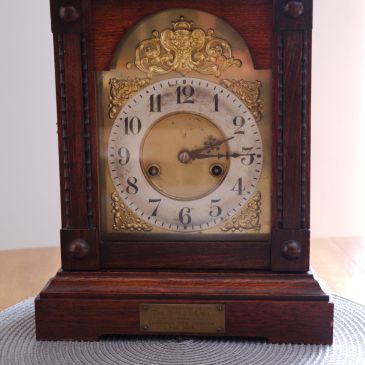
Time and strike mantel clock, shown without the crown and as purchased

About the Company

The company was formed in Germany in 1873 by Paul Landenberger and Phillipp Lang. Originally called Landenberger and Lang, it became the Hamburg Amerikanische Uhrenfabrik in 1891. The company was very active from 1885 onward, became a cooperative in the mid-1920s, and eventually merged with Junghans, one of the world’s largest clock companies, in 1930.

Original investors insisted that “American” be in the company name but “American” also refers to the manufacturing system adopted from America. The name of the company adds confusion to the novice repair person who might assume that what they are working on is an American-made clock.

HAU adopted the cross arrows as their trademark in 1892, and it became synonymous with the brand.

HAC trademark
HAC trademark

In 1925, a few years before its merger with Junghans, the company had a workforce of 2,200 individuals. Junghans remains a successful and thriving company today, specializing in high-end watches.

Condition of Case and Remarks

The case is in very good condition but was missing the crown when I purchased the clock in 2021. Since then, I have sourced a crown, and based on the research I have conducted online, it appears to be the correct “topper” for this clock.

A crown was sourced and it definitely improves the look

The dial face is in good condition and shows some wear but not like the heavily worn dials I have seen on similar HAC clocks.

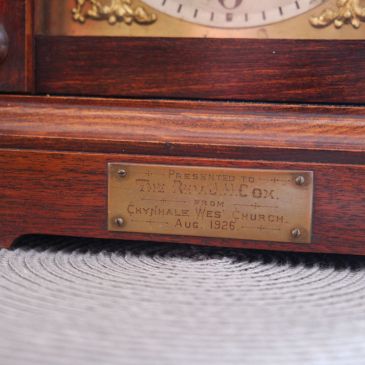
A commemorative brass plaque at the base reads: “The Rev. J. H. Cox Chyndale Wes’ Church Aug. 1926.” I assume this church is in the UK, but my online search yielded no information about this person. However, this inscription helps date the clock to no later than 1926. It is possible the clock may have been on a retailer’s shelf for several months or even up to a year or more before that date.

The Movement | Notes and First Steps in Servicing

In typical HAC fashion, the movement is robust and compact and it is a countwheel strike. The spring barrels are capped in the usual manner but feature four holes that make the mainspring visible. Earlier HAC movements had fully enclosed barrels—perhaps a cost-saving measure to use less brass! Otherwise, everything else is standard HAC.

Four nuts hold the movement plates. Once separated I removed the parts and divided the time and strike wheels.

Take careful note of two wires protruding from the rear plate. They act as tension springs, one for the strike hammer and on the opposite side of the movement, another for the lifting lever. These can easily break off, so handle the movement with care.

After disassembling the movement, it was cleaned in an ultrasonic cleaner. My aim wasn’t to achieve the shiniest brass possible but to ensure the brass and steel parts were thoroughly cleaned. There was some rust on two movement posts, which I removed using emery cloth. All parts were thoroughly dried.

The process may vary, but I moved on to polishing the pivots next. Since pivots are quite delicate, especially the fly, it’s important to handle them with care. Avoid applying excessive pressure on the pivot when using a metal lathe for polishing.

Polishing a pivot
Polishing a pivot with an emery board

I know some repairers prefer to avoid servicing mainsprings due to the difficulty of extracting them. However, it is essential to do so for several reasons. Clean and lubricated mainsprings ensure consistent power, enhancing the clock’s accuracy and performance. Additionally, it provides an opportunity to inspect for defects, cracks, and rust and replace them if necessary.

Once cleaned and lubricated, the springs are returned to their barrels using a spring winder such as the one made by Olie Baker.

Mauthe Horse Crown spring barrel in Olie Baker spring winder
Spring barrel in Olie Baker spring winder, with an appropriately sized collar ready to be inserted in the barrel to extract the spring

Since brass is softer than steel pivots one should expect some wear on the bushing holes. There are parts of a clock movement that exhibit more wear than other parts.

For instance, the wheels that spin the fastest are often the areas that show the most bushing wear but wear can show up in other places as well. I noticed punch marks on the cap side of each mainspring barrel. While punching around any bushing hole is generally poor practice, it appears this was done at some point in the clock’s history and can’t be reversed. Nonetheless, the repair seems to have held up well.

Next Steps

After inspecting and cleaning the movement, and polishing the pivots, the next step is to install new bushings. In my next article, I will focus on this process, along with the reassembly and testing of the movement.

Hamburg Amerikanische Uhrenfabrik: The Clock Company with an Alias

This article traces the historical journey of a significant German clock manufacturer, ultimately absorbed by the Junghans Clock and Watch Company in the late 1920s. After providing a brief overview of its history, the article will delve into the specifics of the clock movement that is next on my workbench.

Among clock collectors and admirers, the Hamburg American Clock Company is a well-known German company. It is otherwise known as Hamburg Amerikanische Uhrenfabrik or HAU and in many parts of the world, it is simply known as HAC or HAU.

The company was formed in Germany in 1873 by Paul Landenberger and Phillipp Lang. Originally called Landenberger and Lang, it became the Hamburg Amerikanische Uhrenfabrik in 1891. The company was very active from 1885 onward, became a cooperative in the mid-1920s, and eventually merged with Junghans, one of the world’s largest clock companies, in 1930.

HAC 14 day time and strike
HAC 14 day time and strike, a relative’s clock

Original investors insisted that “American” be in the company name but “American” also refers to the manufacturing system adopted from America. The name of the company adds confusion to the novice repair person who might assume that what they are working on is an American-made clock.

HAC trademark, crossed arrows
HAC trademark

HAU adopted the cross arrows as their trademark in 1892, and it became synonymous with the brand.


In 1925, a few years before its merger with Junghans, the company had a workforce of 2,200 individuals. Junghans remains a successful and thriving company today, specializing in the production of high-end wristwatches.

Before I embark on servicing a clock from my collection, I make an effort to gather information about the clock’s history. If details about the clock prove elusive, my fallback is to delve into the broader history of the company behind it.

Two Hamburg Amerikanische Uhrenfabrik clocks

The two HAC clocks in my collection are mantel or shelf clocks.

HAC mantel clock
HAC mantel clock

The clock pictured above was acquired several years ago.

HAC clock movement
HAC clock movement, with solid backplate

It has an earlier version of a HAC production movement because of the solid front and backplates. It is quite possible that this clock was made in or around 1900 or a little later.

HAC clock movement with solid front plate

Now, turning our attention to the second HAC clock in my collection, the one I will be working on next. The clock was acquired about two years ago from a clock collector in Ottawa, Ontario. The previous owner knew nothing about the clock but a plaque on the clock case gives a glimpse into the clock’s history.

This clock is a later production model because of the construction of the plates which I will explain further.

HAC clock number #2, model unknown, a later production
HAC clock number #2, model unknown, with a dedication plaque

While the wheel positions, levers, and movement size remain identical, there exists a noticeable difference between the two clock movements as can be seen by the solid front and back plates on the first clock movement and the various cutouts in the front and the back of the second movement.

Open plate, a later production movement

The use of open plates typically indicates a cost-saving decision made by the company. This choice is often driven by the aim to reduce manufacturing expenses by minimizing the amount of brass used in a movement.

HAC clock #2, #36 movement
HAC #2 movement

Aside from the four brass mounting straps and the slight difference in the positioning of one “V” shaped lever springs, HAC movement #2 has all the characteristics of the #36 movement pictured below.

No. 36 HAC time and strike clock movement

The story of two clocks made at different times in the company’s history is both captivating and compelling.

And finally, who is The Rev. J.H. Cox? A search online reveals nothing at this point.

Plaque mounted to the clock case

Before concluding that the clock was manufactured in 1926, it’s important to note that relying solely on plaques for dating may not always be accurate. The clock might have spent time on a retailer’s shelf, or it could have been acquired second-hand, introducing questions as to its actual production date. However, there is a 5,25 number on the upper left of the back plate which might be a date code. HAC was known to have begun dating their movements in the 1920s.

Now, on to servicing the clock movement the details of which will be covered in a forthcoming post.

Dating a Hamburg Amerikanische Uhrenfabrik (HAU) shelf clock

During the Christmas season, we split our time between Calgary, Alberta, and Ottawa, Ontario to see our 2 daughters. While in Calgary my wife spotted an interesting item on an Ottawa Facebook Marketplace, an English time and strike clock.

HAU shelf clock

She showed me the photo and I said, “that does not look like any English clock I am familiar with. The style is definitely German”. There is a commemorative plaque on the front base section which references an English church so, I am assuming the seller thought it was English.

When we picked it up from his home outside Ottawa I was surprised to learn that the seller is a clock collector and had no idea the clock he was selling was German. Occasionally I sell clocks to manage my collection and when advertising one for sale I make it a point to know the maker.

But, no matter, it was in very good condition and in working order.

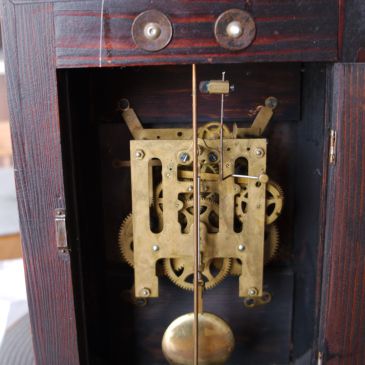
The movement showing the single strike rod and pendulum bob

The maker is HAU or HAC. The familiar cross arrows trademark of the maker is stamped on the movement, in the middle of the backplate.

HAC was formed in Germany in 1873 by Paul Landenberger and Phillipp Lang and was originally called Landenberger & Lang Uhrenfabrik. The company changed its name to Hamburg Amerikanische Uhrenfabrik (HAU)/Hamburg American Clock Company (HAC) in 1883. The famous crossed-arrows

Crossed arrows trademark

became their trademark in 1892. In 1926 the company went into a cooperative with Junghans and in 1930 they finally merged with Junghans.

The date on the plaque says 1926. However, HAC/HAU clocks are difficult to date prior to Junghans acquisition of HAC/HAU in 1930. Once Junghans and HAC began their collaboration in 1926 some of the movements were date coded.

Plaques are a good but not foolproof method of dating a clock. A clock purchased as a gift in 1926 could very well have been sitting on the retailer’s shelf for two or more years.

Catalogs are another good but hardly foolproof method of dating a clock. A catalog confirms that a model was made in a particular year, but that same model was probably offered 5 years +/- from the year of the catalog.

I will probably not determine a more reliable date for my new clock than circa 1926. The movement, compared to an earlier model (below), also has many cutouts and additional holes that indicate that it was a late production model and confirms that is closer to the 1926 date.

HAC clock movement
Solid plates of an early HAC clock movement CA. 1895

The clock runs for a while and stops. It is in need of a service but I expected to clean it as many of these old clocks have rarely seen the inside of a clockmakers’ shop.

Website Powered by WordPress.com.

Up ↑