
Tick Talk Tuesday #43 – Is this a Simon Willard banjo clock?

Tick-Talk Tuesday is about the letters and comments I have received from readers concerning clock issues, challenges faced, a clock you would profiled or advice on your particular clock concern. For those comments and questions that stump even me, I consult within my clock circles for the best possible answer

TM writes, “We have had a banjo clock in our family for multiple generations, and knowing my family’s history it would not surprise me if it was a Simon Willard original. I understand that is a long shot but it is so hard to find information about banjo clocks or reputable people to deal with. It is in relatively good condition, not knowing when my family acquired it exactly, but it is original to us. I am attaching a picture and would greatly appreciate your opinion.”

The family banjo clock

I am not an expert on Willard banjo clocks but have seen and read enough to inform me that Simon Willard clocks have distinctive features that separate his clocks from others.

My reply was, “Hi, and thanks for your email.

It may or may not be a Willard patent banjo. It would have to go through a process of authentication. An expert would identify the classic hallmarks of a Willard clock which would include movement design and construction, distinctive case features, door catch characteristics, construction of the dial, how the movement is mounted, design of the throat and lower tablets, and so on.

However, two things immediately strike me as odd. First, I have never seen a Willard patented timepiece (banjo clock) with an Arabic dial. Secondly, Willard banjo clocks have simple barbed spear hands, none as ornate as the ones on your banjo clock. Your clock could be a variant or the dial and hands could be replacements or the clock could have been crafted by another maker altogether.

Again, an expert in Willard clocks would provide the answer you are looking for.”

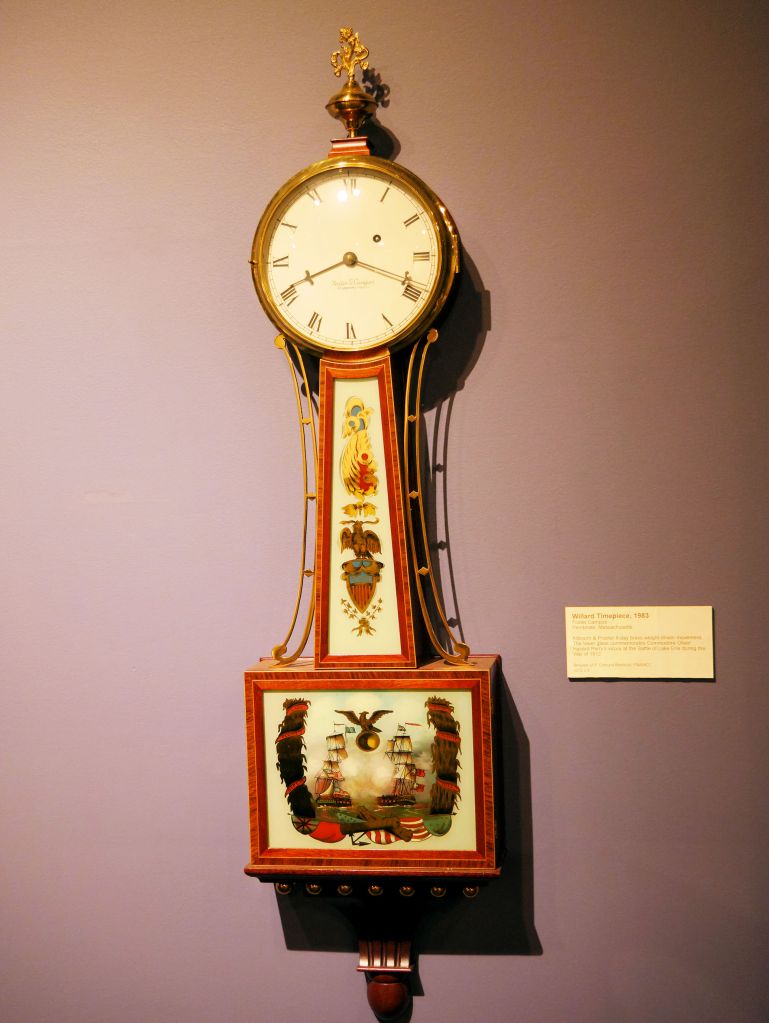
Simon Willard Patented Timepiece, C.1810; photo taken at the Simon Willard Clock museum in 2019

Simon Willard did little to protect his patent and as a result, many copies were made during the Federal period in Boston and in New England. Associates of Willard and apprentices to Simon and his brother Aaron produced clocks by the hundreds. Some of the copies were of high quality though they did not have the desired cache of a Simon Willard clock. And of course, many are fakes.

Willard clock; photo was taken at the American Watch and Clock Museum 2019

According to Robert C. Cheney, executive director and curator of the Willard House and Clock Museum proclaimed that the timepiece is “probably the most faked American clock found today.” Is TM’s clock an original, another maker, or a fake? An expert would immediately determine if it is real.

The photo at the beginning of the article is the only one sent to me and one photo is really not enough to make any kind of definitive judgment but I don’t believe TM has a Simon Willard Patented Timepiece.
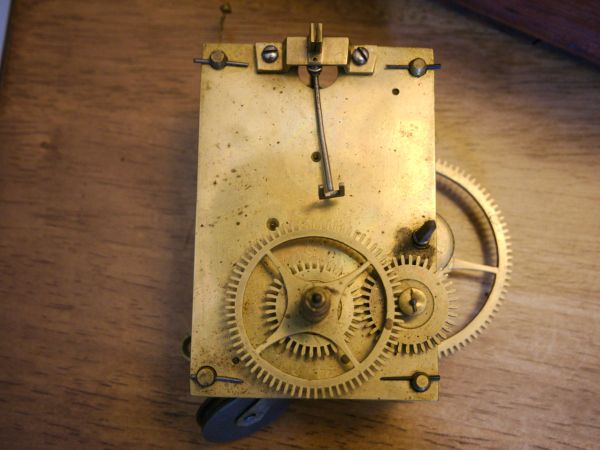
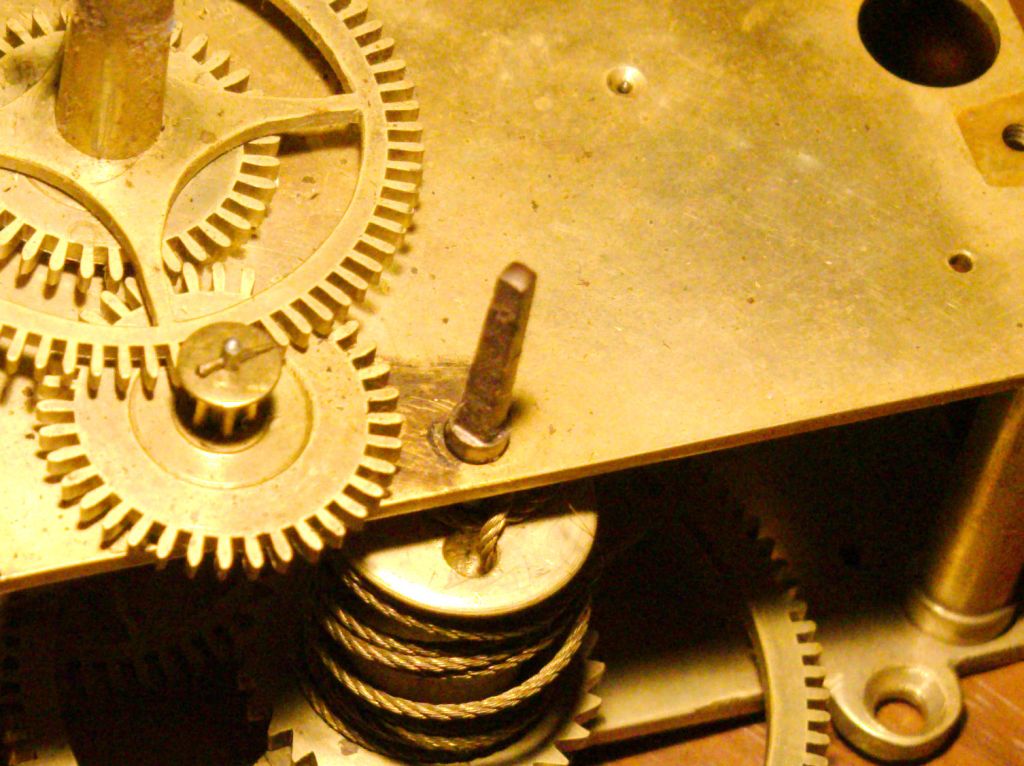
Sawin banjo clock movement servicing – two issues arose later

Weight-driven banjo clocks have simple time-only movements that are very reliable. They can be unadorned like the one I acquired or garish almost to excess like a presentation timepiece. Authenticity can be a challenge since some presentation timepieces started life as simple wooden cases and decorative tablets, finials, sidearms and other items were added later but I love the simplicity of this one.

Presentation banjo clock by Foster Campos

Finding one for $75 is highly unusual but I am convinced the seller had no idea what it was worth. When I picked it up the seller asked me if I was interested in another clock he had for sale, a 30-hour mantel clock. He told me someone valued it at $300. Uh, no, not interested!

This federal-style banjo clock was made in the 1840s. I am reasonably certain it was made by John Sawin of Boston in 1840 or thereabout, by either himself or one of his apprentices or associates. The movement and case construction bares a strong resemblance to a Willard timepiece and there is a good reason for this.

John Sawin apprenticed under Simon Willard and was a journeyman under Aaron Willard, famous clockmakers of the day and makers of the original patent timepiece.

Unfortunately, there are no identifying markings on the movement or the case but there are key indicators, for example, the placement of the movement mounting “ears”, that tell me that this is a Sawin clock.

The case is complete and ready for the movement

Everything is original to the clock, weight, hands, movement, pendulum rod and bob. The dial glass was was broken at some point in the clock’s life. It had convex glass and a good many I have seen with wood bezels had flat glass. Brass bezel clocks, on the other hand, generally had convex glass, so, I have decided to replace it with flat glass.

The movement

The gear train is relatively simple and consists of 4 wheels; the main wheel, second wheel, third wheel, and escape wheel. The motion works are on the front plate.

The movement in its case

Assessment of the movement

As expected there is wear but consistent with the age of the clock. The movement looks good overall, the gear teeth and pinions are in very good condition but, there are punch marks around the pivot holes. It is never a good feeling to see punch marks around the pivot holes. Punching effectively closes the pivot holes but in a very crude way. This was an old practice and is not considered acceptable today.

Pivots are required for the main wheel front plate, second wheel back-plate, third wheel, and the escape wheel front plate. The verge may require front and back bushings but I will see how things look when the other bushing work is complete. Three are 2mm wide Bergeon bushings, the fourth is 2.5 and the main wheel bushing is larger. I don’t often work with bushings as small as 2mm and it simply means extra care must be taken to cut and ream as accurately as possible.

Bergeon Bushing Machine
Punch mark, left of winding arbour
New bushing for main wheel arbour

There was a good amount of movement in the main wheel arbour and installing a bushing was necessary to tighten things up. I have bushings that are 1.5 mm and 3mm thick but the plate is 2mm. A 3mm bushing was installed and using a file I reduced the height to 2 mm. Three other bushings were then installed with no issues.

I have decided to leave the verge bushings as-is for now.

The weight cable had no kinks or broken strands, I cleaned it in the ultrasonic and reused it. For brass cable, I generally knot each end and use solder to secure the knot to prevent it from slipping out of its knot.

Two weeks later and two issues

The weight cable is too short. The clock stops when the weight is several inches from the bottom of the case and it will only run six days instead of the usual eight. Why was the cable shortened? Who knows?

The Keystone

A second issue. The keystone is the piece between the suspension spring and the pendulum leader. It comes very close to hitting the large wheel of the motion works on the left side. Since the suspension spring is quite bent the right side of the keystone rubs against the back of the dial face stopping the clock. A bent spring is a consequence of leaving the pendulum assembly on the movement during transport.

Unfortunately, I cannot source a suspension spring alone and must purchase either the keystone and suspension spring together from an American supplier or the entire spring, leader and stake for about $55.00 from a Canadian supplier. In the meantime the movement runs until I put the dial on.

Sawin banjo clock c.1840

I am in no hurry for this one and will continue testing it until I come up with a solution for the bent suspension spring.

Website Powered by WordPress.com.

Up ↑