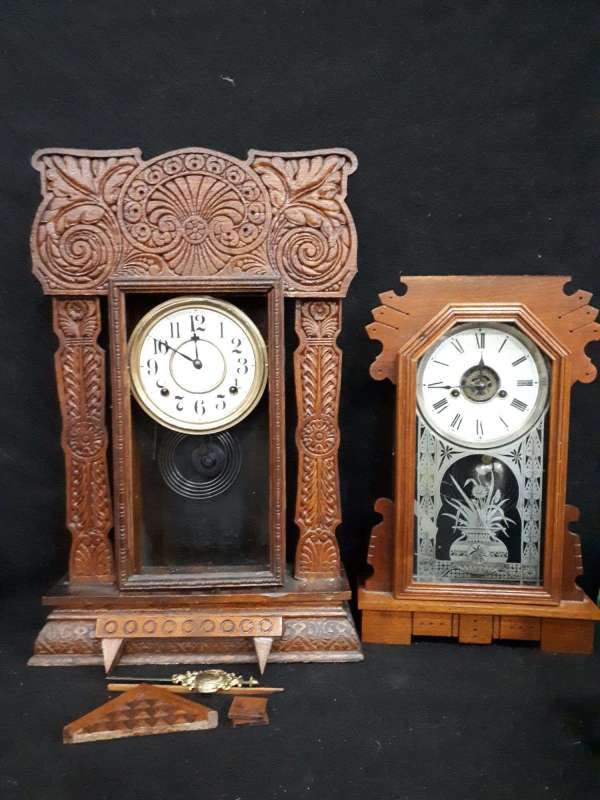
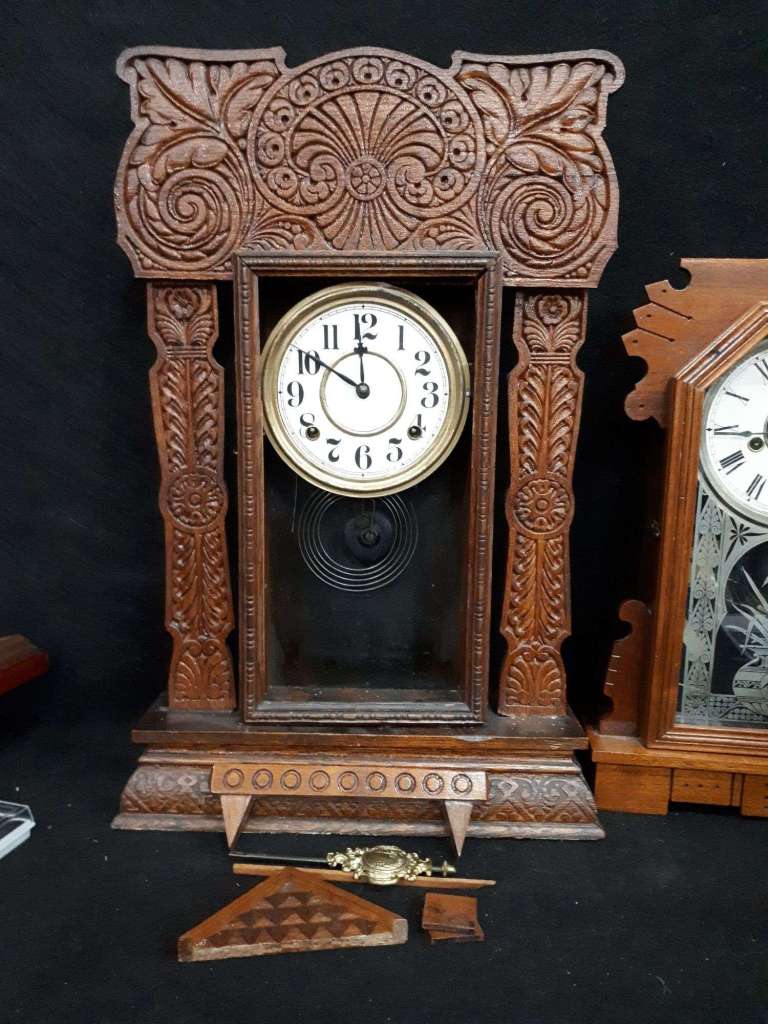
Can this gingerbread clock made by E. Ingraham be saved? Possibly, but this clock is destined to become a parts clock and I will explain why in this post. In the spring of this year (2022) 4 clocks were bought at auction. I can save three of them but not this one.
Gingerbread clock
Gingerbread clocks often called “kitchen clocks”, were introduced after the American Civil War and remained popular until the end of World War I.
The term is derived from the tradition of making decorated gingerbread houses which began in Germany in the early 1800s. The broad application of the gingerbread style applied to almost anything including clocks.
Auction photo
The gingerbread design is polarizing. Collectors either love them or hate them. I am not particularly fond of the design generally, with certain exceptions, but I can see how some collectors are attracted to the style.
The cases were steam-pressed oak and occasionally other hardwoods were used. Various designs were pressed by a heat-bond process which was quite advanced for the time. It was a time-saver, spectacular designs were pressed within seconds and it saved on labour costs. Hundreds of thousands of these steam-pressed oak-cased clocks were made and all are now well over 100+ years old.
So, what is off putting about this clock?
It came with no glass and to me that is the deciding factor. I do not have the time or inclination to look for an appropriate tablet for this clock and obtaining one will not increase its value appreciably will not make it more desirable.
Auction photo
The case may look good but the auction photo does not tell the entire story. There are newer screws and nails in various places in the rear of the case that were used to keep the case from falling apart and not a very professional job at that. It would have to be taken apart and re-glued.
On top of everything I don’t like this clock enough to spend any time on it.
I can use the dial for a Sessions clock I am working on and will keep the case, harvesting what wood I need for future projects.
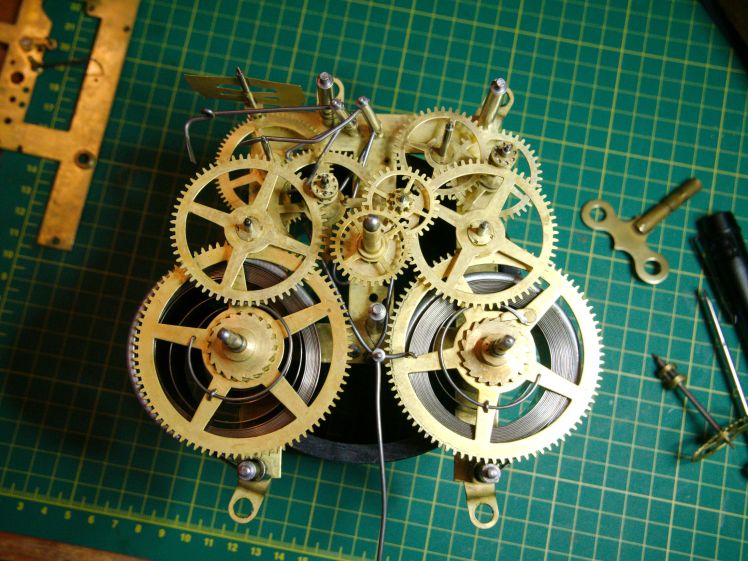
I will inspect the movement and if things look good, service it and sell it separately.
Call this an obituary. The reality is this clock has been around for over 100 years, has served its purpose and has now come to the end of its life.
This E. Ingraham & Co. clock is a garden variety parlour clock. There is nothing special about it but among parlour clocks, it has nice lines and reflects a more conservative approach to clock designs of the late 19th century. It is an 8-day time and strike clock purchased from a local antique store in the spring of 2019. I have recently serviced a number of clocks in preparation for sale and I also considered selling this one. While I am not in the business of selling clocks I will let go of the odd one to keep my collection manageable. My wife feels that it is a keeper though and I agree.
This was a running clock before I took it apart and my goal is to give it a good cleaning and address wear issues
Stamped in the middle of the front plate is “E Ingraham Co patent date Oct 8, 78 Nov 11, 79, Bristol Conn.” On the inside floor below the pendulum, it is stamped “Manufactured by the E. Ingraham & Co, Bristol Conn”. It was not a common practice to stamp the inside floor but it is an interesting feature.
E Ingraham parlour clock with Swigart dial
Tran Duy Ly’s book on Ingraham clocks shows this model, the Mystic, from the 1897 catalogue. The clock sold new for $6.50. Although found in the 1897 catalogue it might have been made some years earlier. Two numbers are neatly etched into the lower right-hand side of the front plate and they are H25,915 and H27,475. They look like service dates, Sept 1915 and April 1975.
There is a stylized “S” logo on the dial face. Some might mistakenly take it for a Sessions clock. The dial is a replacement made by E&J Swigart, a supplier of replacement dials along with other clock and watch supplies. Swigart went out of business in October of 1992. 1972 was the last year they made reproduction clock dials and this appears to roughly coincide with the 1975 service date.
Assessment of the movement
I have worked on a number of Ingraham movements, some with helper springs and some without. It looks to me that helper springs were added, which is not a bad thing and they will stay on the movement. Installing helper springs to ensure levers drop as they should is not an uncommon practice.
Normally these old movements are in varying degrees of wear and quite often there are punch marks around almost every pivot hole plus they are very dirty. This movement has had 13 bushings installed and is surprisingly clean for its age.
This was a running clock before I took it apart and my goal is to give it a good cleaning and address wear issues along the way. It might require some intervention but my first impression is that it looks very good.
Ingraham Mystic
I found a bent second wheel pivot on the strike side. Before blaming a previous repair it is possible that I was the culprit. Both mainsprings were clamped to restrain their power but when I removed the top plate a wheel sprung out from the strike side. Evidently, the strike side mainspring still had residual power remaining and might have bent the pivot. It was easily straightened.
The main and second wheels on both sides are inscribed for location, so, that is helpful. The strike side mainspring arbour hook has been repaired although the pin is loose and had to be secured. It also appears both mainsprings are replacements. The warning wheel lantern pinion shroud has also been repaired. The clutch on the motion works looks like a repair but I have seen at least one other Ingraham like it, so, I’m not sure.
Ingraham Mystic, warning wheel with additional punch marksIngraham Mystic, motion works clutch
This clock has had a lot of attention and has led an easy life. The repairs are neat and tidy and appear professionally done.
But there is some wear. The clock requires bushings on both the time side and the strike side. One on the time side and 3 on the strike side, one new, and 3 replacement bushings.
Reassembly and testing
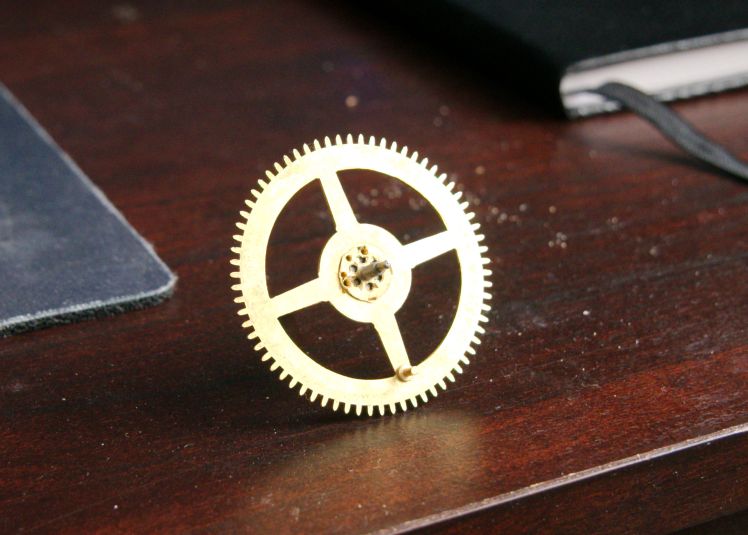
The third wheel on the strike side is a combined locking and pin wheel with 2 locking pins and 2 hammer pins. There is no cam on this arbor, unlike many other American movements. The spaces between the pins allow for the drop lever to descend.
The count wheel is advanced by two protruding pins on the third wheel lantern shroud. It is necessary to ensure that the count wheel is firmly in place, not loose but not too tight, so the third wheel pins can advance the count. The warning wheel is set about half a revolution to set up the strike. During reassembly one of the two lock pins is placed on the locking lever, the end of which has a hook. This is to permit the count lever to go into one of the deep slots.
Since I have worked on a couple of Ingraham movements in the last month there was no need to separate the plates to make additional adjustments.
Unlike earlier Ingraham movements that have no passing strike on the half-hour, this has one.
It is on the test stand and I will let it run for a cycle or two before returning it to its case.
Ingraham Mystic on the test stand, beat amplifier attached
It’s really nice to work on a clock that has been so obviously well cared for. It will look great and run well though the only item that detracts from the clock is the Swigart replacement dial.
This article is the first look at one of my latest online auction finds, an E. Ingraham & Company shelf clock known as the Grecian.
The Ingraham Clock Company operated under a number of minor name variations over the years, E. Ingraham, E & A Ingraham, the E. Ingraham Company, E. Ingraham and Company from 1844 to 1885. Later The Ingraham Company made electric clocks and wristwatches. McGraw-Edison now owns the company and quartz clocks bearing the Ingraham name are still manufactured.
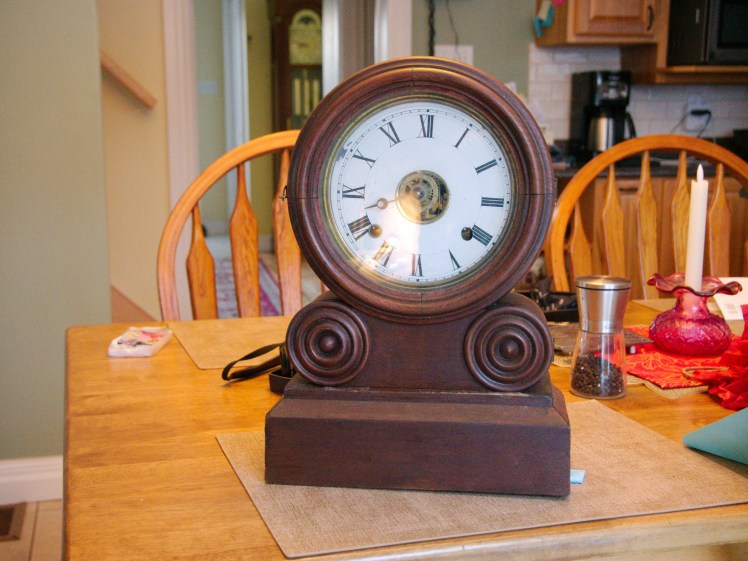
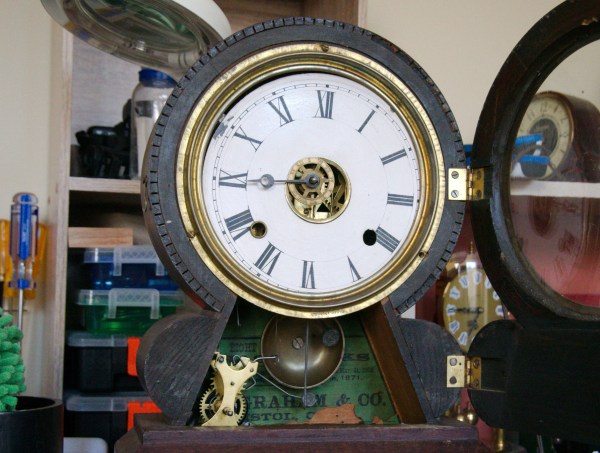
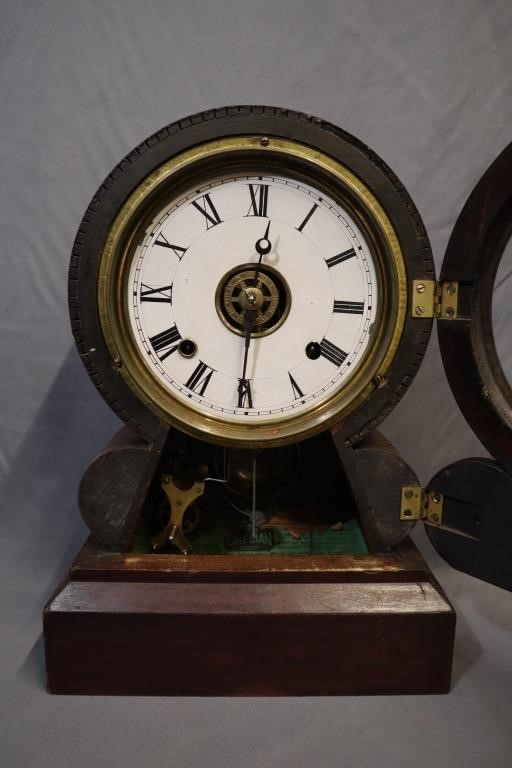
Ingraham Grecian shelf clock, a day after the auction purchase
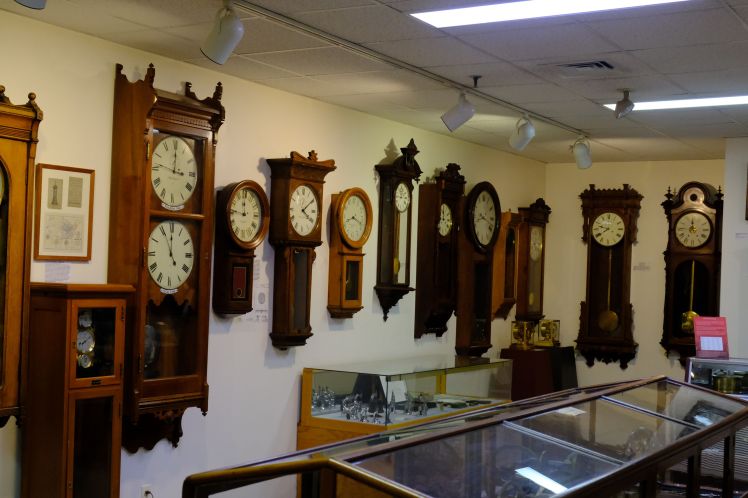
Although not rare the Grecian is quite collectible. Patent dates on the label date the clock to around 1871. The only other one I have seen is at the American Watch and Clock Museum in Bristol Connecticut, a mosaic maple and walnut version.
American Watch and Clock Museum in Bristol Connecticut
It is a handsome clock with clean lines. The E. Ingraham Grecian 8-day time and strike shelf clock is neoclassical in design. It is not only aesthetically pleasing to patrons of the nineteenth century but remains so today.
It is a distinctive clock. It has a moulded Rosewood bezel, carved volutes below the dial frame (or rosettes as Ingraham called them in his patent letters), and a Rosewood veneered case. The dial frame and bezel are one section that makes up the hinged front access door. There are walnut cased versions and mosaic as well but Rosewood has a certain exotic allure. Elias Ingraham was a case designer and no doubt had a hand not only in the design but the choice of woods used for case construction.
This clock was bought at an online auction in early January 2021. From the auction photos, I expected a clock that needed work and now, after having received it, I am pleasantly surprised that will not take much to service the movement and clean the case.
General condition
The case is Rosewood but because of the buildup of dirt and grime over the years, the grain and texture of the wood are hidden. Upon closer examination, there are some small chips of veneer missing from the corner edges of the base, not surprising given the age of the clock. The rounded top and volutes are perfect.
There is some wear on the top part of the base under the door and that is to be expected. The curved wood bezel is in very nice condition. The backboard has age-related cracks in two places but will not require a repair. There is a slight corner separation on the left side of the base but everything else is tight. The door clasp looks good.
Ingraham Grecian shelf clock
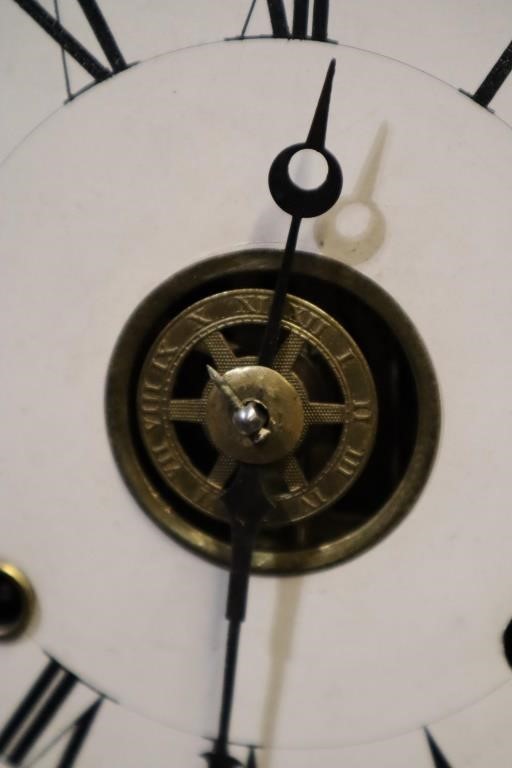
The dial screws came out too easily and the screw holes are well worn. The dial has been taken off more than a few times to make adjustments. The dial is also misaligned as a result of the new screw holes. Both the minute and hour hands are incorrect. The moon hour hand is too short and the minute hand is a slender spade. Both will be replaced.
Ingraham Grecian shelf clock
The painted zinc dial face, which for some reason is detached from the brass bezel, appears to be original with some flaking on the edges. There is a missing time side grommet. The alarm dial is loose, not seemingly attached to anything, and came off easily once the hands were detached. The brass bezel needs a good cleaning.
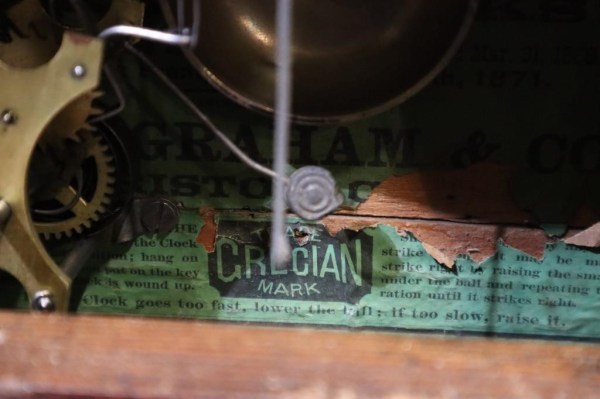
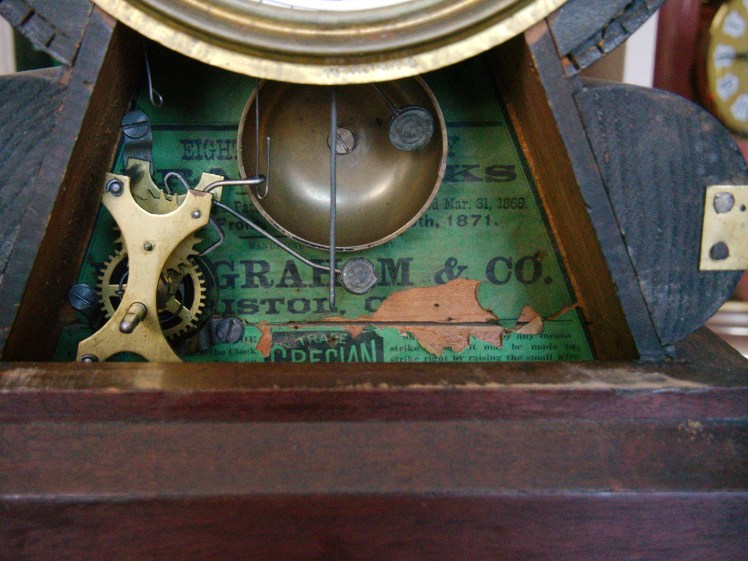
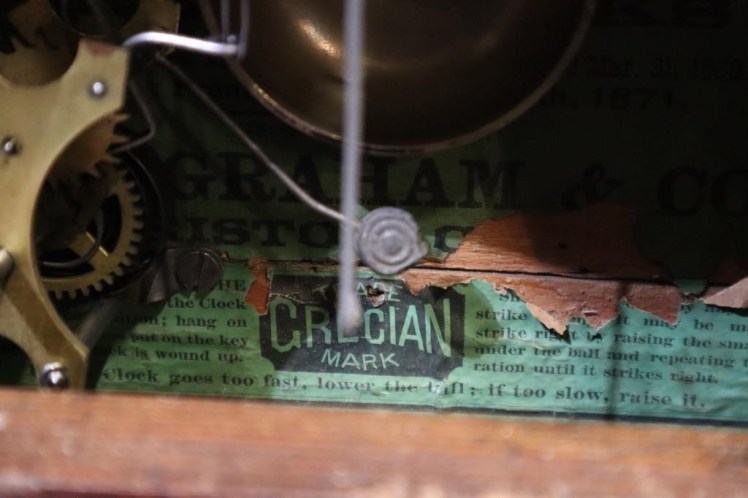
Ingraham Grecian shelf clock, fair label, cast brass bell
The unique green triangular label inside the case is in fair condition with pieces missing at the lower cracked section of the backboard. I found a loose 3cm piece at the bottom of the case which can easily be glued back in place. The alarm mechanism is in excellent condition. The spring on the alarm is typically broken on these old clocks; this one is fine. I doubt if it has seen much use. The bell is cast brass and there are two strike hammers; one on the inside, which is for the alarm, and one on the outside, the hour-strike hammer.
I was told by the seller that the clock would run for a few minutes, even strike but then it stops, which tells me that nothing is broken. The crutch loop is twisted around the pendulum rod and since there is no impulse it is not surprising the clock would stop. I doubt it ran more than a few seconds.
It is a pinned movement. Later movements have screws or bolts holding the plates together. The movement might have been worked on in the past although it is hard to tell. The two lower pins look original but the top pins look like replacements. If it was worked on it was done with care. There are no tell-tale signs such as marks, scratches, and punch marks that indicate past servicing. Since the mainsprings are wound tight I won’t know the extent of wear until I take the movement apart.
I can only guess that the butchered crutch and the detached dial are the results of someone who did not know what they were doing when making an attempt to get the clock to run.
The plan of action
The case:clean all wood surfaces thoroughly with Murphy’s Soap. Cleaning will no doubt remove remnants of the old shellac and new shellac prepared in the traditional manner (flakes and alcohol) will be applied to all the exterior surfaces. The finish will then be dulled with 4X0 steel wool.
The movement: The movement will be completely disassembled and inspected for wear, and cleaned. New bushings will be installed if needed. I made some adjustments to the crutch and ran the clock for two days and it was striking correctly during that period. The mainsprings look to be in good condition and provide plenty of power. The alarm mechanism which might never have been operational, will be taken apart and cleaned. The alarm dial is a friction fit and will be tightened up once the movement is reinstalled and should work as intended. The crutch loop will be repaired.
The dial: I will leave the dial as-is despite a little paint loss on the edges. Once the dial is aligned properly these should be hidden, for the most part. The dial pan has separated from the bezel. A past tinkerer used cellophane tape to secure the dial pan to the bezel and even attempted to solder two of the tabs, poorly I might add. These are fixable. More difficult is sourcing a 2 3/4 inch moon minute hand.
Well, that’s it for now. I plan to get started fairly soon. The only thing stopping me is a Seth Thomas #2 that has stopped and needs a look-see. There will be more on the Ingraham clock later.
I was the successful online bidder for an E. Ingraham Grecian time and strike shelf clock in early January 2021. My wife and I had to travel 3 hours, from one part of Nova Scotia to another, to pick the clock up but since we were taking a small staycation in the nearby area the antique shop was on our way.
It is a very interesting design and I researched not only this clock but the period that influenced its design.
Let’s travel back in time to Duncan Phyfe, a prominent American furniture designer (1768-1854). His interpretation of fashionable European trends made him a major influence in the Neoclassical movement in the United States impacting an entire generation of cabinet-makers. The era of Greek furniture design quickly came to the clock world in the form of “Grecian” clocks made by a number of clock manufacturers including Joseph Ives, E. N. Welch, Seth Thomas, and Ingraham.
This is the E. Ingraham & Co.’s interpretation of the Grecian clock, called appropriately enough, the “Grecian”.
The design is a classical influence and it is not only aesthetically pleasing to patrons of the nineteenth century but remains so today. It has a molded Rosewood bezel with carved volutes below the dial frame. The dial frame and bezel are one section that makes up the hinged front access door. I have seen walnut-cased versions and mosaic maple and walnut as well. The mosaic versions are probably the most desirable.
Elias Ingraham was a case designer and no doubt had a hand not only in the design but the choice of woods used for case construction.
It has a paint-on-zinc dial, moon-shaped hands, and Roman chapters. The Grecian model was available as a 30-hour spring-driven, time and strike, 30-hour time and strike with alarm, 8-day time and strike, and 8-day time and strike with alarm. This one is the 8-day time and hour-strike alarm version. All models strike on a cast bell made of iron, or in this case, brass. Features such as exotic/mixed woods, alarm, and 8-day function would have been an extra charge at the time. The clocks were made between the years 1868 and 1883 with an 1880 catalog price of $5.25 for the 30-hour clock with alarm.
It has a green triangular-shaped paper label inside the back panel of the case which is in fair condition. There are 3 patent dates on the label, September 30, 1862, March 31, 1868, and June 6th, 1871. The newest clocks of this model would have had October 8, 1878, and still newer, November 11, 1879 patent dates so, this clock was made after 1871 and before 1878. The fact that the clock can be dated within a 5 year period is a plus.
Once I receive the clock and look it over more carefully I will post my first impressions and the work that must be done to restore both the clock movement and the case to its former glory. Stay tuned.








 Antique and Vintage Mechanical Clocks
You must be logged in to post a comment.