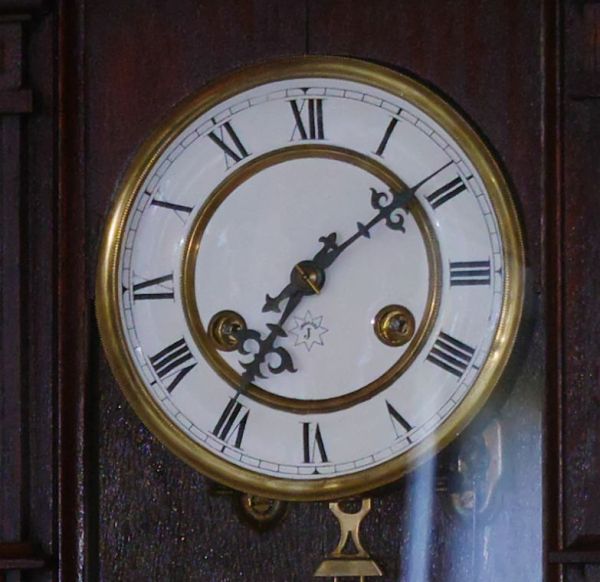
Crispi Wall Clock Movement by Junghans | My Nemesis

I have never been completely happy with how the movement runs in this Junghans Crispi wall clock. When I got the clock in 2017, I jumped right into restoring the case because it was an interesting challenge to put the clock together from a bunch of parts.

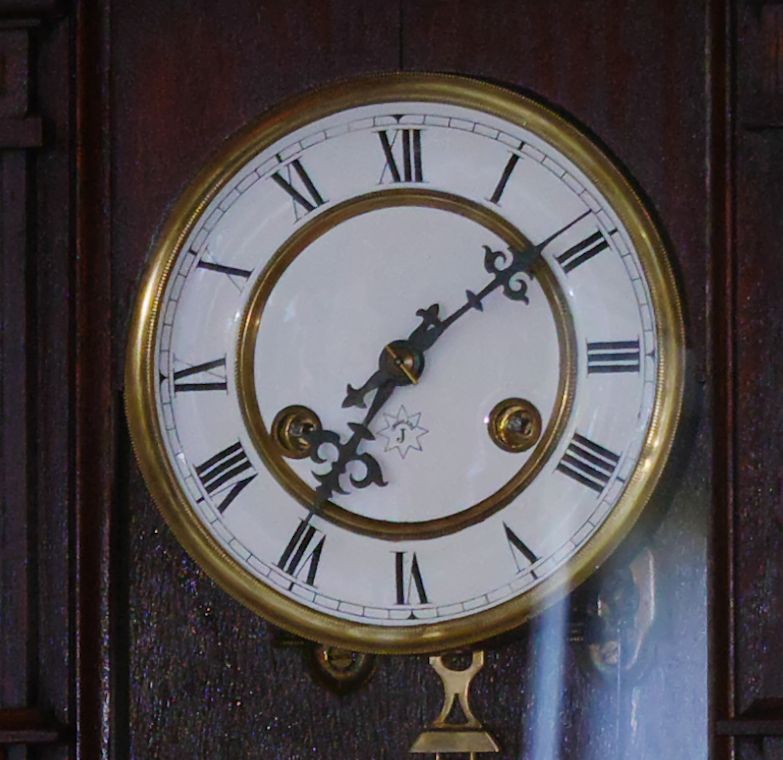
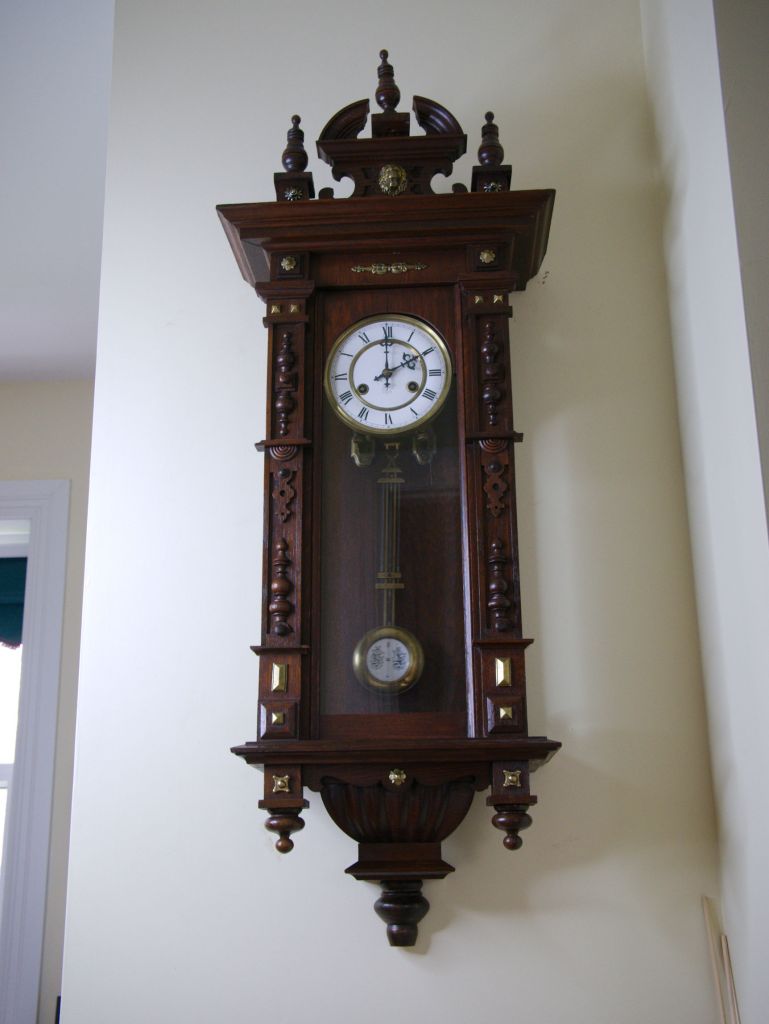
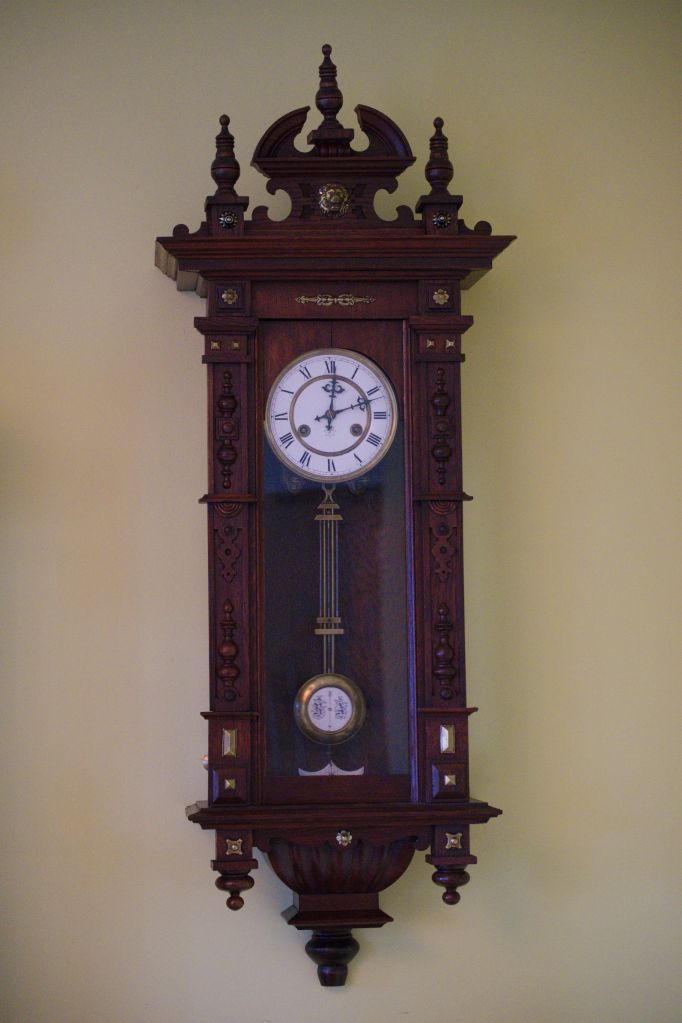
Junghans wall clock, circa 1899, model – Crispi

Now, eight years later, the clock continues to disappoint. The case remains in great shape, but the movement has been a consistent letdown.

Very dirty movement
Movement as found, about as dirty as it gets

Let’s take a step back in time.

Winter 2017

After completing the work on the case, I turned my attention to the movement. During the disassembly and reassembly process, I accidentally broke not only the strike paddle but also a retention spring. In 2017, my skills weren’t advanced enough to repair the paddle and retaining spring myself, so I had the movement professionally serviced.
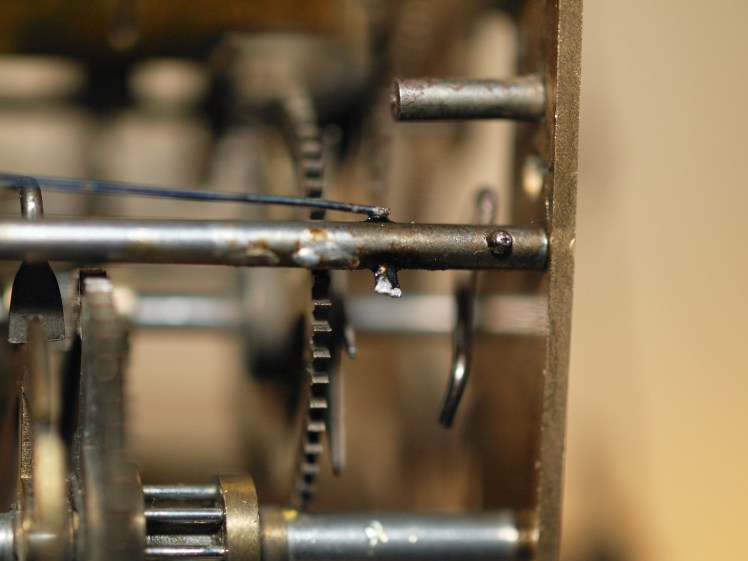
Junghans movement
Broken strike paddle

During its 2017 service, the paddle was repaired and a new spring was installed. In addition, the movement had received extensive bushing work: six bushings on the front plate and six on the rear.

Three months later, I picked up the clock and hung it on my dining room wall. It ran perfectly for over two and a half years.

Spring 2020

For some undetermined reason, the strike became erratic—it would strike incorrectly, fail to strike at all or strike incessantly until the mainspring ran down.

I had a number of other clock projects on the go so I kept the time side going and left it on the wall until later that year.

December 2020

In December, I disassembled the movement and discovered a slightly bent arbor on the strike side cam wheel. All other pivots were straight, and there were no noticeably worn pivot holes—everything else appeared to be in good condition.

I did notice a small amount of dirty oil around many of the pivots. While I was initially a bit surprised, it’s not entirely unusual after more than two years of regular operation.

Unfortunately, disaster struck again. While manipulating the plates, I snapped the paddle arbor retention spring—again! This time, however, I was able to repair it myself.

There was just enough of the original spring left to reuse. The wire is very thin (0.5 mm), extremely brittle, and breaks easily under even light pressure. Using a micro drill with a 0.5 mm HSS bit, I carefully enlarged the existing hole in the plate, reinstalled the spring, and secured it with Threadlocker Red to bond it firmly in place.

The movement was reassembled and tested. After the testing period the movement was returned to its case and ran well until about 6 months ago.

Fall 2024

While the time side was running well, the erratic striking returned, and after a few weeks, the clock began stopping just before the warning phase. I wound both the time and strike sides again to replicate the problem, and each time it stopped at the warning point. Feeling frustrated, I left the clock on the wall, wound only the time side, and still it stopped. Since I had other projects to tend to, I decided to leave this one on the back burner for a while.

Junghans clock
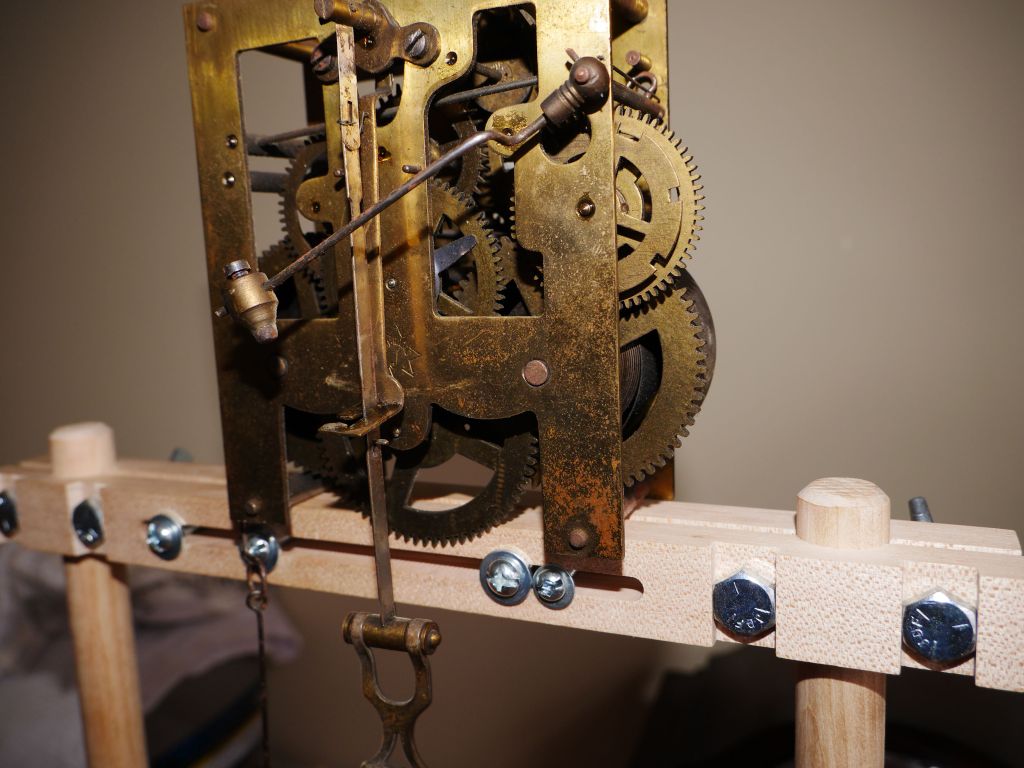
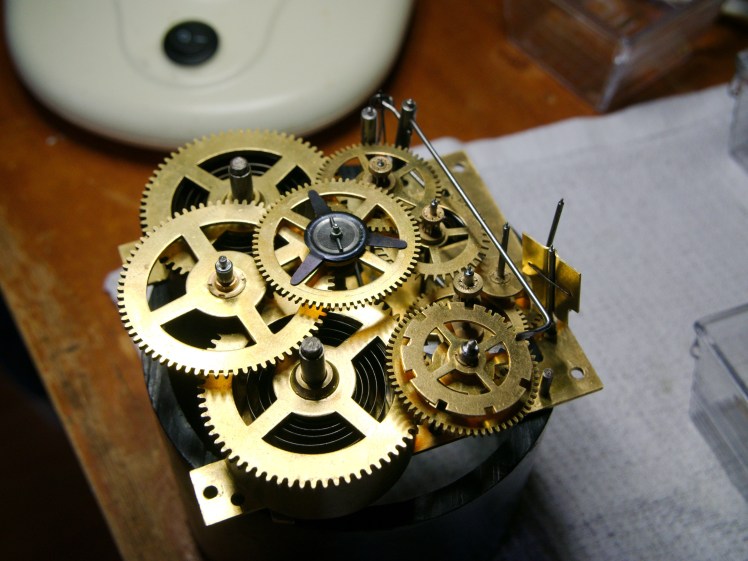
The movement on a test stand

Spring 2025

Since I was free of immediate projects, I removed the movement from its case and placed it on the test stand. As expected, the time side ran fine. It was serviced not so long ago. For the last couple of months, however, it has been striking erratically or not at all. It enters warning without issue, but seems to almost stall during the striking process. I want to address this issue, but I also want to disassemble the movement to clean up both the pivots and the bushing holes, as the oil is dirtier than I expected.

Judging from similar movements I’ve worked on, I believe there are three issues at play:

  1. A power issue, which suggests the mainspring is weak.
  2. One or more bent pivots, preventing the wheels from turning freely.
  3. The paddle is not correctly positioned in relation to the star wheel. The hammer begins lifting immediately at the drop-off, which stalls the strike train. Once it gets going again, the hammer lifts easily and quickly. I’ll try repositioning the star wheel to allow more run time before the hammer paddle is engaged.

The first issue means replacing the strike-side mainspring. The second issue involves manipulating pivots. There is always a risk of breaking a pivot when attempting to straighten it, not a pleasant experience, as re-pivoting is necessary.

Check back later for an update on what I discovered—which of the three issues turned out to be the culprit, and whether I was finally able to fix a clock that, at times, seems determined not to be fixed.

The Stories Behind My Antique and Vintage Clocks

I often wonder about the stories behind my clocks.

Antique and vintage clocks evoke a time when life seemed simpler, a stark contrast to today’s frenetic pace. Old clocks serve as living memories, cherished relics of people and places that are long gone but not forgotten.

Ideally, they should be passed down through generations. Yet, when I look at online marketplaces, it’s clear that many clocks no longer stay within their original families. I can’t help but wonder—has sentimentality lost its place in today’s world?

Out of the 35 clocks displayed throughout our home (a small part of my collection), I wish I knew the stories behind every single one of them. If only they could talk! What tales they would share.

Still, two of my clocks come with stories that I hold dear to my heart.

Junghans Crispi time and strike wall clock

One of my clocks survived the 1917 Halifax Explosion. It is a Junghans Crispi wall clock. I know this because the previous owner had kept it in their family for over 100 years. It wasn’t in the condition you see it in today, though. It came to me as a box of parts, and I imagine they decided it was time to let it go after holding onto it for so long. They hoped that whoever bought it would bring it back to its former glory.

After restoring the clock, I contacted the former owner to show them what I’d done, sending them a photo of the clock in its restored state. I never heard back and I assume they experienced a bit of seller’s remorse.

However, I often look at the clock and try to imagine that fateful day, December 6, 1917, when it fell from the wall in a modest North Halifax home and broke into dozens of pieces.

Ingraham Huron shelf clock

Another story belongs to my Ingraham Huron shelf clock (circa 1878). It was a rare find considering it was made between 1878 and 1880. Some might call the style a balloon clock. It came from a small village outside Bridgewater, Nova Scotia. My wife and I made a day of the trip, enjoying lunch and some shopping after picking up the clock from an elderly couple who were in the process of separating.

The clock’s story unfolded when we met the couple selling it. The gentleman, in his early seventies, recalled seeing the clock in his grandmother’s home when he was a child. After some conversation, we learned that the couple was separating amicably, with the wife planning to move into an apartment nearby. “We need to get rid of a lot of stuff,” he told us. It was a bittersweet moment, knowing they were parting with something tied to childhood memories. My wife and I left with the clock, reflecting on how our connection to objects, even sentimental ones, can change over time.

It seems sentimentality can have a price. People grow tired of the things they once cherished or feel the need to unburden themselves of objects tied to past relationships and memories. Nostalgia can bring comfort, but for some, it may not be enough to hold onto the past.

I often wonder what will happen to my clocks when I’m gone. My wife knows that I’m not emotionally attached to all of them. Some were simply acquisitions that served to give me projects that helped me grow as a hobbyist. Yet, there are several clocks that I hope my children will keep—the ones I’ve spent countless hours restoring, the ones with stories and history.

Among them are my twelve Arthur Pequegnat Canadian-made clocks, two Vienna regulators, a Seth Thomas Empire-style clock, a Sessions Beveled No. 2, my Ingraham Huron, and my Junghans Crispi wall clock.

These clocks represent a blend of history, personal connection, and the passion I’ve poured into them. I think my kids will appreciate that.

Honouring History, One Tick at a Time – the Halifax Explosion Dec 6, 1917

In the heart of North End Halifax, on December 6, 1917, a Junghans Crispi clock fell off a wall in a house on Princess Court. Unbeknownst to it, this simple clock would become a silent witness to one of the worst man-made disasters in Canadian history – the Halifax Explosion.

The cloud produced by the explosion

As the Belgian relief ship Imo collided with the French munitions vessel Mont-Blanc, a catastrophic event unfolded in Halifax’s harbour. The explosion at 9:04:35 a.m. reshaped the landscape, claiming 2,000 lives with 9,000 injured, and left an indelible mark on Halifax’s history.

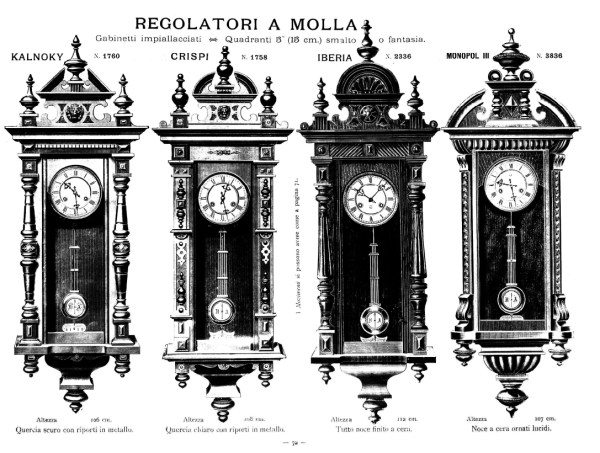
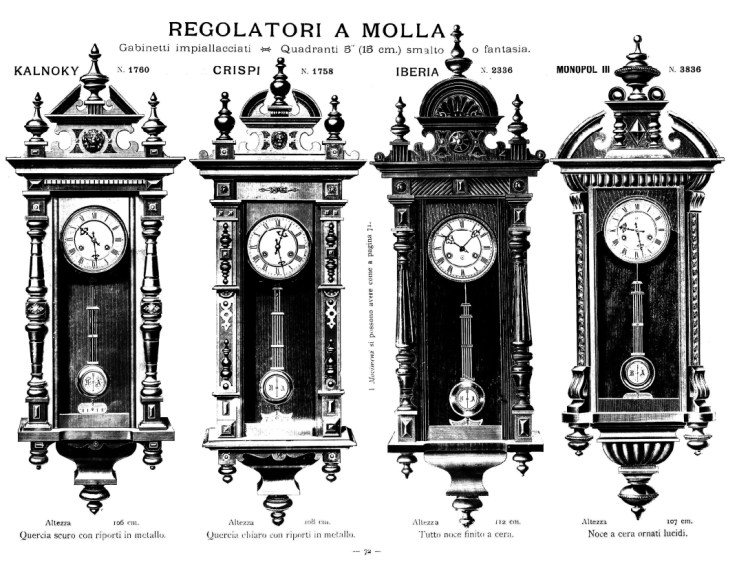
Since some case parts were missing, a catalog image of the clock served as a helpful reference
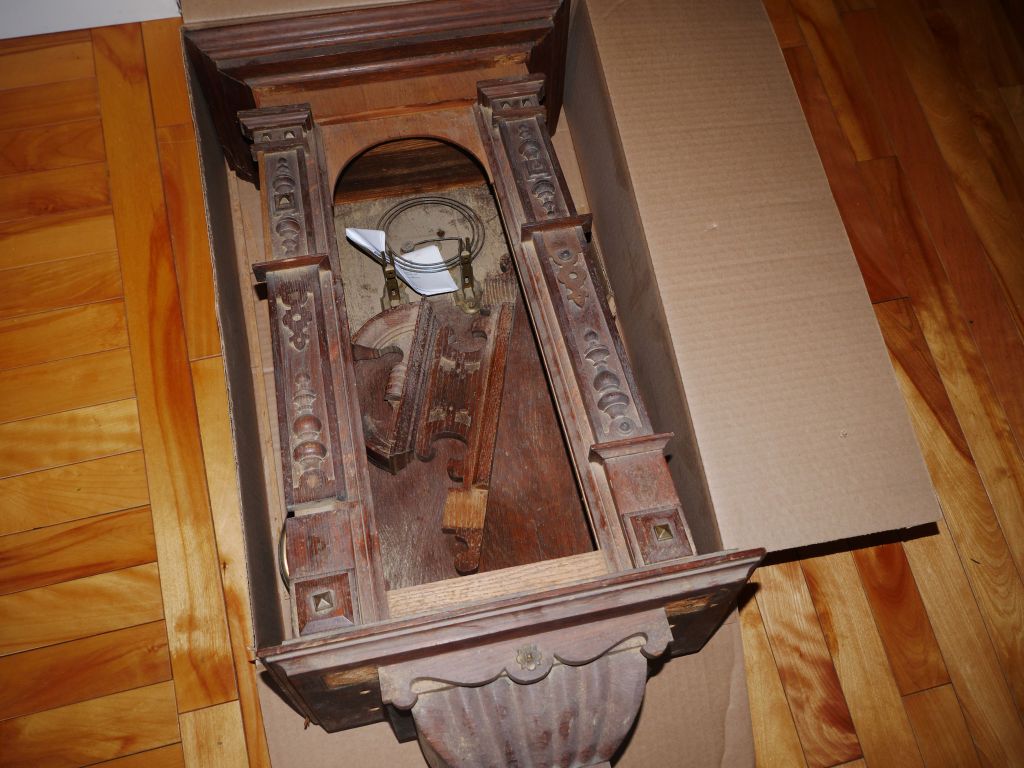
How the clock was received

Fast forward to 2017, a century later, and the remnants of that clock found their way into my hands. The following journey is about a box of clock parts, carefully preserved by a family for generations, passing through to a new owner to be revived and displayed as a connection to history.

Very dirty movement
The movement was very dirty but intact

The task of reviving the clock, and turning it into a connection to history is a process that took over two months.

The restoration unfolded step by step. The clock parts were carefully cleaned, new parts were fashioned, and the correct materials were found to restore the Junghans Crispi wall clock to renewed glory. The hands, frozen since that fateful day, started moving again – a symbol of human resilience.

The restored Junghans Crispi wall clock was finally unveiled in late 2017 and has been ticking away and gracing the wall of our dining room ever since then. Its polished wooden frame, bold brass accents, and rhythmic ticking resonated with the shared history of a city and a clock that refused to succumb to the ravages of time.

As we mark the 107th anniversary of the Halifax Explosion, my Junghans Crispi wall clock stands as a symbol of resilience, remembrance, and the power of restoration.

In the quiet corners of North End Halifax, it tells a story that transcends time – a tale of survival, renewal, and the enduring spirit of a community that rebuilt itself from that terrible moment.

The Philosophical Conundrum of Antique Clocks: When is a Clock No Longer Itself?

In the world of horology, antique clocks stand as both timekeeping devices and exquisite works of art, bearing witness to the craftsmanship and design sensibilities of bygone eras.

Yet, beneath their exteriors lies a profound philosophical conundrum—one that questions the very essence of their identity. As we dive into the realm of antique clocks, we find ourselves pondering a perplexing thought experiment: When is a clock no longer the same clock?

This article embarks on a journey through the intricacies of restoration, originality, and the identity of antique clocks.

When gradually replacing every part of a clock, a fascinating philosophical question arises: at what point does it cease to be the same clock? This conundrum extends to the creation of a “new” clock from those original parts.

This brings to mind the Ship of Theseus thought experiment which raises the intriguing question of identity and continuity. If all the components of a ship are gradually replaced over time, at what point does it cease to be the same ship?

Theseus, Photo by Heinz Klier on Pexels.com

The dilemma lies in determining which of the two clocks can rightfully claim to be the original. This thought experiment delves into the complex nature of an object’s identity, as no two objects can occupy the exact same identity. It challenges us to consider whether an object with all its components replaced can still be fundamentally regarded as the same object.

Several years ago, I had the opportunity to work on a antique clock that was essentially a box of parts.

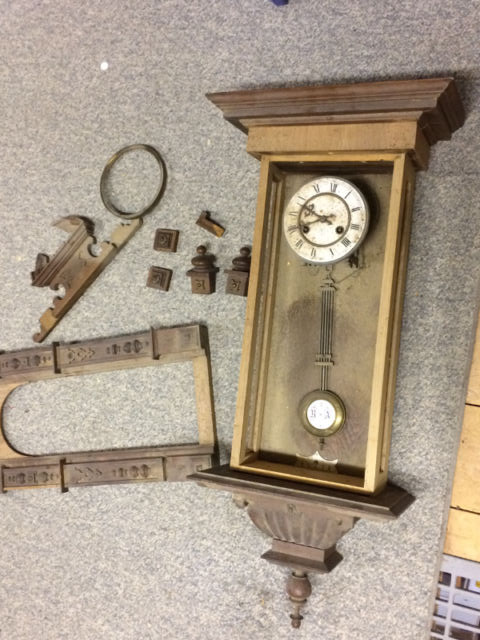
Junghans clock in pieces
Junghans clock pieces

At first glance, it seemed to be in its original state, but upon closer inspection, discrepancies emerged. Contrary to the initial impression that all components were intact within the box, I soon realized that numerous intricate elements, such as case embellishments and finials, were absent. What’s more, a substantial portion of the case had been reconstructed using contemporary materials, and both front and side glass panels were notably absent.
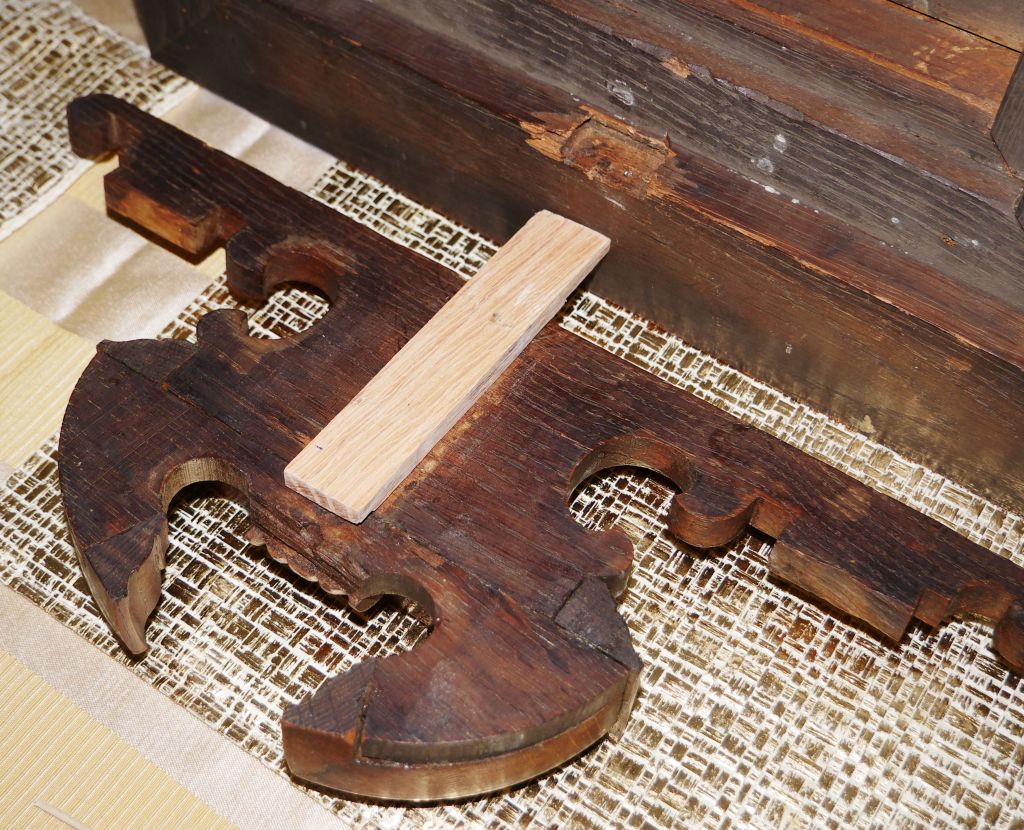
Centre crown support post
Crown support made from new oak

This prompts the question of whether a clock in such a state can still be categorized as original, or if it has strayed too far from the essence of originality due to the incorporation of modern elements and the absence of vital components.

Oak spindle
Fashioning finial bases from an oak spindle
Junghans Crispi dial face

Despite its captivating visual appeal, my Junghans Crispi does not command the same market value as an authentic, original Crispi clock.

Junghans Crispi wall clock C.1899 (??)

People often place a premium on originality, and I, for one, appreciate a well-preserved clock in its original condition. I may reconsider if it has been tastefully restored or repaired, recognizing that it’s a better fate than being discarded or stripped for parts. However, I wouldn’t expect to pay as much for a clock that has undergone significant alterations.

Valuing an excessively restored clock can be challenging. While conservation and restoration have their merits, the question arises: does a clock that was two steps away from the trash bin become less valuable when restored?

In reality, there are no definitive answers to these questions. Collectors will always exist who prioritize originality and others who are more forgiving of certain changes. So, is this debate a significant concern, or simply a matter of personal preference?

My most recent Hunsruck Clock evokes memories of my first Junghans clock

While working on one of my latest acquisitions, a Junghans Hunsruck mantel clock, memories flooded back to the first Junghans clock I ever owned, a Junghans Crispi wall clock, that I still have to this day.

Junghans Hunsruck C. 1913

It was a humble box of parts when it first came to me, but I was determined to bring it back to life.

Junghans clock in pieces
Junghans clock in pieces, not unlike a jigsaw puzzle

The restoration process was a hands-on experience where I had to fashion new parts, source missing pieces, and master the art of staining and gluing. Through this ground-up restoration process, I developed a deeper understanding of the craftsmanship and artistry that went into creating these old clocks.

Piece by piece, I painstakingly assembled the clock, learning about the inner workings and mechanics along the way. It required both patience and dedication, but in the end, it was worth it. The clock not only became a functional piece, but a treasured symbol of my passion for antique wall clocks.

A first examination of the movement

As I worked on my latest Junghans mantel clock refreshing the case and servicing the movement, I couldn’t help but reflect on the journey that led me to this point. Each clock I restore holds a special place in my heart, but that first Junghans clock will always hold a particularly special place. It was an affirmation of a lifelong passion for the timeless elegance of antique clocks.

The fascinating story behind the Crispi wall clock

The story behind the Junghans Crispi clock is the enduring power of objects that connect us to the past.

Junghans Crispi time and strike wall clock

In the midst of tragedy, there can be glimmers of hope and resilience. Such was the case with a Junghans Crispi wall clock that fell off a wall on Princess Court in North End Halifax on the fateful day of December 6, 1917. Despite the chaos and destruction caused by the Halifax Explosion, this clock managed to survive, albeit in a state of disrepair.

Following its century-long journey, the clock that had been treasured by the Halifax family for generations finally found its way into the hands of an avid antique clock collector.

Over the course of two months, I worked tirelessly to piece together the various components and restore the clock to working condition. It was no easy feat, but the end result was a stunning tribute to both the clock’s history and the resilience of the people of Halifax.

In a series of articles documenting the restoration process, I shared not only the technical details of the restoration but also the personal connection to this piece of history.

Unboxing the Junghans Mantel Clock: An anticipated Arrival

Junghans, a name that is well-known to clock collectors and repairers, is not the company it once was. In recent years, the company has established itself as a prominent manufacturer of high-quality wristwatches.

However, During the early to mid-20th century the German company had established itself as a prolific producer of wall, mantel, and tall case clocks. Collectors and enthusiasts highly value the company’s clocks for their superior quality, solid construction, and classic designs that have withstood the test of time.

Although I wasn’t actively seeking out a new Junghans clock to add to my collection, I couldn’t pass up the opportunity to acquire this one at an attractive price. It now joins my collection of clocks, which includes two other Junghans clocks.

Junghans Corner feet finished
Junghans Sydney time and strike bracket clock C. 1911

One is a bracket clock from 1911 (code stamped B11), and the other is an older wall clock from the turn of the 20th century. Both of these clocks are among the 21 clocks in my home that are run and maintained on a daily basis.

Junghans Crispi time and strike wall clock C. 1899

As expected, the clock arrived safely after I chose to have it shipped to me instead of personally picking it up from the auction house, which is located two hours away from my home. I had confidence in the auction house’s ability to package the clock securely for safe shipping, as I have dealt with them in the past and they have always been careful with packaging.

Auction house photo

Having received the clock, I can confirm that it is exactly what I expected it to be, with no surprises or unexpected issues. Checking its functionality, I wound both sides and it runs and strikes as it should.

Backplate and coil gong

A similar movement in my Sydney bracket clock is stamped with a code (B11) indicating its production year, which is two years before this one. The gong block in both clocks is also identical in appearance.

However, I will only be able to confirm if there are any other internal differences between the two clocks when I dismantle the movement for cleaning.

Dial

Is the blemish just above the number five a scuff mark or a permanent abrasion, or is it merely a buildup of dirt that can be cleaned off?

Crackling or alligoration of the finish

The case of the clock appears dull and neglected, and I am uncertain as to the appropriate method for refinishing at this point, nevertheless, it is evident that the case’s appearance would be significantly improved with some care and attention.

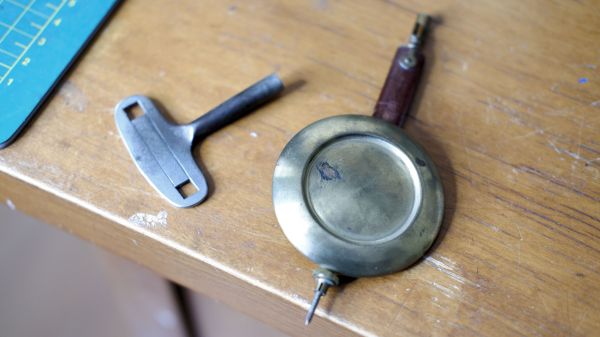
Pendulum bob and key

A correction from a previous article

After believing that the pendulum attached to the clock was not appropriate for the movement, I replaced it with what I believed was the correct one. However, I discovered that the replacement pendulum did not reach down to the beveled glass port and the rod hook was opposite in orientation to the one that came with the clock.

Despite functioning well and keeping accurate time, it did not look suitable. After I posted an article on first impressions, sight unseen, A reader pointed out that they have the exact pendulum bob for their Junghans roundtop clock, which has now led me to reconsider my previous assumption that the original pendulum was not the correct one. Thank you, dear reader!

Now that I have confirmed that the clock is functioning correctly, it is time to proceed with the disassembly and cleaning process, which is evidently long overdue.

Clock prices – a great time to buy despite crazy inflationary times

Inflation seems to be everywhere. The continuing decline in purchasing power is reflected in increased prices on almost everything.

The other day my wife and I bought a container of spray from a garden store. We thought the price was high at almost $25 but when we got to the cash, the clerk charged us $6 more. We showed her the sticker price and she said it was old stock and the computer had already adjusted the price for the new stock coming in. I understand supply chain issues and rising fuel costs but a 25% increase is a bit much. We argued and did not pay the extra $6. Needless to say we will not be buying that product again.

Everything seems to have risen in price as a result of inflation except perhaps antique and vintage clocks!

I don’t actively pursue high end clocks so, there could be movement price-wise for rare and highly collectible clocks but not for garden variety antique clocks. This completely anecdotal but I have been observing the clock market for some time and I do not see a lot of change in prices and if you are into buying and selling clocks this is not a great time to make a profit. Perhaps one day in the future but I believe that day is far off.

$12 cottage clock, unrestored

So, it has been a buyer’s market for the last number of years and it doesn’t look like things will change any time soon. There are many great bargains to be found everywhere and it doesn’t take much looking.

$40 Chauncey Jerome 30-hour ogee

Antique and vintage clocks have flooded the market in the past several years with prices tumbling even further downwards. The new generation of millennials have little interest in antiques and find it pointless to collect antique and vintage clocks. Their loss is our gain, meaning those of us who appreciate the finer things in life.

In addition, modern homes do not have the room for clocks as floor and wall space is limited. In an age when families are living in 800 square foot apartments space is at a premium though there is a hint that things could change as the migration from dense cities to smaller communities continues.

When space is at a premium grandfather clocks or any clock occupying floor or wall space are not items many would consider as necessary for the modern family home. Sentimental reasons aside, the cost of servicing far exceeds the value if the desire is to have a working clock.

$75 Junghans Crispi wall clock

Of course, I don’t have a crystal ball but judging from prices in the past few years I can comfortably predict that things will continue to be much the same this year and next. I do not expect a significant change in the months to come and that $20 bargain clock you discovered today at a flea market will not be worth much more next year.

It is a buyer’s market and there are some terrific bargains out there. Knowledge is power and no doubt there are some great clocks to be found but shop carefully and do your research.

Having a professional service your clock

Is it worth the time and expense to have a clock professionally serviced?

That is the question of the day.

I receive many letters from people who ask whether a clock handed down to them is worth repairing/preserving. It is not an easy question to answer. Shared history and stories connected with the clock can be passed down from generation to generation and it is fond memories that keep it alive and consequently, there is a desire to have a clock in running condition. Sometimes it is better to do nothing and simply remember the stories associated with the clock.

If the decision is made to do something, the first consideration is whether or not the cost of preserving or restoring the clock is worth it. If the clock has deep sentimental value, the cost of repair cannot be compared to its resale value.

In the early days of clock collecting, I sent out clocks to be serviced and happily absorbed the cost. I knew then that some clocks cost more to repair than they are worth but I wanted to preserve some and have them operate daily, so, professional repairs were necessary.

Junghans clock in pieces
Junghans clock before restoration

A case in point

In January 2017 I bought a box of old clock parts (above photo). I was determined to make my German-made circa 1895 Junghans Crispi wall clock into what it is today. It was my first huge restoration challenge. It was a steep learning curve for me but in the end, I was pretty happy with the results.

During the course of restoration, I attempted to repair the movement, which hadn’t run in over a hundred years and made some rookie errors. I had no other course of action than to bring it to a professional in order to correct my mistakes. At the end of the day, the total cost was $475 for the initial purchase plus the servicing.

Last year, after 4 years of reliable running the clock developed an errant strike which required investigation and disassembly (and a good cleaning while I was at it) but I would not blame that on the professional repair. Perhaps it is the nature of that particular Junghans movement requiring the odd adjustment every now and then.

Junghans Crispi wall clock

In the years since then, I have acquired the skills and necessary equipment to perform my own repairs.

Twenty-three of the clocks in my collection are daily runners, all serviced from time to time by myself over the years. I am not a professionally trained clock-maker and some procedures are clearly beyond my capabilities, things such as teeth replacement and repair and fashioning new parts from stock brass. 95% of repairs I can comfortably handle on my own.

Rare Ingraham Huron found on a local online for-sale site
Rare E Ingraham Huron professionally repaired

Should you bring your clock to a professional? This is a decision you will have to make after weighing all factors. Know that by relying on a professional you can be assured that years of knowledge and experience go into the repair of your precious clock which becomes part of the cost.

Reputable repairers have the correct equipment to tackle just about any repair, offer a warranty period, and will correct any problems that arise after servicing, often without an additional fee.

Clocks are machines and machines do not last forever, parts will wear and from time to time they, like any machine, require attention. If, after some years, the clock that you had professionally repaired stops, I would have no hesitation suggesting that you return to the same repairer for servicing unless, of course, you had a negative experience.

Junghans Crispi wall clock and strike woes

Crispi clock back from the horologist
Antique Junghans Crispi wall clock

During the winter of 2017, I restored an antique Junghans Crispi time and strike wall clock, circa 1898.

It came to me as a box of parts. I sensed the seller fully intended to complete the project but never got around to it but at least he reconstructed the case. I saw a challenge in that collection of dusty and dirty parts.

Much of the clock is original; the movement, the pendulum, dial, hands, coil gong, and movement bracket, the bottom base and top section of the case, crown, backboard, vertical columns, and most of the decorative trim. I added glass, smaller trim features, upper finials, and their bases.

Replaced some 40 years ago is the box frame and the front section that supports the right and left columns. Parts of the clock were evidently destroyed beyond repair and the remainder salvaged for later restoration which was never completed.

Junghans clock in pieces
How the clock came to me

While much of the “newer pieces” are hidden, the previous owner took care to replicate woodworking techniques of the period aside from the use of Roberston screws on the back panel.

That aside, the movement was very dirty and had not been running for many years. Perhaps it last worked just before the Halifax Explosion of 1917. The previous owner informed me that the clock was in the family home in north-end Halifax (Nova Scotia, Canada) and the clock took a significant hit from that fateful blast on December 6th.

Very dirty movement
Very dirty movement, right out of the case

After completing work on the case, I set about working on the movement. During the course of disassembling/reassembling the movement, I not only broke the strike paddle but a retention spring as well. Back then (2017), my skills were not advanced enough to repair it so I had it professionally serviced.

Junghans movement
Junghans movement, broken strike paddle

Three months later I picked up the clock and hung it on my dining room wall. It ran perfectly for over two and a half years. Some months ago the strike became erratic. It would strike incorrectly, not at all, or incessantly till the mainspring ran down.

I had a number of other clock projects on the go so I kept the time side going and left it on the wall until December 2020.

Disassembly and Inspection

Once I took the movement apart I found a slightly bent strike side cam wheel arbor. There were no other bent pivots or worn pivot holes and everything else looked good. Back in 2017 during its stay in a clock shop it had had extensive bushing work done, 6 on the front plate and 6 on the rear plate. There was a small amount of dirty oil around the pivots and after 2 plus years that is to be expected.

During the course of manipulating the plates, I snapped the paddle arbor retention spring, again! This time I was able to repair it.

Junghans movement spring repair
Junghans movement spring repair upper center, Threadlocker Red at the base of the spring

There was enough of the spring to reuse. The wire is thin (0.5mm), very brittle and it does not take much pressure to break it. Using a micro drill with a 0.5mm HHS bit I drilled out the existing hole in the plate, reinstalled the spring, and applied Threadlocker Red to bond the spring to the plate.

Electric micro drill

Re-assembly

I cleaned the parts in the ultrasonic, pegged the pivot holes, polished the pivots, and re-assembled the movement.

Junghans movement work
Junghans movement work ready for the rear plate

I took a couple of attempts to line up everything on the strike side; paddle in the deep slot, cam lever in the low part of the cam, and strike paddle aligned between the points on the star wheel while ensuring that the stop wheel pin was in the 12 o’clock (approximately) position. If you have worked on German count-wheel strike movements, all this should sound familiar.

One is tempted to bend a lever or two to correct the strike side behave but in my experience, unless someone has messed with a lever in the past, it is best to leave them alone.

Junghans clock
Junghans movement on the test stand

And now for testing. After several days the movement is running well and the strike side is finally behaving itself. Since there is nothing amiss I will chalk this up to a strike side design that causes it to “wander” over time or that slightly bent cam wheel arbor. One or two cycles on the test stand should be sufficient before returning it to its case.

While it was on the test stand I decided to research this clock. I visited the Junghans archive catalogue site and discovered a few new-to-me details. The clock was available in the 1898 catalog as I suspected.

Four Junghans wall clocks in 1898 catalog; the Cripi second from left

The clock case is described as “old oak” with burnished brass trimmings. The Crispi, as it was called, was designated #1758 and was available with a white or ivory-colored celluloid dial or a white or ivory-colored 5 3/4 inch enamel dial (this clock). The length is forty and a third inches (103 cm) and it is a 14-day strike. Given the description of the length, in inches, the clock was likely marketed for the United Kingdom and Italy as you can see by the above catalog entry.

Overall, a successful servicing and if it “wanders” again, a simple disassembly, reassembly, and re-adjustment at some point in the future should put it right. Let’s hope that is more than two years away this time.

Website Powered by WordPress.com.

Up ↑