
The Empire Gallery Clock: Built to Impress
In the spring of 2022, I brought home a handsome gallery clock from an auction—an English-made piece with a 10-inch dial. What caught my attention initially was its clean, industrial look, but once I opened it up, I found it had just as much character on the inside.

I was hoping for a fusee clock, as many English gallery clocks are fusees, but when I saw this one offered at auction, I knew from the price that it probably wasn’t what I had hoped for—but I bought it anyway.

Empire 150 gallery clock

The Company

According to one source, Astral and Empire were originally trademarks of a company called Williamson, known for its high-quality movement, also named Astral. Through a series of mergers and acquisitions, the trademarks eventually came under the ownership of English Clock and Watch Manufacturers Ltd., which was purchased by Smiths in 1932. As a result, Smiths acquired the Astral and Empire trade names.

However, further research led me in a slightly different direction regarding the manufacturer. It appears that the company was not named Empire, but rather Grimshaw, Baxter, and J. J. Elliott.

Empire was actually a model name used by this firm.

So, the clock is from the Empire 150 series.

Grimshaw, Baxter, and J. J. Elliott was an English clockmaking company formed in 1909 when Grimshaw and Elliott merged. The firm produced a variety of clocks and watches until its dissolution in 1921. The name continued to be used until 1958, although I do not know how it was used during that period.

Interestingly, the company made fusee wall clocks as well.

Features of this Clock

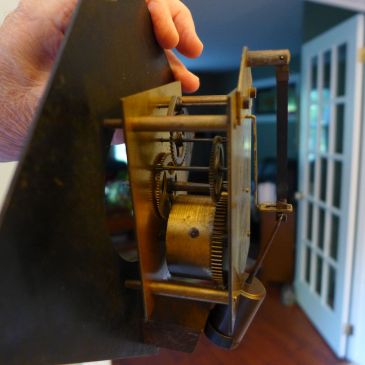
The clock features a classic time-only movement—simple in design, with relatively few wheels to manage during servicing. As with many time-only setups, the minute and hour wheels are located outside the front plate. What sets this one apart is its size: it’s surprisingly large for a time-only movement and impressively robust, likely intended for use in a commercial setting.

The movement is mounted to a heavy steel plate that screws onto its front, and the whole unit fits just beneath the dial. Though the clock is unmistakably English, the layout and engineering give it a distinctly German feel—a nod, perhaps, to cross-European influences in clockmaking during that era.

Accessing the movement is refreshingly straightforward. After removing the hands and three small screws, the dial lifts away easily. Four slotted screws secure the movement to the steel mounting plate.

One particularly interesting feature is the pendulum. It’s a cylindrical style with a large, rotating adjustment screw at the bottom—a practical touch for fine-tuning. Even better, it clips into a clever two-piece caddy system (see below) that makes transporting the clock safe and simple. Push the cylindrical pendulum bob into the caddy and Voilà, it is secured in place! A nice surprise for a piece from the early 1920s.

Grimshaw, Baxter, and J. J. Elliott gallery clock called the Empire

I was also intrigued to find taper pins used to secure the plates—a feature more common in older or higher-quality movements. The mainspring barrel is modest, about the size you’d expect in a typical time-and-strike clock from England or Germany.

A well-made movement designed to last, pendulum is secured in place

The movement had clearly been over-oiled at some point, so before any cleaning could begin, I had to wipe everything down thoroughly. Then it was into the ultrasonic cleaner. While I didn’t expect the plates and wheels to come out gleaming, they cleaned up beautifully. After polishing the pivots and pegging out the pivot holes, it was time to reassemble.

Compared to the American movements I’ve been working on recently, this one has notably finer pivots. This isn’t a movement where you can force the pivots into their respective holes—each pivot needs to be carefully guided into its hole with a steady hand and a bit of patience.

All in all, this Empire gallery clock turned out to be more than just a pretty face. It’s a well-made, thoughtfully designed piece with a few charming quirks. A great example of early 20th-century English clockmaking—and a pleasure to work on.

A Collection of Antique Clocks at Our Summer Refuge

My collection of clocks is divided between my home in Nova Scotia and our cottage in Central Canada. Part of my collection is there because I am not the type of person who abandons a hobby; I make it a part of my everyday life.

Although not an even split, about 15% of the collection is at our summer cottage in central Canada. The clocks at the cottage, though not particularly special, add a charming ambiance to the space. They often serve as great conversation starters when guests are over, contributing to the cozy and inviting atmosphere.

Let’s begin in the sunroom, the focal centre of our cottage. In this room are two German box clocks, a Mauthe and a Kienzle, which has been a recent acquisition. Joining the two box clocks is a 30-hour Ansonia cottage clock.

Mauthe time and strike box clock (the wall to the left is under construction)
Kienzle time and strike box clock

Check out this recently posted article for more information on the Kienzle clock.

Ansonia 30-hour cottage clock

Inside the main part of the cottage which comprises the kitchen, dining, and living area are 3 clocks, a Hemle time and strike weight-driven wall clock, passed on by my wife’s uncle, known as a wag-on-a-wall clock, an Empire time-only gallery-style clock from England, and a 30-hour New Haven miniature ogee.

Hermle wag-on-a-wall clock
Empire time-only gallery clock

This New Haven clock might look good from a distance, but closer inspection reveals that the front veneer has been stripped, likely due to significant loss or damage. This condition is not common with old veneered cases but unfortunately, it is what it is.

New Haven mini ogee clock

In our bedroom is one clock, and one clock only, and it is placed there for a reason. It is a time-only GIlbert gallery clock. Gallery clocks, in other parts of the world, may be known pub-clocks, canteen clocks, or office clocks.

Gilbert gallery clock

This time-only gallery-style clock made by the Gilbert Company of USA is nondescript and quite ordinary looking. There is nothing special or distinctive about it but it is in excellent condition.

Check out this article on how having a clock in the bedroom can aid in getting a restful night’s sleep. The article describes how providing a gentle reminder of the time helps regulate your sleep patterns and creates a more restful environment.

So, there you have it—time flies at my summer cottage with these clocks. They may not be particularly special, but they surely tick all the boxes to enhance my summer experience!

Website Powered by WordPress.com.

Up ↑