The Value of Saving Old Clock Parts: You never know when you may need that difficult to source part

Repurposing old antique clock parts can offer numerous benefits. For clock repair persons, these parts can serve as a convenient source for replacement components.

All clock repair persons consider this to be a best practice because it is sustainable, reduces waste, and conserves valuable resources.

Repurposing also provides an affordable means of obtaining rare and elusive parts for clock repair or restoration projects.

A case in point

Some years ago, I stumbled upon a seller who had four clocks for sale for just $20. It was a barn find in the true sense of the word.

I talked to the seller by phone and purchased them without knowing their condition. Upon inspection, I found that three of them had cases in poor condition but intact mechanical movements, making them well worth the purchase alone.

Although none of the clocks were particularly valuable, they were found in the same barn, all dusty and rusty, cast aside many years ago. In the eyes of the seller, the clocks were one step closer to the trash bin.

I considered resurrecting an Ansonia wall clock, which would have been a project for another day but there was a spring-driven time and strike steeple clock that was essentially intact so I decided to service it instead. The steeple clock movement was serviced and the case was refreshed. The results were quite satisfying.

It was a lucky find because the two mainsprings happened to be crafted from brass, which was utilized as a power source for clocks from roughly 1836 to 1840. Though rare the clock is not particularly valuable.
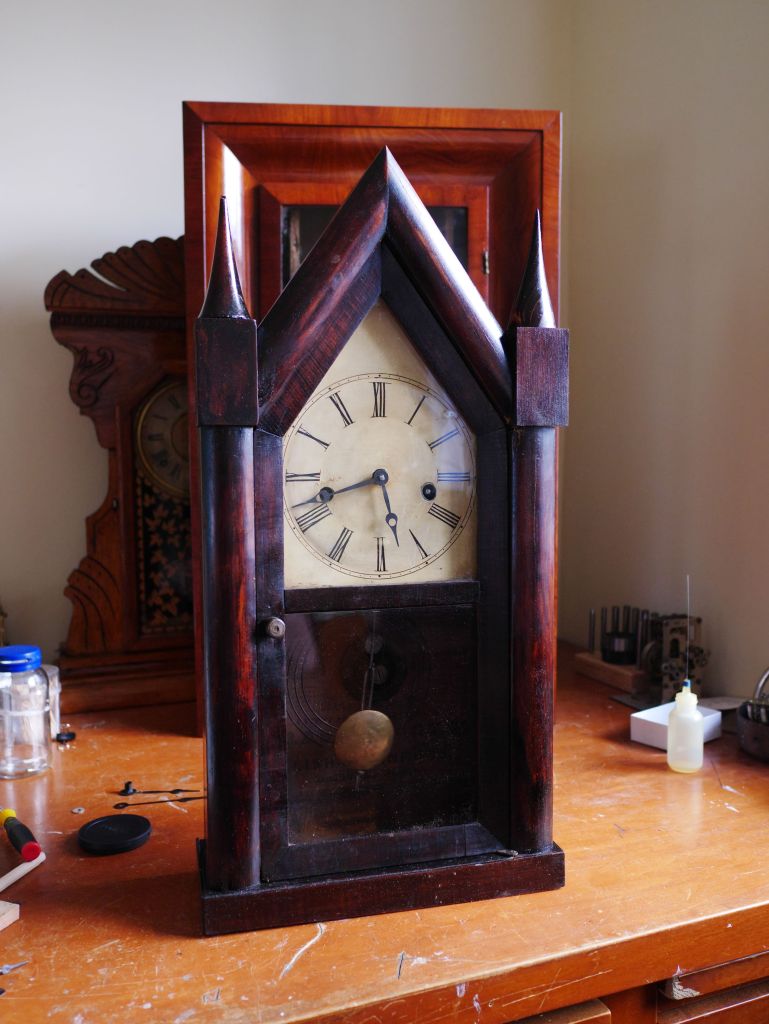
Elisha Manross steeple clock

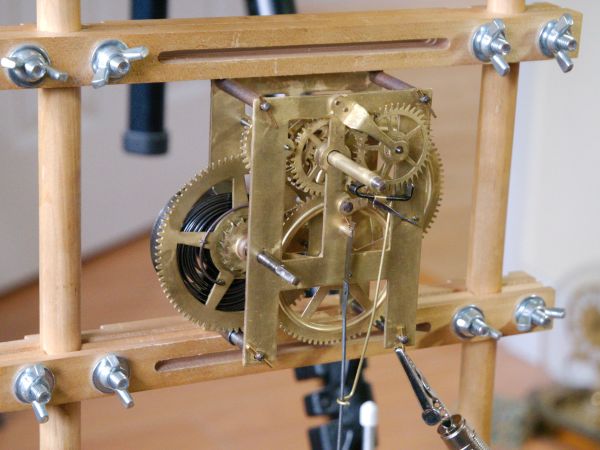
While the Waterbury mantel clock was beyond repair and had to be discarded, there were still many parts from the Welch ogee clock that had the potential for future use. I removed the movement, pulleys, glass, hinges, iron nails, and door catch. The rosewood veneer was stripped from the case and set aside for a future project.

$20 for what some would consider trash

The salvaged veneer was used to create a new finial base for the Elisha Manross steeple clock pictured above and to cover the finial bases on the top crown of an 1850s Scottish tall case clock. In time the salvaged veneer was used for a number of other projects.
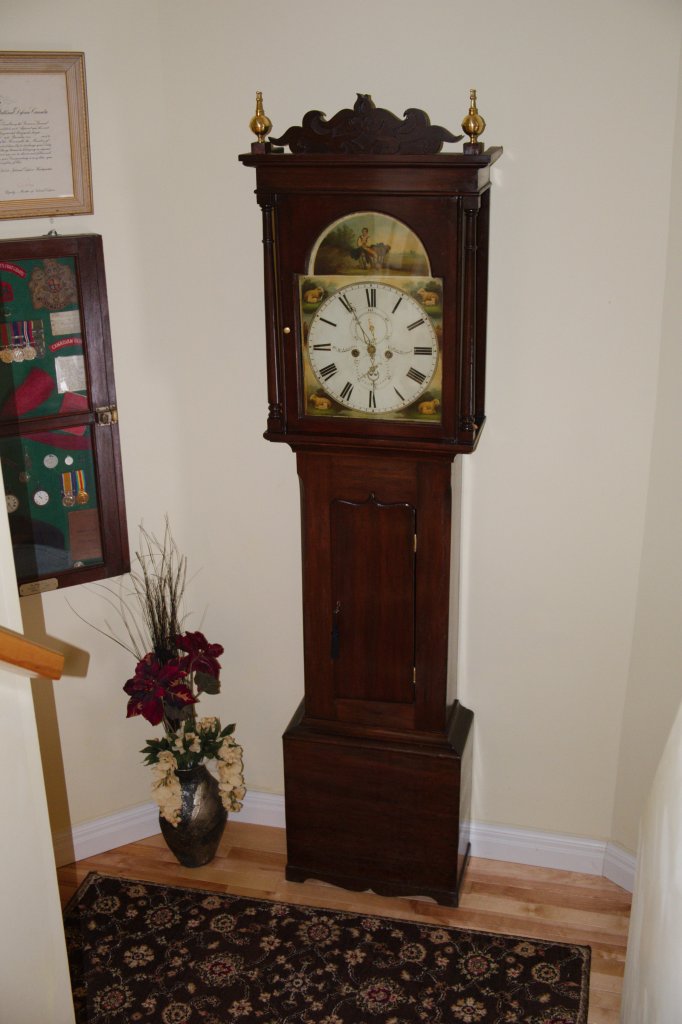
Scottish tall case clock
Scottish tall-case clock

Some clock parts are not difficult to source

There is actually a considerable assortment of new components available for antique and vintage clocks, which can be procured through numerous suppliers.

Examples are clock hands, pendulum bobs and leaders, feet, hinges, finials, bezels, hand nuts, case parts, and so on but by keeping old clock parts, clockmakers have access to replacement components that are no longer produced or readily available.

Ansonia Extra short drop wall clock
Trash or treasure?

As time passed, I revisited the Ansonia wall clock. The Ansonia Drop Extra wall clock shown above was in a disassembled state and the heavily corroded movement might have been deemed irreparable by some.

Ansonia time-only movement as found

I could have salvaged the veneer and wooden components and saved the movement for potential future use, but I chose to rise to the challenge and reassemble the clock instead.

The crucial brass dial bezel was absent from the clock, and while I initially believed I could find a replacement at a later time (I never could), I opted to reinsert the movement into the refurbished case.

Though clearly missing a few cosmetic parts the clock has proven to be a reliable runner to this day.

Ansonia Drop Extra wall clock

There is value in saving old parts

Retaining old clocks for spare parts not only helps to maintain the legacy of clockmaking but also serves as a dependable resource for those elusive components that can be challenging to come by.

Beyond everything else, the parts tell a story about the manufacturing process, the materials used, and the craftsmanship involved in creating a clock. By saving and reusing these parts, clockmakers help to ensure that the knowledge and skills of traditional clockmaking are not lost.

Saving old clock parts is not only practical but also beneficial for preserving history, maintaining authenticity, and ensuring the longevity of antique timepieces.
Dating an antique Gothic Steeple Manross clock

Hi readers, in light of current world events the antiquevintageclock.com family wish to convey our sympathy and condolences to those effected by Covid 19

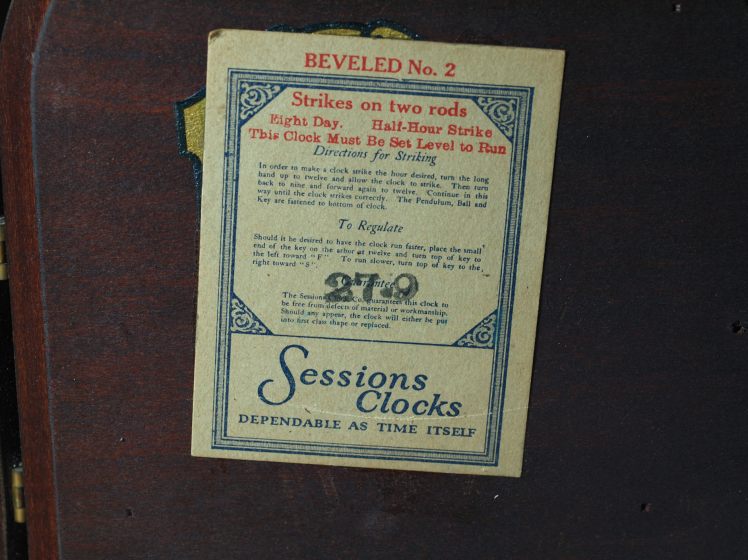
Dating a clock can be a challenge and often an estimate within a range of dates is the best that can be accomplished. Dating some clocks can be relatively easy as in the case of this Sessions Beveled Number 2 tambour style time and strike. Inside the back access door, it is stamped Sept 1927, the date of manufacture.

Further research about the clockmaker, the movement design and the label will reveal a date within a narrow range

Inside access door of Sessions tambour clock

Sessions Beveled No. 2

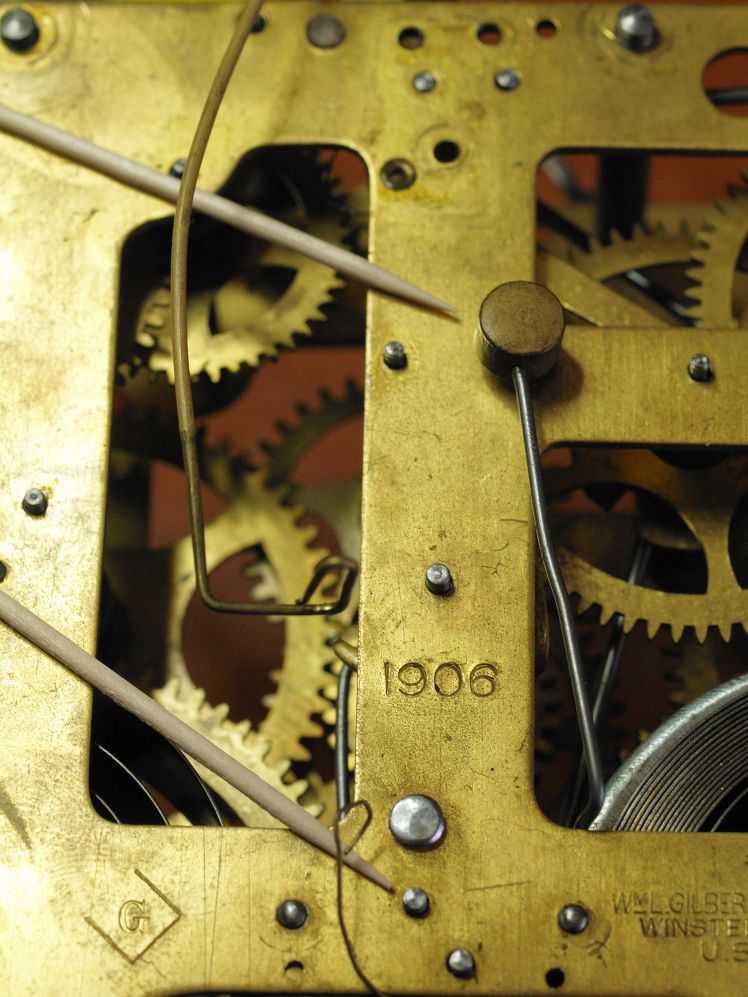
This Gilbert time and strike movement has a die-stamped year but the month of manufacture is unknown. Other markings in the case might narrow it down.

Toothpicks reminding of the location of the bell lever
Gilbert movement made in 1906

Research concerning the maker, the clock design, the model name or number and the label may reveal the exact date or something within a narrow range of years. Books on the identification of American clocks such as those by Tran Duy Ly can be very helpful.

Let’s look at this Elisha Manross Gothic Steeple clock.

Elisha Manross (1792-1856) was an important pioneer of the Connecticut clock and made a variety of clock styles, one of which is the gothic steeple pictured below.

Elisha Manross Gothic Steeple clock. Hands are incorrect; it would have had spade hour and spear minute hands

Although Elisha Manross had been active in Bristol clock-making since 1812 and earlier he shows in the Bristol tax records as making clocks from 1842-1851. His business was dissolved in 1854 and the factory was purchased in 1855 by E.N. Welch.

Manross made two steeple clocks. One is 20″ high and 10″ wide, the other is 19 1/2 inches high by 9 1/2 inches wide. The larger case would have made for other labels but the smaller size such as this one was manufactured in the Manross factory.

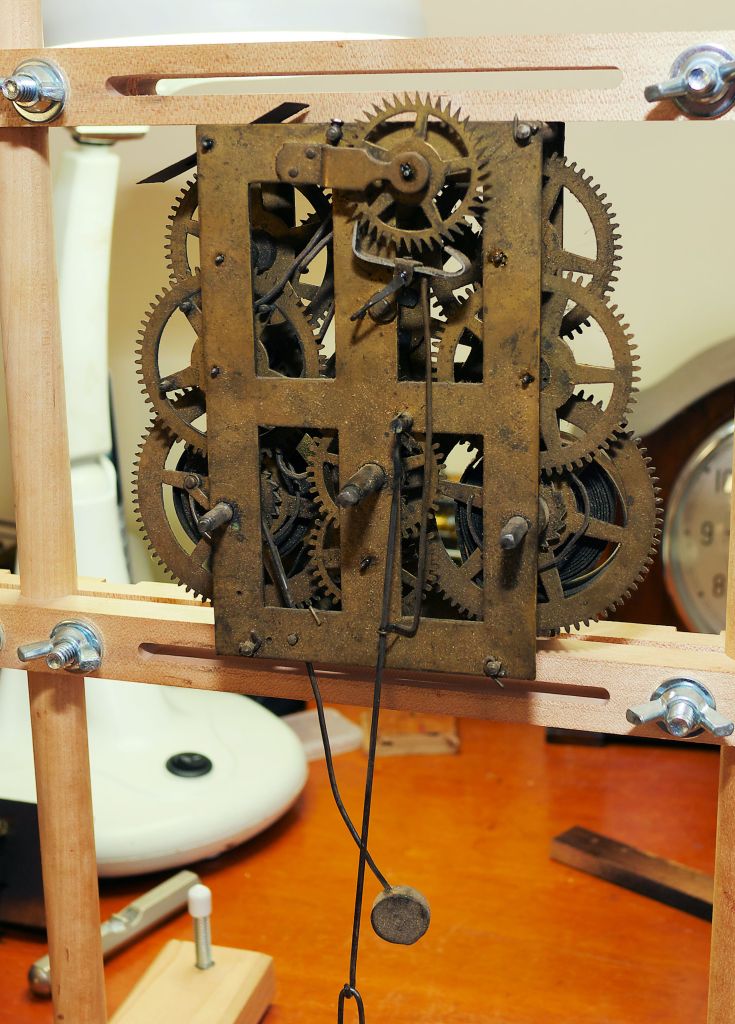
Elisha Manross 30 hour movement
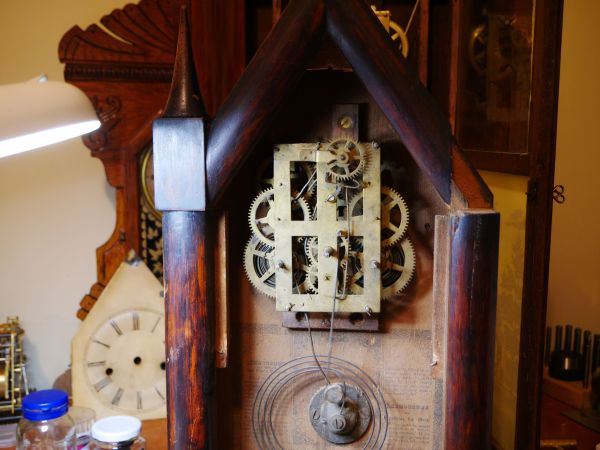
A very dirty Elisha Manross 30 hour movement, just out of the case

This 30-hour clock by Elisha Manross has some distinctive features that help in its dating. Let’s narrow down the date by looking at the design of the movement and case. Three features make this clock interesting. One, it has very rare brass mainsprings; two, the count-wheel is located in the middle on the backplate and three, the veneer on the front columns and door is in a vertical orientation.

Brass mainsprings

Brass mainsprings were invented, patented and first used in 1836 by Joseph Shaylor Ives. Brass was cheaper and more accessible than steel in the mid-1830s and 1840s. Silas B. Terry developed steel springs for clock use in the Bristol area circa 1847, and as steel improved and became cheaper, brass springs quickly disappeared.

In the history of the American clockmaking, brass mainsprings had a very short life, between 1836 and 1850. The brass mainsprings on this movement have survived for a very long time and most clocks of this age have had replacement steel mainsprings.

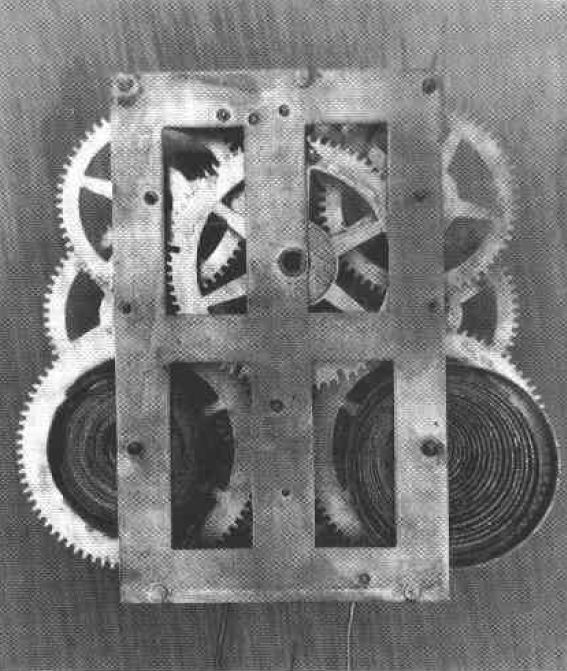
Count-wheel

Many American time and strike movements have the count wheel located on the left side of the front plate just above the mainspring (or winding arbour for a weight-driven clock). Placing the count wheel in the rear of this movement adds complexity to the lever arrangement. Also absent is a strike-side cam wheel typically found on later American time and strike movements.

Manross backplate showing location of count-wheel

Veneer and vertical orientation

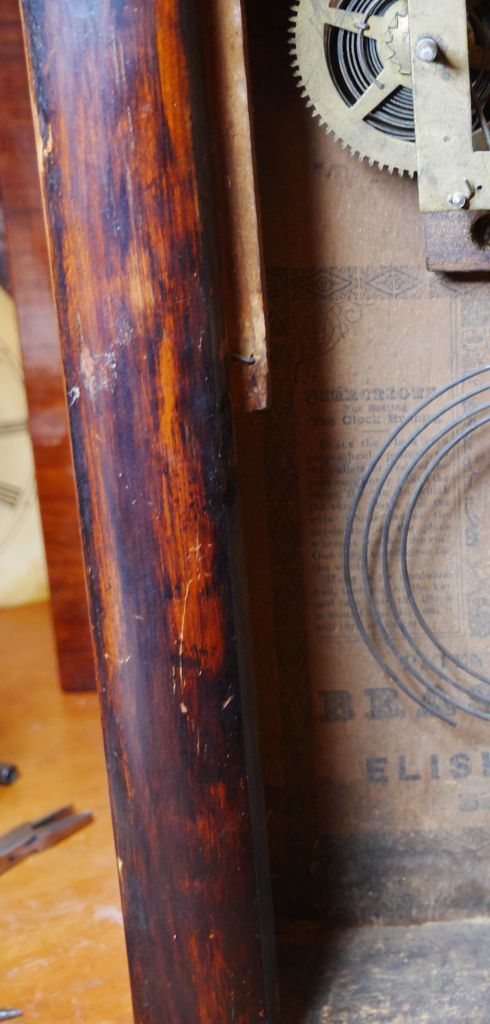
Exotic woods were used to cover the pine case. Elisha Manross clocks were either clad in Rosewood veneer or Mahogany. Manross clocks were produced with the Mahogany veneer in a vertical orientation, such as this clock, and Rosewood veneer in a horizontal orientation. American clockmakers did not normally orient the veneer in this manner.

Left front column

Dating this clock – let’s see what the data tells us

Records also show that steeple cases were made by Manross between 1847 and 1853. The label on the clock is in remarkable condition for a 168-year-old clock and is extremely helpful in dating this clock. On the back of the door, the left side of the upper tablet is the inscription 8/43, not once but twice. Is this the date the case was made? The door is clearly original to the case since it has the same vertical orientation as the veneer.

Records also show the sale of 705 cases (unknown as to type) to “E. Manross” during the months July-November, 1843. It is very possible the case was constructed in 1843, stored until later when the movements were placed in the case and readied for sale.

The date of August 1843 is inconsistent with the label, located on the inside backboard, which was printed by Elihu Geer at his shop on 10 State Street, Hartford Conn on or about 1850. The label was likely added to the case just prior to the sale of the clock.

We can conclude that the clock was made no earlier than 1843 and no later than 1850 and we can safely date this clock within a 5-7 year period.

Dating aside, it is truly remarkable that a mechanical device that is 173 years old is still operating to this day.

NOTE: The principal source of this blog article is the October 1993 NAWCC bulletin.

Website Powered by WordPress.com.

Up ↑