30-hour clocks in my collection – a complete list

While I have over 85 clocks in my collection twelve are 30-hour or one-day clocks. One of the twelve is a relatively modern clock.

The history of mass-produced clocks in America began in the 1820s and 1830s with 30-hour clocks that had woodworks movements. While the clock business was booming with many companies selling clocks to the masses, an economic recession in the late 1830s brought clock production to a halt.

Pioneer clockmaker Chauncey Jerome, who was in the clock business at the time, considered his “business troubles and disappointments” and he along with his brother Noble formulated the idea that movements could be made from brass. Noble Jerome received patent number 1200 for his brass clock movement, issued June 27, 1839. Woodworks movements began to be phased out and replaced by brass movements which were made in the hundreds of thousands. 30-hour brass movements were made well into the 1860s and were eventually replaced by the 8-day brass movement.

Because 30-hour clocks were produced in the thousands many examples have survived to this day. Most clock aficionados today have at least one ogee clock in their collection.

Of the 12 in my collection 5 are running continuously. Yes, winding a clock everyday is a hassle but we often forget that at one time the thirty hour clock in the form of the bedside alarm clock was a fixture in every home but for this post I am excluding the dozen alarm clocks in my collection.

Half are weight driven, so let’s begin with those.

Sperry and Shaw

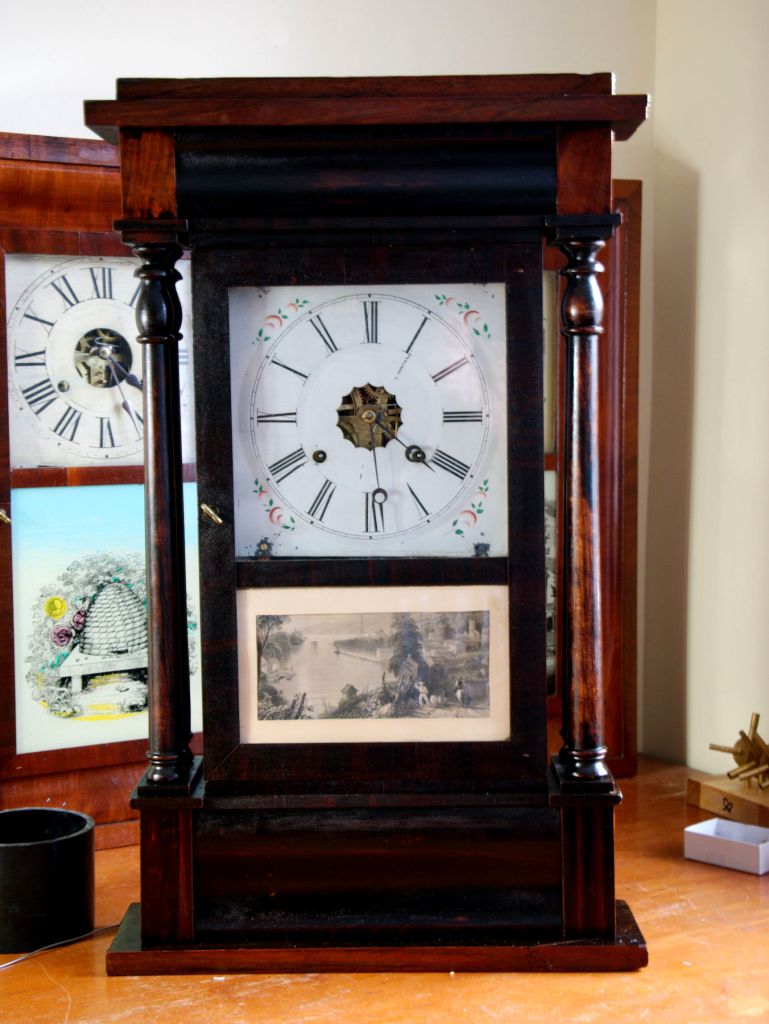
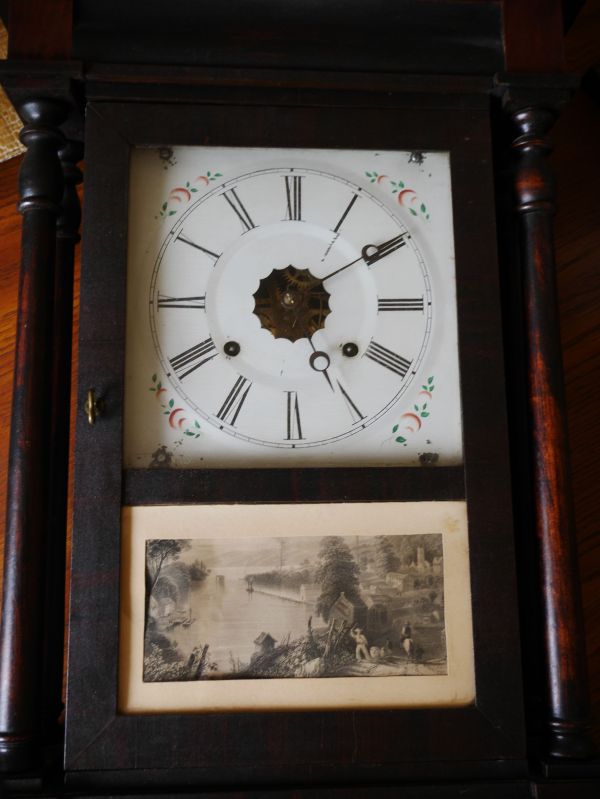
Sperry & Shaw 4 column clock

This, a four-column shelf clock designed in the “New York” style was made between 1841 and 1851. Sperry and Shaw were assemblers and distributors and sourced parts from various producers. The movements and cases could have been made by Silas Hoadley or Chauncey Jerome or both.

I bought the clock from student in Halifax, Nova Scotia in the fall of 2018 and he would not budge on the price. My only question to him prior to making the deal was whether or not the clock had the original wafer weights which would be almost impossible to source if missing.

Daniel Pratt and Son

This is the only clock I have with a woodworks movement. Daniel Pratt worked with others but eventually went out on this own in the 1830s. I would date this clock to around 1837. This clock was won at an estate auction for the price of $30 during a time when clock prices were hitting rock bottom. The clock has a wood dial and a mirrored lower tablet (may or may not be original) and the case is in very good condition for its age.
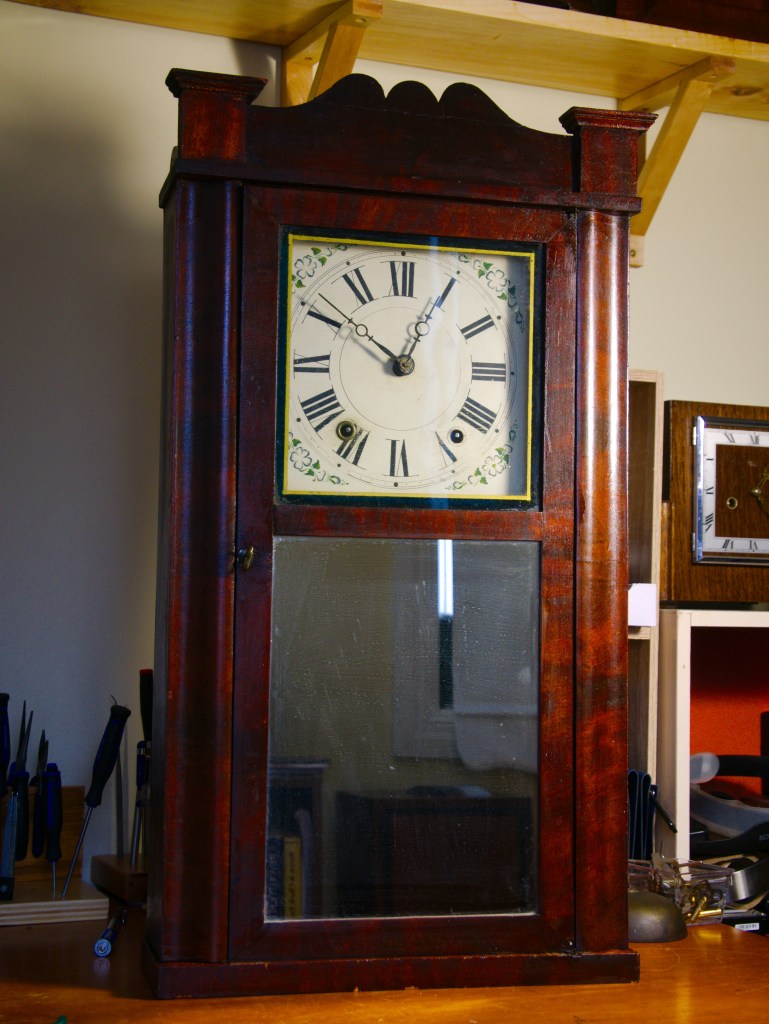
Daniel Pratt and Sons

Chauncey Jerome

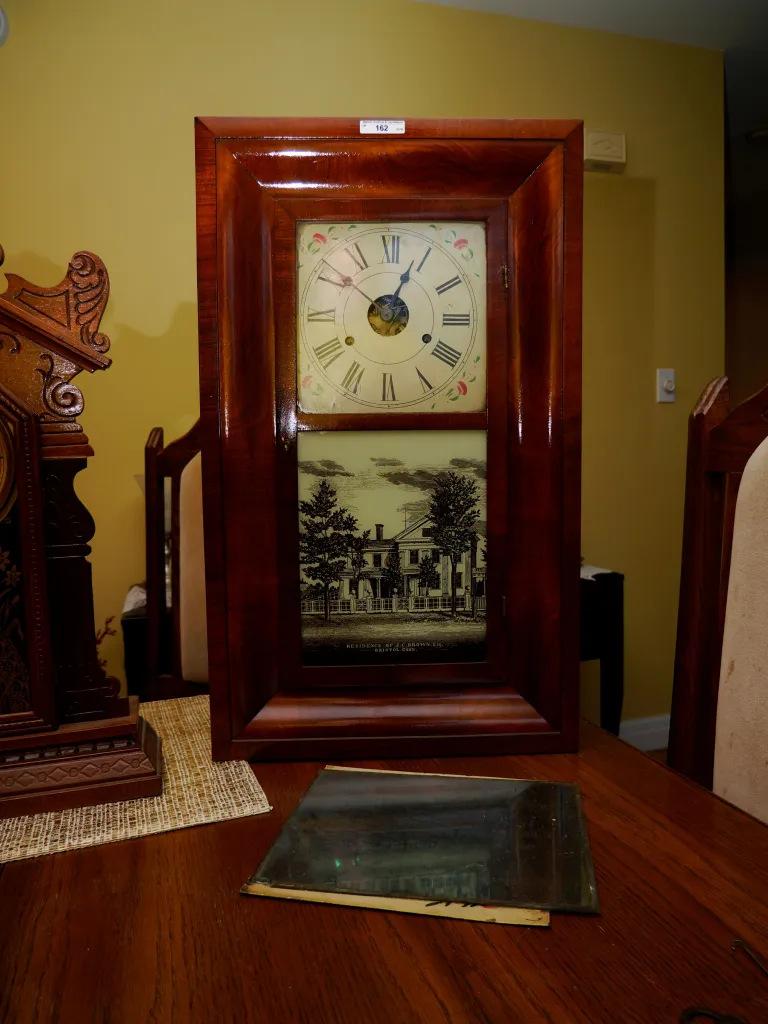
Chauncey Jerome 30 hoir Ogee clock
Chauncey Jerome 30 hour Ogee clock

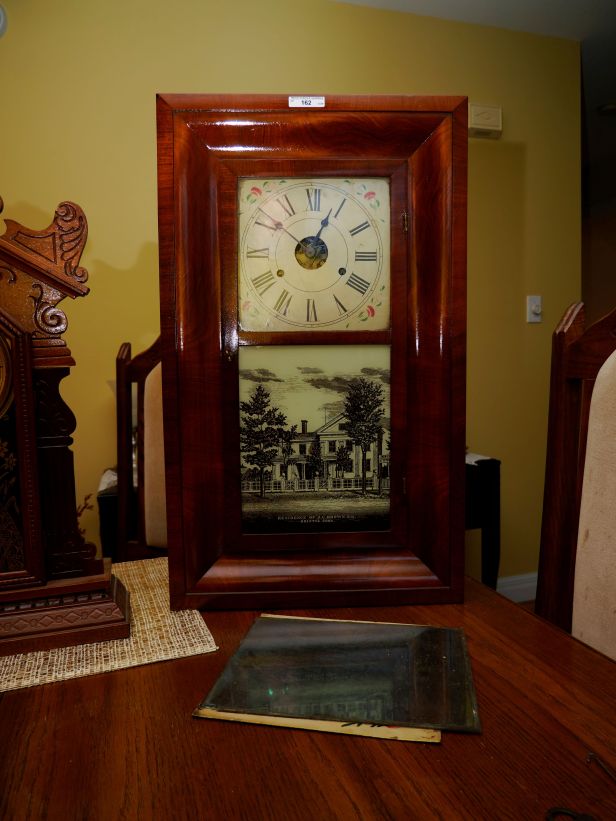
This clock is from around 1855, made just before Chauncey Jerome’s company went into bankruptcy. This was also bought at auction a few years ago. It came with an extra mirrored lower tablet and a “spare” dial. I am not sure if either the mirrored tablet or the JC Brown picture are original. The veneer, however, is in perfect condition.

George H. Clark

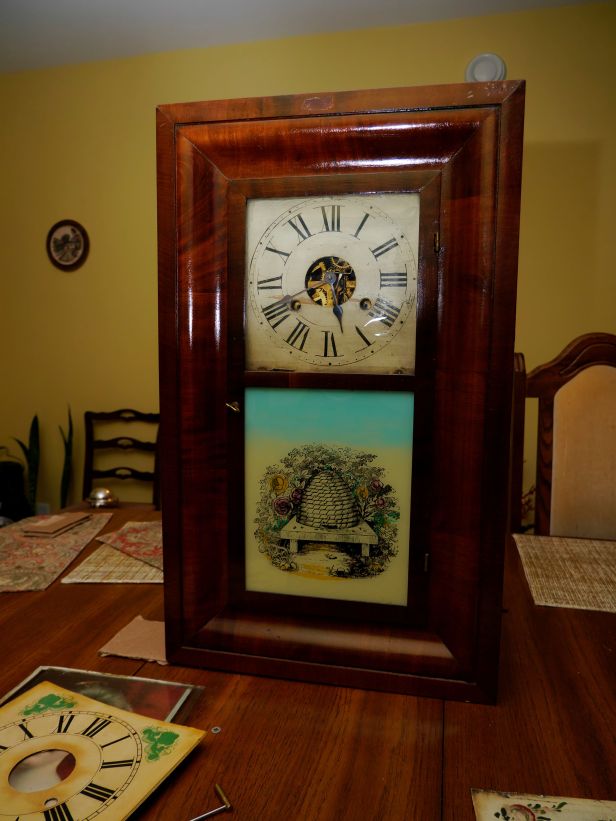
George H Clark 30 hour Ogee shelf clock

This is an ogee from around 1857. There is no makers mark on the works but it is a Waterbury type 2.411 movement. The case is well-preserved and in excellent condition, obviously well-cared for by a previous owner. The beehive tablet looks to be original.

Waterbury Clock Co.

This an ogee style clock from 1865. It was bought at an antique store in Halifax. There was no price on the clock. I asked the owner what he would sell it for. He said, name a price, I said $40 and he said, sold! Evidently it been in his shop for a while. It is the first clock on which I learned how to replace very worn trundles.

Cuckoo clock

Dave's cuckoo clock
Dave’s cuckoo clock

This is a 30-hour cuckoo clock with a Regula movement, made about 1976. A cheap German made mass-produced “tourist” clock that was given to me by a relation. It still works but it is on its 3rd movement.

And now for the spring driven clocks.

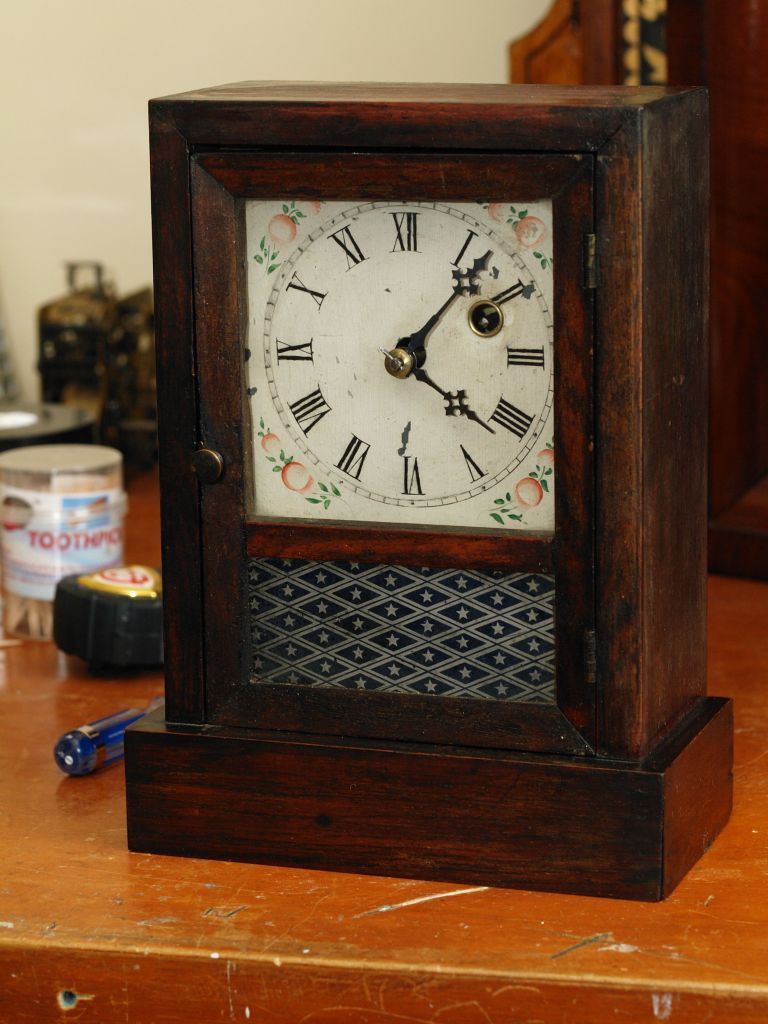
Ansonia Cottage clock

This cottage clock is from about 1895. This another clock that was given to me. These were probably dollar clocks at the time. They had cheap movements but were solid and reliable. Surprisingly, these command good prices on the auction sites since so few remain.
OLYMPUS DIGITAL CAMERA

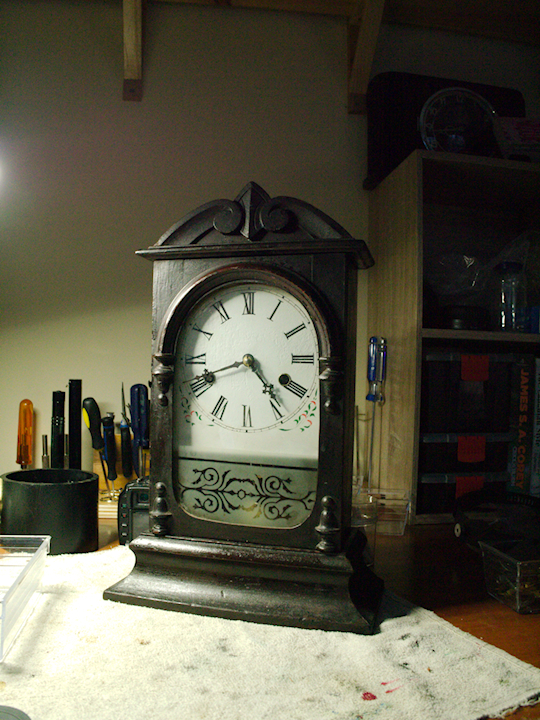
Canada Clock Company

The Hamilton Cottage Extra is from about 1880. These are now very difficult to find since so few have survived. It is Canadian made and collectors will happily pay hundreds of dollars for one. It has a very cheap case made of softwood with no veneers. The acid etched lower tablet is quite unique. It was bought in a local junk store for $40. I could not believe my find.
Hamilton Cottage Extra

Elisha Manross

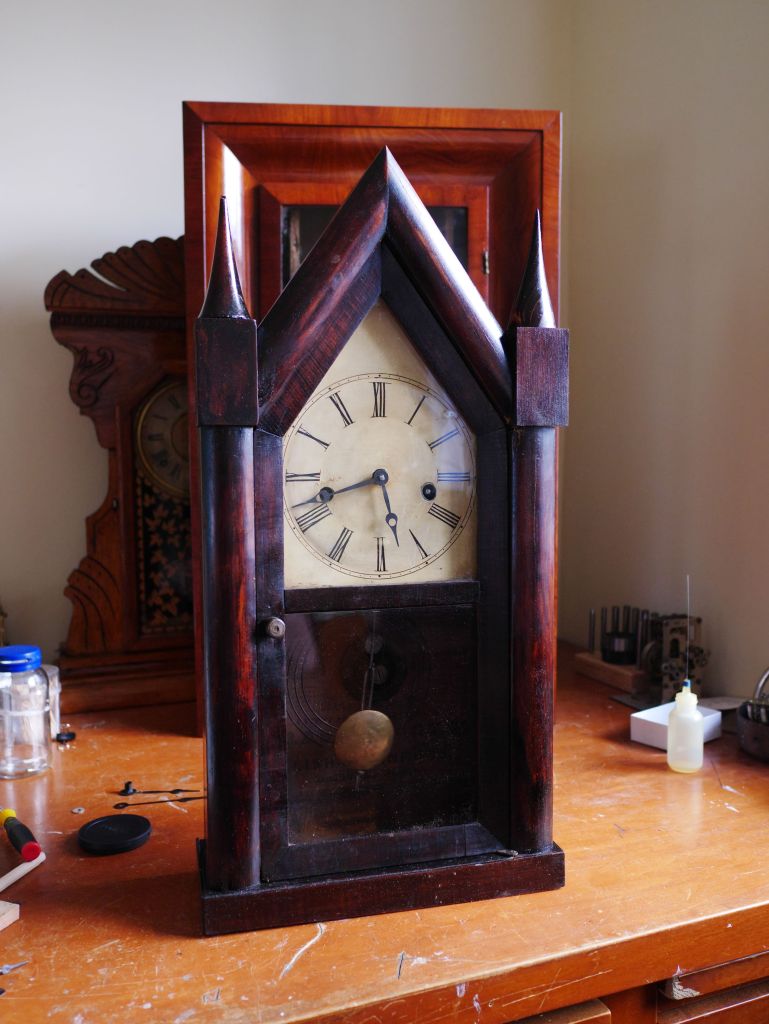
Elisha Manross gothic steeple

The Manross is a thirty hour time and strike and called a steeple clock. One interesting feature is that the Rosewood veneer is in a vertical orientation on the side columns unlike most that have a horizontal orientation. It is also the only clock in my collection that has brass mainsprings which were phased out in the early 1840s making the clock historically significant. Needless to say that in order to preserve the mainsprings I run this clock infrequently.

Hamilton Clock Company

The style is known as gothic steeple. The clock is from about 1876 and features a religious expression on the acid etched lower tablet, “Cling to the Cross”. There are some veneer losses but the clock is in decent shape. The steeple tips never seem to survive on these clocks.

Hamilton Clock Co. 30 hour time and strike

New Haven

This is a spring driven time and strike ogee from around 1875. Unfortunately the veneer has been stripped from the case and the softwood re-stained but it is an attractive little clock nonetheless. The dial is a replacement and the lower tablet has some losses.

Ogee New Haven clock

New Haven

This a called a Sharp Gothic according to the label. It is an American-made clock sold by a jeweler by the name of Thomas B. Spike in Halifax, Nova Scotia (Canada) in the 1880s. The lower tablet features a seaside Parthenon scene which might suggest it was one of many produced for foreign markets. There are some veneer losses but the clock is in running order and keeps reasonably good time. It has replacement mainsprings because it will run for 3 days on a wind. Not bad for a 30-hour clock!

New haven Gothic Steeple clock

I hope you enjoyed this little tour of a part of my collection of 30-hour or one-day clocks and please leave a comment. As for expanding my collection of one-day clocks I am not sure that I would continue acquiring them unless I came across something quite unique or if one were given to me.
Sperry and Shaw 4 column clock back on the bench

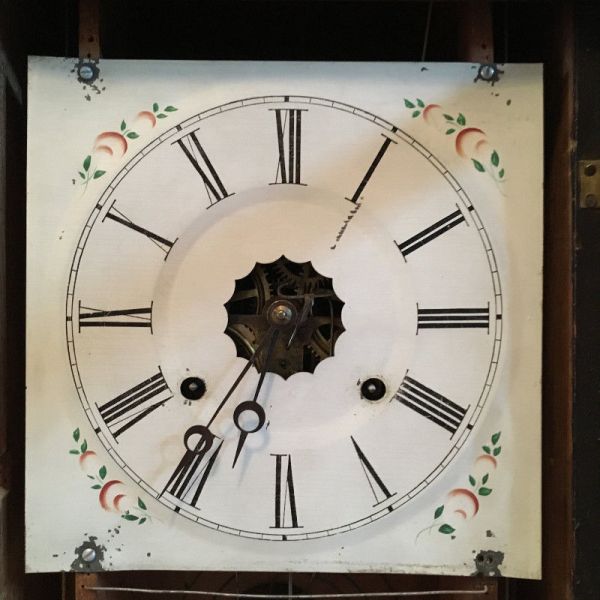
The turned 4 columns of the New York style Sperry and Shaw clock drew my attention because it is so unlike many of the 30-hour shelf clocks of the time.

This clock was made between 1844 and 1851 when Henry Sperry and George Shaw were in the clock business together.

Sperry and Shaw label

The label, which is in superb condition, and affixed to the backboard says 10 Courtlandt Street, the company headquarters at the time. Sperry and Shaw were not clock-makers but business partners and were regarded as distributors and assemblers or as Carl Drepperd in “American Clocks and Clockmakers” put it, “apparently clock racketeers” as they sold clocks with fake labels. Who actually made the 4 column clocks? I ‘ll leave that to the horological history sleuths.

Sperry & Shaw 4 column clock

The company sourced cases and movements, affixed their own stamp on the movement and placed their labels sometimes overpasteing other makers, inside the case, clearly an unethical practice.

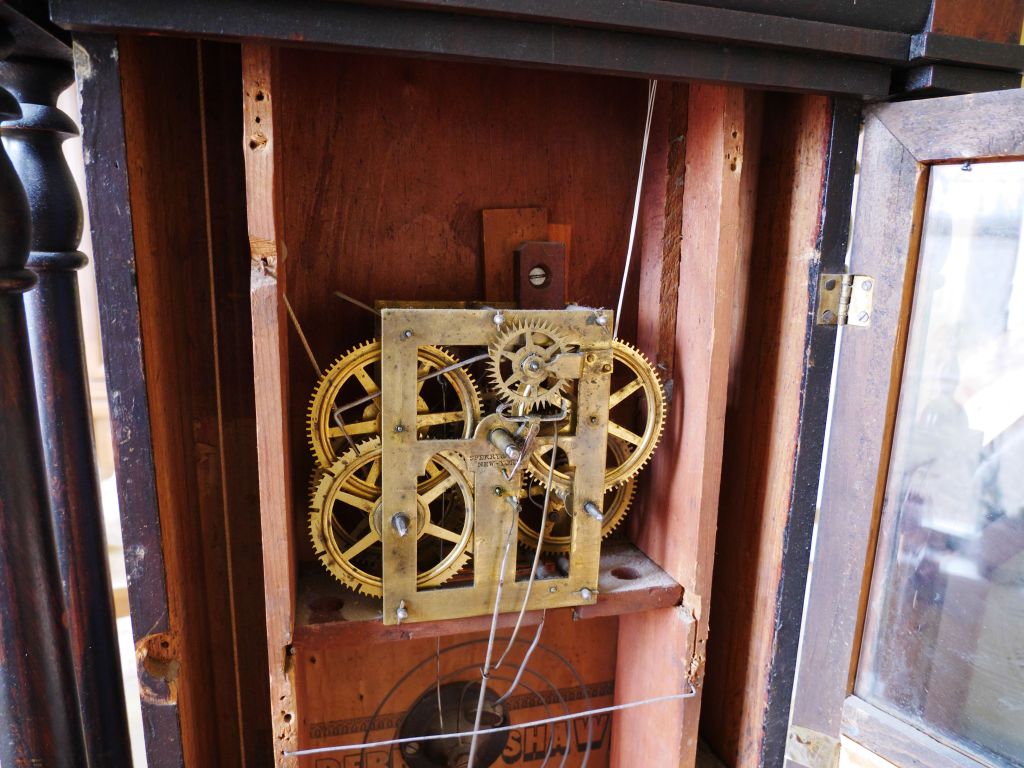
Weight channels on either side of movement

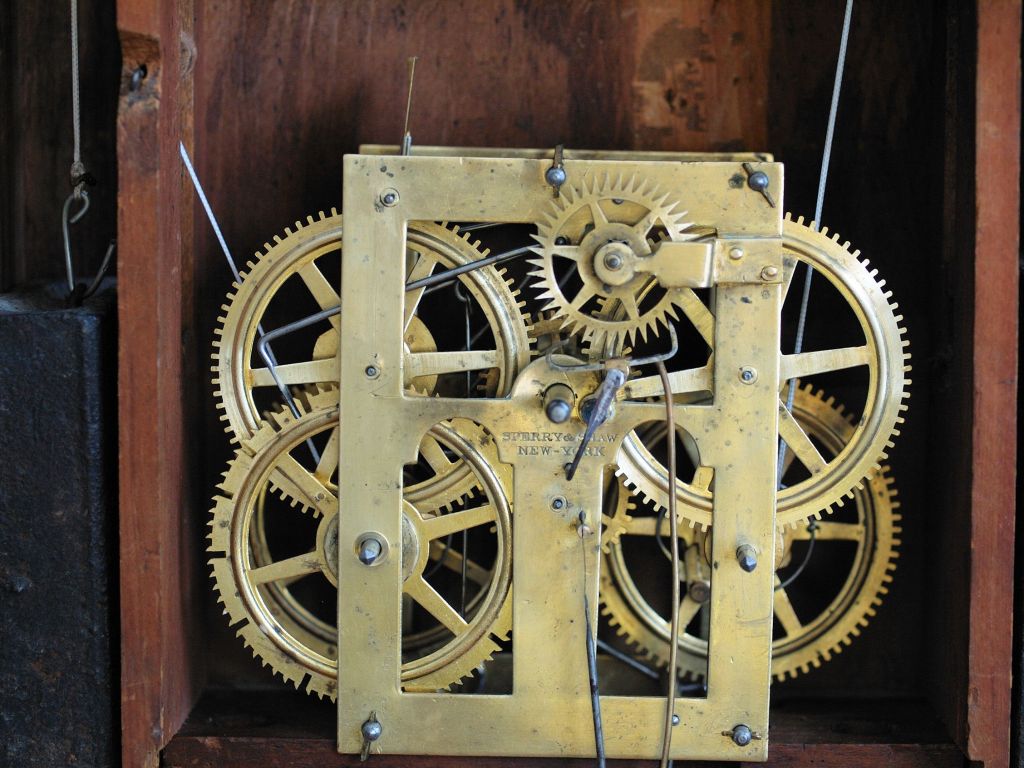
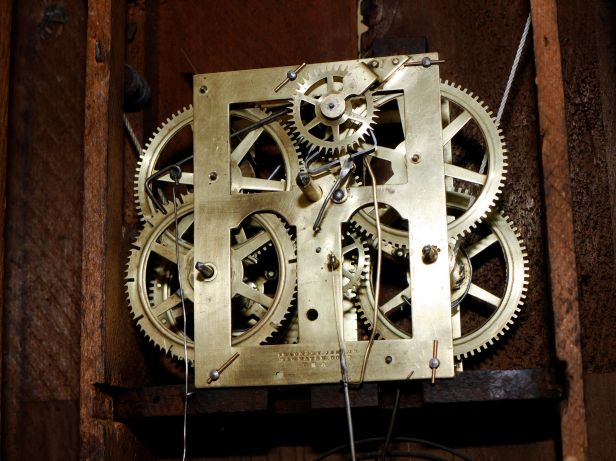
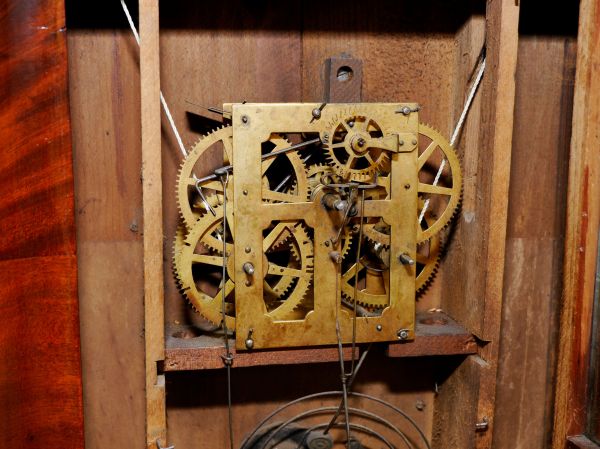
The movement is Jerome-like and stamped Sperry and Shaw, New Jersey. The plates are thinner than a Jerome, evidently a cost cutting measure. The hands are not original, nor is the dial though both appear to be period correct. The lower tablet contains an engraved copy of the Bay of Quinte (Ontario), there to replace the original reverse painted glass.

An interesting feature is the narrow brick-shaped wafer weights (4 3/4 inches X 1 inch) that fit neatly into channels on the left and right with little room to spare. The strike side weight is only slightly lighter than the time side.

Sperry and Shaw 30-hour movement

Service history

In January, 2019 the movement was disassembled and cleaned. All the parts were in good order.

The movement had been serviced perhaps more than once since there were punch marks around almost every pivot hole. Curiously there is only one replacement bushing on the escape wheel bridge, a later repair. Three or four pivots holes were slightly enlarged but not so much that they had to be done immediately. So, no bushing work at that time. I did not make any notes at the time regarding bushing wear but I suspect most of it is on the strike side.

The movement was re-assembled. The dial and hands were re-attached along with new braided nylon weight cords. After several days of testing the clock was running well.

May 2021

I have not been running this clock much in the past several months but I decided to wind both sides to see if everything was in order. As much as I love 30-hour clocks they are a hassle to keep running as they must be wound every day. Many years ago owners took this in stride as 8 day clocks were costlier.

The time side is now stopping after 5 minutes. At first I thought it might be a wear issue until I discovered the weight cord had, for whatever reason, slipped off the pully on the top of the case. It must have slipped off when I moved the clock recently. I repositioned the cable and ran the time side for a few hours just to be sure.

The other problem is the strike side. Lately the strike side has been running erratically. It either strikes the hour or runs continuously until the weight hits the bottom of the case.

The strike side needs an adjustment but there may be other issues. I won’t know until I take the movement apart. Once I have it apart I will address the wear issues I noted in 2019.

Disassembly

The movement was taken out of its case. The four retaining pins were removed and top plate taken off. After 3 years the movement is clean but the clock oil in the pivot holes is black.

I inspected the movement for wear. The lantern pinions have some wear but no more than I saw in 2019 and I have seen far worse in other 30-hour movements. As mentioned there had been a lot of punches around the pivot holes and from my inspection some bushings are now required. The ratchets and clicks look good and the gear teeth are in fine shape.

Sperry and Shaw 30-hour movement tested in the case

Bushing work

Three bushings are required; the time side second wheel front plate and the strike-side mainwheel and second wheel back plate. There is certainly wear on other pivot holes but not enough to justify more bushing work at this time. However, if this was a customer clock I likely would have bushed every pivot hole.

I did not like how bent and twisted the movement plates are. I am not sure whether this is the result of poor quality brass or the rough manipulation of the plates by a past repairer as they went about punching most of the pivot holes. I straightened the worst section so that I could have sufficient end shake for one gear but left the remainder of the plates as-is.

Reassembly and testing

These movements are relatively easy to reassemble. While everything went smoothly the strike side is still giving me grief and is no better than when I began.

However this time it is a simple adjustment issue. There is no need to take the movement out of the case to make the changes. I could see that the count and drop levers were not synchronized. The drop lever should be deep in the cam slot at the same time the count lever is in one of the deep slots of the count wheel. I slid the count wheel over to one side and repositioned it. The paddle should also be radial to the count wheel. I had to bent the paddle slightly to ensure that it pointed directly at the wheel hub.

These were subtle changes but made the difference between a working and non-working strike side. After 4 days of testing the dial and hands were reinstalled and the clock placed back on its shelf.

Sperry and Shaw 30 hour clock

It bears repeating that if you are just beginning your journey into clock repair, the 30-hour ogee, because of the large gears, the overall simplicity and the absence of mainsprings make this a great place to start. I love working on them.

Sperry and Shaw New York Style shelf clock – refreshing the case

The four free-standing turned columns of the New York style Sperry and Shaw clock immediately drew my attention. The style reflects the decorative period of the Empire style popular in the mid 1850s. In a previous blog post I discussed servicing the movement. I thought long and hard about what to do with the case and decided that a refresh was what it needed.

Sperry & Shaw 4 column clock
Sperry & Shaw 4 column clock, as found

Continue reading “Sperry and Shaw New York Style shelf clock – refreshing the case”

30-hour clocks – four for your consideration

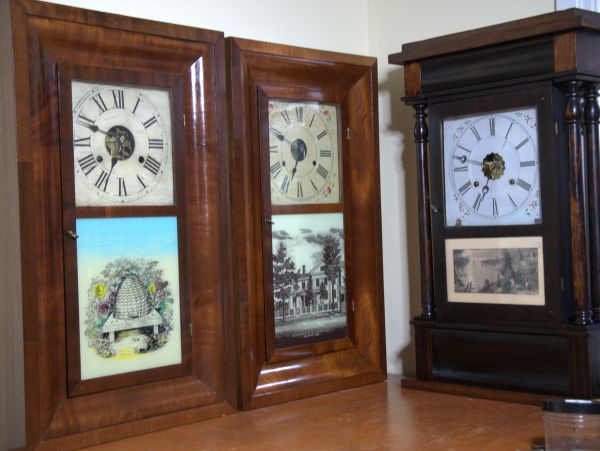
These three 30 hour clocks in the opening photo were serviced in the fall of 2018. The fourth (shown next) is a Waterbury Ogee from about 1870.

It was never my intention to collect 30-hour clocks but I am attracted to this style of clock. Thousands were made, they are surprisingly cheap and come up often on online for-sale sites. Many have the cases that have suffered the ravages of time though these are in very good condition. However, buyers and collectors tend to stay away from 1-day clocks because of the hassle of winding them every day.

I marvel at the engineering and innovative technology of clocks made over 150 years ago and how popular these clocks were in their day.

Waterbury OG clock
Waterbury 30-hour Ogee clock

On the left in the opening photo (and below) is a George H Clark, pre-1850. It features a Jerome-like movement and a wood dial.

George H. Clark 30 hour Ogee

30 hour movement servicing
All of the clocks on this page have similar movements to this Jerome

Touch-ups to nicks and scratches were all that were required to improve the look of the case but the movement required a good cleaning as well as a couple of bushings.

The middle clock (also seen below) is a Chauncey Jerome Ogee clock. The label dates the clock to about 1855-56 just prior to the company’s bankruptcy.

Chauncey Jerome 30 hoir Ogee clock
Chauncey Jerome 30 hour Ogee clock

Eight bushings were installed on this clock. Some of these clocks need a lot of work while others require a good cleaning.

On the far right (and blow) is a Sperry and Shaw 30 hour New York style 4 column shelf clock. The movement was disassembled and cleaned but did not require bushing work. The case was also freshened up.

Sperry & Shaw 4 column clock
Sperry & Shaw 4 column clock with a Canada Clock Co 30-hour steeple to the right

I am fascinated with 30 hour clocks. Yes, they require winding every day but I enjoy it and it has become one of my daily rituals. The sound of the gong is not particularly pretty but it is distinctive. You always know when an Ogee clock is striking in a house.

What other mechanical devices keep running after 150+ years?

Website Powered by WordPress.com.

Up ↑