I received an email from a blog fan this week who posed an interesting question. She was concerned that a number of clocks offered for sale at a local antique store had radium dials. I assured her that I know of no maker of mantel, shelf, or long case clocks that used radium on their dials but had there been alarm clocks, wristwatches, and even antique compasses on display her concerns would have been justified.
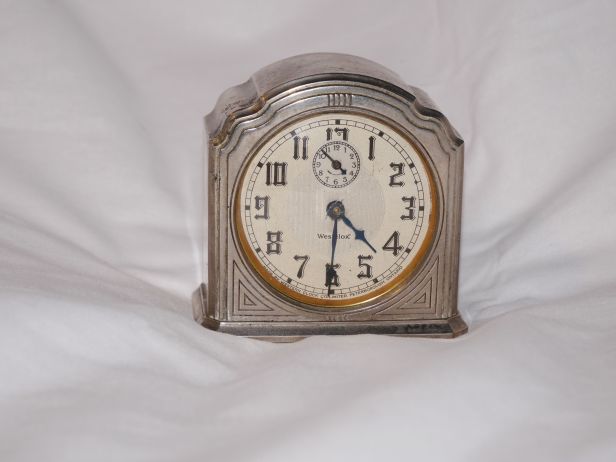
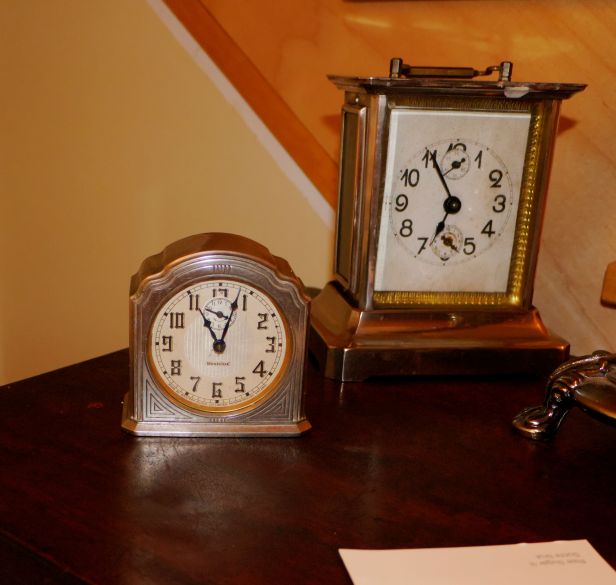
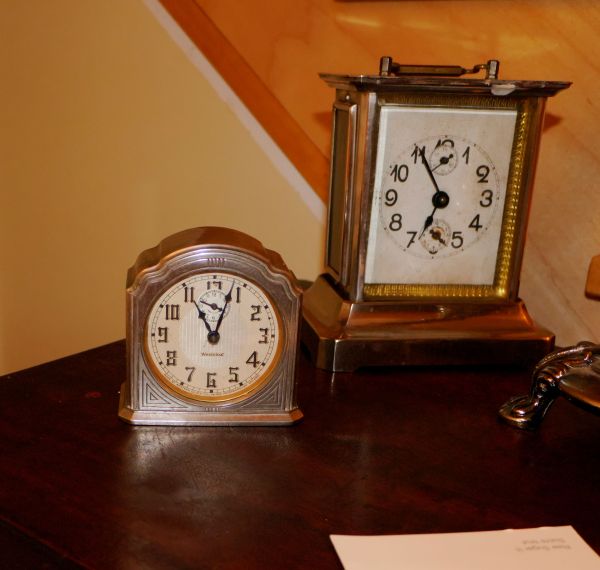
Westclox LaSalle non-luminous alarm clock
As a matter of fact, it reminded me of the number of times I have been in antique and junk stores and have seen clocks with luminous dials and the danger I might have faced during a brief exposure, say within a meter or so and the more serious danger of being irradiated had I purchased and serviced them.
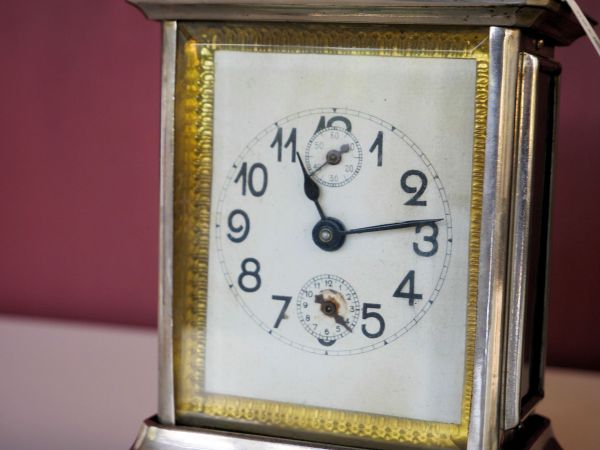
German musical alarm clock or Joker
As a clock collector, I have a limited number of alarm clocks none of which have luminous dials. I understand the potential danger of radium and that is why I confine my collecting to alarm clocks with non-luminous dials only.
Even a clock that has lost its luminescence may still have traces of radium on its dial or particulate matter that has fallen from the clock face which makes them equally as dangerous.
Antique “alarm” clock mechanism from around 1900
Since radium has a half-life of hundreds of years even old radium dials are very hazardous. If working on a clock with a radium dial care should be taken to prevent the inhalation or ingestion of flakes or dust which may contain radioactive materials. My advice is to not work on them at all.
In the past several years radium dials have largely been replaced by phosphorescent – or occasionally tritium-based light sources. Therefore clocks produced after the 1970s had safer luminous material applied to the dials but modern alarm clocks are not nearly as attractive as antique clocks from the 1920s or so.
Clocks with luminous radium dials are certainly a danger to avoid and as far as I am concerned, not worth the risk.
Tick-Talk Tuesday is about the letters and comments I have received from you, the reader, concerning your clock, issues you might have had, challenges you face or a clock you would like me to profile or my responses to your questions with advice on your particular clock concern. For those comments and questions that stump even me, I consult within my clock circles for the best possible answer
LG writes,
“Dear Mr.Ron:
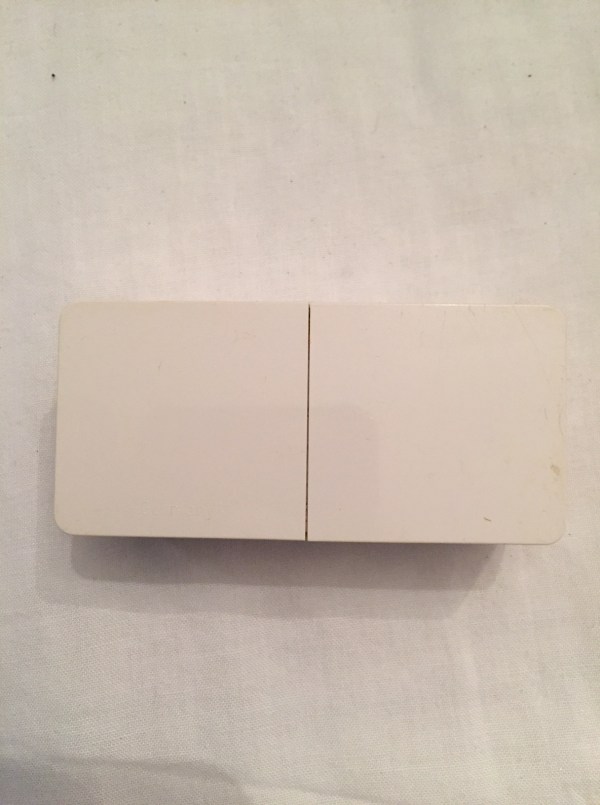
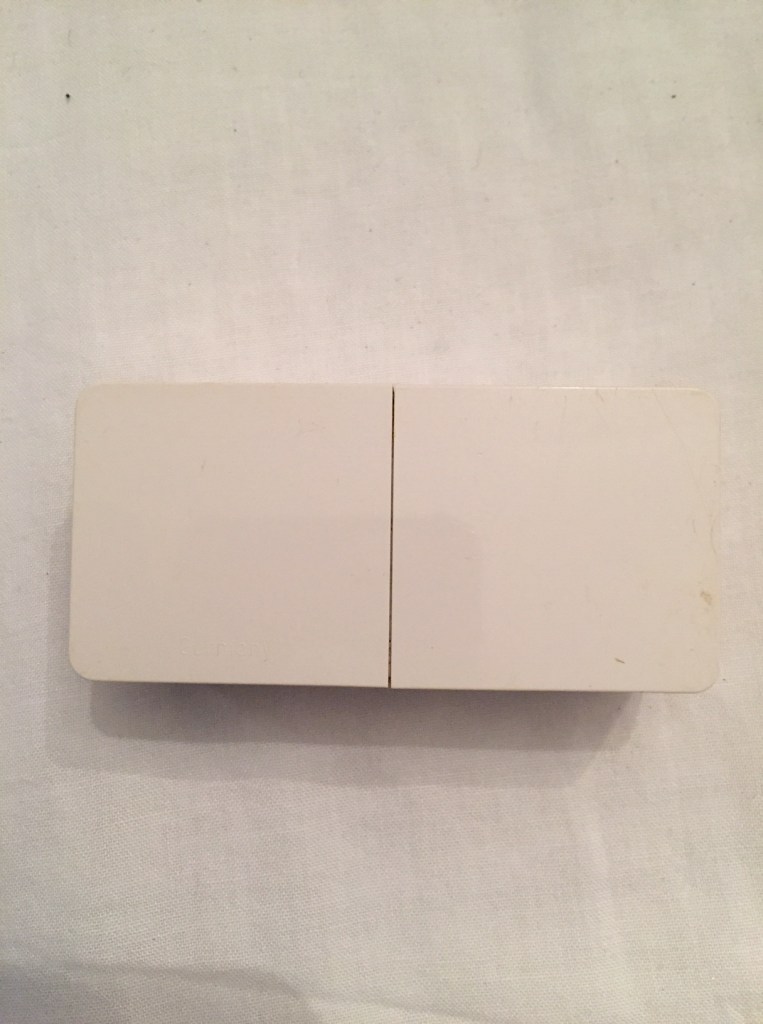
I came across this vintage mini clock by Sonoo-Ron in a leather pouch. I cannot find anything about it and thought this must be very unique and if interest to you? If you are not interested, but know something about it, would love to know more!
Sender’s photo
Thank-you so very much!
Regards, LG”
Sender’s photo
My reply,
“I must confess that I have never heard of the name which I believe is Sonochron. What I found interesting is that the clocks were used by bomb-makers in Europe.
The electro-mechanical travel alarm clock from the 70s is from the Schwarzwälder Müller-Schlenker watch factory in Schwenningen.
The alarm clock is the following size: 70 mm length, 33 mm height and 25 mm depth.
The clockwork is mechanical, the alarm electrical. Due to its construction, it was very popular with a left-wing extremist terrorist group, the “Revolutionary Cells” (RZ). The possibility of separating the clockwork and buzzer means that the alarm clock can be converted into a time fuse for bombs. It was used in the RZ bombings. In 1985, the Federal Criminal Police Office had the remaining stock of Sonochron alarm clocks marked in order to track down future attackers. They could only be bought in selected shops that were equipped with video surveillance by the police. This action sparked a heated debate about state interference with personal rights, because all buyers were monitored. The alarm clock was a hot topic of conversation.
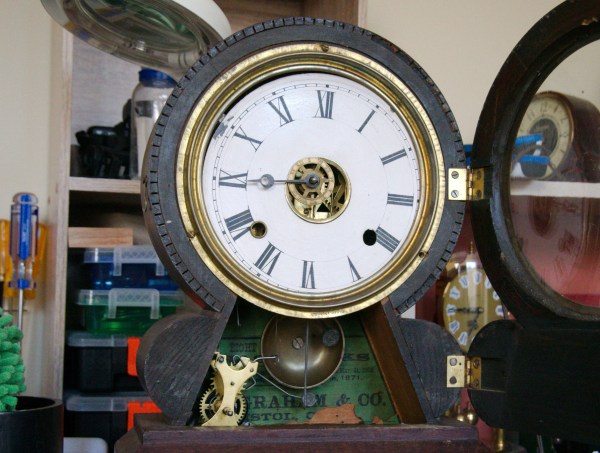
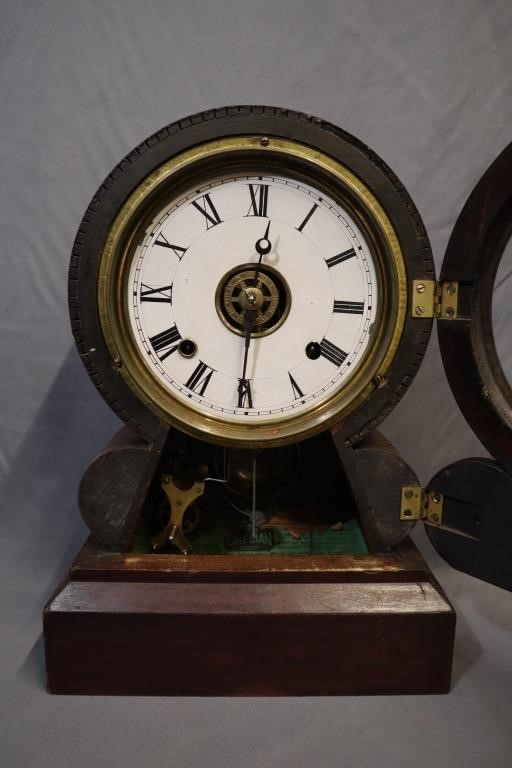
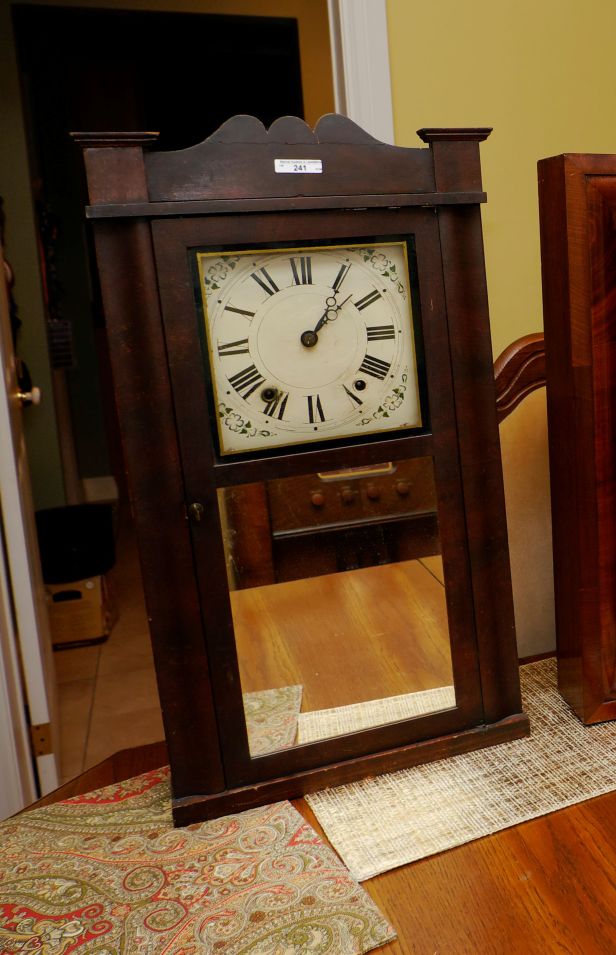
I was the successful online bidder for an E. Ingraham Grecian time and strike shelf clock in early January 2021. My wife and I had to travel 3 hours, from one part of Nova Scotia to another, to pick the clock up but since we were taking a small staycation in the nearby area the antique shop was on our way.
It is a very interesting design and I researched not only this clock but the period that influenced its design.
Let’s travel back in time to Duncan Phyfe, a prominent American furniture designer (1768-1854). His interpretation of fashionable European trends made him a major influence in the Neoclassical movement in the United States impacting an entire generation of cabinet-makers. The era of Greek furniture design quickly came to the clock world in the form of “Grecian” clocks made by a number of clock manufacturers including Joseph Ives, E. N. Welch, Seth Thomas, and Ingraham.
This is the E. Ingraham & Co.’s interpretation of the Grecian clock, called appropriately enough, the “Grecian”.
The design is a classical influence and it is not only aesthetically pleasing to patrons of the nineteenth century but remains so today. It has a molded Rosewood bezel with carved volutes below the dial frame. The dial frame and bezel are one section that makes up the hinged front access door. I have seen walnut-cased versions and mosaic maple and walnut as well. The mosaic versions are probably the most desirable.
Elias Ingraham was a case designer and no doubt had a hand not only in the design but the choice of woods used for case construction.
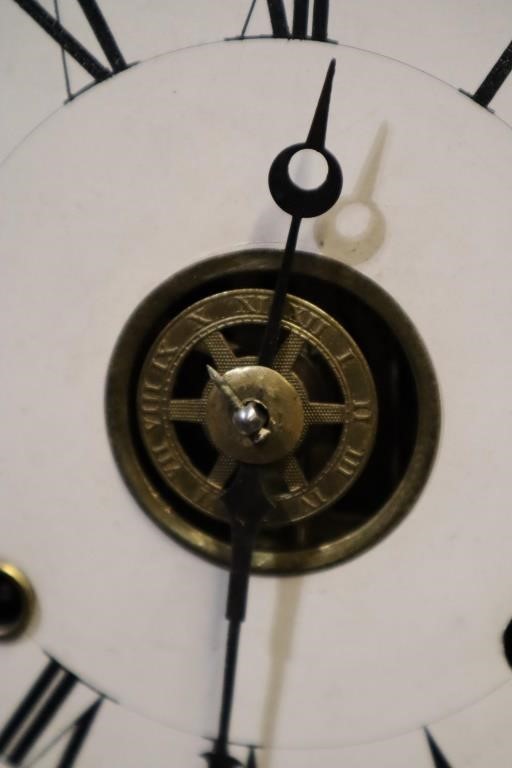
It has a paint-on-zinc dial, moon-shaped hands, and Roman chapters. The Grecian model was available as a 30-hour spring-driven, time and strike, 30-hour time and strike with alarm, 8-day time and strike, and 8-day time and strike with alarm. This one is the 8-day time and hour-strike alarm version. All models strike on a cast bell made of iron, or in this case, brass. Features such as exotic/mixed woods, alarm, and 8-day function would have been an extra charge at the time. The clocks were made between the years 1868 and 1883 with an 1880 catalog price of $5.25 for the 30-hour clock with alarm.
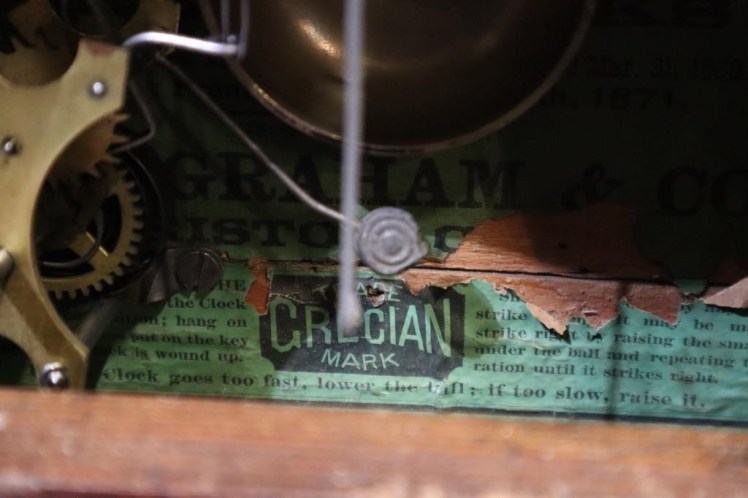
It has a green triangular-shaped paper label inside the back panel of the case which is in fair condition. There are 3 patent dates on the label, September 30, 1862, March 31, 1868, and June 6th, 1871. The newest clocks of this model would have had October 8, 1878, and still newer, November 11, 1879 patent dates so, this clock was made after 1871 and before 1878. The fact that the clock can be dated within a 5 year period is a plus.
Once I receive the clock and look it over more carefully I will post my first impressions and the work that must be done to restore both the clock movement and the case to its former glory. Stay tuned.
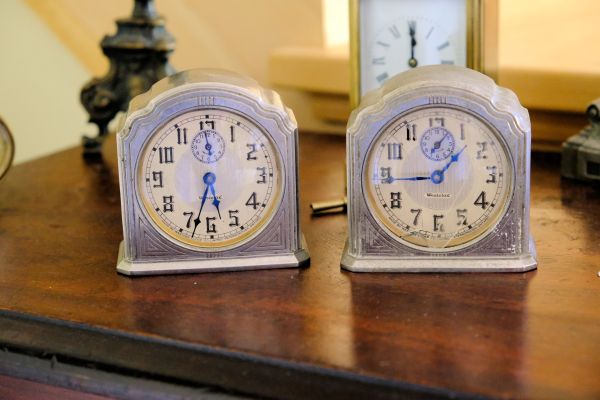
Reader EW asked me if I wanted a second Westclox LaSalle 61C alarm clock. Yes, I said, of course. I was advised of the condition of the clock beforehand so there was no surprise when it arrived in the mail.
The important distinction between my clock and the new arrival is that the new one actually works. My LaSalle may have run at one time but not now. I can hear it briefly ticking but once placed on a flat surface it stops. There is not a lot wrong with it but it definitely requires a good cleaning and perhaps some bushing work.
Gee, our old LaSalle ran great….those were the days
Archie Bunker
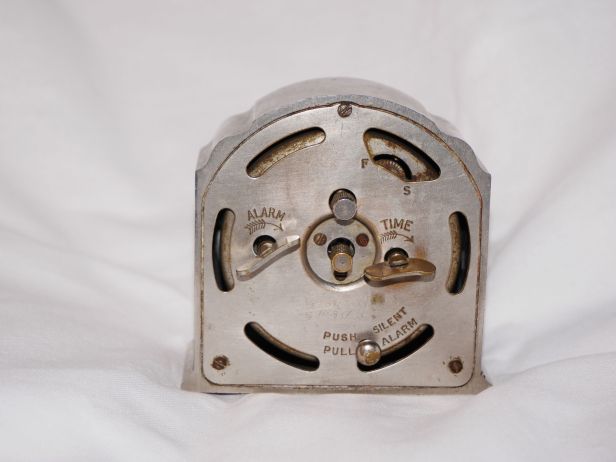
Westclox alarm clock; winding keys and adjustments
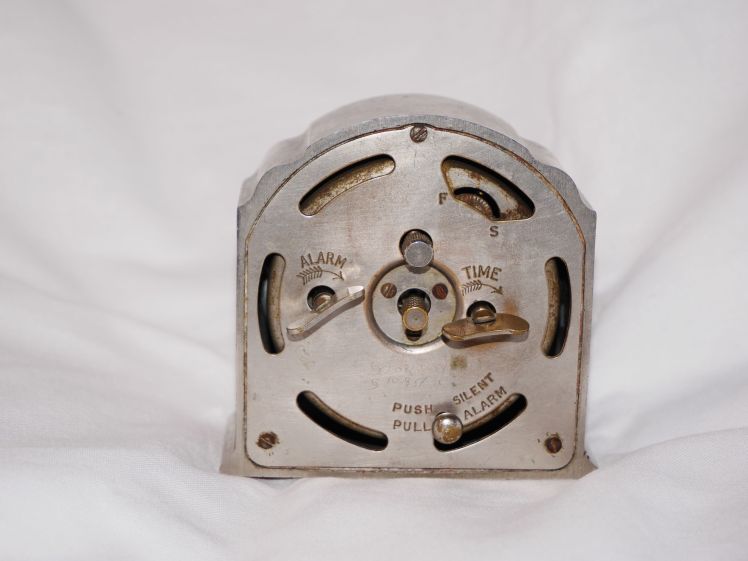
The Westclox Clock Company is better known for various versions of Big Ben and Baby Ben windup alarm clocks produced from 1900 to the mid 1980s. But there were other windup models one of which is the Art Deco styled LaSalle series. Both of these clocks are the model 61-C (401) otherwise known as a Dura clock because they have nickel-plated, die-cast zinc cases made by The Dura Casting Corporation in the United States. There are 6 models in the LaSalle series and all use the Westclox type 61 Baby Ben, one day movement.
My wife loves those little craft shops that seem to pop up everywhere. While shopping for Christmas presents in Truro, Nova Scotia, she spotted an attractive Seth Thomas balloon alarm clock. It is not working, said the vendor but my wife knew that her clock loving husband would likely get it running in no time.
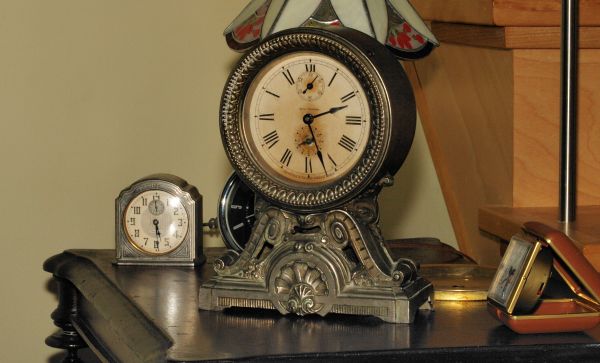
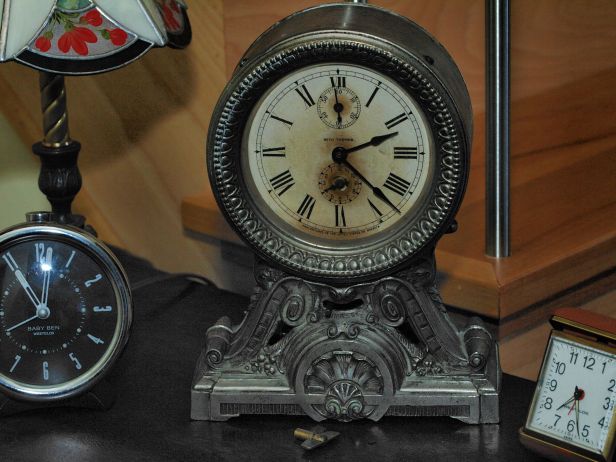
Art Nouveau styled Seth Thomas alarm clock
These clocks are not uncommon on online auction sites
Made around 1900, the clock features a metal case with openwork, scrolling details, a rectangular base with a central shell design. The dial is marked “Seth Thomas” to the center and “Manufactured in the United States of America” underneath the six. An alarm bell is housed in the base and yes, it is very loud. The clock measures 7.25″ W x 9.0″ H x 3.5″ D.
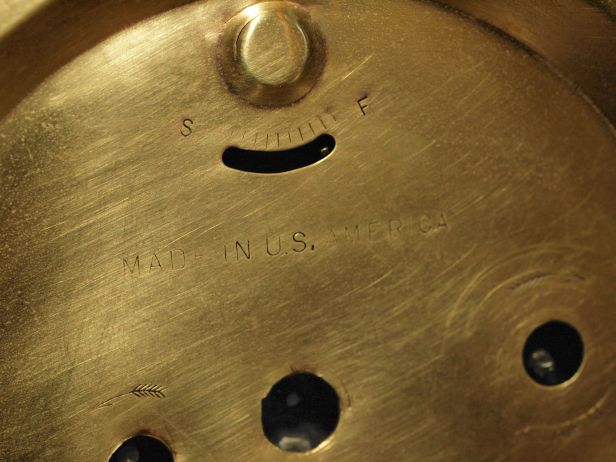
Made in US America
Not rare but interesting
These clocks are not uncommon on online auction sites. Though some describe the alarm clock case as cast iron or copper, it appears to be either plated cast brass or more likely spelter. Some would describe the style as Art Nouveau. Art Nouveau is an international style of art, especially the more decorative arts that were most popular between 1890 and 1910.
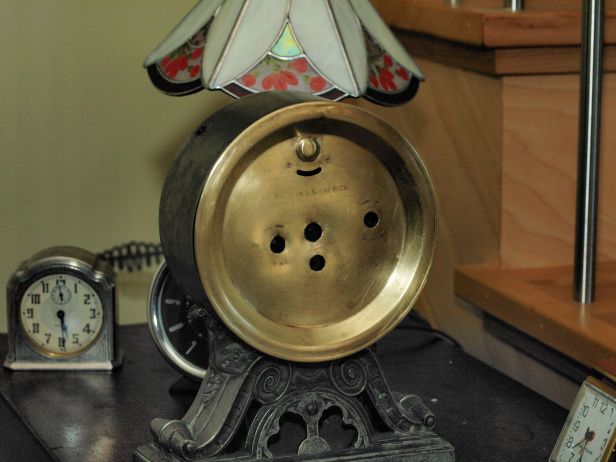
The dial features Roman numerals, a working inset sixty-second dial at the twelve, a twelve-hour alarm dial at the six and a cast metal bezel with a beaded pattern. The clock features two winding keys on the reverse (though one key is missing as well as one set screw) and is marked “Made in U.S. America.”
Back cover, with keys taken off
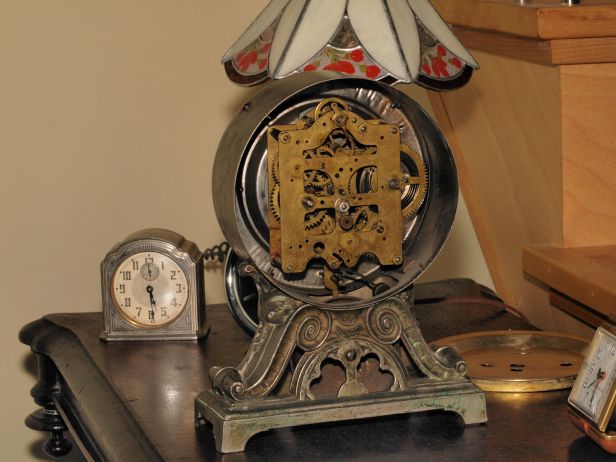
I took off the back cover, put it aside and cleaned it. The 30-hour movement with alarm was quite dirty, as expected. A thorough dismantling and cleaning is in order but for now, let’s see if it works.
Back cover removed
Let’s see if it runs
Using Keystone clock oil I applied oil to the pivots and those I could reach in the front without taking the movement out of the case. New oil introduced to old oil will eventually mix and cause an abrasive sludge that will hasten wear but I wanted to determine if the movement was capable of running. After the oiling, I gave the escapement a gentle push and the clock came to life and continued to run its 1-day cycle. The alarm feature works but I am missing the windup key and the time key does not fit properly. I am also missing the hands’ adjustment set key, so, a pair of pliers was used to set the time.
The clock looks great
I cleaned the case with a mild soap avoiding hard rubbing for fear of taking off the plating. The clock looks great and has a pleasant patina.
My wife paid $15 for the clock. Online auction and for-sale sites reveal realized prices all over the map, from $30 to $410. I am pleased that it is a working clock at a very reasonable price and a nice addition it to my modest alarm clock collection.
While on a vacation in the Dominican Republic we brought along an old Westclox wind-up mechanical travel alarm clock for no other reason but to have it as a curiosity and of course, to get us up in the morning. You might wonder why an alarm clock is necessary for a relaxing beach vacation. Well, if you have excursions planned for a specific day, it’s essential to wake up early and on schedule.
We’ve all become accustomed to using electronic alarms, like those on our cell phones or tablets, to wake us at a precise time. However, my brief testing showed that this compact travel alarm clock works well, even if it’s not quite as precise.
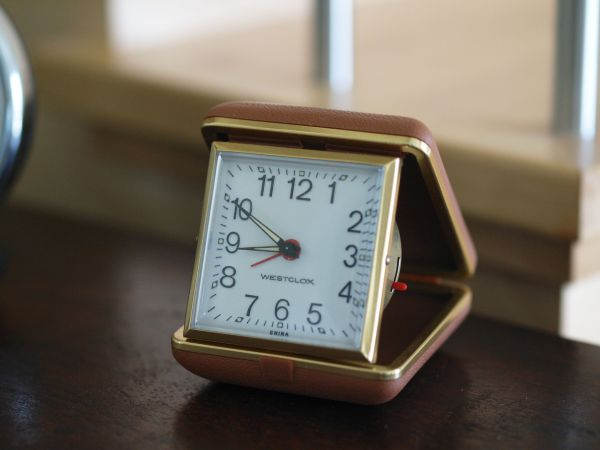
This is a Westclox travel alarm clock I purchased from a local antique dealer for $6. It’s in excellent condition, suggesting it hasn’t seen much travel. Clocks like this often didn’t fare well with heavy use; once they broke, they were typically discarded.
I would date it to the 1960s. It is very compact, measuring 3 inches square by 1 1/2 inches deep when collapsed. It is in a light brown plastic case and folds into its case when transported. It fits easily into a purse, messenger bag, overnight bag, or suitcase.
Collapsed, the clock fits anywhere
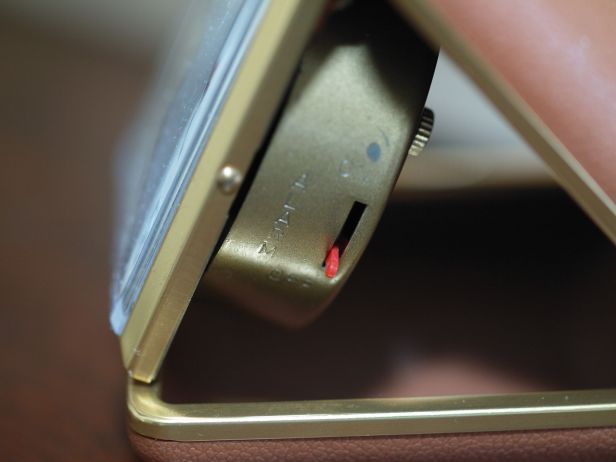
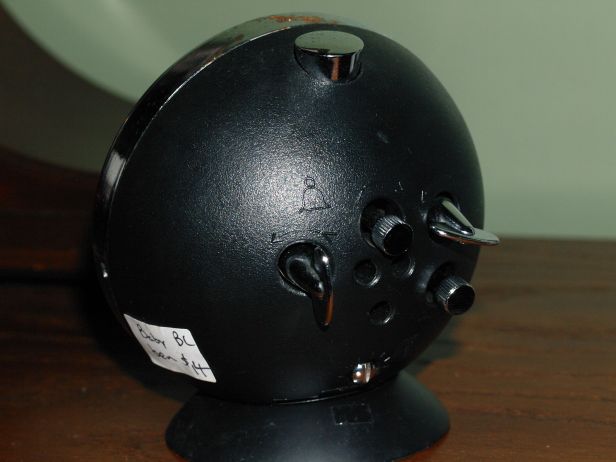
Unlike older alarm clocks that usually have two separate winding keys, this one combines the winding mechanism for both the bell alarm and the time function into a single key. The center knob is used to adjust the time, while the upper-left knob sets the alarm. Additionally, there is a speed adjustment located just above the center knob.
The red lever activates the alarm
The three patent numbers on the back of the clock don’t clearly indicate the exact year it was manufactured.
These clocks were produced in large quantities and can often be found for under $10 on online marketplaces or in antique stores.
Back of the alarm clock shows setting knobs
While many Westclox alarm clocks were produced in Canada and the US, by the 1960s, production shifted offshore to reduce costs. This particular clock was made in China, whereas other similar Westclox alarm clocks from the same era were manufactured in Taiwan.
Westclox alarm clocks were originally produced by the United Clock Company in Peru, Illinois in the late nineteenth century.
The company initially failed, became the Western Clock Co., and again went bankrupt, reorganized under the Western Clock Manufacturing Co., and found success when they acquired the first patent for the Big Ben alarm clock in the early part of the 20th Century. In 1931 Western Clock Co. merged with Seth Thomas with both companies falling under the General Time Corporation. Westclox then became a division of General Time.
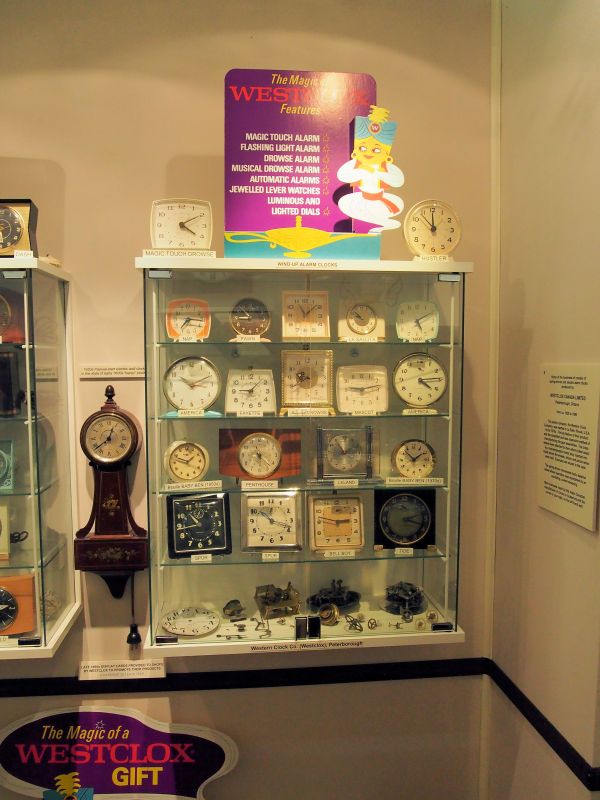
Regarding the Canadian connection, a significant number of Westclox alarm clocks sold in North America were manufactured in Peterborough, Ontario, from 1922 to the early 1980s.
Quite often alarm clocks that I find in flea markets and antique shops are dented, missing winding keys and other adjustment knobs which I try to avoid (unless for parts) but this one was complete.
Although I primarily collect clocks, I do have several alarm clocks in my collection. I am selective, adding only those that are particularly interesting, and I avoid clocks with luminous dials from the early 20th century due to the potential exposure to Radium.
Most traveling alarm clocks remain quite affordable, except for certain Swiss and French models.
This clock is an excellent example from a company that was once the undisputed leader in alarm clock production.
In my past life I was a community college instructor. My students ranged in age from age 20 and beyond but most were around the early 20s.
For years I had an analogue clock just above my office door. I often met with students but when I was pressed for time (not meaning to be rude) I would casually glance at the clock over the office door rather than look at my wristwatch. One day I asked a student what time we should meet again. They said, “well, what time is it now?” I said, the clock is right there, pointing to my office clock. They looked at it quizzically and said, “I can’t tell the time from that”, “I never learned”. What I heard hit me like a ton of bricks and this was a very bright student.
The big hand is on the left
The biggest difference between the Millennials and their predecessors is in how they view the world
We talked.
Me: Where is the small hand pointing?
Them: What do you mean, small hand?
Me: I pointed out the difference between the long and the short hand, the long indicating the minutes and the short, the hours.
Them: Between 3 and 4.
Me: So that means it is 3 something. Where is the long hand pointing?
Them: On the 6.
Me: What’s 5 times 6?
Them: 30.
Me: So it’s 3:30. Simple.
Them: Oh!
Are smart phones destroying our present generation? Is the digital age having a deleterious effect on our young people? Many scholarly articles and vigorous debate attempt to explore how the present generation thinks and as you would expect there are many theories.
It’s no wonder that analogue mechanical clocks are hitting their lowest price levels in years
As a community college instructor I should have been aware of generational differences and the impact that smart phones and the digital world have had on our present generation. I was making assumptions that how we learned way back when was very much like how young people learn today. Boy, was I wrong! The biggest difference between the Millennials and their immediate predecessors and even my generation is in how they view the world; young people today differ from previous generations not just in their views but in how they perceive the world around them as sound-bytes, fleeting images and instant messages. The experiences they have every day are radically different from my generation.
The little hand is between the twelve and the one
Time for them takes on a different dimension. Time is at the same time important yet unimportant. Time for young people is not measured in imprecise phrases like “about a quarter to”. It has a certain curious precision that is at odds with my generation (1950s and 1960s). What time is it? To them the time is precisely “seven thirteen”, not “half past” or ” a quarter past”. And don’t get me going on fractions!
In the following months all the clocks on the college campus were replaced with digital versions. One day I had a conversation with the facilities manager and he said, “we took them all down because the students can’t read them”. It brought me back to my conversation with the student and I completely understood.
I collect antique analogue clocks and it makes me sad there there is a generation, and perhaps future generations going forward who will not appreciate the beauty and utility of the that “old fashioned” analogue clock. Will these clocks be lost to a generation who feel that they are completely irrelevant? I hope not!
It’s no wonder that analogue mechanical clocks are hitting their lowest price levels in years. Case in point. I bought an circa 1835 Daniel Pratt Jr. reverse column and splat 30 hour clock at an auction recently and paid just 30CDN (24USD).
Daniel Pratt Jr. reverse ogee and splat 30-hour clock, bought at recent auction
To this generation analogue clocks (and antique clocks for that matter) are meaningless, unnecessary and pointless.
But to us old folks they continue to have a certain charm that cannot be explained, well, to young people, anyway!
Clocks have been more than just timekeepers throughout history; they are reflections of art, culture, and technological innovation. Whether for practical use or decorative appeal, clock styles have evolved to match the tastes, craftsmanship, and technologies of their times. Here’s a look at some of the most iconic and varied clock styles.
The clock is an instrument designed to keep and indicate time. It is one of the oldest human inventions. The clock has evolved through the ages from sundials in ancient times to early tower clocks of the 14th century weight-driven clocks and finally spring-driven clocks from the 1840s to the 1970s.
The world of mechanical clocks encompasses a wide variety of styles, and distinguishing between them can often be confusing—such as understanding the difference between a shelf clock and a mantel clock. In this article, I’ll navigate through these terms and highlight the most common styles or types, using examples from my own clock collection to illustrate them.
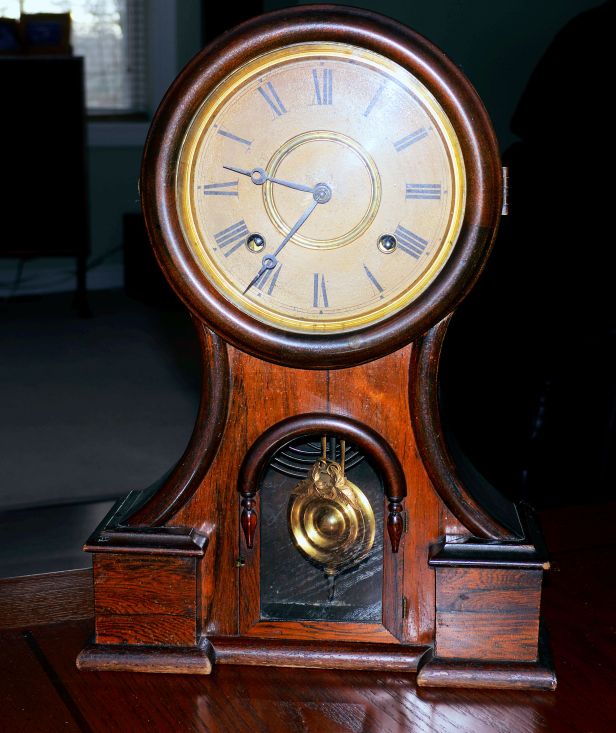
Mantel Clock
Many auction sites and even professional websites use the word mantle. The correct terminology is “mantel”. A mantle is a shawl or coat worn by women, an important role passed on from one person to another or the earth’s crust. A mantel is the top framing of a fireplace or a shelf above a fireplace opening.
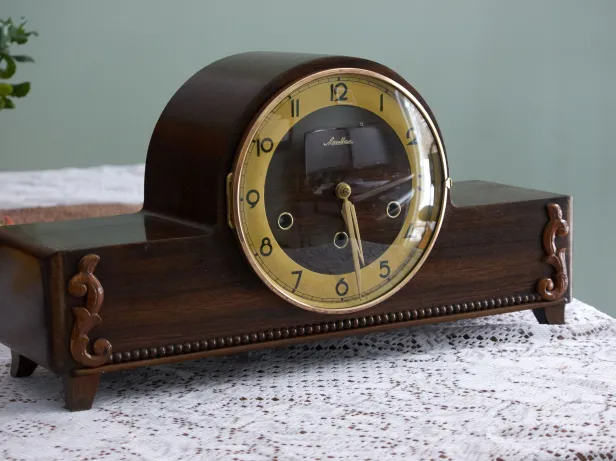
A mantel clock is designed to fit on top of a fireplace or shelf. A mantel clock can be time only, time and strike, or a chiming clock. Generally, if there are 2 winding arbours it is a time and strike clock, if the clock has 3 winding arbours is it a chiming clock that is, it will play a tune on the quarter hours, the most common being the Westminster chime.
Mantel clocks might also be referred to as shelf clocks or buffet clocks.
Kitchen Clock
Arthur Pequegnat kitchen clock
Kitchen clocks are often referred to as gingerbread clocks or parlour clocks. At times, it can be difficult to differentiate between a kitchen clock and a parlour clock. Gingerbread clocks are distinctive because their designs are typically created by steam-pressing the wooden front face. However, some clocks, like the one above, are made using a powered cutting saw but are still classified as kitchen clocks. Additionally, some of these clocks included alarm mechanisms. The terms gingerbread, kitchen, and parlour are often used interchangeably.
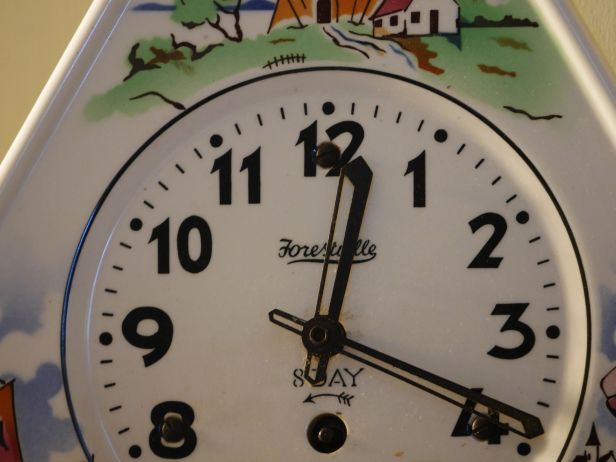
Another type of kitchen clock is shown below. This is an 8-day time-only delft wall clock made by Forestville.
Delft Clock from ForestvilleE. N. Welch Whittier model
A parlour clock is generally considered more ornate than a kitchen clock, although it may still be referred to as a kitchen clock. It is placed in front hallways, entryways, and so on. The designs are always cut and there may be finials, a mercury-filled pendulum or very ornate design, garish trim pieces, and a decorative tablet.
Vienna Regulator
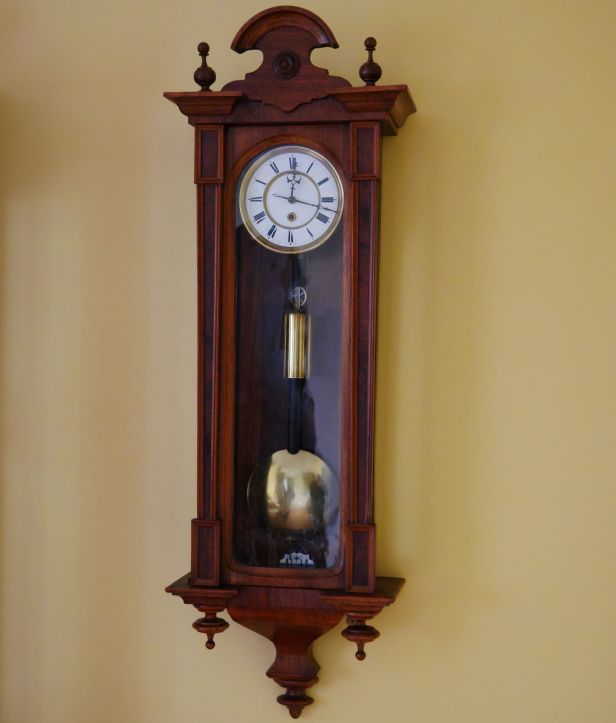
Gustav Becker two-weight Vienna regulator
There are many styles but most are of the single-weight or two-weight variety. The definition of a Vienna regulator is always open to debate but the consensus among collectors is that they are weight-driven, made in Austria/Germany, ornate in design, have porcelain dials, decorative crowns, large pendulums, and finials on the top and bottom.
The broad definition of Vienna Regulator includes those that are spring-driven. Though not defined as “regulators” it is acceptable among collectors to refer to them as a Vienna style.
Cottage Clock
Canada Clock Co Hamilton Cottage Extra
Sometimes called a mantel clock or a shelf clock, they are usually diminutive in size to occupy a smaller space. They are found in bedrooms and kitchens and are sturdily built since they are often designed to be portable. They come in time only, time and strike, or may have an alarm function.
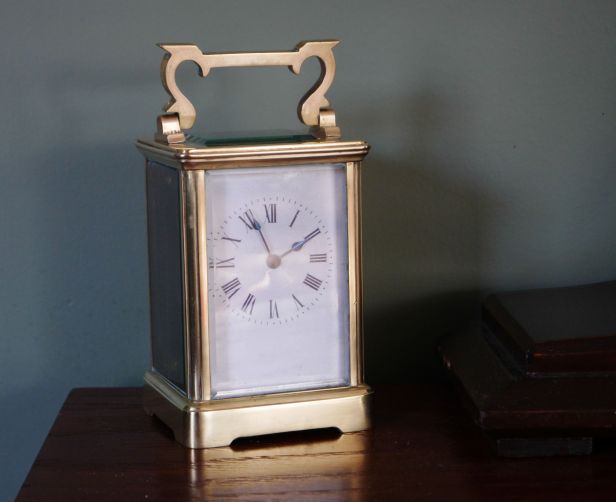
Carriage Clock
French Carriage Clock
Carriage clocks are portable and were very popular around the turn of the 20th century. French-made carriage clocks are more collectible and fetch generally higher prices although American ones can be quite desirable. Carriage clocks are designed to be portable and are time-only but some are time and strike (with a repeater function) while others may have an alarm function.
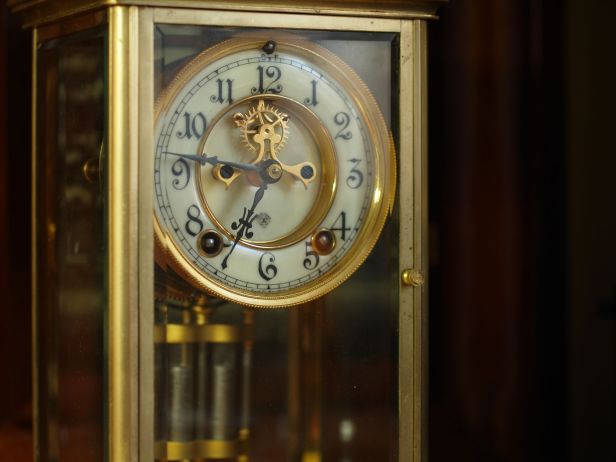
Crystal Regulator
Ansonia Crystal Regulator
Crystal Regulator clocks are identified by a brass case with 4 crystals or glass panels. Porcelain dials, Roman or Arabic numerals, ornate in design but sometimes quite garish. Most are 10-12 inches in height though some are smaller. Makers are American and French though French crystal regulators are called four-glass clocks and tend to have higher value. Distinctive by their mercury or faux mercury pendulums. Some have visible Brocot escapements and the time and strike movements are always visible.
Cuckoo Clock
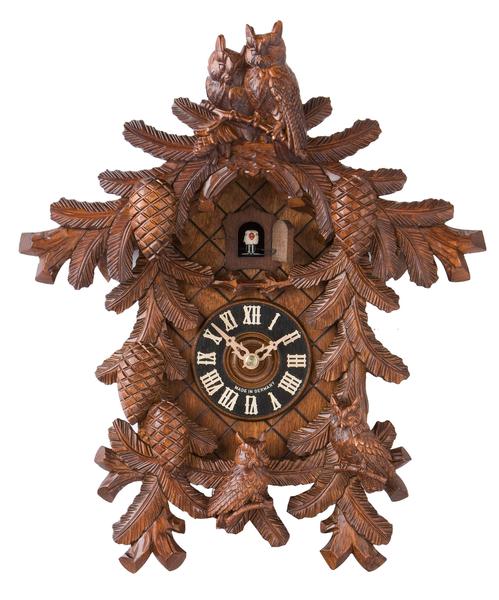
Cuckoo clock
These clocks are pendulum-regulated and make an automated sound like a cuckoo when it strikes the hours. Some can be very intricate with several animated characters. Desirable ones are antiques from the Black Forest region of Germany. Modern ones are generally frustrating to repair, cheaply built, and are poor timekeepers.
Lantern Clock
Converted lantern clock
A lantern clock is a type of antique weight-driven wall clock, shaped like a lantern. They were the first type of clock widely used in private homes. They probably originated before 1500 but only became common after 1600 and in Britain, around 1620. They became obsolete in the 19th century. The one pictured above has been converted into a fusee movement.
Alarm Clock
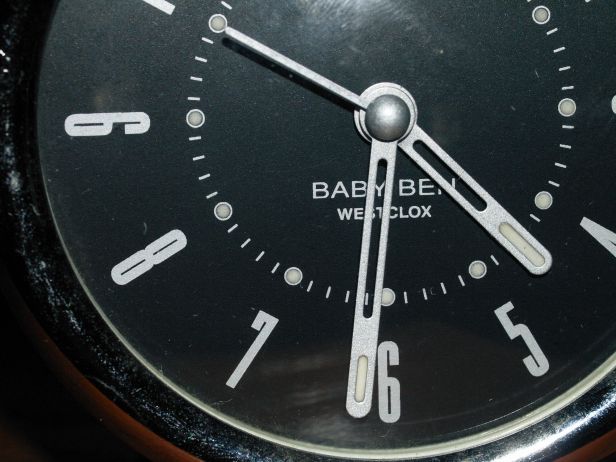
Baby Ben alarm clock with seconds hand
Alarm clocks are wound once per day and designed to do two things, wake you and display the time. They are cheap, and are average timekeepers but have long-lasting and reliable movements.
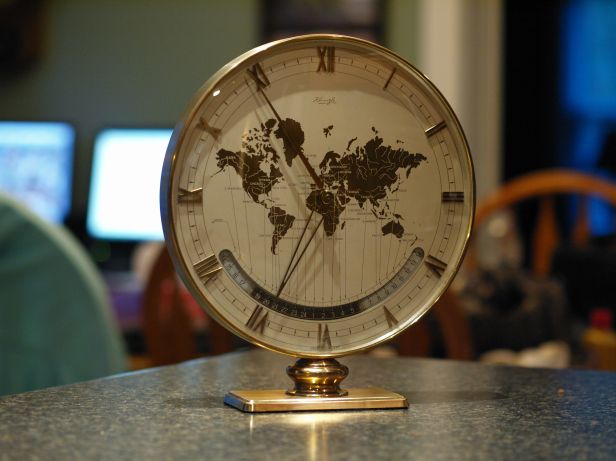
Desk Clock
Kienzle World Time clock
These sat on fancy office desks or credenzas in office locations. They are either time-only or time-and-strike. Most were time-only to minimize distractions in the office environment. Some are very attractive and have unique designs and are more decorative than utilitarian. This one above is called a World Time Clock by Kienzle.
Wall Clock
German Mauthe Box clock
A wall clock is broadly defined as any clock designed to be hung on a wall, making it a practical and visible timekeeping solution. Wall clocks come in various styles, from simple and functional designs to highly decorative pieces. This one by Mauthe is often described as a German “box” clock which became popular after the First World War and made into the 1940s.
Schoolhouse Clock
Ansonia schoolhouse clock
They are known as schoolhouse clocks because they hung in many schoolrooms in North America. Usually distinctive by their octagon shape and short or long drop feature with a glass door displaying a swinging pendulum. Many thousands were made; they had cheap mass-produced softwood cases and robust movements. Most were time-only though some were time and strike and others even included a calendar function.
When they were marketed years ago they were not called “schoolhouse clocks” but rather, clocks made for the schoolroom.
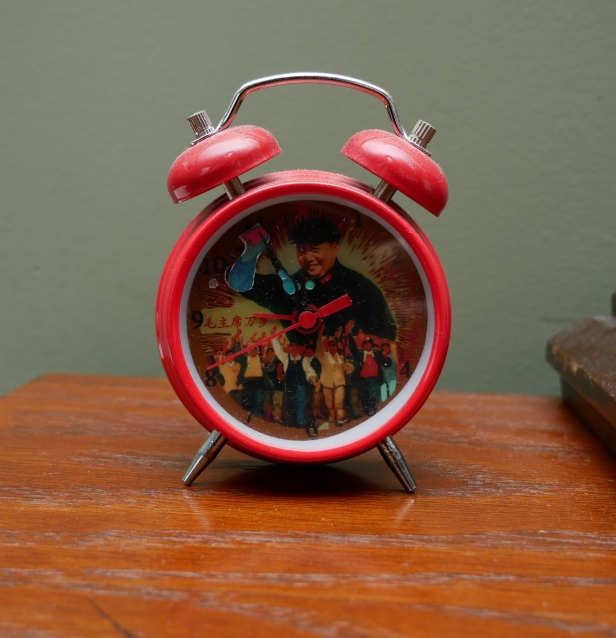
Novelty Clock
Chairman Mao Zetong waving as the clock ticks
These clocks are designed for the tourist trade with interesting features. In the case of the above clock, a smiling Mao Zedong has his little red book in hand and is waving “to the masses” as the clock ticks.
Ogee Clock
Waterbury OG clock
It is so-called because of the curved molded wood case. It might also be referred to as an OG clock. The design originated in the United States in the 1830s, distinguished by a case (usually pine) the front outer edges of which are curved into an S-shape (Ogee). This shape is formed by the union of a convex and a concave line. A mass-produced variant of the shelf clock, the Ogee clock typically stands about 30 inches (75 cm) high and is usually weight-driven. The movements were generally made of brass (earlier ones were made of wood) and ran for 30 hours or eight days. This is a 30-hour weight-driven version from the 1870s.
Tall Case Clock
Ridgeway Hamilton Country, Westminster chime
Tall case clocks are known by various names depending on the region. They are referred to as tall-case clocks in American terminology, long-case clocks in British terminology, hall clocks in Canada, and sometimes as floor clocks. However, the most commonly used term is “grandfather clock.”
They are usually weight-driven, with the weights on chains or cables, and are distinctive by their obvious height. They are always 6 feet or over but can be as high as 8 feet high (1.8 to 2.4 meters). They often feature elaborately carved ornamentation on the hood (or bonnet), the frames, the throat, and the dial or clock face. Older ones have 30-hour movements but all modern grandfather clocks run on an 8-day cycle.
Smaller clocks are called grandmother and granddaughter clocks. They are under 6 feet.
Anniversary Clock
Kundo standard size 400-day clock
These clocks are also called torsion clocks or 400-day clocks. 400-day clocks are torsion driven having a long suspension spring to which a weight oscillates back and forth. Typically these clocks operate at 8 beats per minute and run for long cycles on a single wind, up to 400 days. These clocks were popular as wedding gifts or gifts to mark special occasions. They are relatively simple to repair but can be finicky to set up. The newer quartz clocks are very accurate but do not replace the charm and curiosity of the older mechanical ones.
Some might call them purely decorative.
Tower Clock
Tower clock in Holguin, Cuba
In the early 14th century large mechanical clocks began to appear in the towers of Italian cities. There is no record of any working models preceding these public clocks that were weight-driven and regulated by verge-and-foliot escapements. They are referred to as Turret clocks in the UK.
In conclusion, while there are sub-categories for some of the clocks described above, this overview provides a general understanding of the commonly used terms. Having this knowledge can be especially helpful when shopping for a special gift or identifying the style of clock you may have in your possession.
Mercedes makes a great car. Do they make clocks? No! Is this Mercedes novelty timepiece a great clock? Read on.
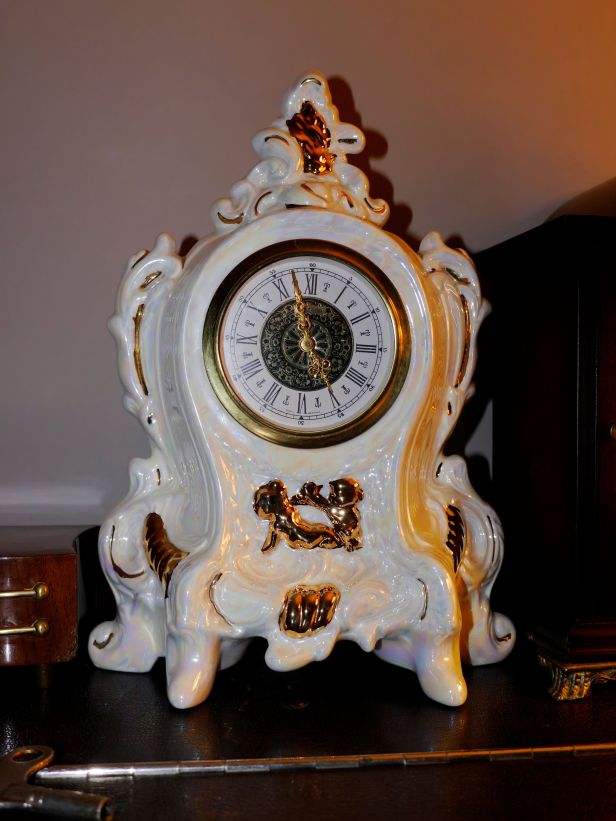
Attractive ceramic clock with time-only movement
This very attractive 30-hour Mercedes ceramic mechanical shelf clock of the Baroque Meissen style (debatable) from the 1970s is more of a novelty item than a clock.
It is a time-only alarm clock movement made by Gebrüder Hauser and marketed under several names one of which is Mercedes. Ceramic clocks on eBay or any other auction sites will reveal the Mercedes name as well as other retail names on similar-looking clocks. For example here is a similarly styled Alana clock. Same casting sans gold detailing.
The Alana, similar to Mercedes but without the gold-colored accents
This Mercedes novelty clock is in excellent condition with no chips, cracks or any sign of wear. But is it worth anything? Not a lot.
History of the company
The Gebrüder Hauser clock factory (Die Uhrenfabrik Gebrüder Hauser) was founded in 1923 by Otto and Josef Hauser in Weigheim, Germany. Josef Hauser resigned in 1926 and moved on to form his own company. The company name Gebrüder Hauser then received an additional owner, Otto Hauser.Aside from alarm clocks, clocks with pendulums and chess clock works were produced.
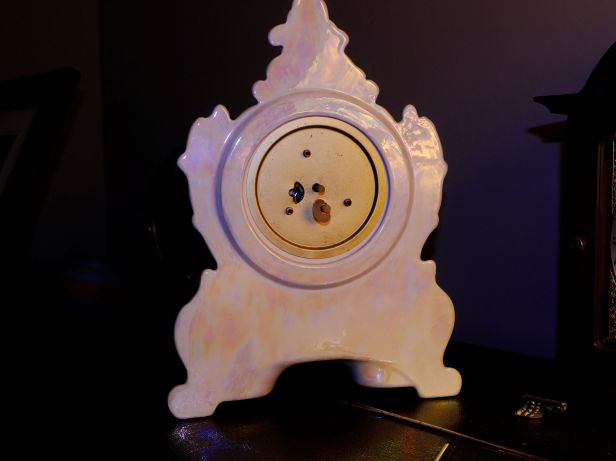
Spring winder, time set screw and speed lever on rear of the clock
In 1951, the son, Eduard Hauser joined the company.From 1955 onward small affordable alarm clocks and chess clockworks were manufactured.In 1965 Norbert Hauser joined the company and the company name was changed to KG.
The Gebrüder Hauser KG clock factory in Weigheim was eventually closed on 31 July 1998.
Are they common?
There are a number of variants of this clock, mechanical, electrical, and quartz. The mechanical version will command higher prices and is more desirable. Unfortunately, they are throwaway clocks and the cost of servicing would be far more than they are worth.
Nevertheless, it makes for an attractive mantelpiece and as a gift, it is likely the recipient will not keep it wound.
I am a retired educator living in Nova Scotia Canada. I collect vintage and antique clocks that I repair and maintain. I also write about horological areas of interest, interesting clocks and clock stories when I search for new acquisitions.
As most bloggers know the key to building a successful blog is not only attracting new visitors but keeping existing ones interested enough to come back
Baby Ben alarm clock with seconds hand
In the spring of 2015 I began my journey into blogging. The first few months of writing about clocks, clock collecting and repair were very challenging. How could I interest those who not only collect antique and vintage clocks but have just a passing interest? As time went by I began to realize that there was plenty to write about, that the world of clock collecting and repair is incredibly vast and that there is much to learn.
This blog has given me an opportunity to profile my own clock collection, walk the reader through the challenges of restoring and repairing my clocks and the knowledge gained from those experiences.
Cuckoo clock
As I write this article my blog has over 49,000 total views, 33% from United States, 17% from Canada and the remainder from around the world including the United Kingdom, Australia, Romania, Germany, India, The Netherlands, South Africa, Malaysia and 80 other countries. The top 5 articles this year were:
Mauthe Mantel Clock
Daniel Dakota Wall Clock
What is my clock worth?
How to wind a mechanical clock
U.M. Muller Box Clock
As most bloggers know the key to building a successful blog is not only attracting new visitors but keeping existing ones interested enough to come back. In the past year alone viewership has doubled. My visitors average 1.8 articles per visit with an average of 88 views on a typical day in 2017. November and December peaked at 100+ views per day.
Swiss made smoothing broaches
Providing enough stimulating content so that visitors want to return is always a challenge. I post 7 articles a month, sometimes one or two extra, usually spaced 4-5 days apart, on various topics of interest. I also attempt to appeal to all facets of clock collecting and repair from profiling my own acquisitions and experiences restoring and repairing my clocks to articles of general interest. I also inject historical horological context as much as possible.
I receive about 30+ comments per month on average. All comments and inquiries are welcomed. Interesting comments come from people who typically ask me how much their clock is worth, particular problems they have with their clock, strategies for repair and information about the history of their clock. All questions are answered to the best of my ability but I make no pretense that I am a trained professional.
Miniature one-weight Vienna wall clock, circa 1870
In 2018 my intent is to continue to write interesting articles about clocks in general as well as profiling my modest but expanding collection of antique and vintage clocks. I also plan to explore special areas of interest.
Future articles include, “Letting a clock sit without running”, “Mercedes clock – not made by the car folks”, my 4th Arthur Pequegnat clock, a second installment of the Waterbury Ogee 30 hour clock, a mini New Haven Ogee that has some curious modifications, how to set up your grandfather clock, “What style clock do I have?” and more Crazy Clock Ads.
Ingraham Huron mantel clock circa 1878
Mauthe Westminster chime mantel clock
Stay tuned and if there is an area of interest you would like to see me to explore, drop me a quick note. If you like what you are reading express “Like” it at the end of each article.
Thanks for your comments, your encouragement and your continued support.
You can still buy a brand new Westclox today and few people realize that the company was a pioneer alarm clock manufacturer.
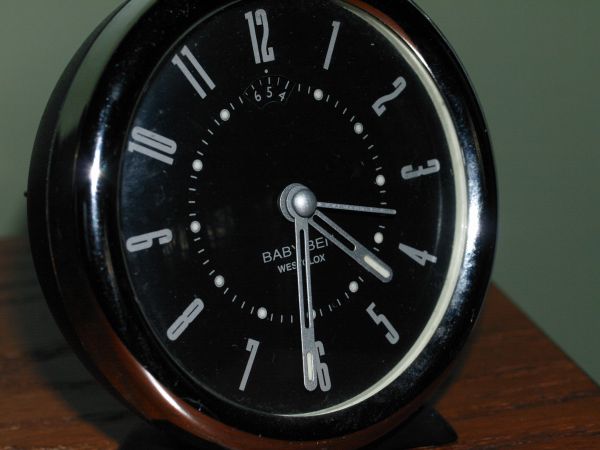
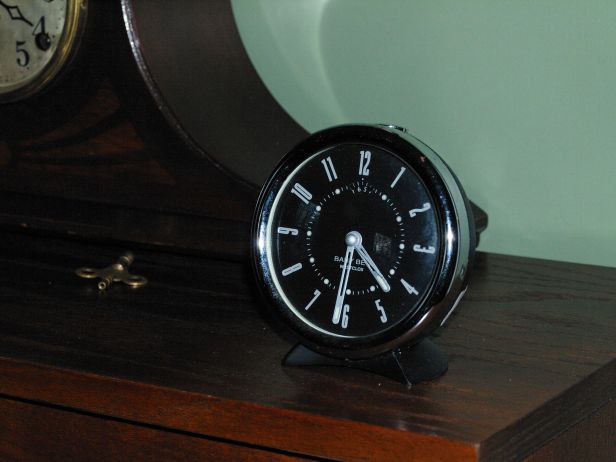
Baby Ben alarm clock
This is a nondescript Baby Ben clock; thousands were sold but unlike older alarm clocks made in the USA and made and/or assembled at the Peterborough plant in Ontario (Canada), this one was made in China.
The Baby Ben has had a long and interesting history. The Baby Ben movement was originally marketed in 1910 and first nationally advertised in 1915. The 5-year delay occurred because the company was going through organizational changes and it took 3 years to improve the reliability of the Baby Ben movement.
An early Baby Ben, the Westclox LaSalle alarm clock
In 1912 Westclox opened a sales office in Toronto, Canada as part of its policy to establish world markets. Between 1920 and 1922 production began at the plant in Peterborough, Canada. At that time parts were shipped from the LaSalle-Peru plant for final assembly in Canada. Unfortunately, there is no information on which clock parts were made in Canada and which parts were manufactured in the Peterborough plant through the years.
Thousands of Baby Ben alarm clocks were manufactured and sold through the 1920s to the 1970s. In the early 1980s production in Canada ceased. “Westclox” and “Big Ben” trademarks were acquired by Salton Inc. in 2001. In October 2007, Salton sold its entire time products business, including the Westclox and Ingraham trademarks, to NYL Holdings LLC, which, to this day sell clocks under the Westclox name. In addition to clocks the company’s line of business also includes the wholesale distribution of jewelry, precious stones and metals, costume jewelry, watches, and silverware.
Baby Ben alarm clock with second hand
Back controls
I have not had the chance to look inside this alarm clock but from its style and other design elements it is from about 2001 when production shifted to China under General Time Corporation, parent company of Westclox, just prior to the sale to Salton and before quartz clocks entered the mainstream. It is the Style 10 Baby Ben with radial numerals and a sweep second hand.
This example is still working and keeping good time. I bought it to study the Baby Ben movement.
Though every bit as reliable as the older American and Canadian alarm clocks it is unfortunate that we lost this segment of the industry to the Chinese. For more information on the history of Big Ben and Baby Ben clocks you can go here called appropriately enough, Westclox History.
During the early days of the industrial revolution a certain practice lasted well into the 20th century. These were days before alarm clocks were affordable and reliable when workers had to rely on professions that we would not think would ever have been considered mainstream work.
One of these professions was the person whose job it was to wake people up. The profession is sometimes referred to as the knocker-upper. It was the job of the knocker-upper to make sure people got to work on time. Large numbers of these persons worked in the industrial centers of England and Scotland where the poor could not afford their own watches.
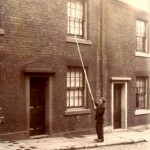
They were often women or the elderly but occasionally police constables would work as knocker uppers to supplement their income. Aided with a long stick the knocker upper would tap on the bedroom window and proceed to the next customer’s house. He or she would not dawdle, 3 or 4 taps and they would be swiftly on their way. Other methods were often used; a rattle, or soft hammers and even pea shooters.
With a long stick the knocker upper would tap 3 or 4 times
My how times have changed. How do you get yourself up in the morning?
The Westclox Clock Company is better known for various versions of Big Ben and Baby Ben windup alarm clocks produced from 1900 to the mid 1980s. But there were other windup models one of which is the Art Deco styled LaSalle series. This is the model 61-C (401) otherwise known as a Dura clock because they have nickel-plated, die-cast zinc cases made by The Dura Casting Corporation in the United States. There are 6 models in the LaSalle series and all use the Westclox type 61 Baby Ben, one day movement.
Westclox LaSalle alarm clock
Gee that old LaSalle ran great….those were the days! (a line borrowed from the theme song to All in the Family)
I have a modest collection of alarm clocks and if something interests me I will buy it. My wife found this Westclox Alarm clock at an antique store in Halifax (Nova Scotia, Canada). At $20 the price was right. It is solid, well made, attractive and partially assembled in Canada.
There is no information on which clock parts were made in Canada and which parts were manufactured in the Peterborough plant through the years
Westclox alarm back of clock showing winding mechanism; oftentimes knobs are missing on these old clocks
The LaSalle 400 series ran from 1930 to 1934. This is model 61C. The clock measures 3 1/8 inches high. The base is 3 1/4 inches and the depth is 1 3/4 inches.
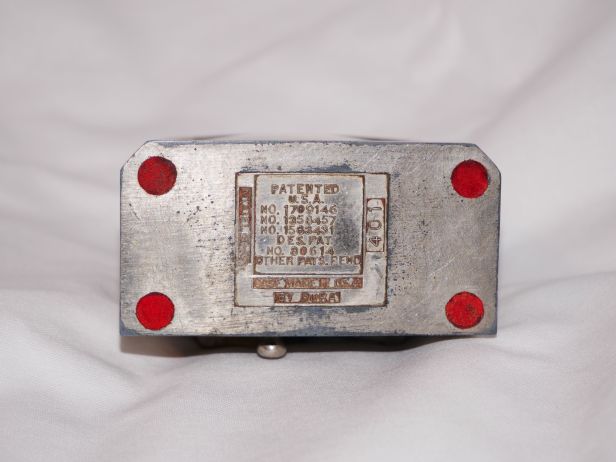
Bottom of clock showing Patent dates & “Case made in USA by Dura”
Inside is a Baby Ben movement. The Baby Ben movement was first marketed in 1910 and first nationally advertised in 1915. The 5-year delay occurred because the company was going through organizational changes and it took 3 years to improve the reliability of the Baby Ben. The patent date on this clock is 1914.
In 1912 Westclox opened a sales office in Toronto, Canada as part of its policy to establish world markets. Somewhere between 1920 and 1922 production began at the plant in Peterborough, Canada. At that time parts were shipped from the LaSalle-Peru plant for final assembly in Canada. Unfortunately, there is no information on which clock parts were made in Canada and which parts were manufactured in the Peterborough plant through the years. Thousands of Big Ben and Baby Ben alarm clocks were manufactured and sold through the 1920s to the 1970s. In the early 1980s production in Canada stopped.
I avoid clocks with radium dials. Since radium has a half-life of hundreds of years even old radium dials are very hazardous. If working on a clock with a radium dial care should be taken to prevent the inhalation or ingestion of flakes or dust which may contain radioactive materials. In the past several years radium dials have largely been replaced by phosphorescent – or occasionally tritium-based light sources.
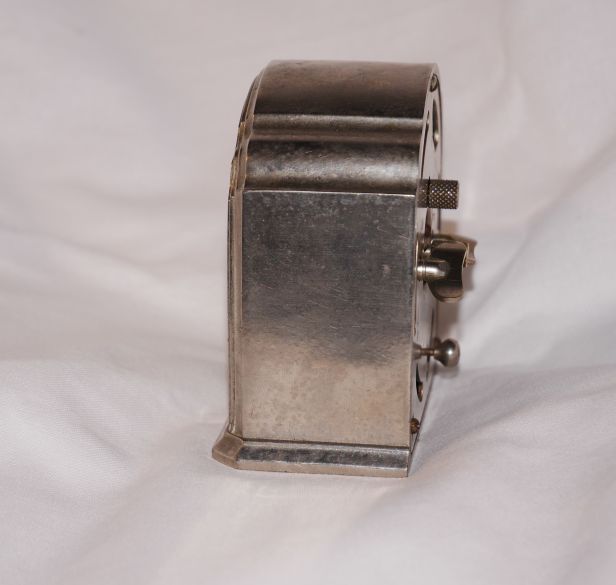
Side view of alarm clock
I took the back cover off and found an inscription indicating that it was last serviced in 1955. The markings are unusual because alarm clocks rarely see servicing and once they stop they are simply discarded or used as paper weights.
That LaSalle may have run great at one time but not now. I can hear it ticking but once set down it abruptly stops. A thorough cleaning is required.
It is a nice piece of Canadian Horological history.











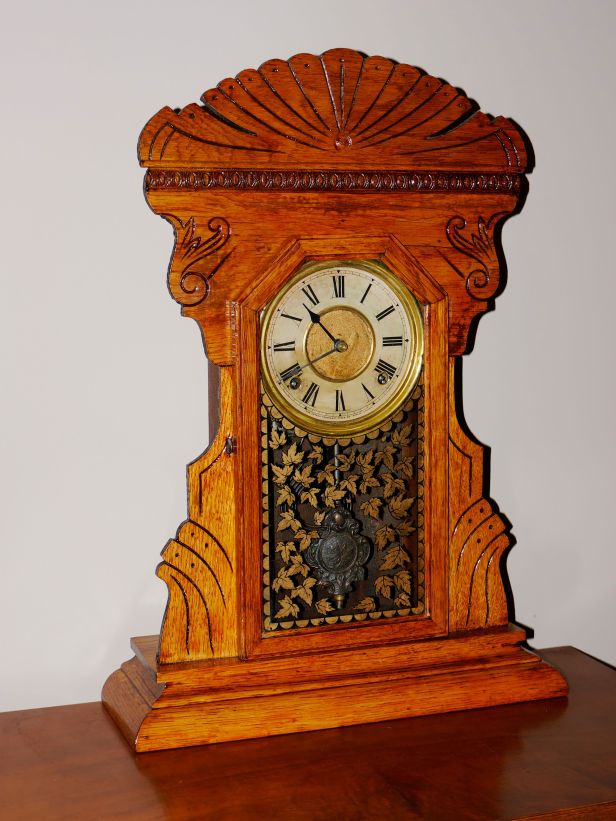

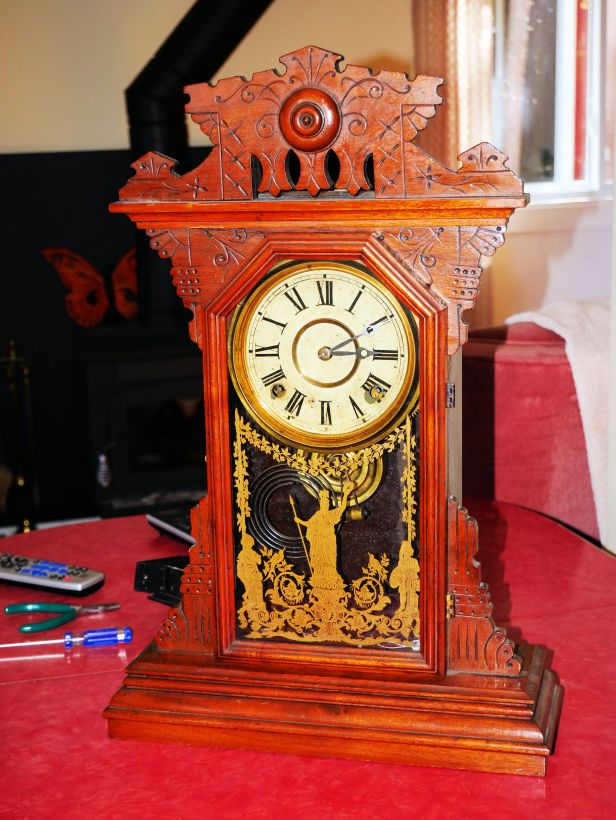
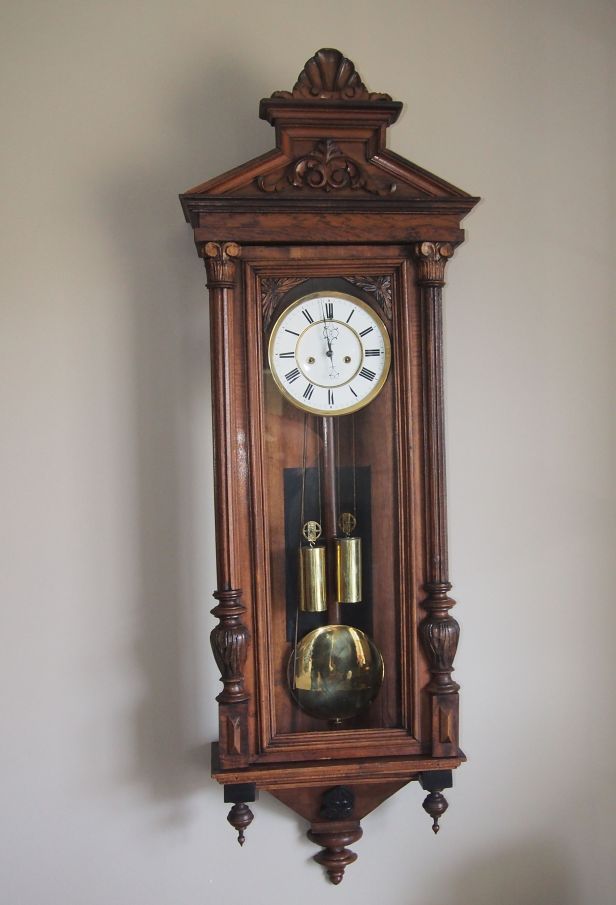
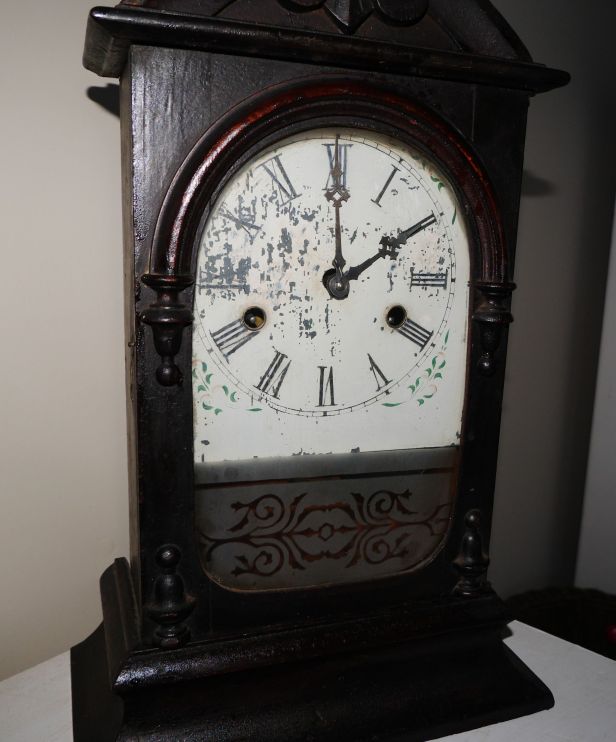










 Antique and Vintage Mechanical Clocks
You must be logged in to post a comment.