
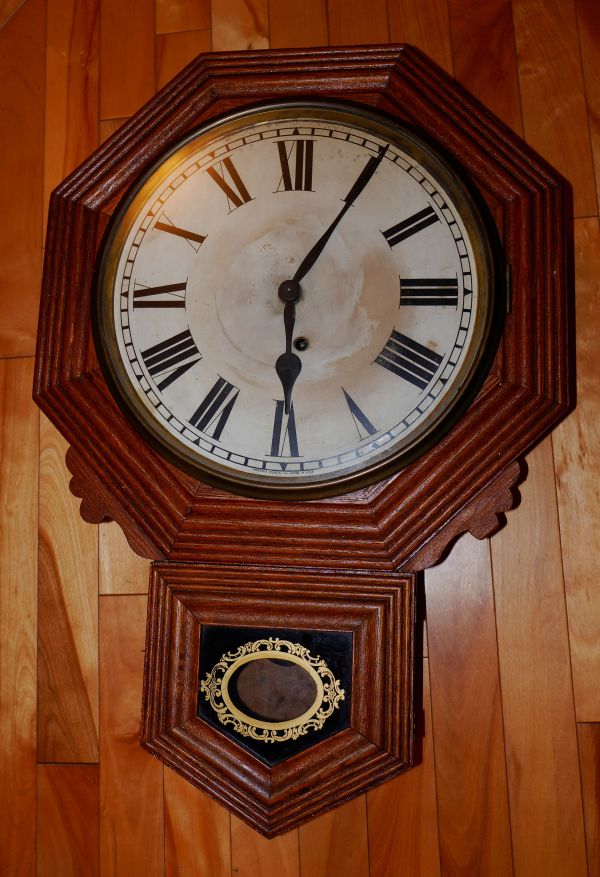
We live in the northern part of Nova Scotia, and a trip to the Annapolis Valley for clock hunting is always a pleasure on an early fall day. It’s one of the province’s most beautiful regions — a mix of rolling hills, orchards, small farms, and picturesque little towns that always seem to welcome you back. Our destination this time was the town of Berwick, nestled right in the heart of the valley. It’s one of those places where time moves just a little more slowly — fitting, perhaps, for the clock that awaited us there.

We had planned the trip beforehand, arranging to meet the seller at an agreed-upon time. The seller welcomed us warmly into his home and soon began to share the clock’s story. The clock had been in his family for over fifty years. “I never actually saw it running,” he said with a smile, “but my mother really loved that clock.” His mother had recently passed away, and he was in the midst of settling her estate. It was clear that selling the clock was not easy for him — it held sentimental value, as many family clocks do, but he knew it was time to let things go.
He told me that an antique dealer had been through the house earlier and offered one price for each room. “The clock alone was worth more than what he offered for one whole room,” he said, shaking his head. I could tell he wanted it to go to someone who would truly appreciate it. I promised it would be cared for and restored.
He believed the clock had come from an old schoolhouse in Ontario, decommissioned sometime in the 1950s, though its exact location has been lost to time. One can imagine it ticking away the hours for many years in that classroom.
The pine case is in lovely condition with only minor issues. Around the center of the dial, near the winding holes, some paint has been added — likely an attempt to cover small stains from decades of oily fingers winding and adjusting the clock.
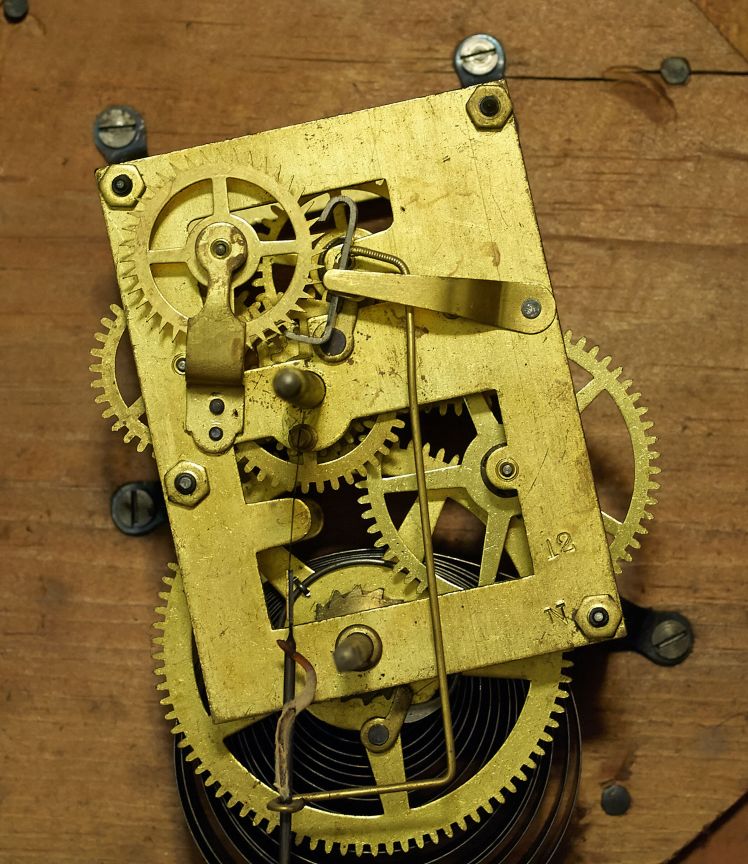
The clock is an Ansonia octagonal short drop, often referred to as a schoolhouse clock. I’d place its manufacture around the turn of the 20th century — likely between 1900 and 1912. The number “12” is stamped on the movement, which may represent the year, though it could also just be a batch mark. The faint Ansonia trademark is still visible, and the letters “TT” are stamped nearby. This was my first Ansonia, and it’s always a thrill to study a new movement up close.
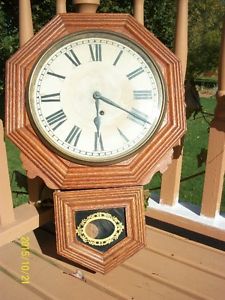
One issue quickly revealed itself: the hour hand bushing was missing. The bushing provides the necessary friction fit with the cannon pinion, and without it, the hand simply spins. I suspect that’s why the clock was deemed “not working.” Someone probably thought the movement was faulty when, in fact, it was just missing this small part. Fortunately, it’s an easy fix that can be done with a replacement or a handmade bushing.

When I examined the pendulum, I noticed something curious — small pieces of a rotted elastic band on the rod just below the suspension spring. Why it was there, I have no idea. Perhaps someone thought it would steady the pendulum, or maybe it was part of an old improvised repair. These little mysteries often make clock restoration interesting.
After a minor adjustment — a slight bend of the crutch to bring the clock into beat — it began ticking steadily. There’s minimal wear visible, which was confirmed when I removed the movement for a full cleaning and inspection.
Much has been written about the Ansonia Clock Company, once one of the great names in American clockmaking. The company went into receivership just before the 1929 stock market crash — a sign of difficult times ahead. The machinery and dies were later sold to a Russian company, marking the end of an era. It’s always a little sad to think that such a remarkable chapter in horological history closed that way. Clocks bearing the Ansonia name are still sold today, but the name on the dial bears no real connection to the company that once was.
When the new hands arrived in the mail, the final touches were complete. The hour hand came with a proper bushing and fit perfectly on the cannon. The clock, fully serviced now, runs beautifully — a fine old Ansonia, rescued from dormancy and restored to life. It’s now proudly ticking away on my daughter’s office wall in Alberta, keeping time as faithfully as it did more than a century ago.


 Antique and Vintage Mechanical Clocks
You must be logged in to post a comment.