
Pendulum Length Vs. Pendulum Weight in Clocks: What Matters More?
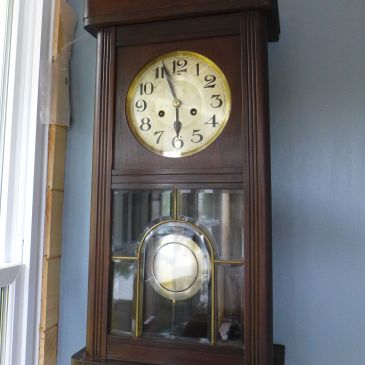
A clock’s pendulum is a swinging component made up of a rod or wire with a weighted bob attached at the end. It is a key part of pendulum clocks, responsible for regulating the movement and ensuring accurate timekeeping.

The pendulum swings back and forth in a precise, periodic motion, controlling the clock’s escapement mechanism and dividing time into equal intervals.

The topic of pendulum weight is a frequent subject of discussion among amateur and professional horologists.

The weight of the pendulum in mechanical clocks is not critical for precise timekeeping but must fall within an acceptable range. Let’s explore why in this article.

Controlling variables

The controlling variable is the length of the entire pendulum assembly (suspension spring, pendulum leader, pendulum bob) from the point where the suspension spring flexes to the center of mass of the entire pendulum assembly. Some clocks will have that length expressed in centimeters or inches stamped on the movement plate.

These numbers 34 and 116 are found on most German antique time and strike clocks
The number 34 refers to the length of the pendulum in centimeters

The weight of a pendulum has a much smaller effect on its timekeeping compared to the length. In an ideal pendulum, the time it takes to complete a swing (the period) is mostly determined by the length of the pendulum and the acceleration due to gravity, and not by the weight.

The weight of the pendulum

In practical mechanical clocks, the weight of the pendulum can affect the clock’s movement in subtle ways. However, the pendulum’s weight must fall within an acceptable range specified by the movement’s design.

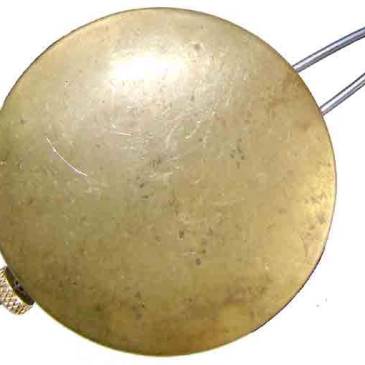
pendulum bob with adjuster
Pendulum bob with adjustment screw

Heavier pendulums are less affected by air resistance. A pendulum that is too light may slow down more over time due to friction with the air. Heavier pendulums tend to be more stable in motion and less affected by external forces like small drafts or air currents.

The weight of the pendulum can affect how much power is required from the clock’s escapement mechanism to maintain the pendulum’s motion. A heavier pendulum may need more energy to keep swinging. If the clock’s escapement is designed for a certain weight, using a much heavier or lighter pendulum could affect timekeeping accuracy.

Suspension spring post

On the other hand, heavier bobs tend to overcome mechanical friction more effectively. If the clock’s gears or escapement are under significant load due to weak mainsprings, old grease, or worn pivot holes, a heavier bob helps maintain consistent motion by stabilizing the escapement’s action. If the clock runs better with an overly heavy pendulum bob, it’s a sign of wear, indicating that the movement needs servicing.

Worn Pivot hole
Worn Pivot hole

Additionally, the attachment points (or suspension) of the pendulum and the escapement mechanism may experience increased wear or friction if the pendulum is too heavy. This could cause irregularities in the clock’s timekeeping over time.

In summary

While the length of the pendulum is the primary factor controlling the rate of timekeeping, the weight affects stability, efficiency, and how the clock interacts with the pendulum. However, the length of the pendulum, rather than its weight, is the primary factor in determining a clock’s accuracy.

For a more detailed or technical analysis, horological journals and bulletins delve deeper into the physics of pendulum design and weight. However, I hope this straightforward explanation will be sufficient.

How to Keep Your Clock In Beat

You have just brought a clock that was running smoothly when you first saw it. You bring it home, select a location to display it, reattach the pendulum, and give it a slight push but after a few seconds, it stops. One crucial aspect of keeping a mechanical clock functioning properly is making sure it is “in beat.”

This article assumes that your clock is equipped with a pendulum rather than a balance wheel or platform escapement. A pendulum on a clock is a weight suspended from a pivot so that it can swing freely back and forth. The pendulum’s regular, consistent motion is used to regulate the time on your clock.

What does In-beat Mean

When a clock is “in beat,” it means that the pendulum swings symmetrically, with equal time intervals between the ticks and tocks. This even rhythm ensures that the escapement releases energy consistently, which is essential for keeping accurate time. You will hear a steady “tick-tock” rhythm, with equal spacing between each tick and tock.

If the rhythm sounds irregular—like “tick-tick… tock-tock” or has uneven gaps—the clock is out of beat, meaning the pendulum is not swinging properly in balance.

Ogee clock showing replacement pendulum bob
Ogee clock showing a brass pendulum bob

As the pendulum swings, it controls the release of the clock’s escapement, which allows the gear train to move in a controlled manner, driving the clock’s hands forward.

How to Correct a Clock That’s Out of Beat

Method 1: Tilting the Clock

One way to fix a clock that’s out of beat is by gently tilting it sideways while listening for the sound to become even. Once you hear an even tick-tock pattern, prop the clock in place to maintain the tilt. While this method works, the clock may end up looking tilted and uneven in its position.

Method 2: Adjusting the Crutch

The second method is more precise and involves adjusting the crutch. The crutch is the rod that extends down from the pallets and rocks back and forth with the escape wheel. The pendulum rod passes through a crutch loop or fork at the end of the crutch, and it’s important to ensure the pendulum rod sits in the middle of the loop without being too tight or too loose. The crutch connects to the pendulum leader, which is then attached to a post with a suspension spring.

Mauthe movement back plate
Movement crutch and pendulum leader

For mantel clocks, making this adjustment is relatively straightforward, as they usually feature rear access doors. Through these doors, you can easily reach the crutch, pendulum rod, and bob. If your clock has a wire crutch (brass wire is pliable), gently bending the wire slightly at the midpoint in either direction will help correct the beat.

For English and German-style clocks, you can make a slight adjustment to the crutch on one side or the other since the crutch is connected to the escapement arbour and fits snugly but moves enough to make an adjustment. Moving it alters the entry and drop of the escapement pallet and corrects the beat.

Additionally, you may need to adjust the height of the escapement by loosening two screws on the suspension spring post and repositioning the pallet, a process that requires time and patience and is best performed on a movement test stand.

Wall clocks, on the other hand, require more effort to perform a beat adjustment. To access the crutch on a wall clock, you’ll need to remove the hands— the minute hand is held by a screw or pin, and the hour hand pulls off— and then remove the dial, which is usually attached with screws. Once these parts are removed the crutch can be adjusted.

Minor beat adjustments on wall clocks can also be made by slightly tilting the clock. The tilt may or may not be noticeable.

A One-Time Procedure

The good news is that you’ll only need to adjust the beat once. Whether your clock is a wall clock, mantel clock, time-only, time and strike, or time, strike, and chime, the principles remain the same. This is a straightforward DIY procedure, so professional help is not necessary.

Moving the Clock

If you relocate the clock to a different spot, it’s often necessary to repeat the process of checking and adjusting it to be in-beat. This is because changes in the environment, such as variations in surface level or vibration from nearby activities, can affect the pendulum’s swing. After moving the clock, always recheck if it is in beat. You may need to re-adjust the pendulum’s crutch to ensure a smooth and even tick-tock rhythm.

Final thoughts

If your clock is not running and efforts to put it in beat have no effect, several underlying issues require remediation. If there is significant wear of the pivots or pivot holes, wear in the pinions, there are broken components, or dried oil creating friction in the movement, all of which may need attention to restore the movement’s function.

After the movement has been serviced, adjusting the clock to be in-beat becomes a much easier task.

For a more comprehensive or technical examination, horological journals, articles, and bulletins provide in-depth insights into the physics of escapement design and theory. However, I trust that this simple explanation will suffice.

There’s something wonderfully calming about the rhythmic ticking of a perfectly in-beat clock.

Tick Talk Tuesday #29 – A bob for a Pequegnat wall clock

DBs friend’s clock is similar to this one, an Arthur Pequegnat Brandon (2nd edition)

Tick-Talk Tuesday is about the letters and comments I have received from you, the reader, concerning your clock, issues you might have had, challenges you face or a clock you would like me to profile or my responses to your questions with advice on your particular clock concern. For those comments and questions that stump even me, I consult within my clock circles for the best possible answer

DB wrtes,

“Good morning, I stumbled across your site this morning while looking around for parts for what I think is a Pequegnat Brandon. It belongs to a friend and is missing the pendulum bob and key, but she thinks it works otherwise. I found parts that seem to be appropriate, but I’d like to find originals (or close to it) if I could.

Any advice?”

Pendulum bob
Pendulum bob

My reply,

Hi DB,

Thanks for your email. There is no known source for original Pequegnat parts although you might get lucky on eBay when clocks are parted out. It must be as close to 4.3 oz. or 125 grams, 62mm or 2.5 inches as possible, and it must be adjustable. I don’t see anything at Perrins, a Canadian supplier and the closest I could find is this one at Timesavers in the US. This one at Ronell looks to be the same but cheaper.

https://www.ronellclock.com/Adjustable-Pendulum-225-Bob-PM-63.htm?categoryId=-1

Ron

DB reply,

“Wow Ron, that’s very helpful, thank you very much.”

Website Powered by WordPress.com.

Up ↑