I have worked on several Gilbert clocks in the past few months which is unusual for me. Certain makes of clocks seem to come in bunches. This clock is a 6 column time and strike antique Gilbert mantel clock made in 1913, and reflects a period when every American maker had a similar style. Some parts of the case have an Adamantine finish but those particular areas are not in good shape.
A family relation asked me if I could get it running. Sure, I said.
Gilbert 6 column mantel clock,1913
History of the Gilbert Clock Company
The Gilbert Clock Company began making clocks in December of 1828 and produced clocks over a span of 130 years.
In 1837, John Birge joined the firm, and the name was changed to Birge, Gilbert, & Company. Shortly thereafter, Chauncey and Nobel Jerome and Zelotus Grant became partners with Gilbert, and in 1837 the company was know as Jerome, Grant, Gilbert, & Company. This company manufactured Jerome’s cheap brass-movement clocks.
While antiquing some time ago I came across boxes of clock movements in a shop. Some were fairly new though I found a Gilbert time and strike date stamped 1906 which piqued my interest. In the box was the key, the coil gong, clock hands, pendulum and movement mounting screws. A movement without a case. Hmm, interesting! Here’s what I’m thinking.
You dig up an old clock from the basement. It was your mothers and you were immediately reminded of the soothing sound of the clock when you were a kid. Wouldn’t it be nice to get that old clock running again. You fiddle with it and despite your best efforts you just cannot get the thing going. Why not bring it to the local clock-maker? He takes a look at it and explains that it is worn out. It will cost much more than the clock is worth to repair it, he says. But there is a solution. Take the works out and replace the movement with a reliable quartz one and all for less than half the cost of a repair. It sure would be nice to get that old clock running again and who would know that a new quartz movement is inside. The clock-maker takes the movement out, asks the customer if they want it, puts it in a box on a shelf and uses it for parts on the next clock. I’ll bet I’m close.
It is a Gilbert time and strike with a passing bell strike on the half hour. It has a distinctive 24 hour count wheel meaning that the count wheel rotates just once every 24 hours, each half with slots for 12 hours.
Gilbert time and strike date stamped 1906
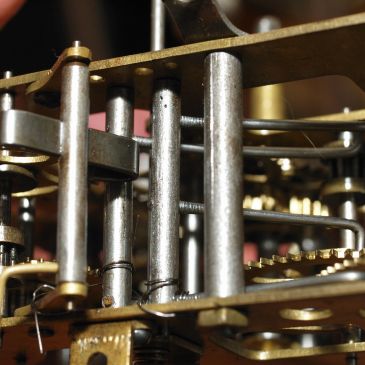
It sat in a box in my office for several months. The other day I placed the movement on a test stand to determine its condition, wound the time side and BANG, the mainspring blew apart. A nice clean break! Luckily it did not take me or any other parts with it. The break was so far from the loop end that the mainspring was not salvageable. You can see the snapped section of the left mainspring in the photo above. Determined to see this movement in running condition I ordered a new spring from a clock supply house.
Top plate removed
When I dis-assembled the movement it was worn but repairable. However, all pivots were in very good condition except one, the second wheel on the time side, front plate. It was worn at the shoulder as you can see in the next photo.
Unusual wear on second wheel, time side
Was this enough to stop the clock and why just one? Perhaps a combination of factors. It is the second wheel and under the most axial load or probably a contaminated pivot hole with enough embedded detritus that would have ground away at the pivot shoulder.
There are only two solutions, fashion a new pivot or turn down the pivot and polish it. Fashioning a new pivot is a lot of work. However, there is enough steel left after it is turned down to give me a strong pivot. I chose the second option and installed a new bushing to fit the new pivot size which is much easier than re-pivoting. I put the wheel on a lathe and ground the pivot down to the size I wanted and then gave it a polish.
New bushing had to be punched to stay in place
The second issue was an old bushing that had been installed at some point in the clocks life. I drilled out the old bushing knowing that the replacement bushing would be loose. Alas, it slipped out too easily. The solution, two punches adjacent to the bushing to secure it in place. Punching a brass movement is rarely a good idea but this was a solution that was appropriate to the situation.
I installed two more bushings on the strike side second wheel back plate and third wheel front plate and one more on the time side, second wheel, back plate.
With the new mainspring installed and the repairs completed, it was time to assemble the clock and test it. I cannot count the number of times when I have re-assembled an American time and strike only to find that the strike setup was slightly out of adjustment. You know you have a problem when the clock strikes until the mainspring winds down. Placing the lever in the maintenance cam while the count lever is directly into the deep slot and hoping that the warning wheel pin locks at just the correct moment is always fun. I have cursed a few times when I cannot get it right. In this case it was first time lucky, the stop pin was in the right location on my first try.
On the test stand, bell is now fixed in placeAs an aid in re-assembly toothpicks remind me of the location of the bell lever
The clock has been running but does not seem to be able to get past 5 days of an 8-day cycle. I realize that there are some things I need to address before I get this clock running a full cycle but I have other projects on the go. Since this movement does not have a case I took it off the test stand, put it in a box on a shelf, included some notes, and will address it at a later date when and if I ever get a case.
Notes about the movement reminding me what needs to be done
So, I’ll wait for that illusive case but in the meantime into storage it goes.
During two vacation trips to Cuba in the last 4 months I managed to locate a few clocks in my travels. Though some clocks were very intriguing none that I saw save for the tower clocks were in working condition. Nonetheless it made me wonder about their provenance in a land that time seemingly forgot.
At Christmas time my family and I traveled to Trinidad of Cuba. We stayed overnight at Los Helechos Hotel in Topes de Collantes which is located about a half an hour bus ride from Trinidad of Cuba. The next day we spend our time exploring the wonders of Trinidad of Cuba.
I saw some interesting clocks in a couple of restaurants. The first is a Wm L. Gilbert time and strike wall clock with calendar dial from Winsted Conn., USA. It looked like a reasonably well preserved dark walnut regulator clock with an 8-day brass movement with pressed features dating to about the 1900s.
Wm L. Gilbert clock found in a restaurant
The next is unknown to me. It is a Spanish clock. Whether or not Malaprade is the maker was difficult to determine as I could find no information on the internet. However, it is clear that this spring wound time-only clock with second hand feature was made in Barcelona. I would date it to pre-1930. It is a relatively short clock and might have been originally designed as a wall mounted clock as it stands less than 5 feet tall. I am not sure what the area around and below the keyhole represents. I cannot make out any sort of design if there is one.
Malaprade Floor or wall clock
Next is a floor clock. Again the maker is unknown. I do not see any winding arbors on the dial face and can only assume that it is weight driven (the weight was not attached) and that the weight (or weights) were pulled up by chain to reset the clock likely once every 8 days. This clock was clearly in meed of restoration as were most of the clocks that I saw.
Floor clock of unknown maker
In March we stayed at the Paradisus Rio de Oro in Holguin province located on Playa Esmeraldo near Guardelavaca. The resort is set on a beach next to Bahía de Naranjo Natural Park. In it are a number of interesting clocks.
Time only lobby clocks
There were a total of 4 of these lobby clocks which were originally intended to display time zones for the guests. They are time-only and the cases appeared to be in good shape but I do not think they have been running for quite a while. My thought is that there is nobody at the resort tasked with the responsibility of maintaining these and other fine clocks.
Face of unknown floor clock, second hand is missingUnknown floor clock
This clock actually works though it needs servicing. It is located in an ante-chamber adjacent to a Mediterranean themed restaurant. I opened the front door of the clock and found the rod gong impeding the pendulum. Once I dislodged the gong the clock happily began to function and it was in beat, surprisingly. Although it had two weights there were three winding arbors and I would be curious to see the internal workings of that movement. Inside the door was an official seal from the Ministerio de Cultura.
400 day clock
This 400 day clock was made in Germany. There were no other markings that I could determine. It could be a Kundo Kieninger & Obergfell dating to about the 1940s or so but that is just a guess. It needs a thorough servicing and clearly it has been neglected for some time.
Carriage or wall mounted clock
This is another an anniversary mantel clock but it appears to have a wall mounting bracket on the rear. Not sure why as these clocks are not meant for wall mounting. Again, an unknown maker but possibly German and in very poor condition. The front glass looks like it can be lifted up for adjustment purposes.
Clock in a peasants home
While hiking through El Cubana National Forest we came across a small dwelling and we were able to briefly tour inside. In it I found an old quartz clock dating from the 1980s or earlier.
Tower clock at Peublo La Estrella tourist villageTower clock in Holguin
The first tower clock is located in a tourist village in Cayo Santa Maria called Peublo la Estralla while the next is in a downtown principle square in the city of Holguin. The Olvera clock is a modern electric clock and I am assuming that the tower clock in Holguin might also be electric.
I am told that my next stop in Cuba (another time) should be the Paladar Decameron restaurant in Havana, a fixture in the paladar scene that’s located in the leafy residential district of Vedado. The restaurant is said to said have an old world charm with a collection of various collectibles including antique clocks of all shapes and sizes.
Cuba is a fascinating country and certainly worth exploring time and time again.
You must be logged in to post a comment.