Common Reasons Your Clock Is Running Slow

There are four general categories of clocks: quartz, electro-mechanical, electric, and mechanical. Mechanical clocks—whether antique or vintage—are the focus of this discussion on why a clock might run slowly.

We’ve become accustomed to the accuracy of quartz clocks, which lose or gain only milliseconds per week. Contrast that with an era when people were content to accept that their mechanical clock might be a minute fast or slow over the course of a week. It was common practice to make small adjustments throughout the run cycle of a clock.

In fact, a typical American spring-driven clock in properly serviced condition may gain or lose a couple of minutes per week as a norm. Weight-driven mechanical clocks that gain or lose only a few seconds per week are considered to be much more accurate.

That said, how many mechanical devices do you know that still run (relatively speaking) perfectly after 120 years?

A clock can run slowly for a variety of reasons.

  • Environmental
  • Pendulum too low or too high
  • Pendulum of incorrect weight
  • Suspension spring length is incorrect
  • Suspension spring is not attached correctly
  • Lack of lubrication
  • Gummed-up lubrication (over-oiled)
  • Balance wheel needs adjustment
  • Weak mainspring
  • Changes or alterations during servicing
  • Clock cycle time variance
  • Slipping or binding
  • Bent gear teeth or arbors

Let’s explore each one of these factors:

Clock parts

Environmental Factors

Mechanical clocks are subject to environmental conditions that may cause them to gain or lose time over the year. These include heat, cold, and humidity. Warmer temperatures can slow down a clock due to the expansion and lengthening of the pendulum, unless it has a compensating pendulum with mercury or dissimilar metal rods. Denser air can also cause the pendulum to swing more slowly.

Even a change in elevation, such as moving a clock from sea level to a higher altitude, can affect the speed of the clock.


Pendulum Too Low or Too High

The lower the pendulum, the slower the clock will run. Many pendulum clocks have an adjustment screw at the bottom or on the bob itself. If not, there is often a regulator on the clock face. You can use the small end of a double-sided key to insert into the dial and adjust the speed.

Shortening the pendulum speeds up the clock. Anything that increases the pendulum’s effective length will slow it down.


Incorrect Pendulum Weight

A pendulum that is too heavy lowers the center of gravity, which causes the clock to run slowly. Using the correct weight for your clock ensures proper and reliable operation.


Incorrect Suspension Spring Length

When someone unfamiliar with the mechanics of a clock replaces a suspension spring with one of the wrong length or thickness, the result is a clock that may run too fast or too slow. Always ensure the spring matches your clock’s specifications.


Suspension Spring Not Attached Correctly or Kinked

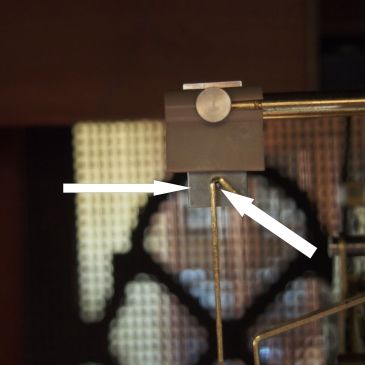
The suspension spring connects the top post to the pendulum leader and allows the pendulum to swing. If it’s not installed securely, the pendulum may not swing properly or may wobble, reducing efficiency and affecting the clock’s accuracy.

A kinked or damaged suspension spring will impede the smooth action of the pendulum rod.


Lack of Lubrication

Dry pivot holes mean there is no lubricating barrier between the pivots and the bearing holes—even if the movement appears clean. Apply a small drop of clock oil to each dry pivot hole to ensure smooth running. Without oil, steel pivots will wear the brass holes, eventually causing gear misalignment and stopping the clock.

Note: Only a small drop of oil per bushing hole is needed—no more.


Gummed-Up Lubrication

When a clock runs slowly, the instinct may be to add more oil. But if there’s already old, dirty oil—often blackened or greenish—it will mix with new oil, forming an abrasive paste. Though this may offer a temporary improvement, the clock will soon begin running slowly again.

The only solution is proper servicing: disassembly, thorough cleaning, addressing wear, reassembly, and testing.


Balance Wheel Needs Adjustment

For those clocks that have a balance wheel instead of a conventional escapement arrangement.

The escapement is regulated by sliding the two small weights on the balance wheel. Slide them inward to speed up the clock, outward to slow it down. Use the adjustment “finger”—moving it to the right increases speed, to the left decreases it. One dot of adjustment usually changes the time by about 10 seconds per day.

Look for markings near the balance wheel: “S” for slow, and “F” for fast.


Weak Mainspring

Many antique clocks still have their original mainsprings. These springs were often made from high-quality steel, though they weaken over time—a condition known as becoming “set.” A set mainspring won’t run a full cycle (8 days for eight-day clocks or 30 hours for one-day clocks).

While repair shops often replace mainsprings as standard practice, most properly serviced original mainsprings still perform reliably. If replacement is necessary, use a correct-size, high-quality American or German mainspring for dependable performance. Avoid springs made in India at all costs!


Changes or Alterations During Servicing

Altering a mechanism—such as replacing a gear with one that has the wrong tooth count—can affect timekeeping. Even if parts look identical, manufacturers often made slight variations over the years. Using incorrect parts may lead to a slow or fast clock.


Clock Cycle Time Variance

American spring-driven eight-day clocks typically run a little faster at the beginning of their cycle (when the mainspring is fully wound) and slower as the power diminishes. This is considered normal and usually does not require adjustment.

Weight-driven clocks provide constant power, so any time variance from the beginning to the end of a cycle is more likely due to wear or other issues.


Slipping or Binding

If your clock is losing hours per day, something is slipping or binding inside the movement. If it’s losing minutes per day after all adjustments have been made, worn bushings or components may be the cause.

Clockmakers check for end shake—the slight lateral movement of gears between the movement plates. Without sufficient end shake, gears may bind, slowing the clock. Ensuring proper end shake is a standard part of any professional servicing.


Bent Gear Teeth or Arbours

Bent or slightly out-of-true arbors or gear teeth can cause intermittent resistance, slowing or halting the clock temporarily.

Final Thoughts

Your situation may be unique, and if your clock issue isn’t covered in this article, I recommend consulting a professional clock repairer. If you have limited experience, attempting your own repairs may lead to irreversible damage.

Working with mechanical clocks also involves risk. Mainsprings store a significant amount of energy and can cause serious injury if mishandled.

Understanding why your clock runs slowly is the first step. Addressing the problem is the next. Beyond that, periodic maintenance and the use of quality parts are key to a long and reliable life for your clock.

Understanding Clock Pivot Wear and Bushing: Part I of Two-Part Series

Is your mechanical clock experiencing issues such as intermittent stopping or simply not running at all? This might be due to several issues with the movement, one of which could be pivot wear.

This is a two-part series. In Part I, I will explain why it is necessary to bush a clock movement, and in Part II, I will describe my method for bushing.

What are pivots?

Pivots are the ends of the axles, known as “arbours” in horology, that rotate in small holes drilled into the clock plates as the clock runs. They are the turned-down ends of the arbour. These, along with the holes they rotate in, can wear down over time causing enlarged holes that will contribute to poor running or stopping. The pivot hole must be perfectly round, and the pivots need a mirror-like polish to minimize friction within the train of gears. To protect the surfaces and reduce friction, approved clock oil acts as a barrier between the pivot and the pivot hole.

Worn pivots or pivot holes can cause the wheel to drift away from the pinion, eventually stopping the clock as the gears fail to mesh properly. Clocks in need of bushings may run erratically or stop altogether.

Worn Pivot hole
A very worn pivot hole

Oiling a dirty or worn movement

If a clock movement isn’t routinely serviced (cleaned and oiled), the plates of the movement will experience wear at the pivot points. Applying new oil over old oil can free abrasive dirt and provide a temporary solution but accelerate wear on the steel pivot and brass bushing holes because the contaminated oil acts like a grinding paste.

Worn pivots are often found in clocks repeatedly oiled without proper cleaning. Proper servicing requires disassembling the movement, cleaning the parts, addressing wear issues, reassembling, and testing.

Punch marks

From time to time, there is evidence of punch marks located around the pivot hole which is an attempt to close worn pivot holes. While a common practice in the past, this is no longer considered an acceptable repair practice.

Bent pivot
A pivot – in this photo, the pivot is slightly bent
Punch marks on a movement

Pivots need periodic cleaning and polishing to turn freely in the clock movement plate hole. Worn pivot holes are easy to identify as they appear oval-shaped rather than round.

Close-up of bushing wear
Bushing wear – the left portion of the hole is elongated

What is bushing?

“Bushing” is the process of replacing worn brass around the pivot so that the hole is round again. A new hole is drilled into the plate, and a new, appropriately sized bushing is pressed into place using a bushing machine like the Bergeon Bushing Machine.

Bergeon Bushing Machine

Some clockmakers prefer to hand-bush using reamers and smoothing broaches, producing satisfactory results, though a machine simplifies the task and is more accurate.

Severely worn steel pivots must be replaced with new ones, a process called re-pivoting. This involves using a watch or clock lathe to drill into the end of the wheel arbor to install a new pivot made from pivot wire.

Minor wear is expected over a clock’s life and can be managed with careful filing, polishing, and burnishing.

In summary, bushing is an integral part of movement servicing. Well-maintained clocks may show minimal wear and may not require new bushings, while others, due to neglect or improper servicing, may require many bushings.

Proper pivot and bushing work can extend a clock movement’s lifespan, ensuring reliable operation for years.

In Part II of this two-part series, I will describe my method for bushing a clock movement

How does a mechanical clock work?

A mechanical clock is more than just a sum of its parts; it is a remarkable machine designed to measure, verify, keep, and indicate time. These devices allow us to measure intervals shorter than the natural units of the day, the lunar month, or the year.

Pequegnat double spring time-only movement

How many machines can you name that run almost as well as they did the day they were built over 100 years ago and still operate exactly as designed? Not many! This enduring functionality is a testament to the ingenuity and vision of their inventors. Mechanical clocks are truly a marvel of engineering!

Clock mainsprings, one for the time side and one for the strike side

A True Story

Let me begin with a sad but true story. A few years ago, a friend of my son was visiting our home. He showed an interest in my clock collection, and I was more than happy to answer his questions.

At one point, he asked me how a clock worked. I picked up an American time-and-strike spring-driven movement and explained how the spring provides power, how the wheels transmit energy, and how that energy is released to keep time. He took the movement in his hands, examined it closely, and then, with a puzzled expression, asked, “Where do the batteries go?”

How A Clock Works

But how does this centuries-old invention actually work? Let’s take a closer look at the fascinating inner workings of mechanical clocks and discover how they keep time with such precision and elegance.

Photo by Brett Jordan on Pexels.com

Let’s keep it simple by focusing on the Five elements that are required. They are Power, Gears, Escapement, Regulator, and Indicator. Let’s discuss each one.

Power

Double spring time-only movement with top plate removed revealing the gears

The power is in your hands. The energy from you is transferred to the mechanical clock when winding it. As you insert the key into a winding point, energy is converted from your hand to the spring or weight.

The spring when fully wound or the weight pulled to its highest point provides the motive power or releases energy through the gears and allows the clock to run for a fixed period of time. Without a source of power, a mechanical clock will not run and a mechanical clock will stop when power is spent.

Gears or Wheels

Gears are also called wheels. The wheels have teeth. Each gear or wheel meshes or interacts with the next gear by way of pinions.

Energy is transferred to each wheel through what is called the train and in the process, the subsequent wheels turn faster. The time side gear train, for example, through a series of wheels leads to a wheel or gear called the escape wheel which turns much faster than the main wheel with the spring or weight. But the power that is released through the train must be controlled.

Escapement or Controlled Release Mechanism

The escapement is the last wheel in the time train. It is designed to release the power from the mainspring or weight in a controlled manner.

Bushing installed on escape wheel arbour
Escape wheel and verge

This is the tick and tock you hear when you are close to a mechanical clock. It is the sound of the verge catching and releasing the teeth of the escape wheel. The tick and tocks transmit an impulse to the pendulum to keep it swinging.

Similarly, the mainspring releases the energy through the gears or wheels on the strike side of a clock by means of a series of levers and pins.

The Regulator

Bracket clock
Bracket clock showing pendulum leader and bob

A regulator controls the speed of the clock. An example of a regulator is a pendulum. Generally speaking, a pendulum with a longer rod will oscillate more slowly than one with a shorter rod.

Regulating or adjusting the length of a pendulum will speed or slow down a clock. On the same clock, lengthening the pendulum slows the clock, and shortening the pendulum makes the clock go faster.

Clocks without a pendulum have lever escapements, floating balances, and balance wheels that rely on a coiled spring and are regulated by means of an adjustment dial or lever on the escapement arbour.

Vienna Regulator clock face
Clock face showing the hour and minute hand

Indicator

The indicator is the hands on the dial face. Regardless of the size of the dial, the style of the hands, how numbers are displayed, they all do one thing, tell the time.

The indicator also points to the sound a clock makes at a certain part in the hour whether it is quarterly, the half-hour, or the hour on a bell(s) or chime rod(s).

Synergy

The five elements come together to create synergy—a harmonious interaction of parts that produces a result greater than the sum of their individual contributions. This controlled harnessing of energy is ingeniously designed to make the machine perform one task: tell the time.

I think my son’s friend still wondered where the batteries go.

Website Powered by WordPress.com.

Up ↑