
Tick Talk Tuesday | Jauch Clocks of Germany

I generally do not reveal the names of those who write to me when sharing their comments. I attempted to reach out to the author, but after several months without a response, I believe quoting their letter does not breach confidence, especially as I have also safeguarded their location.

It’s a sincere message, so here it is.

“I Just stumbled across your article. Theodor Jauch’s company was my grandfather’s. It was located in Deisslingen (not Schwenningen which is a nearby larger town). I grew up in Ireland, but as a boy, we visited my grandfather regularly, he lived in an apartment at one end of the U shaped factory building, to reach it one walked down a corridor with about 3 offices on each side, each with what seemed like 100 clocks in it, each chiming at different times.

Jauch wall clock
An example of a Jauch clock, a time and strike wall clock

After my grandfather’s death, it passed to my father and his older brother, soon thereafter as far as I know it was wholly owned by his brother when the estate was settled, but went bankrupt within several years (1976). I do know from my father, that while some clocks were sold in the USA, far more clock mechanisms were sold to US companies who put them into their own housing designs. I do of course have one of the wall clocks, with the 2 weights, on my living room wall (and recently brought another one from a family member in Germany, back to another family member in USA.”

A time-only calendar schoolhouse clock

Thank you so much for reaching out and sharing such a personal and fascinating glimpse into your family’s history. I’m particularly intrigued by the vivid image of the factory building and the offices filled with clocks striking/chiming at different times—it must have been such a unique experience for a young boy to witness. 

It’s also interesting to learn that Deisslingen, rather than Schwenningen, was the true home of the company. These details help paint a fuller picture of Jauch’s history, and I deeply appreciate you taking the time to share them.

The insight about clock movements being sold to U.S. companies aligns with the approach of many clock manufacturers of that era. This was a common practice. 

It’s wonderful to hear that you’ve preserved a piece of this legacy with one of Jauch’s wall clocks on your living room wall, The connection to these clocks clearly goes beyond just their functionality—they’re a tangible link to your family’s story.

Thank you again for taking the time to share your memories. It’s been a privilege to hear your perspective, and I hope we can continue this conversation.
Timeless Treasure: My First Arthur Pequegnat Clock Discovery

During my article review this week, I stumbled upon my first-ever blog post from 2015 about my fortunate discovery of an Arthur Pequegnat clock in a nearby antique shop. It was an exciting experience for me, and I was thrilled to share it with my readers.

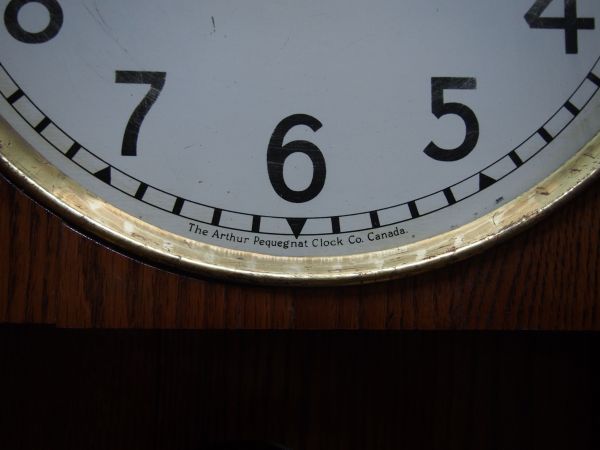
Arthur Pequegant Brandon II

This was my first Arthur Pequegnat clock whihc was the second edtiiion of the Brandon model. The second edition was made from 1917 to 1941. The first edition of the clock, which was produced until 1916, had similar dimensions but a more ornate frame around the dial bezel.

The Arthur Pequegnat Clock Company’s Brandon II model is a simple clock and was one of their most sought-after designs. It was primarily used in Canadian schoolrooms and office settings during the 1930s and 1940s.

The clock’s octagonal shape and short drop make it a recognizable design, and it is often referred to as a schoolhouse clock. Schoolhouse clocks were a popular type of clock used in schools during the late 19th and early 20th centuries, characterized by their simple yet sturdy design and often featuring a visible pendulum.

Schoolhouse clocks were usually time-only, as there would be other methods such as bells or alarms to mark key points in a typical school day. If placed in an office environment, a strike train would be too distracting for employees. Brandon models also came with calendars, a useful feature for both school or office.

Time-only Brandon with Calendar and “Regulator” decal

Both the case, made of quarter-sawn oak, and the brass movement were produced by the Arthur Pequegnat Clock Company in their small Kitchener factory until 1941. The company stopped production abruptly due to brass shortages during the Second World War.

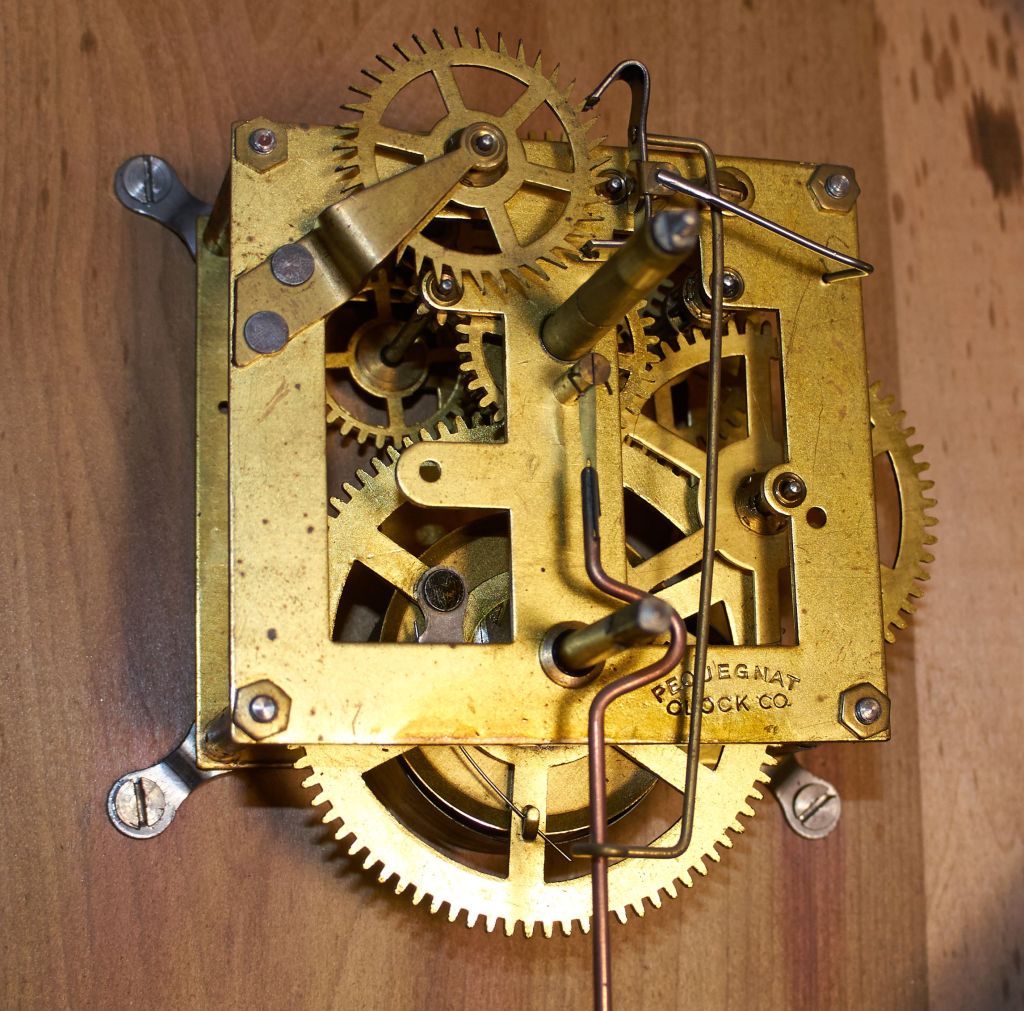
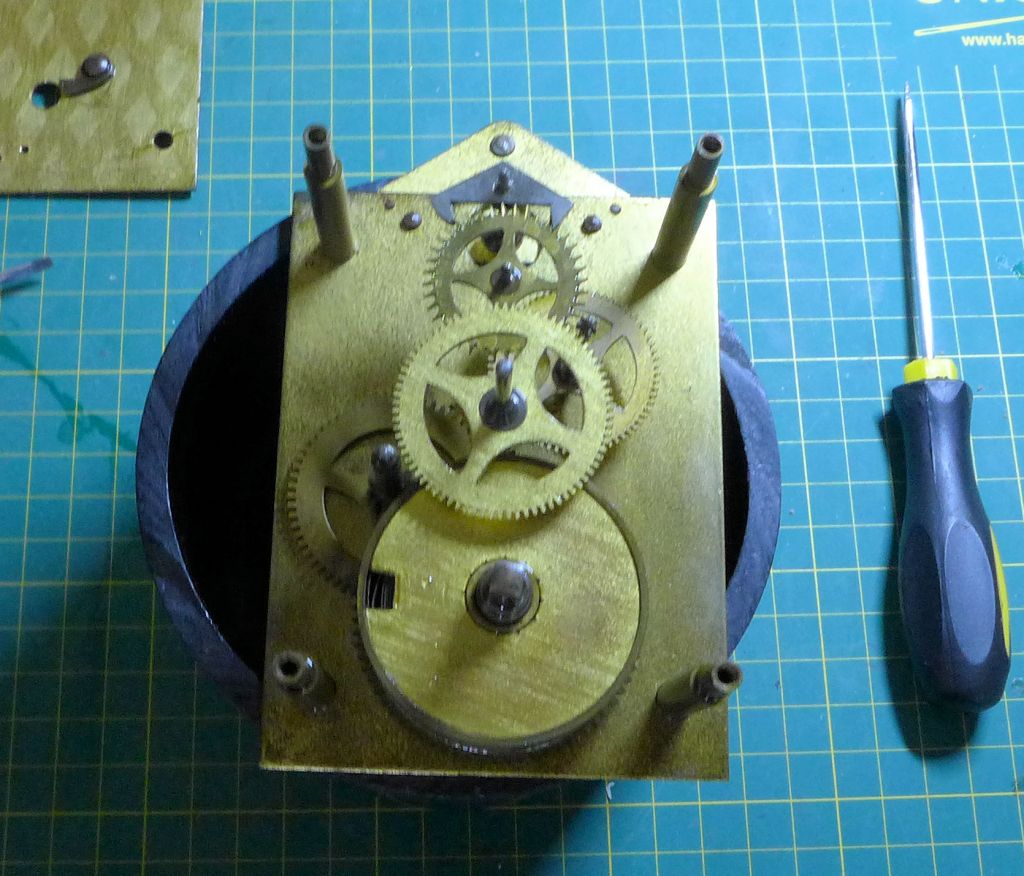
The time-only movement is relatively simple with few gears and little that can go wrong. It was designed to be reliable, dependable, and able to withstand the abuse of a school or office environment.

Arthur Pequegnat Brandon time-only movement

I purchased this clock from an antique collector who had owned it for a number of years. He decided to sell it in his antique shop in Great Village, Nova Scotia, and I found the price to be reasonable. The case, face, and bezel are all in excellent condition. However, the clock had an annoying squeak that suggested something was wrong. After investigating, I discovered that the first wheel had considerable pivot hole wear.

Regrettably, due to my lack of expertise and tools at the time, I couldn’t repair the clock on my own. I had to take it to a horologist in Halifax, Nova Scotia, who performed the required repairs. The clock needed five bushings, a thorough cleaning of the mainspring, and oiling of the movement. Following the necessary repairs, the clock has been consistently dependable and has required only an inspection and re-oiling two years ago.

Since then, I have acquired eight more Arthur Pequegnat clocks and have since gained the skills to service each of them myself.

Empire gallery clock servicing – no bushing work this time

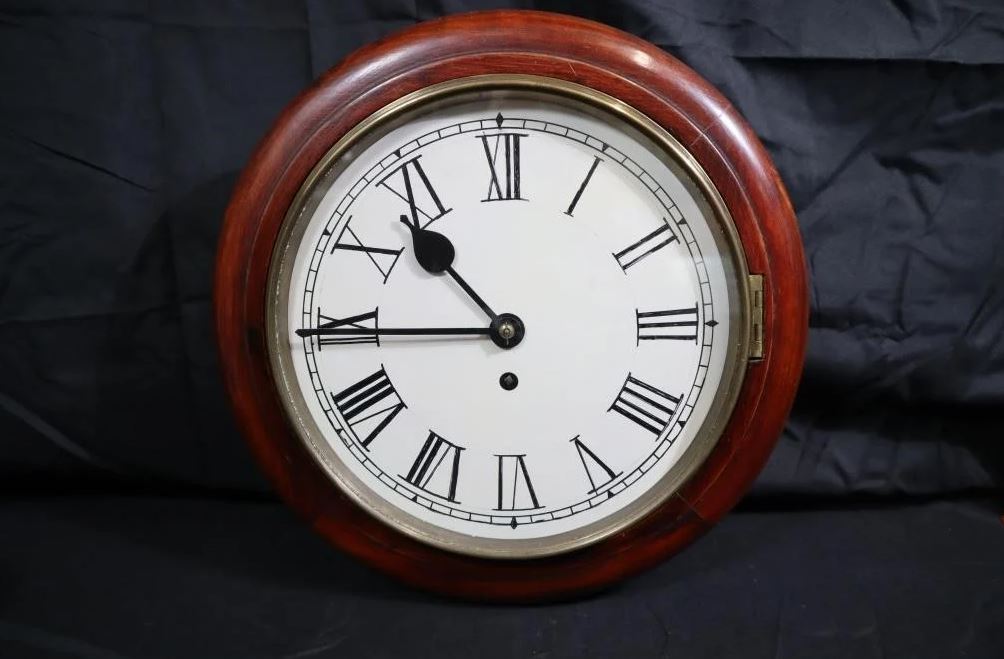
An attractive gallery clock made by the Empire Clock Co. of England was bought at auction this past spring. It has a very conventional time-only movement and as with most time-only movements there are only a few wheels to worry about when servicing. The minute and hour wheel are outside the front plate.

Empire gallery clock

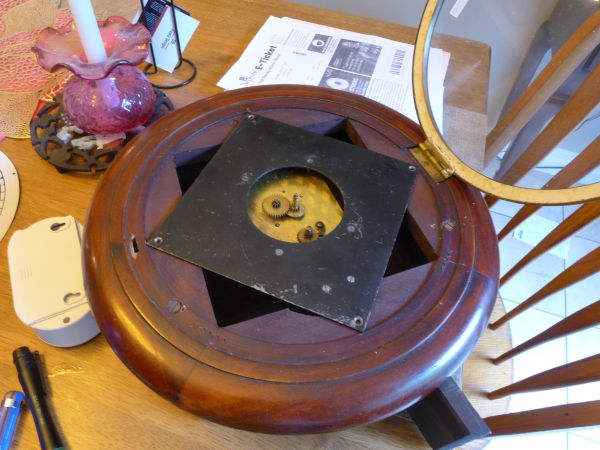
The movement is rather large for a time-only movement and is well built. It is attached to a heavy steel plate that is screwed onto the front of the movement. The whole assembly mounts just under the dial. It has a very German look to it, though it is definitely English-made.

To access the movement the dial must be removed which is a relatively simple process of removing the hands and three small screws.

Hour and minute wheel

Four slotted screws secure the movement to the steel plate.

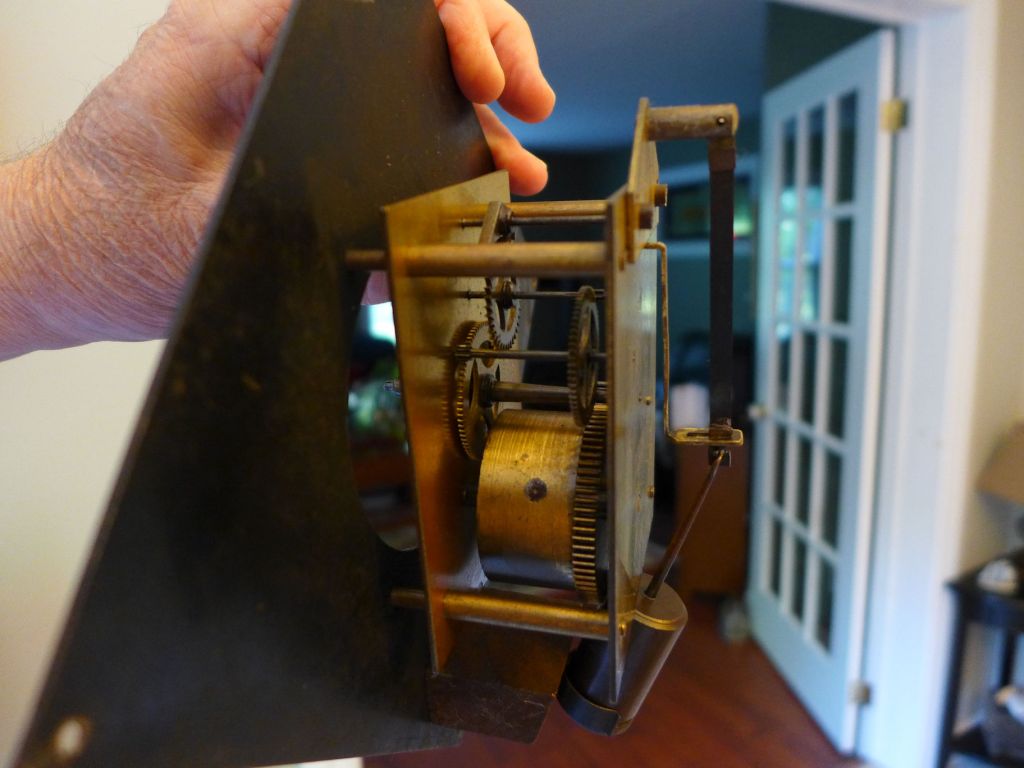
Time-only movement made by Empire

An curious feature is a cylindrical pendulum with a large rotating adjustment screw on the bottom. The pendulum clips into a two piece caddy system for easy transport.

Conventional wheel arrangement

For a fairly modern (1920s) movement I was surprised to find taper pins used to secure the plates. The spring barrel is no larger than one would ordinarily find in the average time and strike clock made in England or Germany.

As the movement was drenched in oil all the parts had to be wiped down before going into the ultrasonic cleaner.

I did not expect the plates and wheels to brightly shine after the ultrasonic but all the parts cleaned nicely just the same. After polishing the pivots and pegging out the holes the movement was assembled and tested.

After working with a number of American movements in the past months the pivots on this movement are comparatively tiny. This is not a movement one muscles to put back together, the pivots must be carefully guided into their holes.

Website Powered by WordPress.com.

Up ↑