Smiths Enfield mantel clocks are highly regarded by beginning clock collectors due to their popularity, abundance, and durable movements. For amateur clock repairers, they offer relatively few challenges.
I acquired my Smiths Enfield time-and-strike clock in 2013 from a young clock tinkerer in Dartmouth, Nova Scotia, but it was never a reliable runner. It would only run for a few minutes before stopping. Eventually, the clock was set aside and left in a corner of my shop.
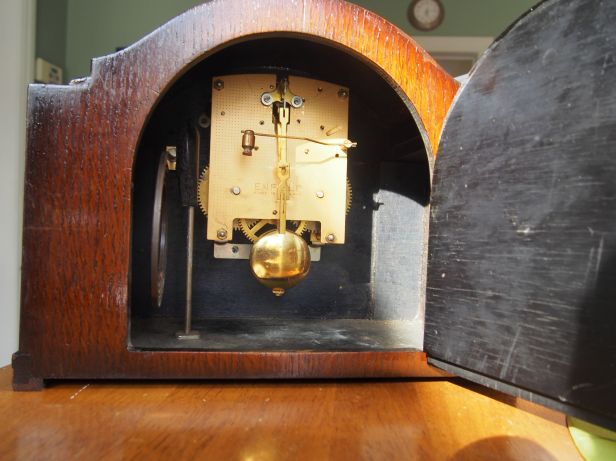
Post war English time and strike movement
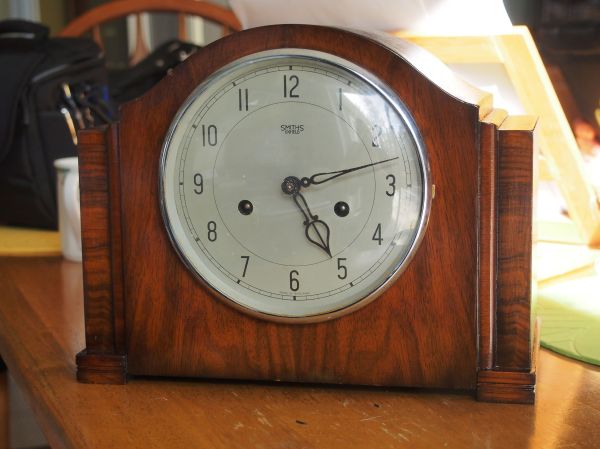
While not an especially attractive clock it embodies the utilitarian design typical of post-war English clocks from the late 1940s and early 1950s.
After several months and armed with new knowledge of clock repair, it was time to take a second look.
About Smiths Enfield
The Enfield Clock Company (London) Ltd. was established in 1929, with its first clocks sold in 1932.
The company utilized modern assembly line techniques to manufacture and assemble its clock movements, inspired by the American system of automated factories. Initially, clocks were sold wholesale and for export, with the movements supplied to shops that would then assemble the cases themselves. Enfield took pride in producing “British-made” clocks. However, in 1933, facing difficulties competing on price, the company was sold to Smiths Industries, which led to the name change to “Smiths Enfield”.
In 1935-1936, they introduced a striking 14-day clock in a Jacobean Oak case, which helped solidify the company’s position in the market. With the outbreak of war in 1939, the factory shifted to wartime production. While clock production continued, material shortages became a significant challenge.
After the war, American machines were allowed to be kept and production of the 53mm movement re-commenced. Production was later moved to the Smiths factory at Cricklewood and then later to their Welsh factory in about 1955. Under Smith Industries the production line was changed to watches. Ultimately all clock production was phased out and the company closed shortly thereafter.
A New Suspension Spring?
I serviced the clock in 2015, and it needed bushing work. Since the wear wasn’t severe, I thought I could delay it for another two years. However, the clock has not been running since then. At the time, I knew little about the purpose and function of a suspension spring, and since I assumed the one that came with the clock was correct, I thought there must be another issue causing the clock to run poorly.
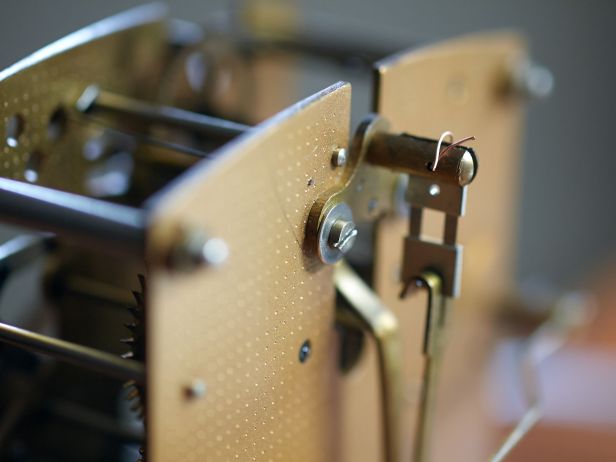
Suspension spring post
It’s time to revisit the suspension spring to determine if that’s the issue.
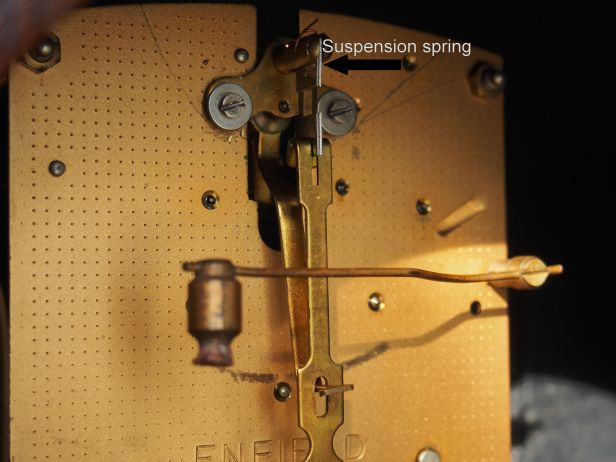
Suspension spring location
Over the past four years, I have accumulated an assortment of suspension springs and, through trial and error, found one that is either correct for the movement or very close.
The suspension spring has a mounting hole on one end and a small T-bar on the other where the pendulum hangs. I replaced the old spring with a shorter, more flexible one. As a result, the clock started running. In the first week, it lost about five minutes, but after making minor adjustments to the pendulum length, the timekeeping improved with each change.
The takeaway from this is that the correct suspension spring is crucial to whether a clock runs, and it should be considered as one of the potential reasons when a clock is not working.
I have been to Middleton, Nova Scotia many times. I have even passed the Macdonald Consolidated School where the clock museum is located without realizing what treasures lay inside. The clock museum represents a small section of the museum, the remainder of which is dedicated to the history of the area.
In the Spring of 2018 my wife and I set off on one of our many mini staycations. On my agenda was a visit to this museum and I was not disappointed.
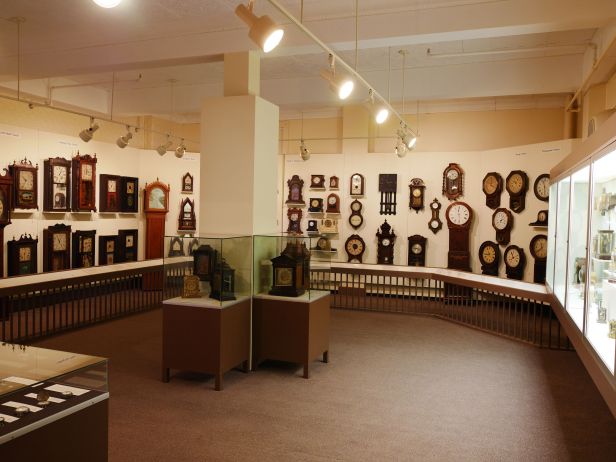
Macdonald Museum main clock exhibit area
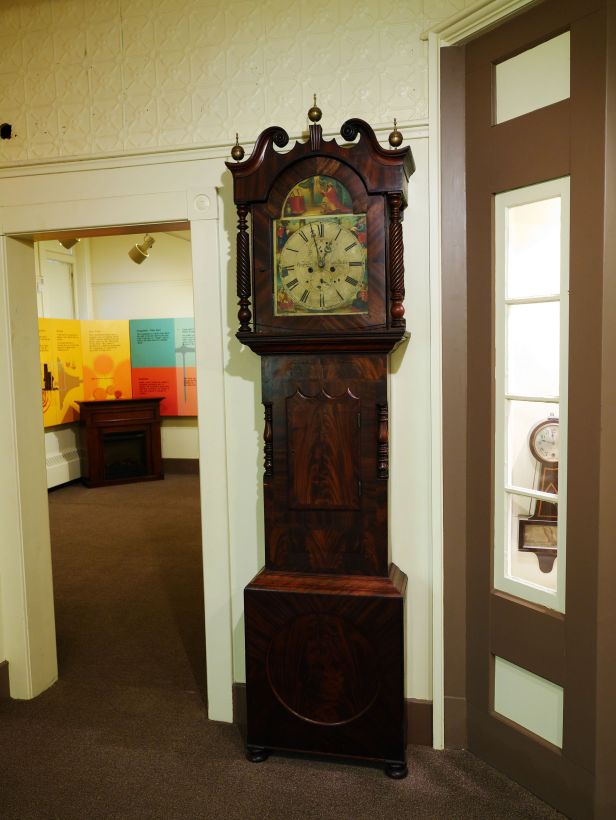
Holbeck made tall-case clock
It certainly ranks as the best exhibit in Atlantic Canada
Off highway 1 on School Street, Middleton, Nova Scotia stands the Macdonald museum. I had some expectations because I had been to two well respected clock museums, the NAWCC museum in Columbia PA. and the Canadian Clock Museum in Deep River, Ontario. Though not on the same scale as these two, it certainly ranks as the best exhibit in Atlantic Canada.
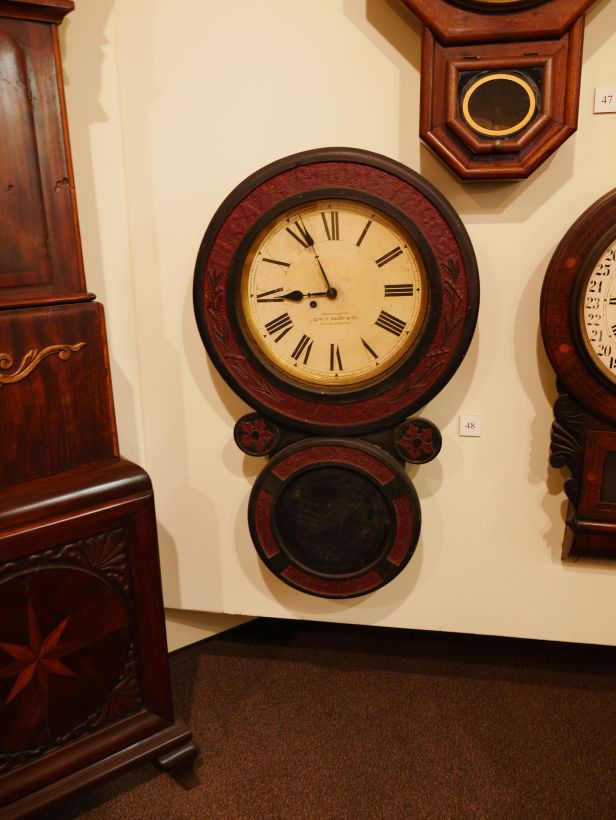
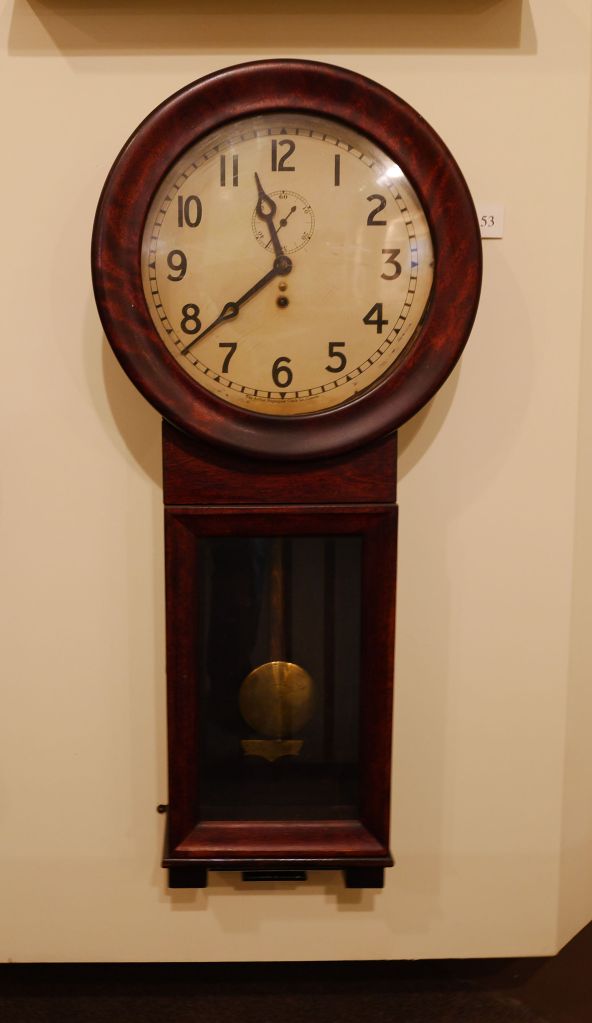
The Annapolis Valley Macdonald Museum is home to the Nova Scotia Museum’s collection of over 150 antique clocks and watches. This permanent exhibit showcases items collected by the late Norman Phinney and was one of the primary reasons for establishing the Macdonald Museum. Many of the clocks are in working condition. There are a wide variety of clocks and watches on display, with some dating back to the late 17th century. Anyone interested in clocks would do well to see this exhibit – one of the best in Eastern Canada.
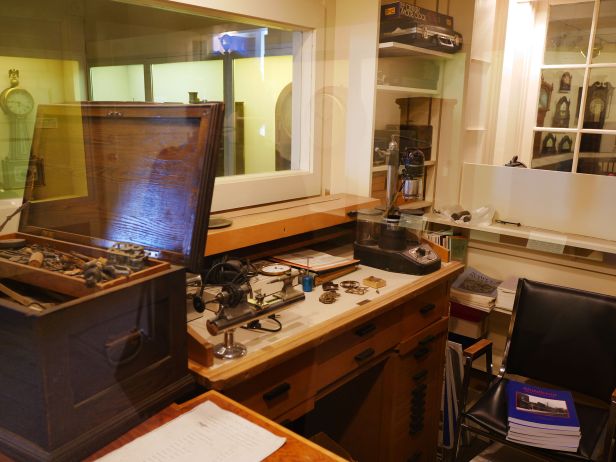
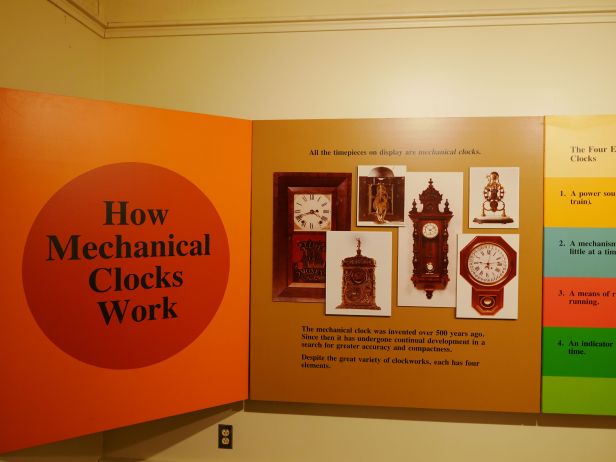
The museum is well laid out with enough information on each of the clocks on display to satisfy the general public and clock enthusiasts alike. Each display highlights its significance as an important development in horological history. We were alone as we walked though the main exhibit area and an adjacent room which contained a fascinating old clock-maker’s shop and a well laid out and informative interactive display on how mechanical clocks work.
Clock-maker’s shop
How mechanical clocks work
At least one example from the Baird Clock Co. of Montreal and five examples from the Arthur Pequegnat Clock Co. of Berlin (now Kitchener) Ontario were on display including the Arthur Pequegnat Regulator #1, that the company once advertised as “The finest clock made in America”.
Baird clock from Montreal
Arthur Pequegnat Regulator #1
None of the clocks were running, however. Though the clocks appeared to be in excellent condition, the sound of ticking clocks make for a more authentic experience. All other clock museums make a practice of running some clocks on a rotating basis at any given time.
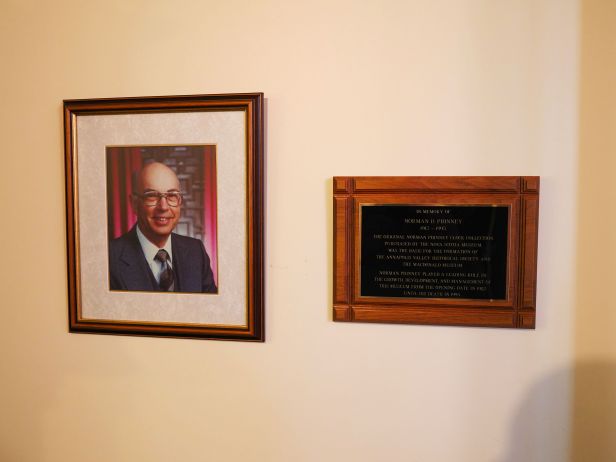
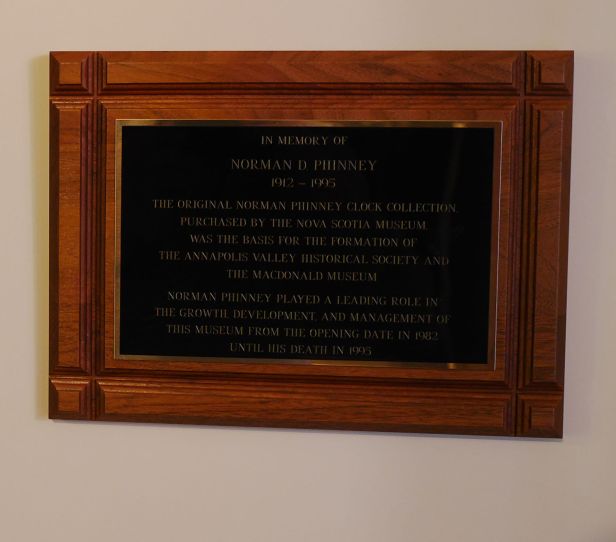
At the entrance to the clock collection there is a simple plaque dedicated to Norman D. Phinney. Learning more about Norman D. Phinney, his contribution to the Macdonald Museum and the story of how the museum received his clock collection would add to the experience.
Norman D Phinney
If you are a clock fan or even if you only have a casual interest in the world of horology, this small clock museum may surprise you
Though perhaps not within the scope of Phinney’s original collection, examples from the Canada Clock Co. and the Hamilton Clock Co. or more peddlers clocks from Nova Scotia and New Brunswick would have provided an enhanced Canadian horological perspective.
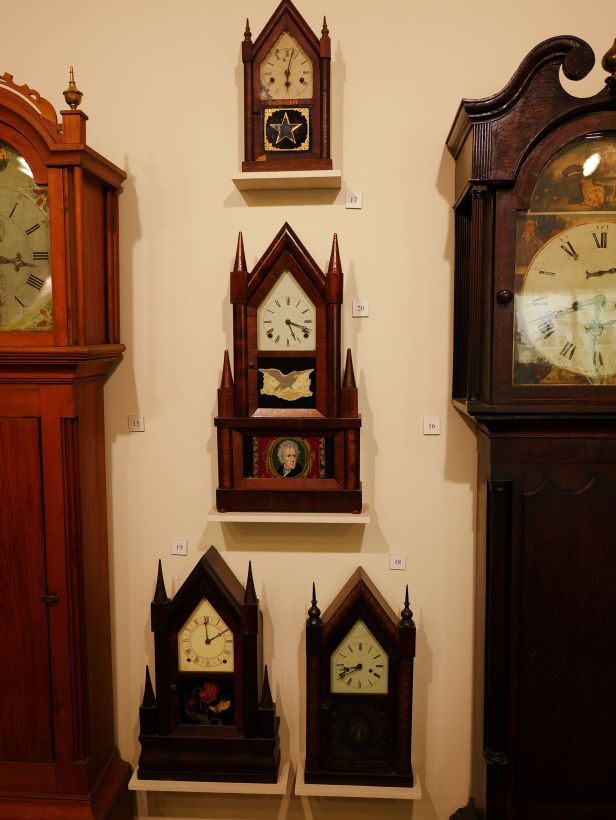
Steeple or sharp Gothic clocks
However, these are minor quibbles and should not detract you from appreciating the high quality of the exhibits which contained British, American, French and Canadian examples or the many styles that included Pillar and Scroll, tall-case, shelf, beehive, steeple, drop octagons, mantel, alarm clocks and Ogee clocks, all of which were well represented.
If you are a clock fan or even if you only have a casual interest in the world of horology, this small clock museum may surprise you.
Oh, and while there, visit the rest of this fascinating museum.
In the early spring, my wife and I travelled to Portugal and Spain. We attended our daughter’s destination wedding in Sintra, Portugal and we decided to expand our stay, visit Spain and see the sights in Barcelona and Montserrat. Spain has always been on our bucket list and it did not disappoint.
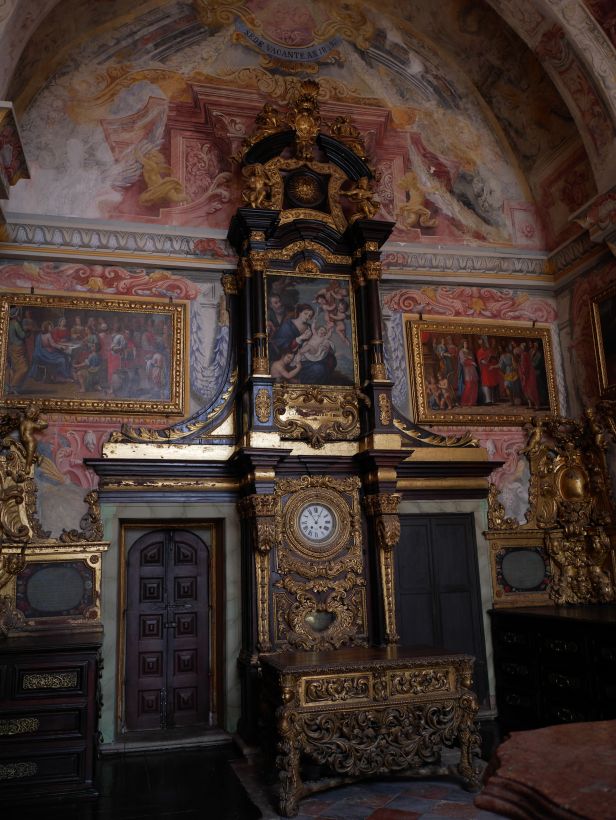
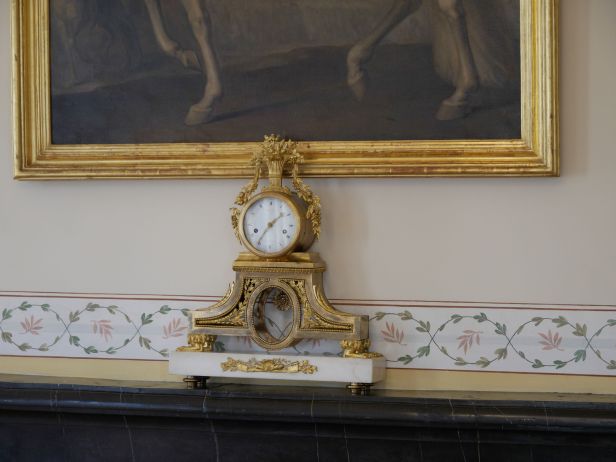
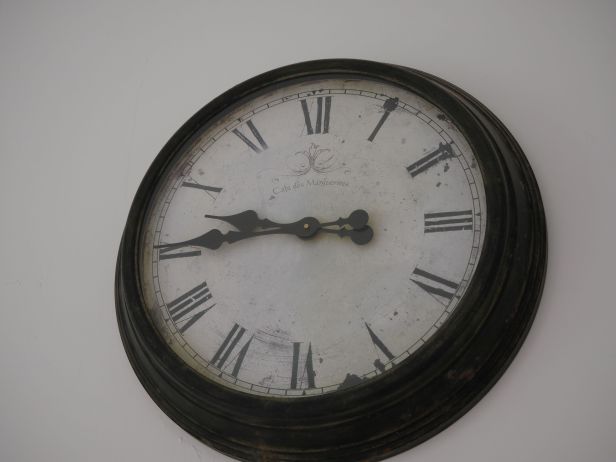
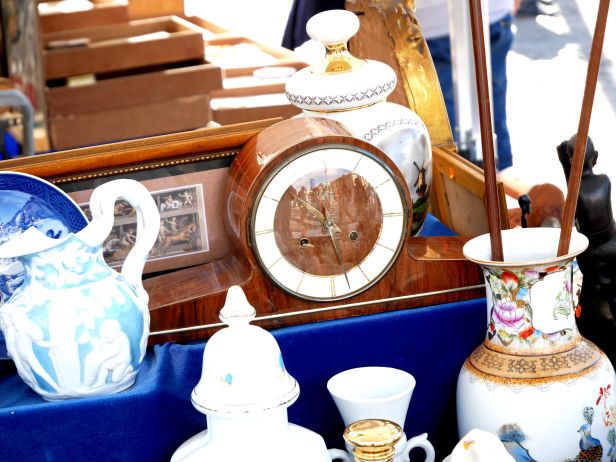
Being a clock enthusiast I did a little research beforehand to find out if there were any clock museums along our travel route. Alas, we travelled to places that were very distant from the well know clock museums. Clocks in Europe were made in specific regions and that is where you will find clock museums. Here are a few clocks that I found in various places in Spain (Barcelona) and Portugal. I will let the photos tell the story.
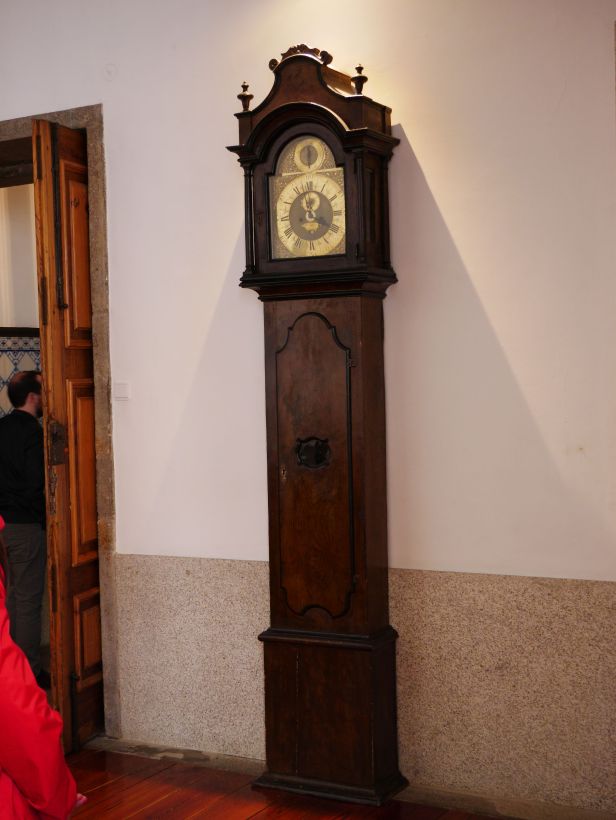
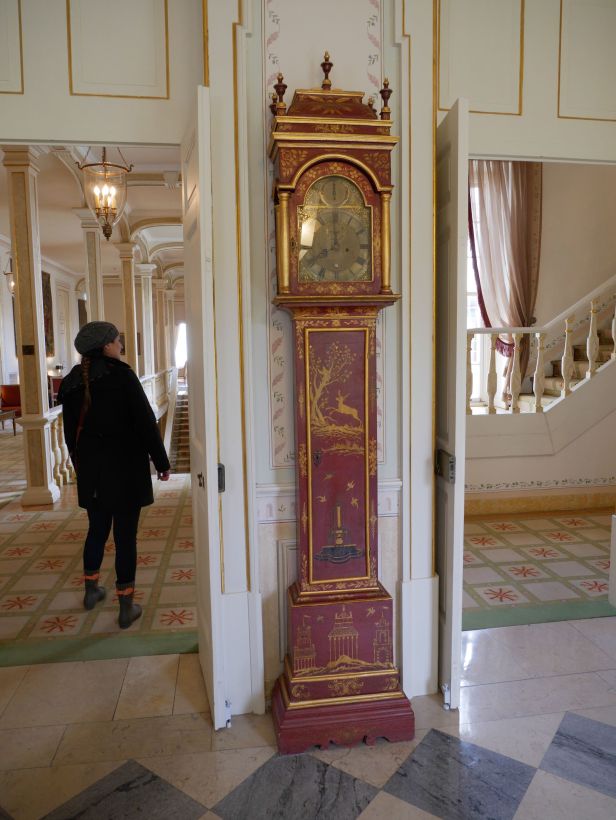
Tall case clock in a Barcelona cathedral
Little card on the side simply said “High box clock, school clock”, Barcelona
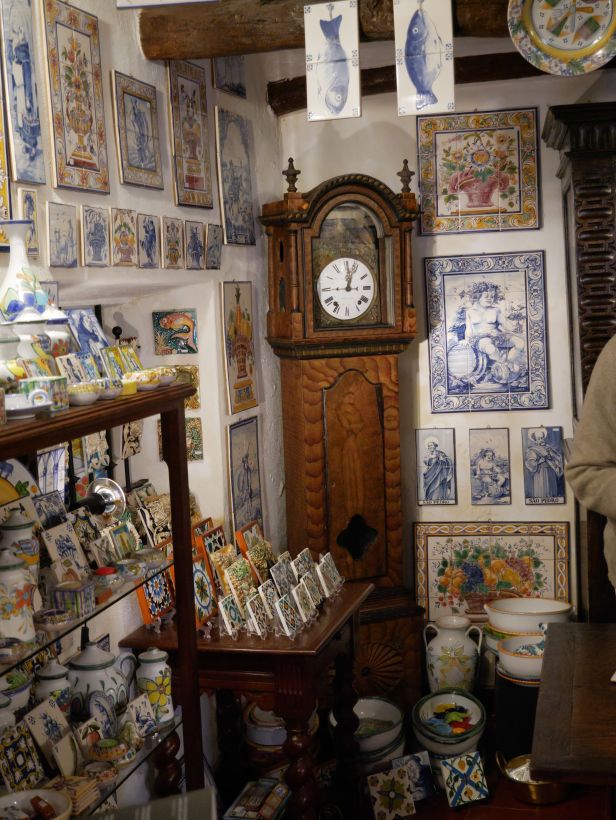
A marriage of movement and case found in a shop in Sintra, Portugal
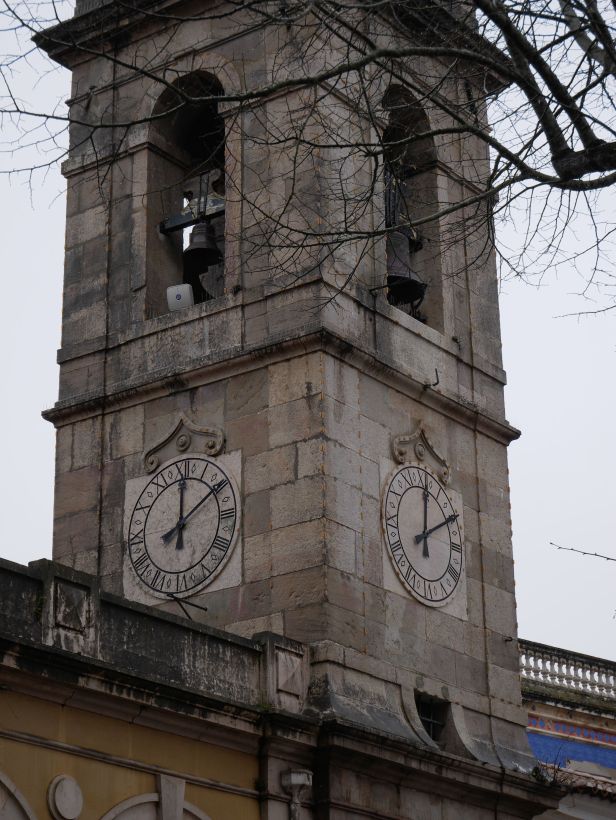
Town clock in downtown Sintra, Portugal
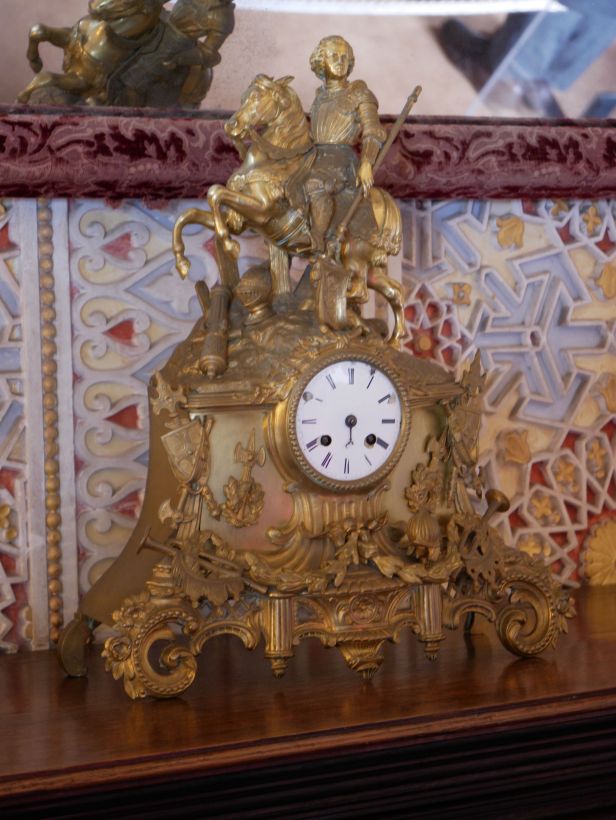
A very ornate clock in poor condition, Pena Palace, Sintra, Portugal
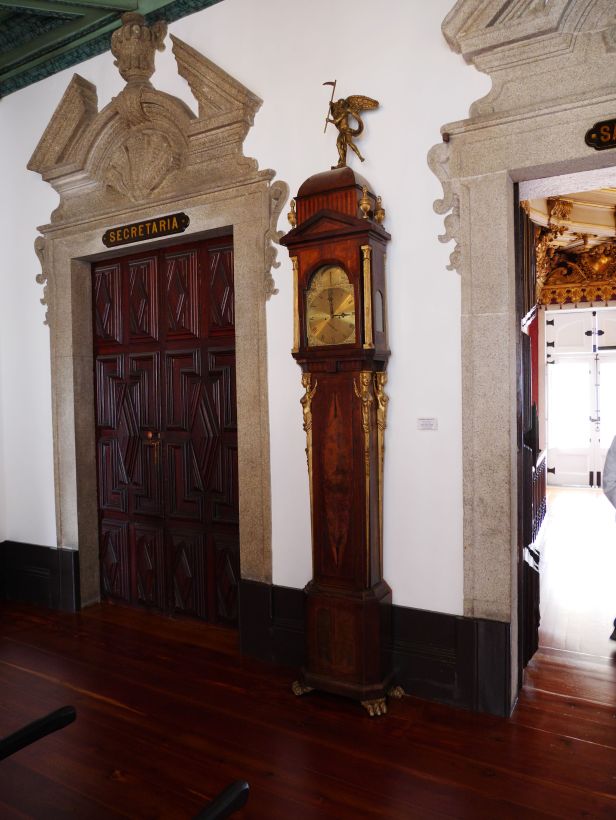
The most ornate clock I found is this working example at the Porto basilica
Unknown mantel clock, Tivoli Hotel, Sintra, Portugal
Unknown gallery clock. I could not find an opening on this clock. No arbour holes on the clock face. Found on an estate in Sintra, Portugal
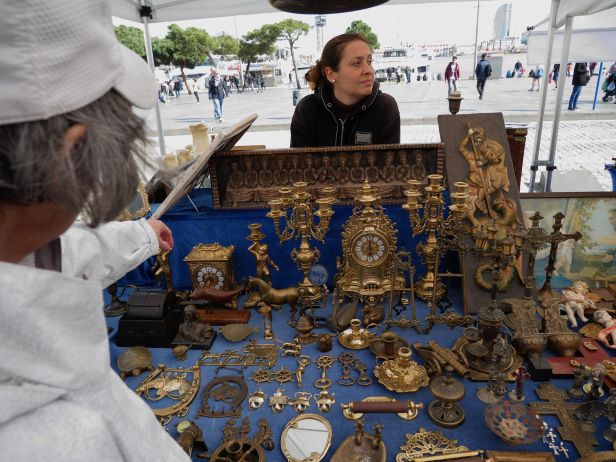
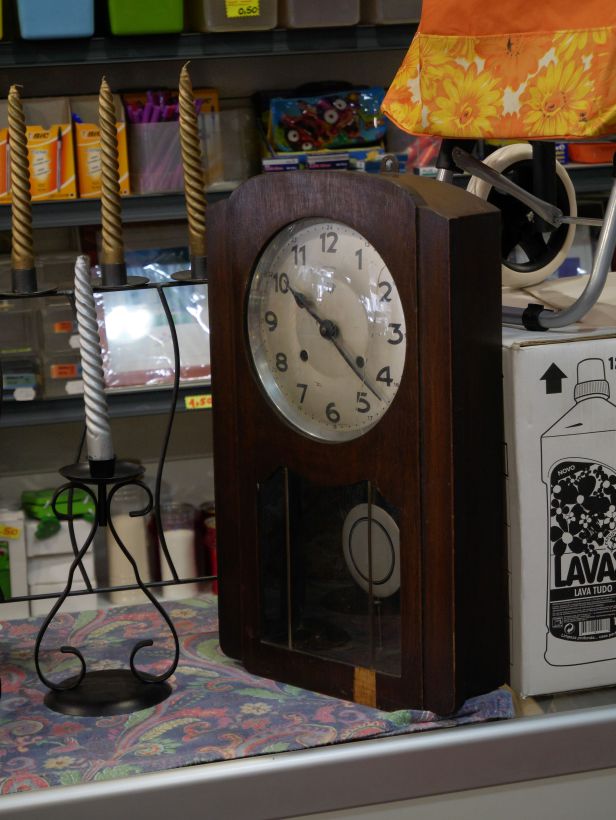
Flea market clock. Time and strike English or German clock, the 1960s
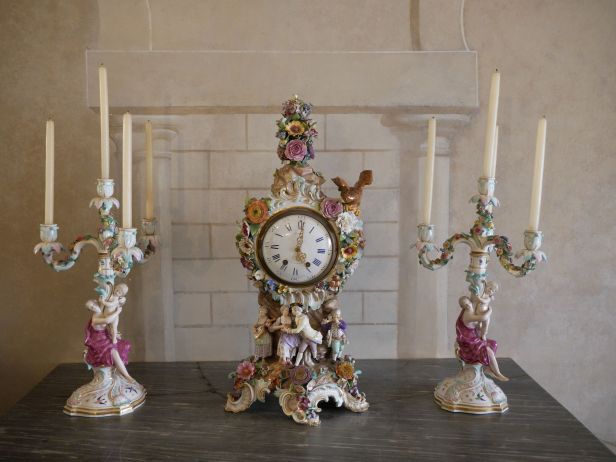
Flea market clock. Time and strike French clock with matching candelabra
Used goods store, time and strike wall clock, possibly French
I was not specifically looking for these clocks but as we visited churches, museums, shops and public places I photographed any I discovered in our travels.
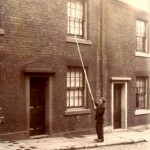
During the early days of the industrial revolution a certain practice lasted well into the 20th century. These were days before alarm clocks were affordable and reliable when workers had to rely on professions that we would not think would ever have been considered mainstream work.
One of these professions was the person whose job it was to wake people up. The profession is sometimes referred to as the knocker-upper. It was the job of the knocker-upper to make sure people got to work on time. Large numbers of these persons worked in the industrial centers of England and Scotland where the poor could not afford their own watches.
They were often women or the elderly but occasionally police constables would work as knocker uppers to supplement their income. Aided with a long stick the knocker upper would tap on the bedroom window and proceed to the next customer’s house. He or she would not dawdle, 3 or 4 taps and they would be swiftly on their way. Other methods were often used; a rattle, or soft hammers and even pea shooters.
With a long stick the knocker upper would tap 3 or 4 times
My how times have changed. How do you get yourself up in the morning?
We have a seasonal cottage that is used primarily in the summer and at times during Thanksgiving in October. While I have a number of clocks at my residence in Nova Scotia the cottage is a great place for displaying a small selection of my clocks.
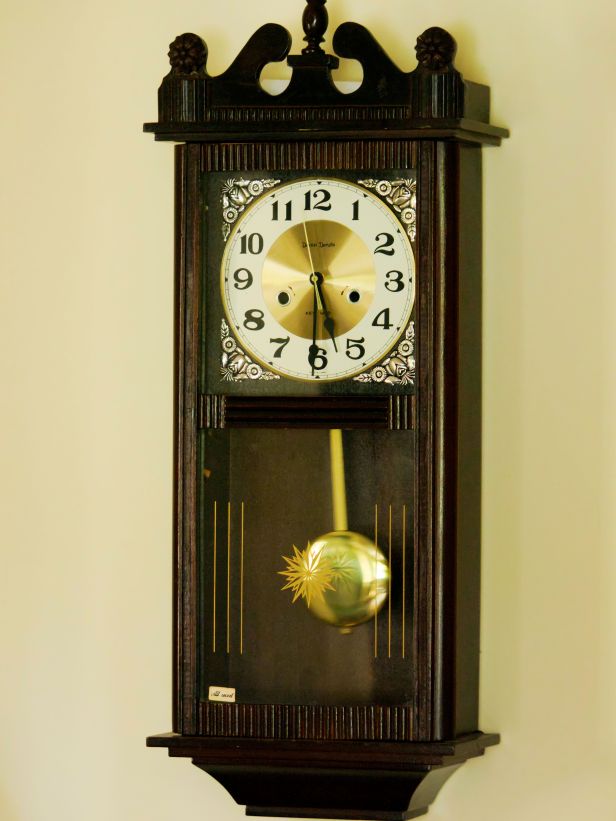
Our first clock at the cottage was a Danial Dakota time and strike that we had converted to a quartz movement. The clock is from the 1960s and reflected Chinese design elements copied from American clocks at the time. It requires very little maintenance and is as accurate as one would expect. It requires a “C” cell battery to operate. It is a chiming clock with Westminster and Whittington chimes and my wife and I much prefer the Whittington chime. I still have the original mechanical movement and may someday use it in another case.
Converted from a mechanical clock
The clocks do not run during the winter but oiling once per year addresses the issue of dried pivot holes
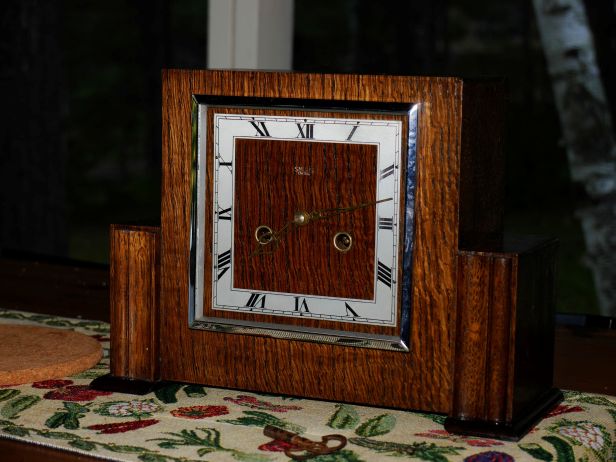
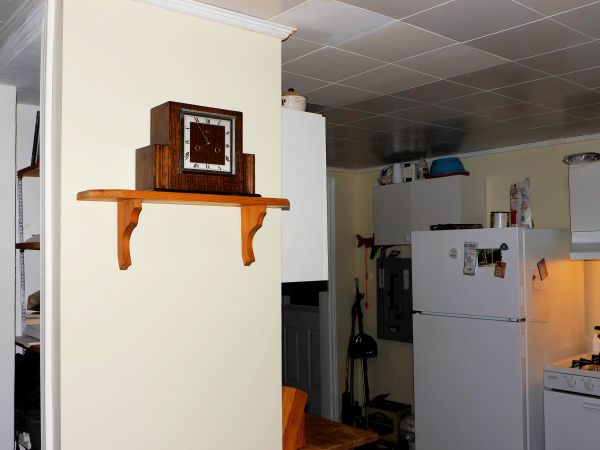
Last summer (2016) we were travelling through an Ontario town of Halliburton and stopped by an antique shop. The owner brought in a number of clocks from Ireland, all British made. They were in very good condition though some were a bit on the pricey side. My eye was drawn to this simple but attractive Smiths Enfield time and strike Art Deco style clock. It has a chromed square bezel and Roman Numerals on a slivered background. The ornate brass coloured hands compliment the square dial face. The squared off dark oak case with half height side shoulders is in excellent condition. I placed this clock on a shelf between our kitchen and family room.
Smiths Enfield time and strike, circa, 1950
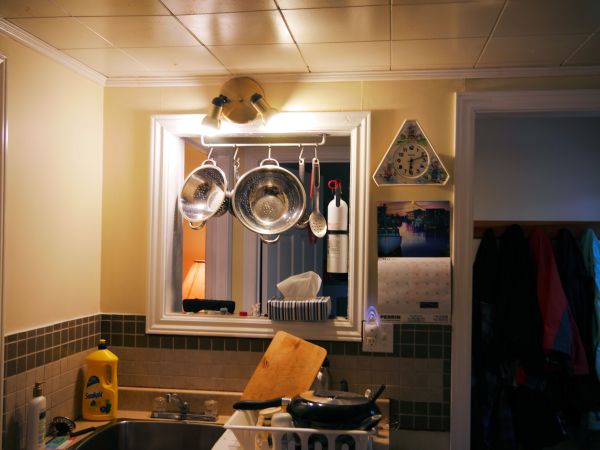
Our kitchen has a Delft style, triangle shaped front-wind 8-day time-only porcelain clock with a lever escapement similar to those found in marine movements. It is an estate auction purchase. On the dial is the name Forestville. The Forestville Clock Company of Toronto operated from 1928 to the late 1970s. Though wholly Canadian owned the company had cases made in its early days (from Kitchener, Ontario) but later imported cases and movements from Germany then France and England during the War years and Germany again, after the Second World War. The clock has a Dutch motif which reflected a popular trend in the 1950s and 1960s but also recognized Canada’s close relationship with the Dutch people since the war years.
Delft Clock from Forestville
The clocks do not run during the winter but oiling once per year addresses the issue of dried pivot holes. We also take the battery out of the quartz clock.
There is nothing like the sound of mechanical clocks at the cottage particularly on a cold, quiet night when the only other sound is the melancholic cry of the whippoorwill.
Last month I posted a article on Minimal Invasive Intervention in which I posed the question, how far do you go to repair, restore or conserve a clock without changing it in a significant way? I was having a discussion with my daughter who is a civil engineer and she raised the philosophical argument that questions whether an object like a clock that has had all of its components replaced remains fundamentally the same object. This paradoxical thought experiment exercise is called the Ship of Theseus. Plutarch, a Greek philosopher, asked whether a ship that had been restored by replacing every single wooden part remained the same ship.
The ship wherein Theseus and the youth of Athens returned from Crete had thirty oars, and was preserved by the Athenians down even to the time of Demetrius Phalereus, for they took away the old planks as they decayed, putting in new and stronger timber in their places, in so much that this ship became a standing example among the philosophers, for the logical question of things that grow; one side holding that the ship remained the same, and the other contending that it was not the same.
In Nova Scotia we have a sailing ship called the Bluenose II. It is the pride on our province, an important tourist attraction and our provincial ambassador. The original Bluenose was a fishing and racing schooner that ran aground and sank some 90 years ago. To honour the original Bluenose, the Bluenose II was built in the 1960s and she sailed for over 50 years before it was determined that she was in need of significant restoration. In the last 4 years the hull of the Bluenose II has been completely rebuilt. Some of the original vessel is being reused including: rigging, masts, sails, ironwork, deck structures, safety equipment and electronics. In time the masts, sails, rigging and deck structures and other components will be replaced. Will the ship be fundamentally the same? Will it retain it’s identity?
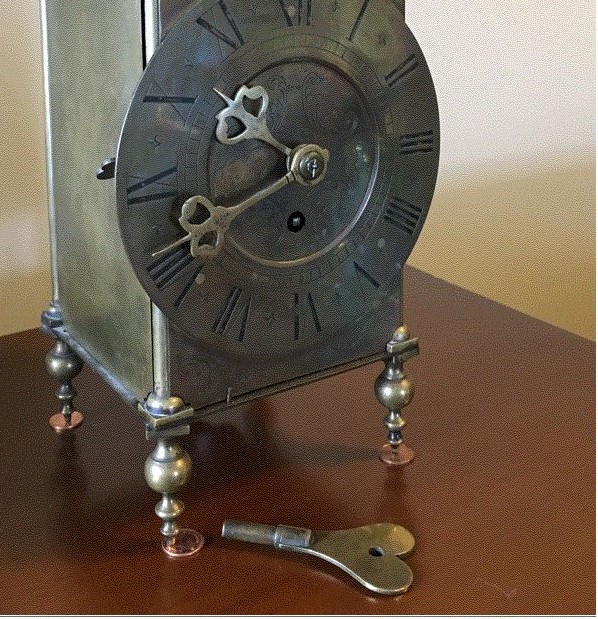
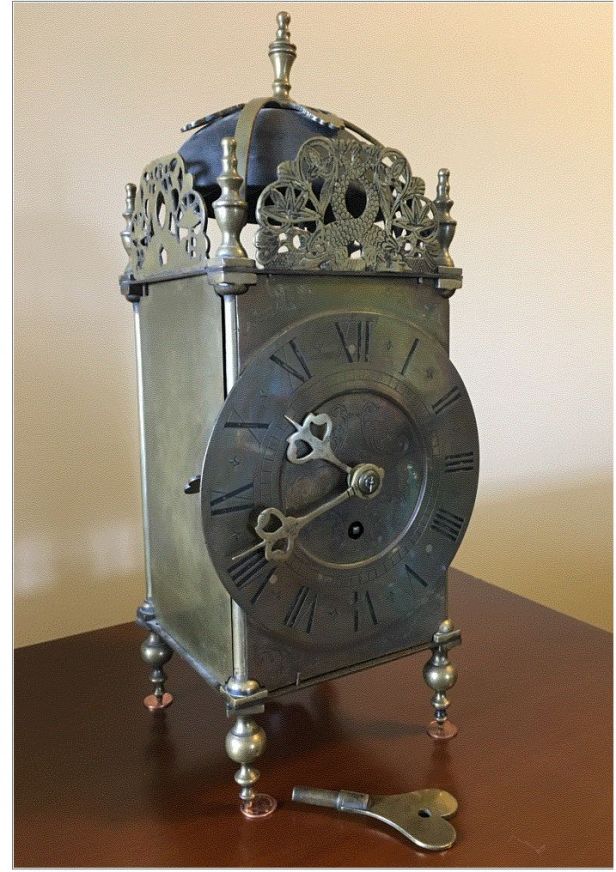
Early English lantern clock
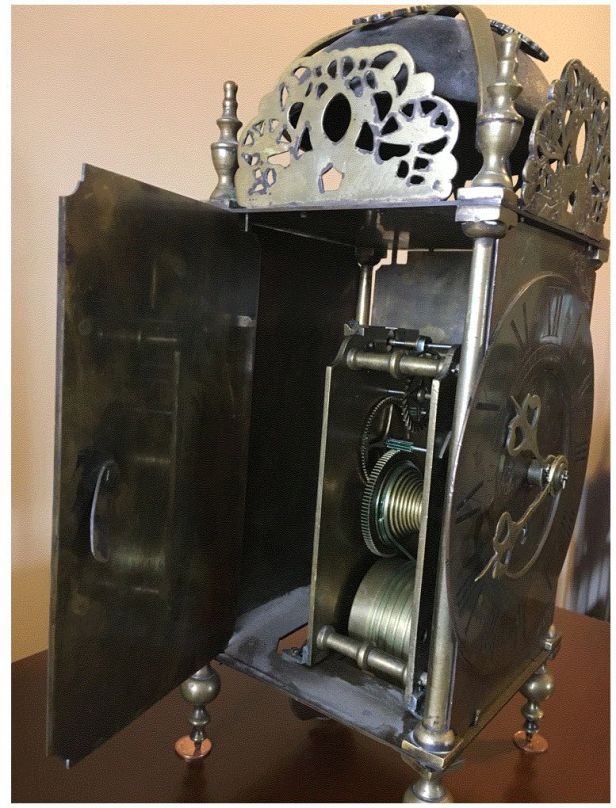
English lantern clock converted to fusee movement
Let’s look at another example, the lantern clock. The lantern clock, a weight driven wall clock shaped like a lantern were the first type of clock widely used in English private homes in the 17th century. With the arrival of long-case clocks with 8-day movements the lantern clock became obsolete. Lantern clocks are very collectible today and those that are in “original” condition are the most desirable. The problem with lantern clocks is that almost all of them have been altered, even those regarded as totally genuine. In this example I will cite a quote from a seller of lantern clocks, D. and J. Benson, specialists in early English clocks.
We are strong believers that if a clock was converted to a different escapement many years ago, this should be retained, being part of the history of the clock, rather than reconverting clocks back to former guises. Only under compelling circumstances would a clock be returned to a former state. Only absolutely necessary restoration work is carried out in order that the original clock survives for future generations. We conserve rather than replace.
Some of the more expensive lantern clocks they offer for sale have early conversions from verge to anchor escapement. Later ones had the original movements removed and a fusee movement (single or double) installed. When converted original movements including alarm mechanisms were taken out, a single-hand was replaced with two hands (or the minute hand added), broken finals and door handles might have replaced, chapter rings re-silvered, doors are often lost due to their nature of lifting out easily. Therefore, what is the nature of the clock after it has been changed, how original is it and does it retain its identity?
One clock collector might have the opinion that if too much is done to restore a clock it is not fundamentally the same and cannot be considered original even though the new parts were made from the same materials and using the same methods when the clock was first made. Another might have the opinion that changes or alterations to the clock that bring it back to its original look and function including the making of new parts make it more “original” and therefore more desirable. Moreover, if the changes are not recognized by the observer, is the clock original?
Furthermore, if one replaces one part at a time on a clock so that at some point all parts are replaced, at what point does a clock no longer become the same clock? It follows that if you take all of those parts and make a “new” clock which of the two clocks is original? What is the nature of the clock’s identity since no two objects can occupy the same identity.
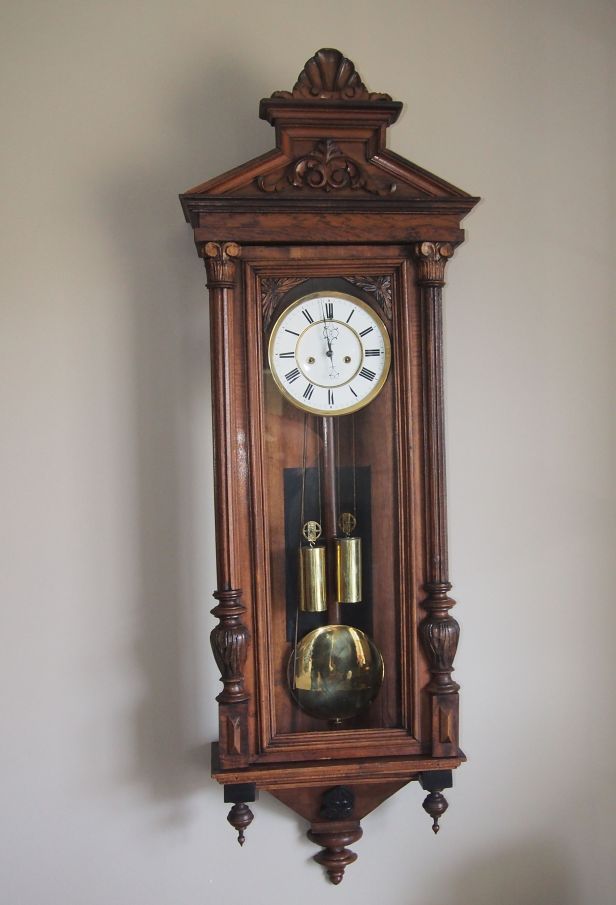
Gustav Becker two weight regulator
I am sure that those of you who are collectors have experienced the dilemma of identity. I know that when I bought my first Vienna Regulator I began to realize that many parts were replaced over the years and it made me wonder to what extent the clock is original. It is an unwinnable argument and I began to accept the notion that it may not matter to me or to a casual observer who may view the clock as completely original.
What most people visualize as the Schoolhouse clock
My recent acquisition of another schoolhouse clock stimulated my curiosity and prompted me to do some research on the origin of the name. In this article I will describe my thoughts on how the schoolhouse clock came to be and my most recent Sessions wall clock purchase.
During my research I found it very interesting that little can be found regarding the history of the schoolhouse clock. I realize that many older readers growing up in the rural areas of Canada and elsewhere in North American have fond memories of the one-room schoolhouse with a large clock in either the front or the back of a classroom. I did not live that experience rather, when I was young and attending a large urban school the Simplex master / slave clock is the one I remember best.
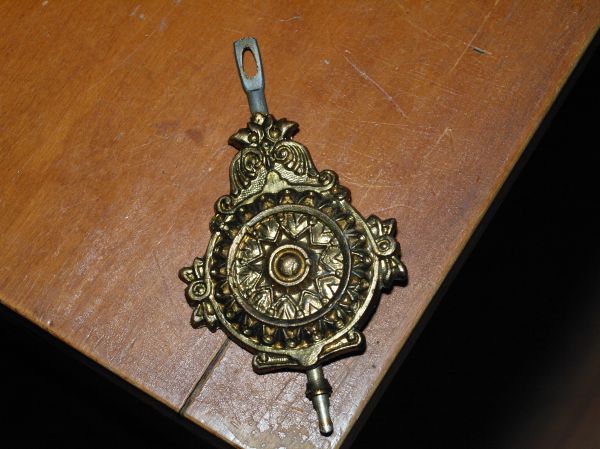
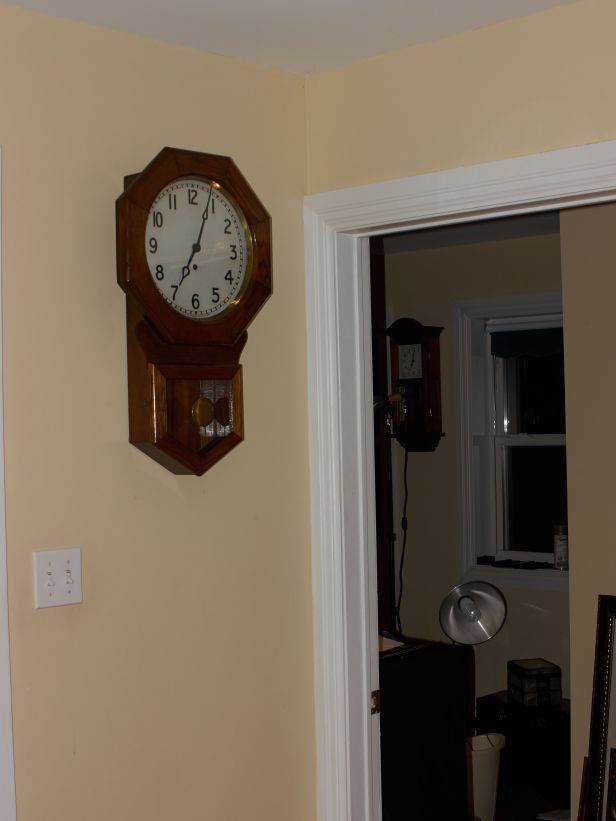
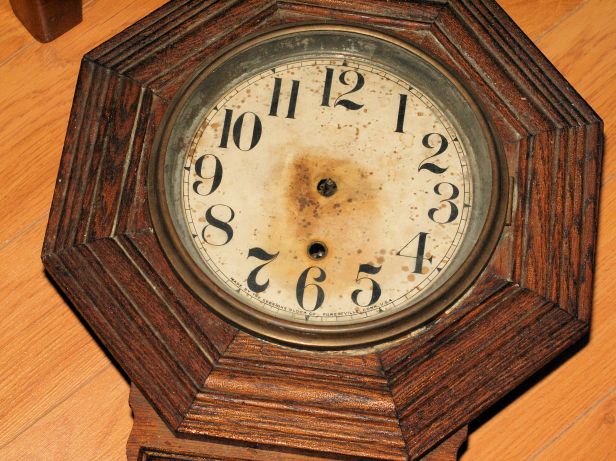
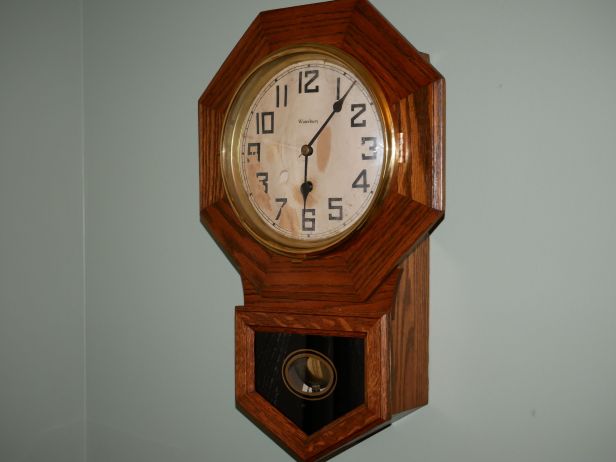
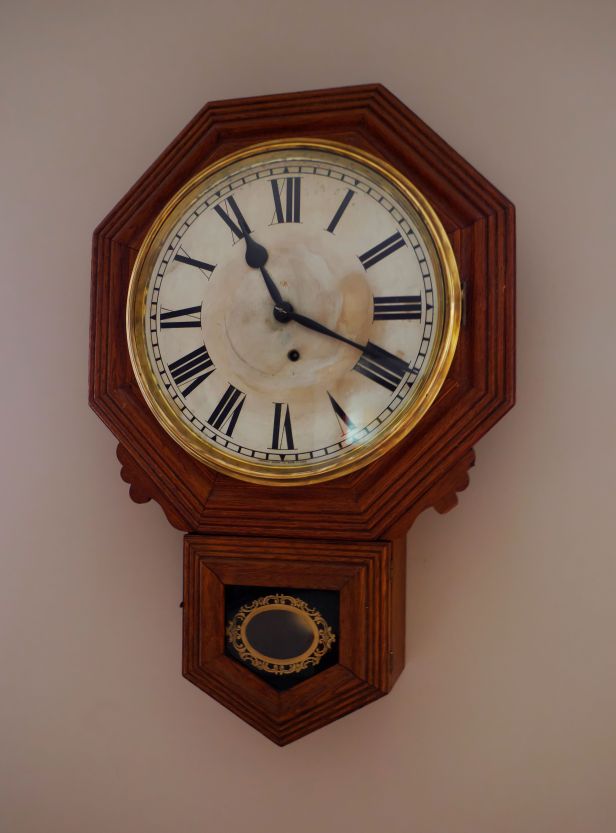
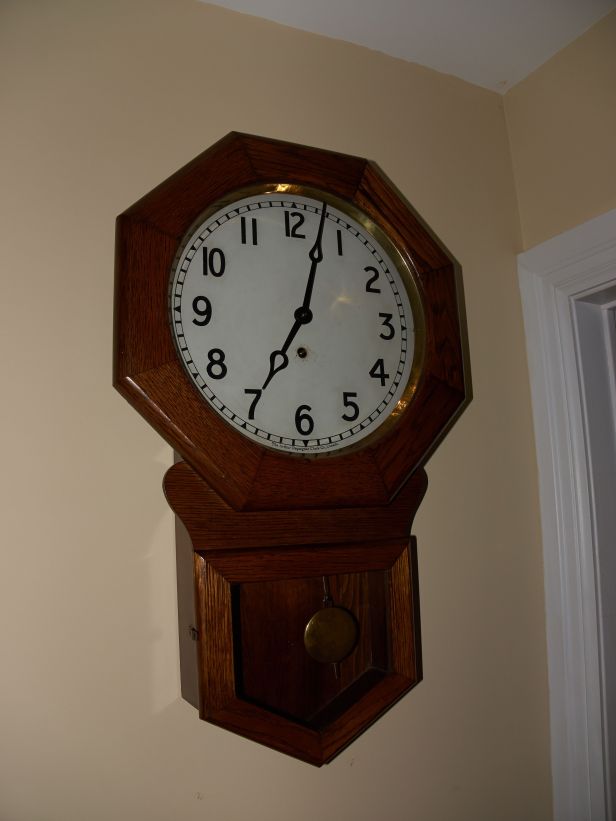
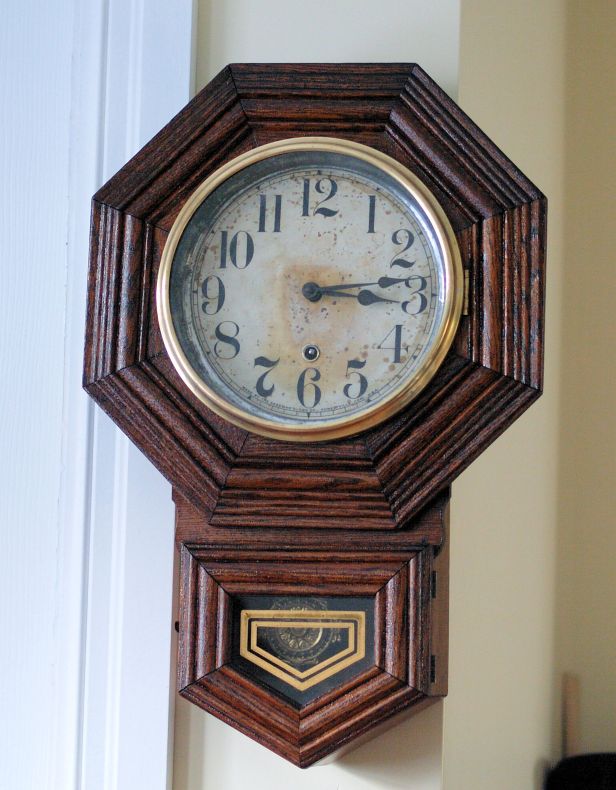
The schoolhouse clock that I bought recently adds to my modest collection of three schoolhouse clocks. Given that I spent many years as an educator, it seems only fitting that I would have an interest in schoolhouse clocks. My schoolhouse clocks are all a similar style; short drop octagon, constructed of oak, brass dial bezel, bottom glazed access sash, 12 inch dial or 9 inches as in this case of this clock and the Waterbury pictured below. Although 9 inch clocks were used in schoolhouses they were also found in office or workplace settings.
They were not called a schoolhouse clock when they were made
Schoolhouse clocks were the standard design for early North American school houses because of their larger, easy to read dials. These distinctive clocks were hung in many schools rooms across Canada. The majority had simple but tough time-only movements and some even came with a calendar function. Occasionally they were ordered with time and strike movements but the cheapest and most popular versions were time-only. This type of clock had a very utilitarian look and function.
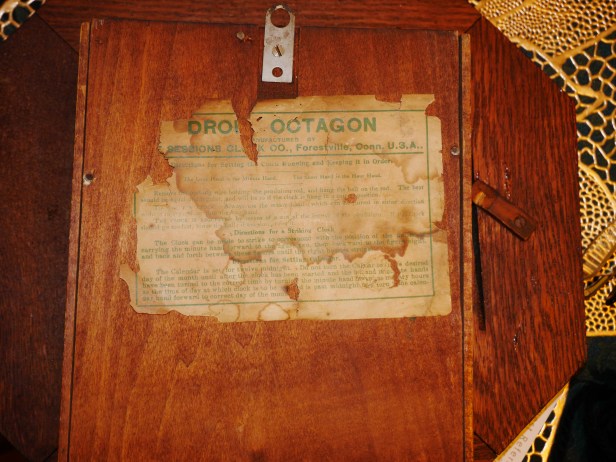
They were not always called schoolhouse clocks. None of the labels on my clocks have the word “schoolhouse” written on them and are either described as a”drop Octagon” in the case of this Sessions or have a specific model name. The term schoolhouse clock was not applied to them when they were made but came to be known as a particular style of clock found in school settings by later collectors. If a particular style was ordered by a school authority makers might have informally described them as clocks for schools or “school clocks”. In any event, the term has become a permanent part of the clock collector language.
Label on back of Sessions clock
With a swinging pendulum visible from a distance the clock can easily be seen running and the open-door bottom access sash allowed for restarting and adjusting the rate. In some clock collecting circles it is said that schoolhouse clocks are a derivative of the English drop dial fusee clock, an example of which can be seen here. Drop dials were produced in the late 18th through to the 19th century and closely resembled the schoolhouse clock. Unlike spring-driven schoolhouse clocks, fusee clocks have conical construction from which a chain or gut-line is pulled by the mainspring barrel allowing the power of the mainspring to be released evenly thus assuring better accuracy.
When I am in the process of buying a clock I always ask the seller this question. “How much do you know about this clock?”
When I am in the process of buying a clock I always ask the question. “How much do you know about this clock?”. I always ask this question because I am interested in a clock’s provenance and some of the stories are quite intriguing. The seller, a man in his late fifties, thought about it for a moment and said, “Well, I’ve had it since I was 14”. The clock came out of a decommissioned one-room schoolhouse in a small town called Springhill, Nova Scotia (Canada). However, when I first saw the clock I said to him, “It looks like a nice office clock”. The seller quickly corrected me and said, “It’s a schoolhouse clock”. “It runs for a little bit and then stops, maybe you can do something with it”, he added.
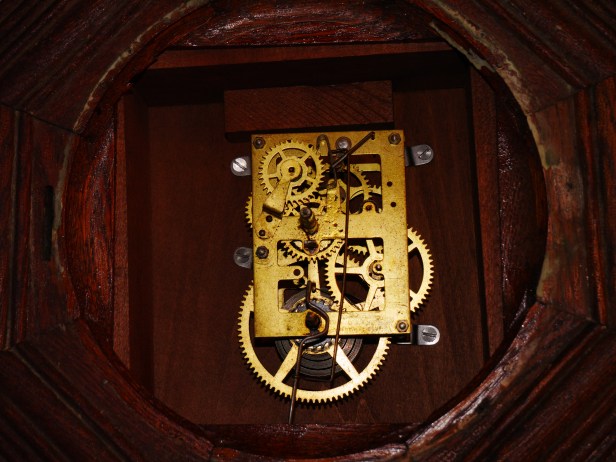
It is a 1920’s vintage Sessions Drop Octagon wall clock. It has a solid medium dark oak case with original hands, ornate pressed brass pendulum bob, solid brass bezel, 80% of an intact label on backboard, tin dial pan and stenciled lower glazing on the sash. The paper dial is original but it is heavily “foxed”. The movement is 8-day time only. The dimensions of the clock are a 9″ diameter dial, 19″ high, 13 1/2″ wide by 4″ deep. It is in reasonably good condition given it’s age and for $20 it was quite a bargain. It is also intact; there are no missing or broken pieces.
Sessions time-only movement
I don’t think this clock has been run in quite some time.
I took it home, hung it on the wall and true to what the seller said it would run less than a minute and stop. I noticed a rubbing sound around the pendulum area as it was running. The pendulum bob was hitting against the inside front of the case. I took the movement out and observed a bent crutch rod, corrected it, put it on a test stand and it ran immediately. As expected the movement had quite a bit of grime and required attention but it ran for a day before I took it apart for a thorough servicing. I don’t think this clock has been run in quite some time.
I found it curious that the suspension spring was soldered where the spring hooks into the top block. It likely kept slipping off and solder was used to keep it in place. In any event, the spring cannot be taken out without first removing the solder! The clock is in very good overall condition for it’s age and the movement was not as dirty as I first thought. The pivots are in decent condition for the most part and there is minimal wear overall. The movement was disassembled, cleaned and in the process I decided to install two bushings for added insurance, one on the escape wheel (front plate) and the other on an intermediate wheel (front plate). The movement was tested, put in beat and reinstalled back into it’s case.
I may replace the paper dial but I am going to see if I can live with it for the time being.
The dial has many brownish spots as you can see in the next photo. The clock had to have been in a moist environment for a long period for the paper to discolour. My two options are, one, leave as is or, two, replace with a paper dial. I may replace the paper dial but I am going to see if I can live with it for the time being. The brass bezel cleaned up well but the exposed tin surrounding the paper dial has blackish areas which I managed to reduce with CLR but could not totally eliminate. Of course, I later learned that CLR is really not appropriate for this purpose as it is an acid.
Dial showing rust staining
The case has years of grime which was easily remedied with Murphy’s soap and water. It cleaned up very nicely. Following the cleaning I gave the case a light coat of shellac to restore the luster of the oak. It looks good and it runs well.
My other drop octagon clocks are a Waterbury Arion, an unknown Ansonia and an Arthur Pequegnat Brandon II.
This Waterbury Arion is 19 inches long
Ansonia short drop octagon, model unknown, 12 inch dial
Arthur Pequegnat Brandon II, 12 inch dial
Time-only movements are the easiest to work on and a very good movement to learn on.
Repaired Sessions Drop Octagon clock
Time-only movements are the easiest to work on and a very good movement to learn on. If you are a beginner in clock collecting and repair clocks such as this are satisfying clocks to work on and presents few challenges. I am happy that I managed to bring this particular clock back to it’s former schoolhouse glory.
The term schoolhouse clock is a term that was not applied when they were made but came to be known as a particular style of clock found in school settings by later collectors. The schoolhouse clock is such an endearing name that when one thinks of a schoolhouse clock the memory of these specific styles of clock immediately comes to mind.
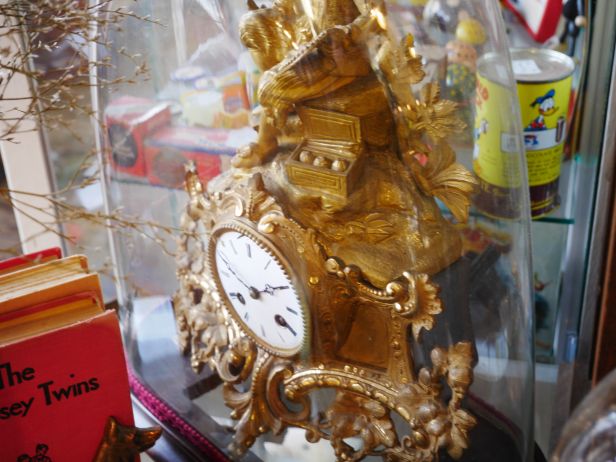
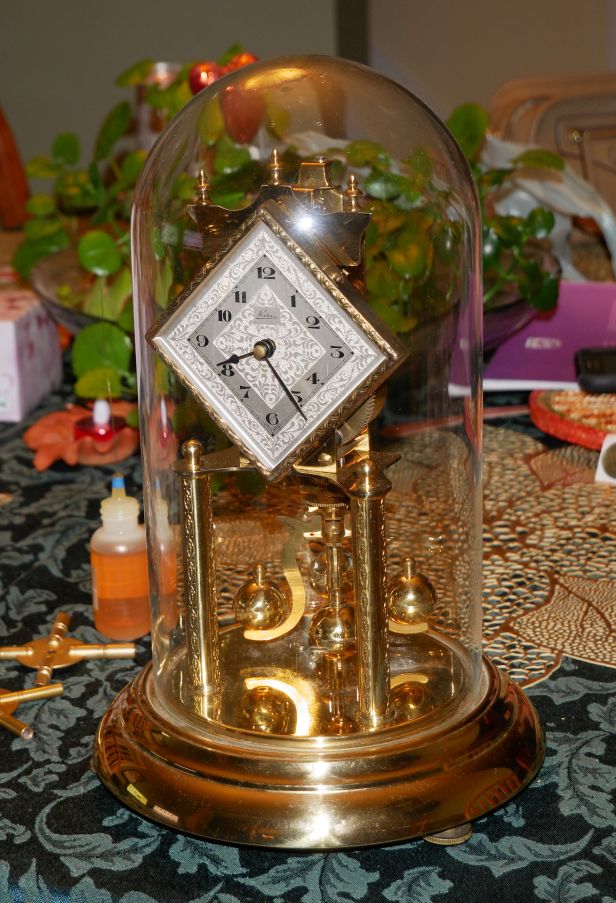
Sadly the number of antique shops in Nova Scotia is dwindling. We were antiquing in the city of Halifax (Nova Scotia, Canada) this past spring and one of the store owners remarked that there used to be dozens of antique shops in the city, now only a few remain. There are still a few antique shops left in the rural areas and one of our favorites is located in Great Village, Nova Scotia. We decided on a little drive to Great village on a sunny fall Sunday. We were not disappointed in the variety of clocks we discovered. Although I saw all the following clocks during our day of antiquing I bought only one, the Kern “diamond face” 400 day clock (see photo below).
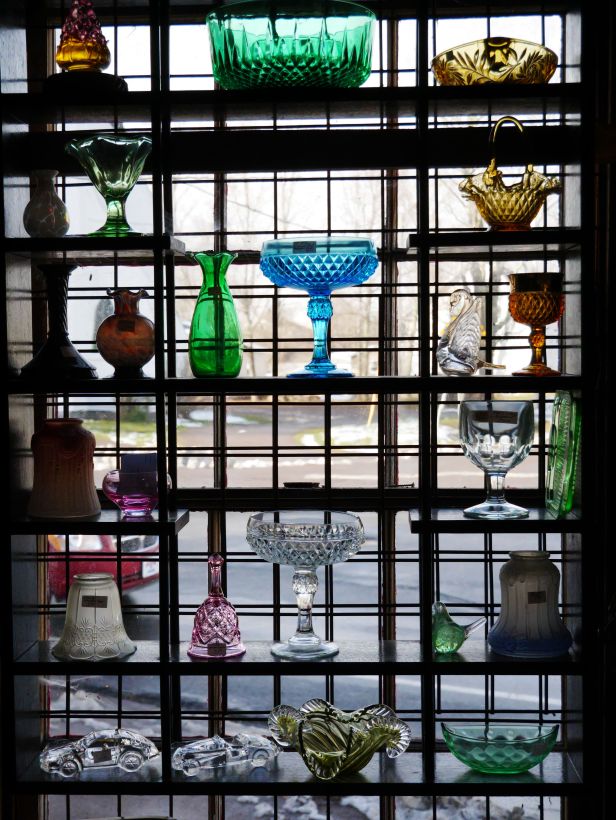
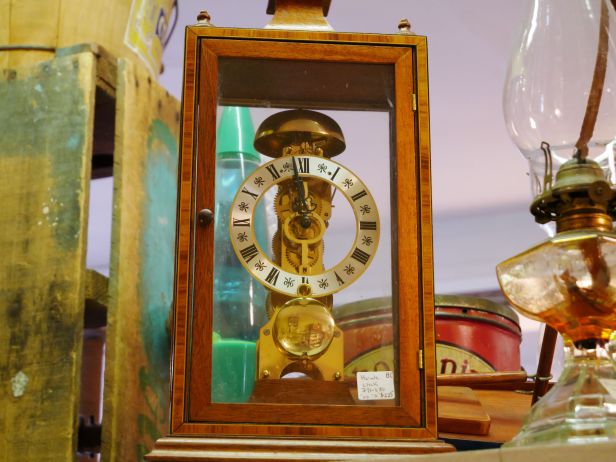
Window display
Unknown French clock
I want to give readers a sense of what is out there if you are collector like myself or you are new to collecting. Now is an excellent time to buy. There are certainly deals to be found and plenty of clocks in the shops. My personal experience is that the antique stores are great places to buy clocks but it can be bit of a gamble. For example, the Kern 400 day clock was advertised for a very fair price complete with glass dome. I asked the store owner if they knew anything about clocks and they said “no, nothing at all”. Sometimes that is a very good answer! The tag on the clock said “as is”. The owner evidently thought the pendulum balls were seized. Prior to the purchase I discovered, that they were, in fact, in their locked position. I got the clock home, unlocked it, gave a little push and it has been running for the past week.
Stamps for sale
You can get a “steal” of a deal, a clunker or something in between in an antique shop. In this same shop two years ago I bought an Arthur Pequegnat Brandon wall clock for under $200. The case is in excellent shape as is the dial but the movement, though barely running, required servicing. Even though I had to put a little more money into the clock I still consider it a great deal!
Having some knowledge of clock models, styles and types in particular is an advantage. Or, perhaps you might have a good sense that what you are looking at is a good deal. In the case of the Kern 400 day clock I inspected it beforehand and found that it was not only complete but in excellent condition. The $58 Garrard time and strike (photo below) might be a good deal but if it is missing the pendulum you are going to have to search long and hard for a replacement or buy one which adds to the cost. You might ask yourself, what else is missing and how much more money would I have to put into it? The Garrard was missing the front glass and I could not figure out how it was attached so I passed on it. Those are some of the factors to consider when you see something at an attractive price.
A doomed Ogee
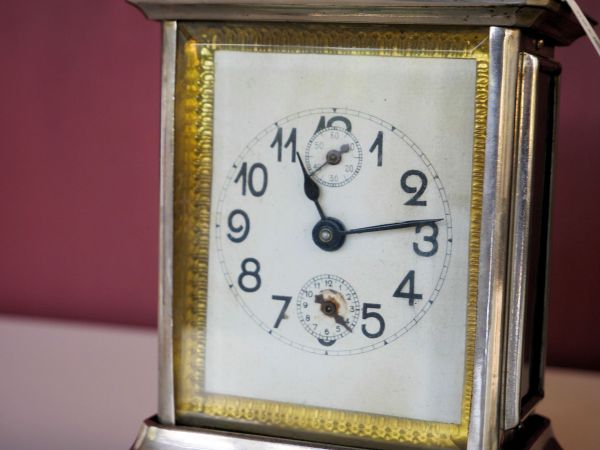
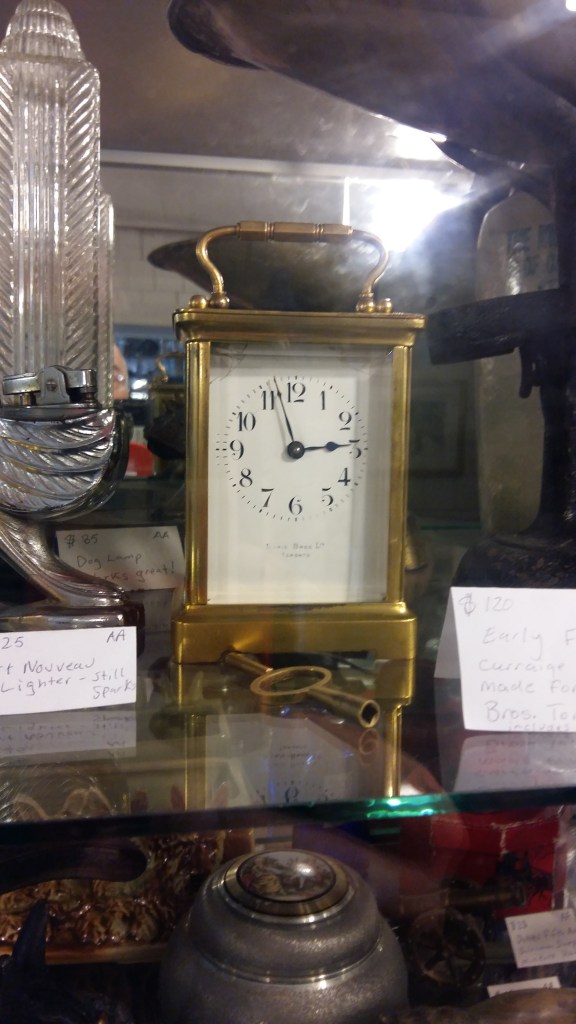
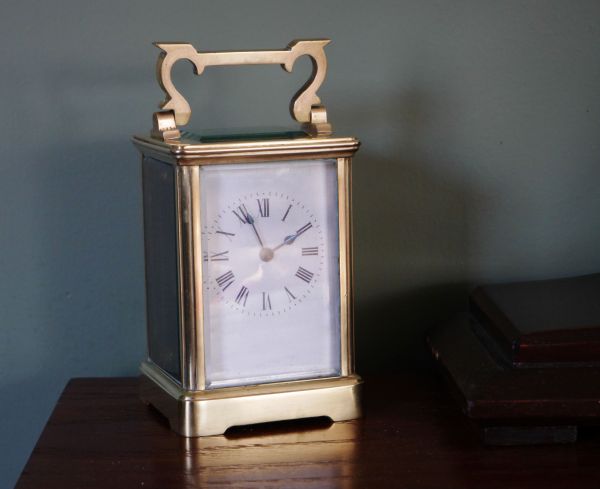
In the case of the carriage clock (first photo) the seller wants $120 but the day I was there they were offering a 20% discount which works out to $96. There is a jewelers inscription on the front which says Ryrie Bros. Toronto. Ryrie Bros was a jeweler in Toronto and was incorporated in 1905 with James Ryrie as president and W.M. Birks as vice president. In 1924 the firm changed it’s name to Ryrie Birks and finally in 1933 became Birks. As any Canadian knows Birks (Maison Birk) is one of the premier jewelers in this country. One could comfortably date this clock at between 1905 and 1924. Although the tag says that it is French it is likely American. It might be desirable however there are two bothersome issues that I could see right away with this carriage clock. One, the left side beveled glass panel has a chip in the lower back corner and two, there are noticeable hairline cracks in the upper two corners of the face. The tag said it was in working order. $96 may not be a bad price when you consider that comparable clocks fetch upwards of $130 or more + shipping on Ebay. If it is still there before Christmas I might take a second look.
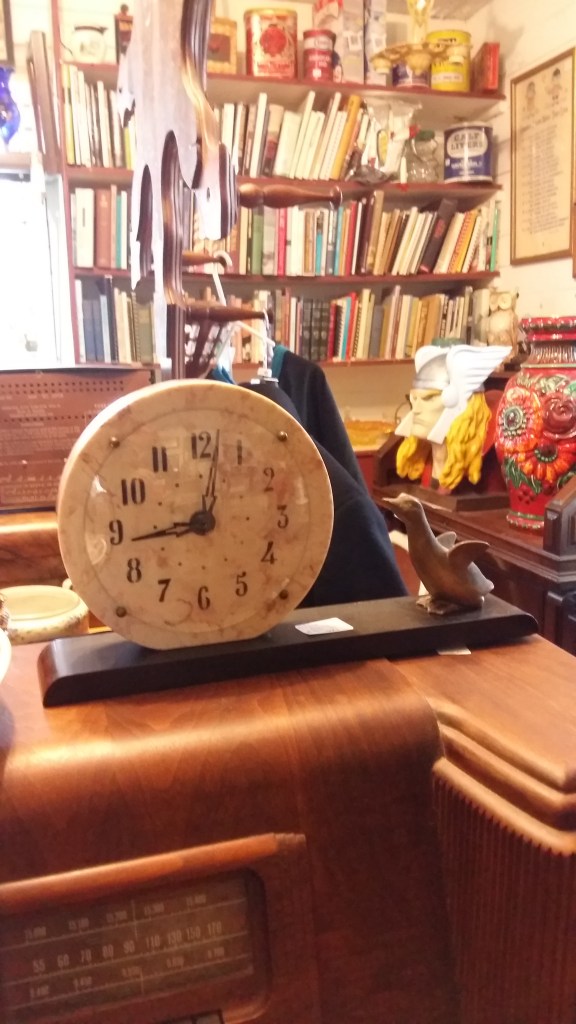
Unknown “marble” desk clock
This unknown “marble” desk clock was very interesting and quite heavy. It had an alarm clock style movement with a key wind and an adjustment for the time, and what appears to be brass bird (duck?) on it’s right side.
Kern diamond face 400 day clock
As I mentioned I bought this Kern 400 day “diamond face” clock. It is in excellent condition; unlocked the pendulum, oiled the movement, gave it a gentle push of the pendulum and now running very well.
Could be Sessions, Ingraham, Ansonia
In decent shape, 1873 it said on the label, but the seller wanted too much, $450 if I recall. The seller claims it is running, according the tag. Is it a Sessions, Ingraham, Ansonia or …..?
Sessions shelf clock in oak case
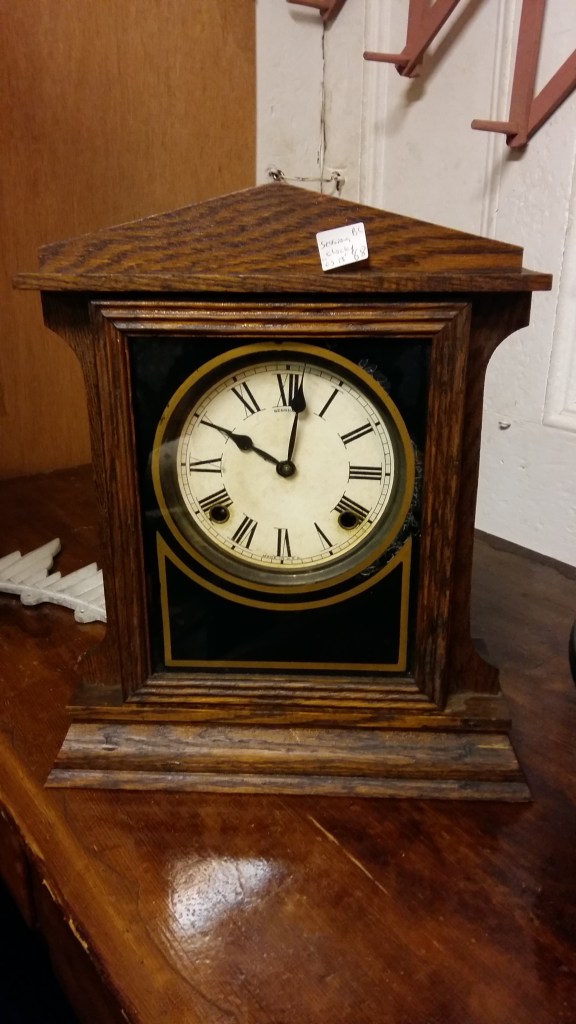
This clock looked to be in decent shape, the strike side appeared to be working properly. The case is oak but when I picked it up to examine it more closely, the construction, fit and finish had a cheap feel. There was a card inside describing a servicing performed in 1994. $68 – a little high, I thought but there may not be a lot wrong with it.
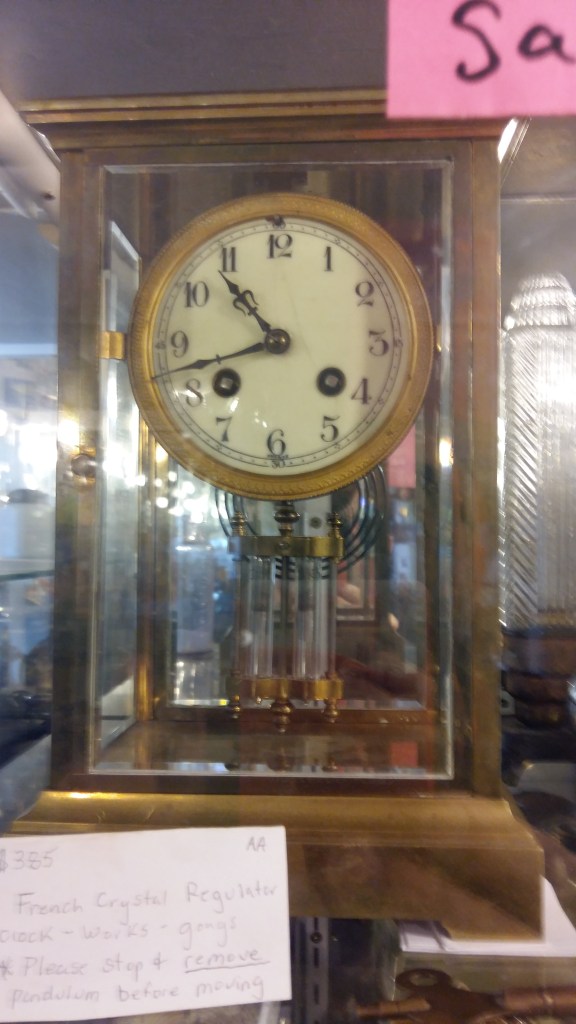
I like this clock but know very little about crystal regulators. What I do know is that most American companies made them, from simple brass and glass cases to elaborate cases with cast and gilt ornaments. Equivalent French examples seem to be more valuable than American ones. They can be highly expensive. Generally, the more elaborate the case, the more expensive the clock, even though the simple cases could easily be considered more tasteful. I remember seeing a very ornate one on Antique Roadshow which was valued at $8000. Condition is very important with these clocks, including the condition of the beveled glass, dials, and original finish (generally gilt) on the case ornaments. Is the pendulum supposed to be filled with anything? Mercury? These cylinders looked empty. The seller claims the clock is running and wants $365. A fair price? I don’t know. It needs a thorough cleaning though.
Garrard mantel clock
This English Garrard clock had a well constructed case and appeared to have a well-made, robust movement but was missing its front glass. I have been to this particular shop several times and nobody seems to be interested in the clock though the price has not changed.
Seth Thomas made by Talley Industries
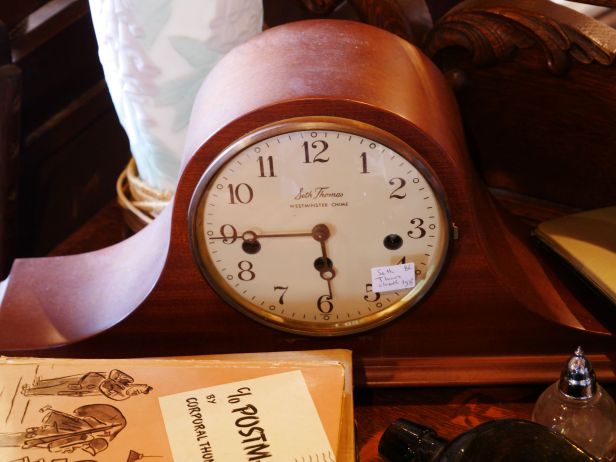
I noticed a Seth Thomas mantel clock in a dark corner. This particular example is one that I would not recommend to anyone unless you are a fan of Talley Industries. It is a Seth Thomas Westminster chime mantel clock made by Talley Industries, Peterborough, Ontario in the early seventies with what appears to be an imported West German Hermle movement. This clock was cheaply constructed (corners were chipped), likely has the dreaded plated pivot problem and has absolutely no collector value. Those in the clock collecting world familiar with Seth Thomas know that it was a reputable clock maker for many years and produced many fine clocks but the Talley Industries era must have been a very dark period for the company!
A unique clock design
I hope this blog article gives the reader some ideas when it comes to antique shop clock shopping. It certainly pays to do your research. Although I love browsing the shops I do not limit my shopping to them. I acquire many of my clocks from a variety of sources including Ebay, Kijiji, and word of mouth but I like browsing through antique shops because there are always other interesting items that catch the eye.
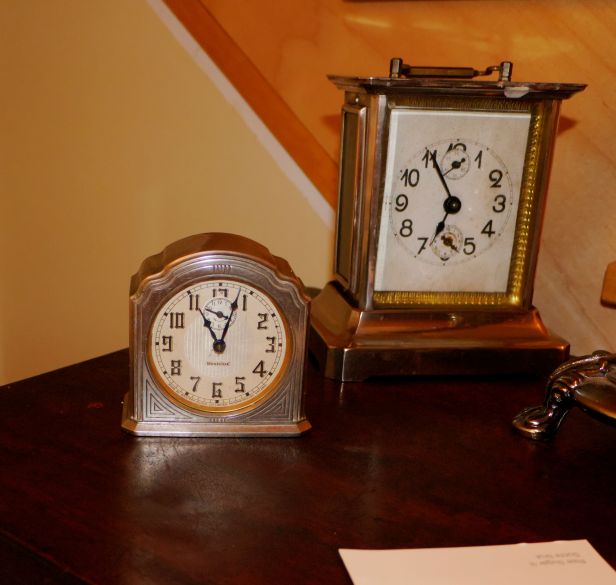
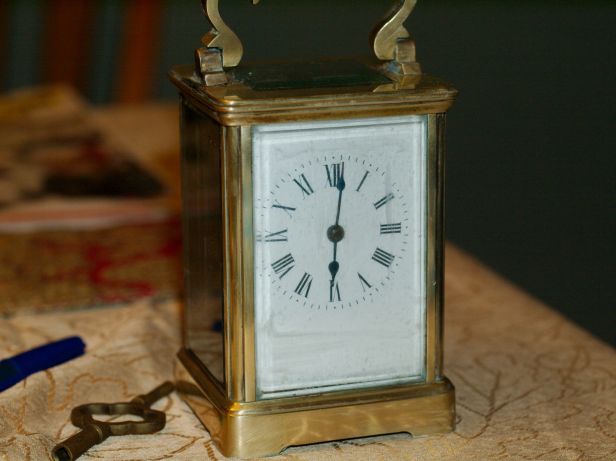
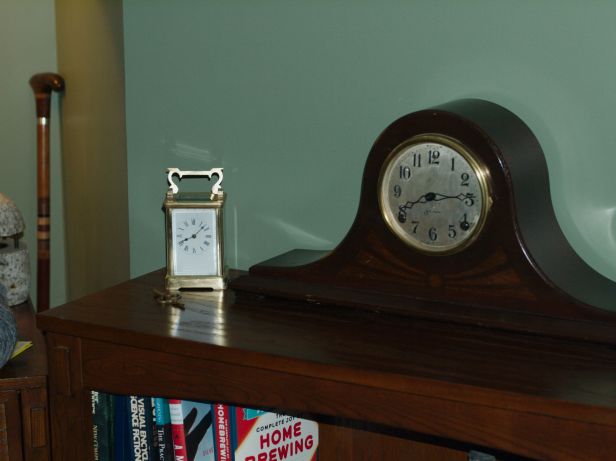
I have in my collection an unsigned 8-day carriage clock in a moulded rectangular brass case. This attractive little clock has a white enamel dial with Roman numerals, blued steel hands and a spring driven movement with platform lever escapement visible through the top beveled glass. The moulded brass case has beveled glass panels on all sides complete with a fold-down travel handle and two sided key.
Next to a Sessions Beveled No. 2
Although my knowledge of carriage clocks is somewhat limited, searching the origin of the carriage clock on the net reveals that this type of clock was a very popular item for well-to-do travelers in days gone by. Carriage clocks were spring driven clocks popular in the late 19th and early 20th century designed for travel. It’s golden age was somewhere between 1860 and 1900. The first carriage clock made by Abraham Louis Breguet was designed exclusively for Emperor Napoleon of France in 1812. More information about this fine inventor and horologist can be found here. Many came with a sturdy leather carrying case with one hinged panel that opened to check the time. Mine came without one.
The movement plates in my clock are secured by screws rather than pins suggesting that it was made at a later period. This clock would have been produced for the English market since it has “S”and “F” stamped on the escapement. If one assumes that the key which has “France” inscribed on it is original, then the clock is French. There are no markings on the outside of the clock save for the number “73” stamped twice on the inside access door and once on the bottom of the carrying handle. There are numbers visible on the inside of the plates that I can barely see but once I get the clock apart I can determine if they mean anything and report in a subsequent blog entry if I find anything of significance.
It’s diminutive size, 3 inches wide by 4 1/2 inches tall (without the handle) and 2 1/2 inches deep makes it exceptionally portable. If it is to be displayed on a mantel, a shelf or a desk, it is small enough to be placed anywhere in the home without dominating a room.
The balance and spring-driven platform jeweled escapement that comprised the working mechanism of the carriage clock made it ideal for transportation. The fact that it needed to be transported means it was more robust in dealing with jostling and movement than any other type of clock in it’s day. They were built to last which is why so many of them survive in very good condition to this day. Many had time and strike mechanisms, some with a repeater function, but this is a simpler time-only version.
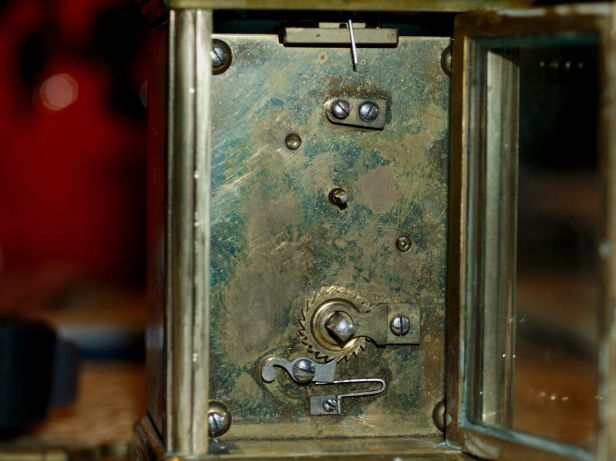
Back plate showing winding arbour and lever for speed adjustment, with verdigris present
I managed to revitalize the case as you can see in the first two photos. However, the back plate shows a significant amount of oxidization though one hopes that the movement itself is in good condition. This oxidation is called Verdigris. Verdigris is a bright bluish-green encrustation or patina formed on copper or brass by atmospheric oxidation, consisting of basic copper carbonate.
Although the clock came to me in running condition the movement is very dirty and requires disassembly and a thorough cleaning. I am encouraged by the fact that the clock ran through an eight day cycle so I must assume that the jewels in the escapement are in good condition. Repairing jeweled escapements is not something I can do at this stage.
At the moment I see two issues with my clock. One, there is a small break in the lower corner of the beveled glass on the left side which is barely visible and two, the pull handle on the access door is slightly bent. There may be other issues once I get it apart but we’ll cross that bridge when it comes. I might even find that missing piece of beveled glass trapped somewhere in the movement.
During my research concerning the repair and servicing of carriage clocks I have discovered that letting down the mainspring is critical prior to disassembling. I read about a case where the platform escapement was taken off without letting down the mainspring and the result was the contrate wheel (having teeth that are at right angles to the plane of rotation) below the escapement was seriously damaged. I want to avoid that.
At the moment I have too many other clock projects on the go. However, in the meantime, that won’t keep me from displaying this beautifully crafted timepiece in a prominent location.
In a future blog I will report on the steps I will take to bring this clock to a healthy running condition.
I absolutely love Art Deco clocks. They are understated, elegant, have great collector value and are timeless, of course (!).
Although we tend to throw the term around loosely Art Deco is actually derived from the phrase Arts Décoratifs which was a dominant decorative art style of the 1920s and 1930s, it’s heyday. This unique form is characterized by precise, bold geometric shapes and strong contrasting colors, used most notably in household objects, and, of course, in clock design as we see here. Style Moderne (as Art Deco was otherwise known) originated in France and was centered in Paris, just before World War I and became very popular after the Great War (World War I). Perhaps the most visible example of Art Deco architecture is the Chrysler Building in New York City in this photo taken from the Empire State Building in 2014.
Chrysler Tower, New York City
The Art Deco style had a far reaching influence and permanency that went far beyond the 20s and 30s through to articles, objects, architecture, furniture and yes, even clocks to this very day.
This is a Smiths Enfield Art Deco style clock. The Enfield Clock company was started by two German brothers in Enfield, North London, in the early twentieth century. During the Second World War (1939-1945) they were the major UK supplier for essential aircraft clocks and instruments. After the war the company vigorously resumed clock and watch production. No doubt most homes in Britain at that time had a Smiths clock. The Smiths Clock Co. became Smiths Enfield in 1949 and the Smiths Enfield name first appeared in catalogs from 1950 onward.
Smiths Enfield clock
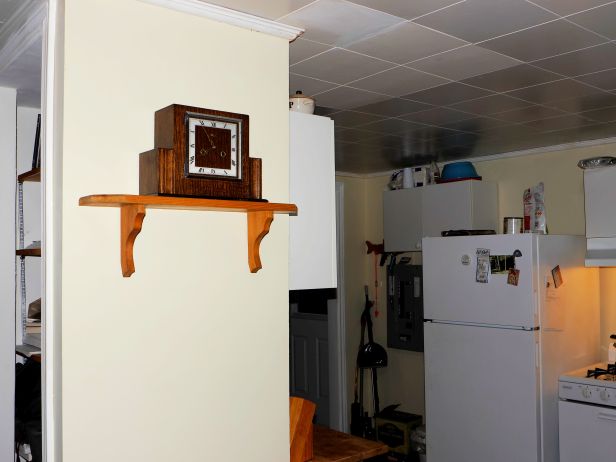
Smiths Enfield clock on a shelf
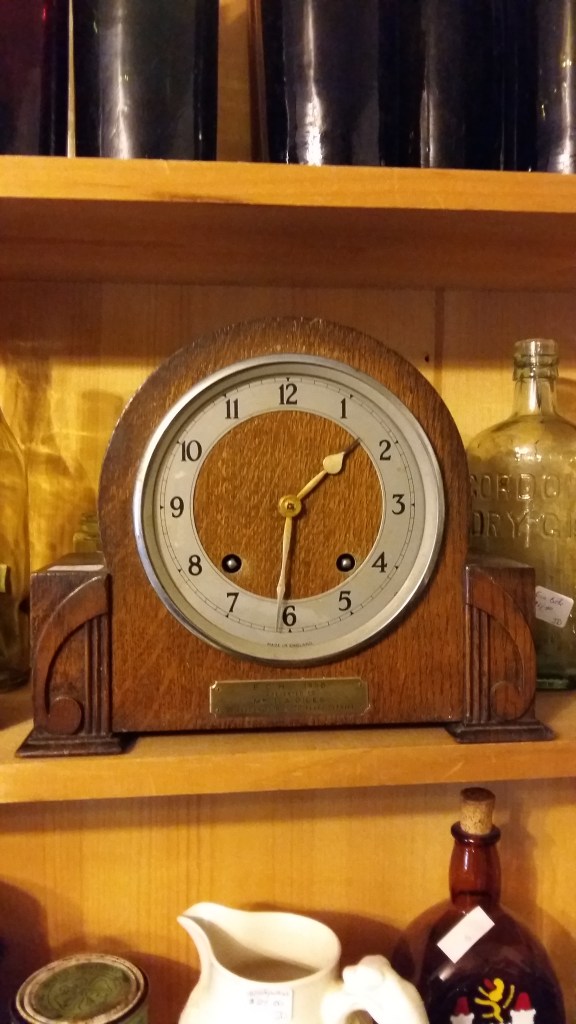
This elegant Smiths Enfield oak case time and strike shelf clock was made somewhere between 1949 and 1955. I know little of the provenance of this particular clock suffice to say that it came from overseas where it likely spent it’s life in someone’s home prior to coming to Canada about a year or two ago. The clerk at the antique shop located in Halliburton, Ontario this past summer (2016) told me that the owner of the shop purchases the bulk of his antiques from Ireland and judging from the store contents he imports a quite a lot of antiques and a lot of clocks.
The oak cabinet is made up of veneers and solids and is well constructed. The case is in excellent condition with nary a nick or scratch; required a soap and water cleaning and a little lemon-based furniture polish to bring the shine up. The clock runs well and keeps relatively good time although it certainly requires a thorough cleaning.
Floating balances were introduced by Smiths Enfield in 1956. Since this clock has a pendulum it was manufactured during the period I mentioned above (1949 to 1955). The inverted numbers on the lower clock face, which at first look strange, are actually very common on clocks with Roman Numerals.
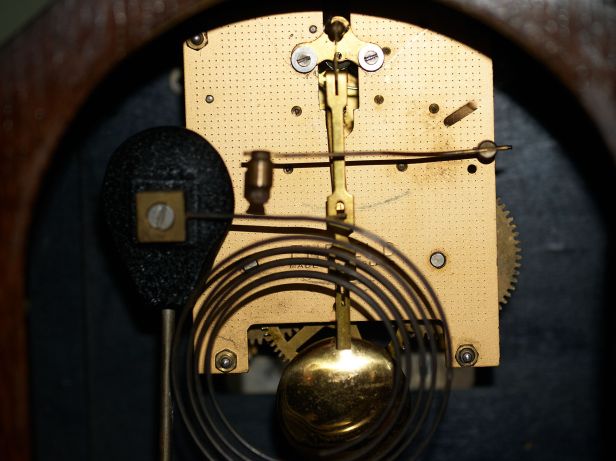
Movement showing coiled gong
It has a coiled gong and a nice pleasant strike if I can get the hammer to strike the gong as it should. A trial and error approach ensuring that the hammer is above but not quite touching the gong or replacement of the hammer leather are two possible solutions.
This is one of two cottage clocks I have. By that I mean they are literally at my summer cottage, and since it remains at my cottage a cleaning will have to wait until next summer.








 Antique and Vintage Mechanical Clocks
You must be logged in to post a comment.