Essential Clock Movement Servicing Steps

Why does a mechanical clock movement require servicing? The answer is quite straightforward. Maintaining your clock’s movement is essential to ensure it continues to function properly and extends its lifespan.

Regular servicing reduces wear and tear, ultimately preserving the clock’s functionality. Ideally, most clocks should undergo servicing every three to five years to maximize longevity.

Seth Thomas mantel clock C.1930

This article outlines the seven steps I typically follow when servicing an antique or vintage clock movement, using a common American, pendulum-driven movement as an example, Seth Thomas’s Type 86 8-day time and strike movement.

Step 1 – Initial Assessment: Upon receiving a clock, my first task is to determine if it runs. I assess whether it runs and strikes correctly and completes its full 8-day cycle. If it operates for fewer than 8 days, there may be an underlying power problem, which could stem from various factors like weakened mainsprings, worn bushing holes, bent arbours, and so on but more often than not a good cleaning will improve its run time even if there is some wear in the movement.

The movement is mounted to the front of the clock

Step 2 – Addressing non-running clocks: When the clock does not run, I conduct an examination to identify potential issues such as missing or broken components, bent wheel assemblies, and arbours, damaged or worn gear teeth, worn pinions, snapped mainsprings, and broken or broken clicks along with any missing parts like suspension springs or pendulum bobs.

Nevertheless, when all components are intact and the mainsprings appear to be in good condition, I take measures to ensure the clock is properly adjusted for an even beat.

I’ve observed that on many occasions, the mainsprings are wound tightly, and relieving this tension tends to address the problem (albeit temporarily), allowing the clock to operate relatively smoothly. However, if it stops running soon after starting, I note the problem areas and set it aside for servicing.

Step 3 – Disassembly and assessment: After removing the hands, dial face, and taking the movement out of the case (4 screws hold the type 86 in place), I conduct a thorough visual inspection. This step involves checking for damage, dirt, and excess oil, and determining the extent of cleaning required.

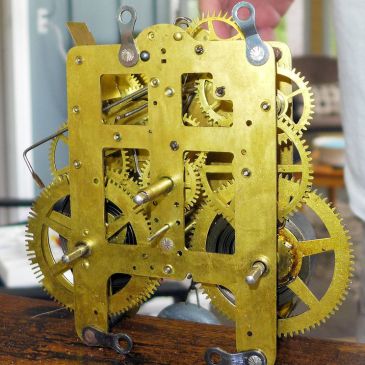
Type 86 time and strike movement

I use retaining clamps to safely secure the mainsprings’ power and then proceed with disassembling the movement. Disassembly includes removing outboard parts such as the crutch and suspension rod, releasing the four or five bolts holding the plates in place, and proceeding to remove the wheels and levers.

I assess wear in various areas, including pinions, pivot holes, arbor conditions, and connections between plates and pillars. I also look for tool marks and indications of previous servicing.

Step 4 – Cleaning the parts: Cleaning the clock movement parts is crucial, and I prefer using an ultrasonic cleaner. I use a mild alkaline, biodegradable degreaser concentrate for cleaning. I organize the parts in compartments for easy identification, with strike parts separated from time-side parts.

Deox 007 is a concentrate.

For open-loop mainsprings such as the type 86, I detach them from the main wheel before cleaning. To guarantee that the mainwheels and springs are reinstalled in their original spots, I mark them with either “T” or “S” for clear identification.

Ultrasonic cleaner by L&R

Drying the parts promptly is vital to prevent rust formation. I use shop towels and a portable hair dryer to ensure all areas are dry. Lantern pinions tend to be especially difficult to dry and a hair dryer is an ideal tool to remove excess water.

After cleaning, I inspect the cleaning solution and, if suitable, reuse it.

Step 5 – Polishing pivots: The next step involves polishing the pivots. If the pivots are in good condition, a few passes with an emery board are sufficient. A small metal lathe is ideal but a portable drill will do.

Taig lathe with 1/4 hp motor

For pitted pivots, more aggressive cleaning and polishing may be necessary, and in extreme cases, pivot replacement may be required. Cleaning and wiping the pivots with a soft cloth is essential, followed by bushing if needed.

Step 6 – Bushing, broaching, and pegging pivot holes: I determine which pivot holes need bushing by assessing lateral pivot movement and marking each one (with a black marker) to be bushed.

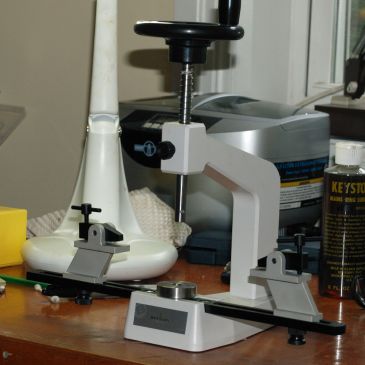
Bergeon Bushing Machine

I use a Bergeon bushing machine known for its precise work. After making the bush hole, I clean it from chips and burrs, followed by broaching if necessary. In the process, both cutting and smoothing broaches are used to ensure an optimum fit.

Drilling a hole with Bergeon bushing machine
A hole is enlarged with a cutter to accommodate a new bushing

All pivot holes are pegged with toothpicks until no residue remains.

Step 7 – Making necessary repairs: Other potential repairs include re-pivoting, straightening or replacing wheel teeth, sourcing parts, making new parts, and addressing issues with worn lantern pinions and escapement components.

Step 8 – Reassembly, testing, and adjustment: Finally, I reassemble the clock movement, carefully securing the gears and levers in place. I use a pivot locator to move the pivots to their correct location. Once reassembled, the movement goes through a testing process and adjustment on a test stand, ensuring it is in beat and properly regulated. This testing phase can take up to a month before returning the movement to its case.

A movement on a test stand. Attached is a microphone for a beat amplifier

In conclusion, servicing antique or vintage clocks significantly extends their lifespan. These seven steps provide a general guideline for clock movement servicing, though some steps may require further explanation, and individual procedures may vary among clockmakers.

Gilbert tambour clock with Normandy Chime – movement servicing

Gilbert mantel clock 1925

This Gilbert tambour style mantel clock is model 2038 with a bim-bam strike or what Gilbert called a Normandy chime. The model number along with the words “Normandy Chime” are stamped on the bottom of the case. Gilbert called this the “Normandy Chime” as it was reminiscent of the old bells of Normandy (Corneville) in France. In terms of nomenclature within clock circles, calling it a “Chime” certainly adds to the confusion as this would be considered a striking clock rather than a chiming one.

Whoever did the past bushing work chose to avoid the motion works area, and for good reason

The Movement

And now to service the movement.

Dis-assembly of the movement is done in the conventional manner with the exception of two items. Both the striking disk (upper arrow) which runs off the cam wheel and the passing strike L bracket (lower arrow) which runs off the centre cannon are friction fit and must be pulled off beforehand to work on the movement. I don’t have a puller but two small screwdrivers positioned across from each other will lift the parts off with minimal effort. Do not polish the ends of these two rear pivots.

Arrows showing striking disk and passing strike L bracket

A prior examination of the movement revealed that it is generally good shape. Overall, the lantern pinions are in good condition with minimal wear. There has been extensive bushing work completed in the past. I see six replacement bushings on the back plate and seven on the front for a total of thirteen which suggests that there was a lot of wear. They are all in very good condition which tells me that the work was done fairly recently.

It also tells me that whoever did the past bushing work chose to avoid the motion works area and for two reasons. It is a tough one to fix because there is so little brass to work with and there is not a lot of torque on this wheel so it can be left as-is.

Although the following photo does not show it well, there is a lot of play in the bushing hole. This is the only one that is addressed in this servicing because I wanted to ensure good meshing of the motion works gears.

Motion works gear with bushing wear

To address the motion works bushing I sought advice from my colleagues at the NAWCC forum site with comments ranging from doing nothing to immediate replacement. The best advice came from a member who suggested I install a smaller diameter bushing and broach out the hole to fit the pivot and that is exactly what I did. A #46 Bergeon bushing was chosen with a diameter of 3mm and an inside diameter of 1.30mm. The pivot is 1.48mm and the result is a side wall that is about 0.80mm. This should allow the gear to mesh nicely and since there is not a lot of torque on this gear the fix should last a long time.

Re-assembling was straightforward. There are no helper springs on this movement so there was no tension pushing on the levers. The only adjustment I had to make was to pull the movement slightly apart to correctly align the stop pin to the stop lever so that the movement strikes as it should.

Arrow showing stop pin (my healing thumbnail from a mainspring that let go)

Since the movement has a Normandy chime the striking hammers are located outside and to the bottom of the movement.

Striking hammer assembly for Normandy Chime

The final process in re-assembly is to attach the hammer mechanism. But before doing so two parts are re-attached, the strike wheel and the L bracket which are pushed back into place. Once in place they can be moved slightly to sync the hourly and half hour strike.

Some folks give Gilbert movements a bad rap but they are not much different than a Sessions, or similar inexpensive movement of that period and the fact that this one is still functioning after over 90 years has to say something for its engineering.

What does bushing a clock mean?

American Sessions time and strike clock showing a gear pivot and the build-up of dirt in the pivot hole

Is your mechanical clock not running as well as it should? Does it stop intermittently or not run at all? There may be a number of issues with the movement and among them pivot wear.

Pivots are the ends of the axles (the horological term is “arbours”) that spin in small holes drilled in the clock plates as the clock runs. They are reduced or turned down end of an arbour. These, along with the holes themselves, can become worn. The pivot hole must be perfectly round and the pivots must have a mirror-like polished surface in order to minimize friction within the train of gears. The two surfaces must be protected and the barrier between the pivot and the pivot hole is clock oil.

A badly worn pivot

A worn pivot or worn pivot hole causes the gear to slowly move away from the pinion and it will eventually stop when the gears no longer mesh properly. A clock that is in need of bushings runs erratically or stops altogether.

If a clock movement is not serviced (cleaned and oiled) routinely there will be wear in the plates of the movement where the pivots come through. If new oil is applied over the old il it will free up abrasive dirt and keep grinding away at the steel and the brass bushing hole. Worn pivots are typically found in clocks that have been oiled over and over again and not properly cleaned. The term “properly cleaned” implies disassembly of the movement, cleaning the parts, addressing wear issues, reassembly, and testing.

Occasionally you will see punch marks made to close the pivot hole. Though not an accepted practice today this was a common method of repair employed by past clock repairers

Pivots must be cleaned and polished periodically to ensure they can turn freely within the hole in the clock movement plate. A worn pivot hole is easy to observe as they are oval-shaped instead of round as you can see in the next photo.

Close-up of bushing wear
Close-up of oval-shaped bushing wear. The circle shows what the hole should look like

The process of bushing consists of replacing the worn brass around the pivot so that the hole is round again. A new hole is drilled into the plate. A new, properly sized, the bushing is punched or pushed into the plate using a bushing machine such as a Bergeon Bushing Machine.

Some clock-makers prefer to hand bush using reamers and smoothing broaches and the results are entirely acceptable but a machine simplifies the task.

Badly worn pivots which are made of steel must be replaced with new pivot. This is called re-pivoting in clock circles. A watch or clock lathe is used for re-pivoting which involves drilling into the end of the wheel arbour with a high-speed bit and installing a new pivot made from pivot wire.

Drilling a hole with Bergeon bushing machine
Drilling a hole with a cutting reamer

Punching the bushing home
Punching the bushing home using a Bergeon Bushing machine

Using a micrometer to check pivot
Using a micrometer to check pivot diameter

Minor wear is tolerable and expected over the life of a clock and can be addressed by careful filing, polishing, and burnishing.

X marks pivot holes that need to be bushed
X marks pivot holes that must be bushed

Clock pivot oil
Clock pivot oil

Looks like a large pivot hole but actally punched close to the hole
Punch marks near the pivot hole. This was a common practice of past clock repairers

Bushing is an integral part of movement servicing. Some clocks that have been well-cared for may have minimal wear and may not require new bushings while others, through neglect or improper servicing, may require many bushings.

Bushing a clock is one of the most fundamental tasks of the clock-maker. Pivot and bushing work performed correctly will extend the life of a clock movement while ensuring that a clock runs reliably for years.

More fascinating terms – the language of clocks

Regular reader and contributor JC suggested a few more clock terms I thought readers and fellow horologists might find interesting.

My source for this article is the Watch and Clock Encyclopedia by Donald de Clarke, published by Bonanza Books (1984) which is still available on Amazon.

Gridiron pendulum: A pendulum consisting of alternating steels and brass rods coupled together to compensate for downward expansion so that the centre of oscillation of the pendulum remains consistent with changes in temperature, invented by John Harrison in 1725.

final look
Gridiron pendulum on a Junghans Crispi wall clock

Broaches: To broach is to open and enlarge a hole. A Broach is a steel cutting or smoothing tool with a tapered or parallel sided edge used to cut or “finish” holes in a clock plate. Used to enlarge and then finish (smooth) a newly installed bushing on a clock plate.

Swiss made smoothing broaches
A set of Swiss made smoothing (or finishing) broaches

Motion Works: The train or wheels of a clock directly connected with the hour and minute hand.

Great wheel: The teeth that form part of the barrel of the going barrel. It is also the wheel to which the mainspring is attached.

The motion works of a clock; the largest wheel on this movement is the great wheel (Pequegnat Clock Co.)

Maintaining Power: A method to maintain the driving power while the weight is being lifted or mainspring with fusee is being wound. In effect keeping the mechanism going while winding.

Weight driven movement with maintaining power
Weight driven movement with maintaining power, (unmarked Vienna Regulator)

Huygens Endless Rope Drive: It is a method of providing maintaining power to drive the clock while the weight was being raised. The endless cord passes over pulley A which is attached to the great wheel and supports the driving weight B, it then passes over pulley C which has a ratchet to support small weight D. As cord E is pulled down to wind the clock ratchet C turns under it’s click to raise weight B which continues to drive the clock as it supplies torque to wheel A. This ingenious system is found in some 18th century long-case clocks.

Huygens endless rope

Locking Wheel (or Count Wheel): A count wheel is the wheel that determines the number of blows to be struck in striking mechanisms.

The left wheel with notches is the count wheel

Ratchet wheel: A toothed wheel into which a click engages permitting the wheel to revolve in one direction only.

Click replaced
Toothed ratchet wheel and click

Cam: Usually a disk so that upon revolving it transmits movement to or exerts pressure upon a connecting unit.

Arrow showing location of a cam
Arrow showing location of a cam, the fly is located in the upper right

Fly: Often called the governor or controller of a chime or strike train. It is the last piece in a train of wheels.

The language of the clock world always amazes me. There are a plethora of other clock terms that I will be happy to explore in future blogs.

Website Powered by WordPress.com.

Up ↑