
Kundo 400 day clock and why I love anniversary clocks | Part I

The 400-day anniversary clock, also known as long-duration clocks, is a fascinating category of clock known for its ability to run continuously for a full year without needing to be wound. These clocks, often featuring intricate designs and beautifully crafted mechanisms, were first introduced in the late 19th century and have since become a beloved collectible.

Kundo standard size 400 day clock

In this article, we’ll explore the history, mechanics, and appeal of these interesting clocks. This is a two-part series. The first part describes my most recent purchase, a 400-day Kundo anniversary clock. Part II involves the installation of the suspension spring, cleaning, testing, and post adjustments.

400-day clocks are known for their inaccuracy, although they are undeniably beautiful and fascinating to observe. A minute lost each day adds up over the course of a year, potentially totaling many minutes—or even hours—by the end. Despite this, I still find great joy in owning and appreciating them.

A brief history

400 day clocks have been with us since about 1900. There were torsion clocks produced before 1900 but in limited numbers from about 1894 onward but the real push was after 1900. The Kundo model you see here was made in the late 1950s or early 1960s, probably the peak and subsequent decline of the anniversary clock era.

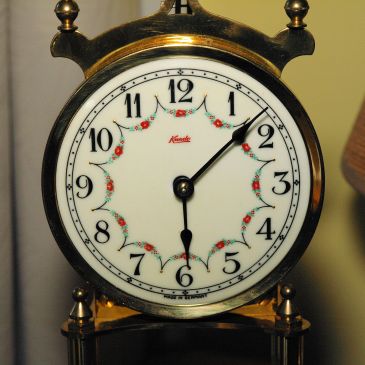
Dial face Kundo Clock

Once quartz clocks were introduced mechanical versions declined precipitously. Kundo is one of many companies making anniversary clocks in the 1950s and 60s. Kundo is a combined form of Kieninger and Obergfell. The company exists to this day as Kieninger, a subsidiary of Howard Miller which is part of a larger company.

This particular clock is a good example of a typical anniversary clock of the period. There are signs of wear as one might expect, dents on the base where an unrestrained pendulum did its damage and a snapped suspension spring but all the parts are there, complete with its dome.

Dents from weights bouncing around during transit

The clock was purchased at a local antique store. It is not in running condition. These clocks typically sell for around $50 to $100 or more on online marketplaces. Domes are often chipped or missing entirely. The glass dome on this one is free of chips.

I have ordered a Horolovar spring  (.0032″) and will report on the installation, cleaning, and testing of this 400-day clock. Look for the second part of this series.

Ridgeway Grandfather Clock

Should every clock collector have a Grandfather (tall case or long case) clock? No, but it was something I had always wanted.

RS Ridgeway clock_2
Ridgeway tall case clock

In 2012 I was perusing a local for-sale site and came upon this particular Ridgeway grandfather clock. The ad said that the clock was in excellent condition. When I called the seller and asked what he meant by “excellent” he said, “You have to see it to believe it”. He was right. The brass was bright and shiny and the only indication of its age (1996) is slight tarnishing of the column capitals.

Unfortunately, this type of clock takes a real hit on the used market. The smaller homes that many folks prefer today simply means there there is no room for a clock this size.

Clock face showing moon dial
Clock face showing moon dial and raised Arabic numerals

The clock has a graceful, regal look. It stands 83 inches tall, has a scalloped bonnet crown, functional blue moon dial with constellation, 5-rod Westminster chime with shut-off, stately columns with brass base and caps, raised Arabic numerals, oak solids and veneers, brass lyre pendulum with 10 5/8 polished bob and access panels on each side. It was made by the Pulsaski Furniture Company. The Pulaski company struggled financially in later years and was eventually bought out by the Howard Miller Clock Company in 2004. Howard Miller continues to offer the Ridgeway line.

clock face
Moon phase with constellation

And it came with the original cabinet key.

key
Original Ridgeway cabinet key

The seller advertised that it had a quality Keininger movement. Later ones did; this has a Hermle movement. In the 1990s the German clock company Hermle was the principle supplier.

clock movement
Hermle movement

In this case the ubiquitous 451-033, with 114 cm pendulum and 60 bps.

grandfather clock
Sussex model

The clock is very similar to the Sussex model as shown in this advertising brochure.

I have also seen the clock referred to as the Hamilton Country model. Nonetheless, it is impossible to verify since very little information about the original company exists to this day.

clock pendulum
Lyre pendulum with brass bob

The clock runs very well and to within a minute a week. When it fails it is more cost effective to replace the movement rather than bring someone in to repair it. I will simply swap the movement out with an identical one since Hermle continues to make this movement to this day.

Perhaps my only grandfather clock for now.

Website Powered by WordPress.com.

Up ↑