Echoes of an Unknown Maker: A Banjo Clock’s Journey Through Time

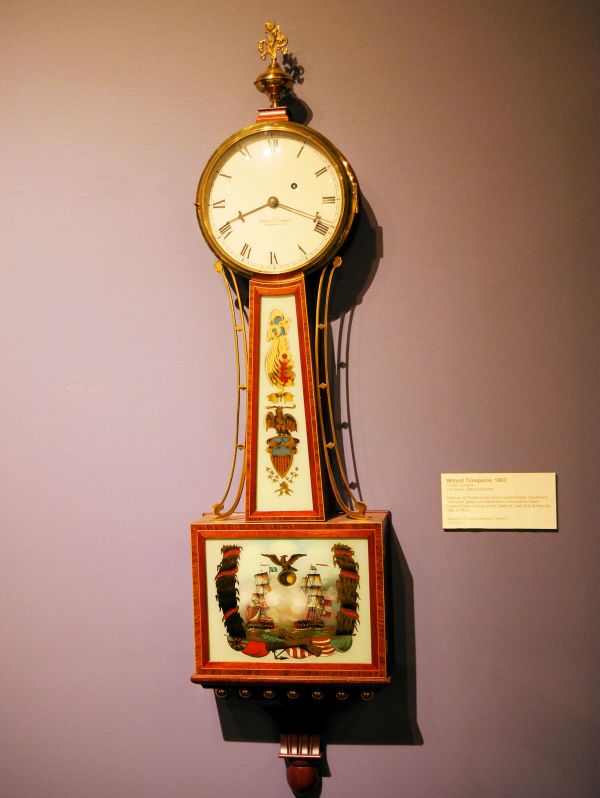
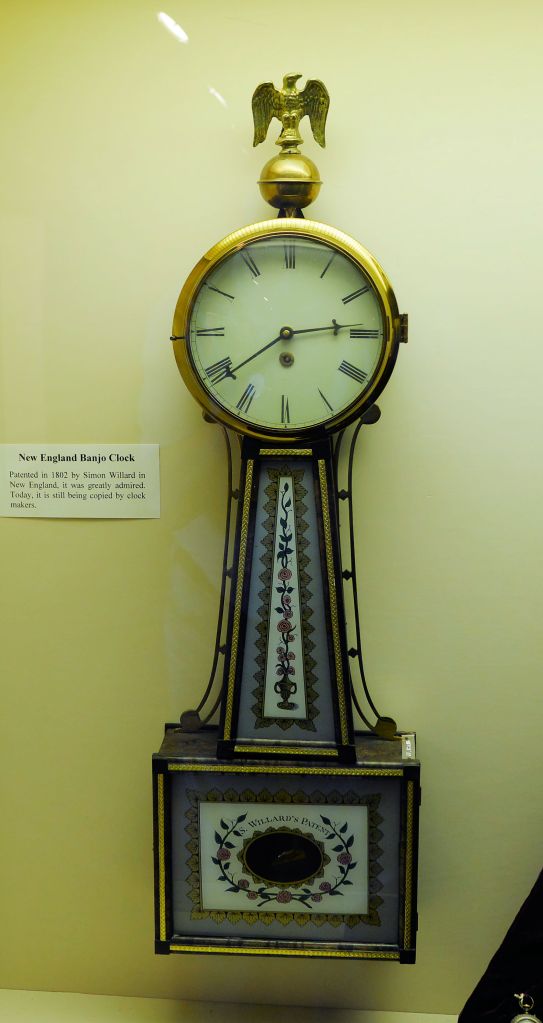
The American Banjo clock — often just called a banjo clock — got its name from the shape of its case, which resembles a banjo musical instrument. Although the design was patented in 1802 by Simon Willard, a renowned clockmaker from Roxbury, Massachusetts, Willard referred to his invention as the “Improved Timepiece,” not a banjo clock.
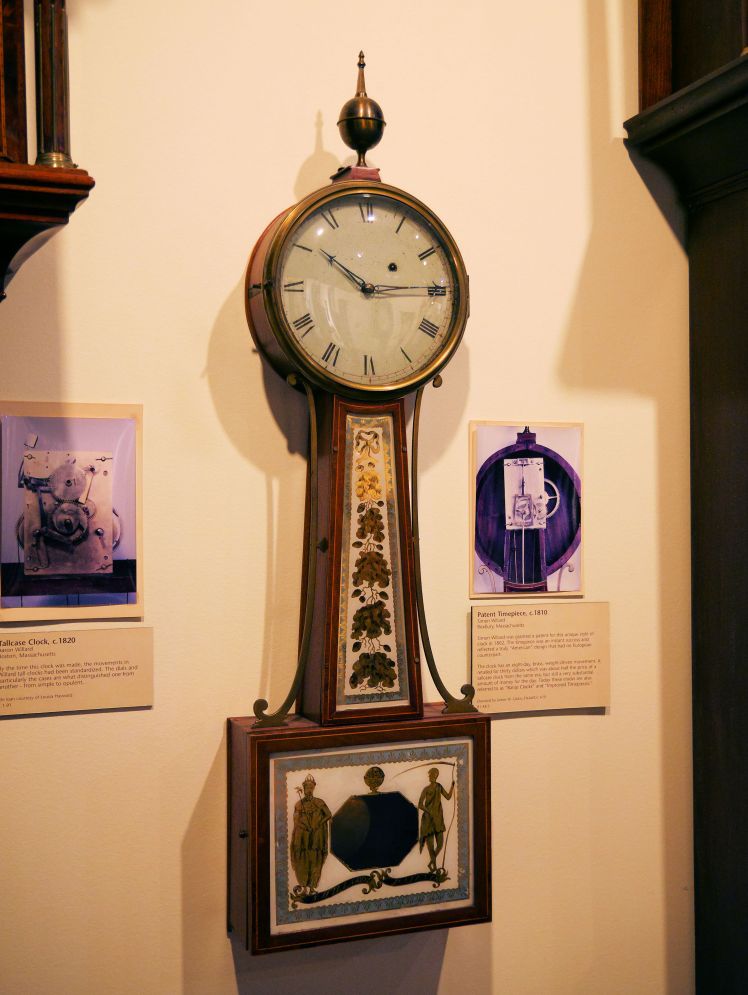
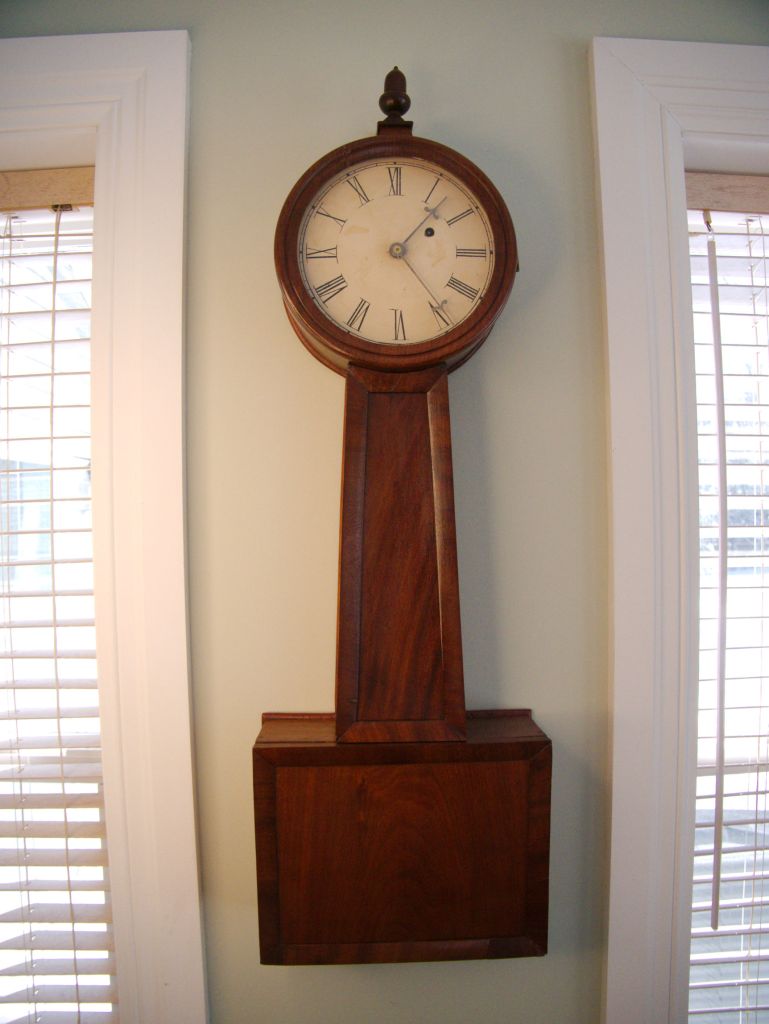
Willard-style banjo clock, c. 1810

There are essentially three types of mechanical banjo clocks. Those with lever escapements are usually in the lower price range, spring-driven examples occupy the middle ground, and weight-driven banjo clocks represent the higher end, typically costing several hundred dollars in fair condition to several thousand for authenticated examples from reputable makers.

My wife spotted the clock on Facebook Marketplace one evening. It was listed for $100, and the photo immediately caught my attention. I had a feeling it might be a diamond in the rough. I suggested she offer the seller $75, and to our surprise, the offer was accepted almost immediately. It seemed they just wanted it gone.
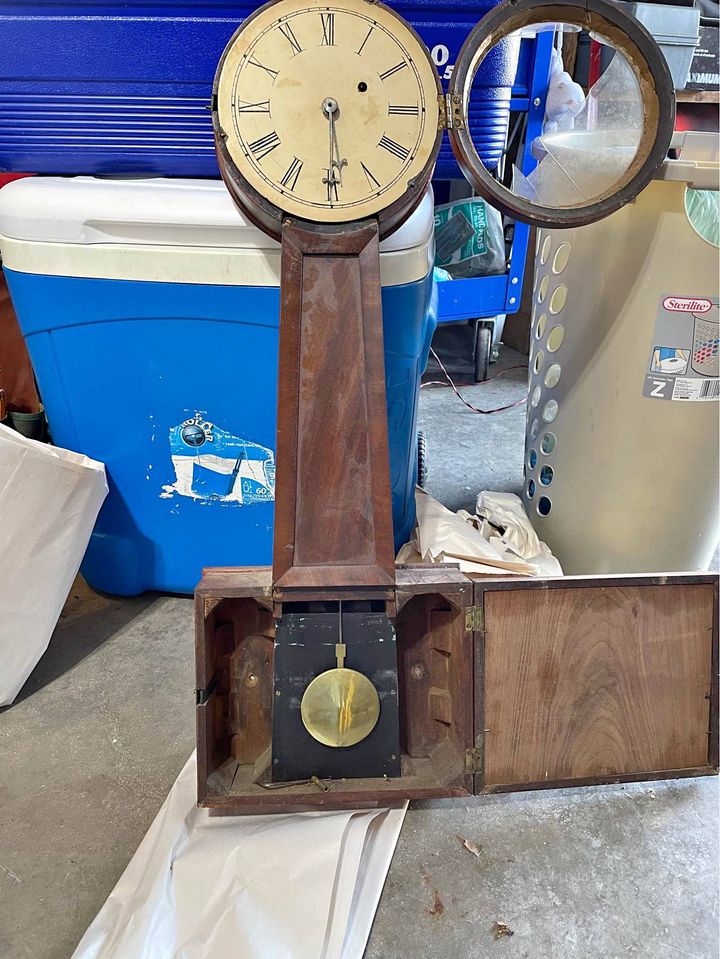
Seller’s photo, looking a little tired

The clock was one of several items the seller had for sale as part of a community-wide garage sale. So, a day later, we made the drive out to the rural part of Nova Scotia where the sale was taking place. When we arrived, we found the house and asked to see the clock. It was sitting there among other odds and ends, looking a little tired but full of promise.

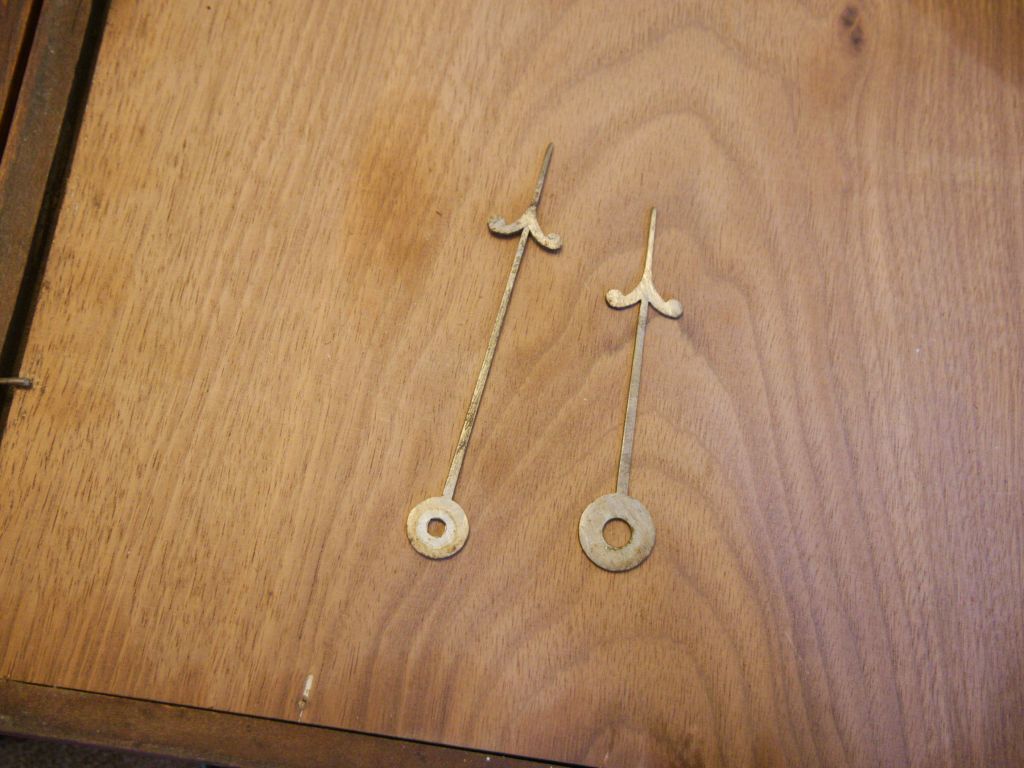
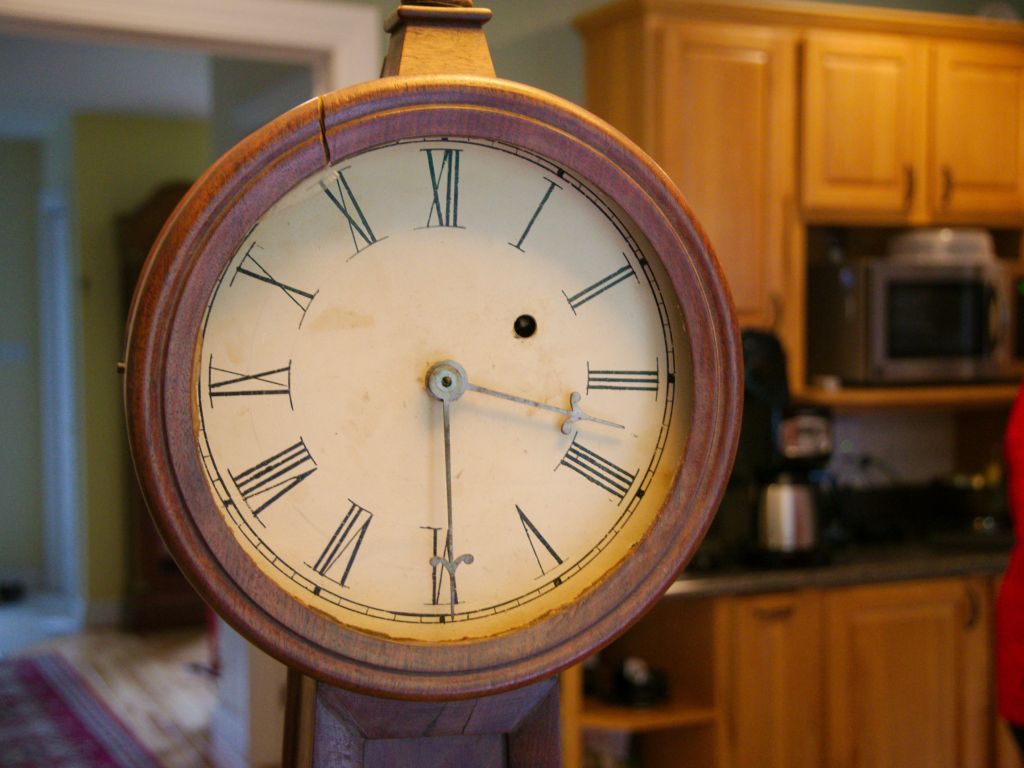
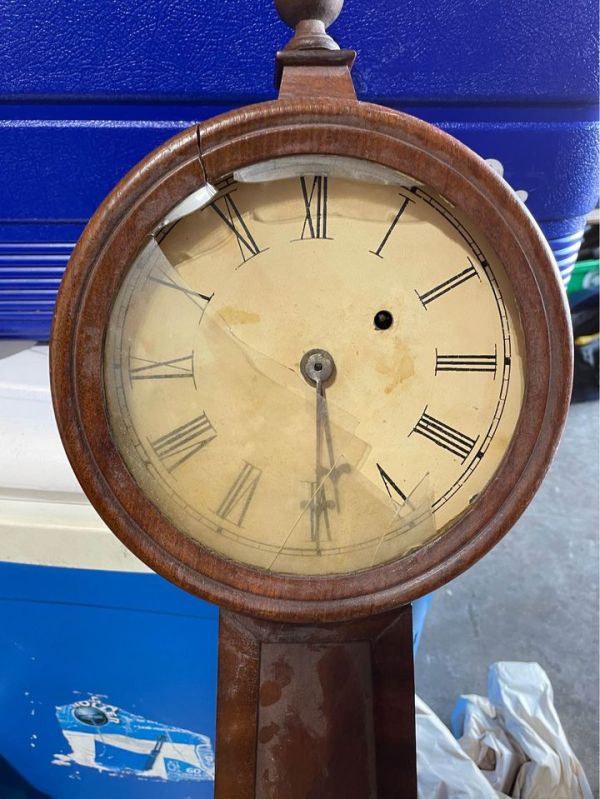
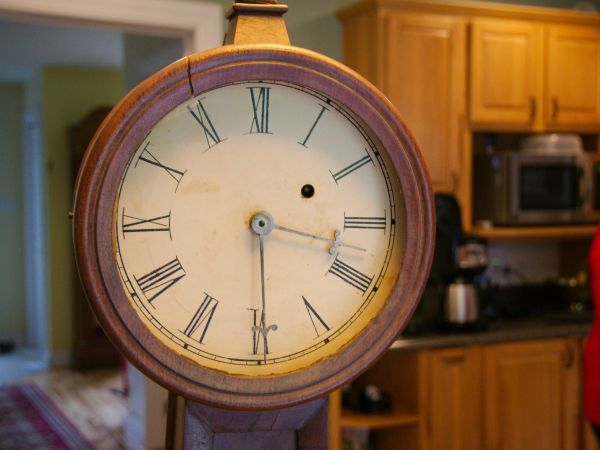
Broken dial glass, original hands

As we examined it, I asked a few questions about its history. The seller explained that it had belonged to an uncle in Wolfville, Nova Scotia—a man who had once owned a large collection of antique clocks and had been in the family for over 60 years. That was all I needed to hear.

Before we left, the seller asked if I might be interested in another clock—a 30-hour mantel clock. “It’s worth a lot more than that one,” they insisted, nodding toward the banjo clock. I smiled and politely declined. Something told me the first clock was the one worth keeping.
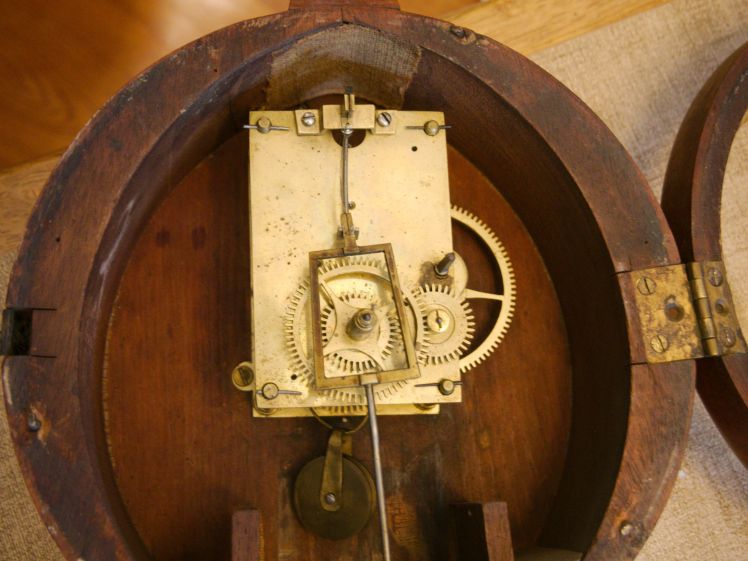
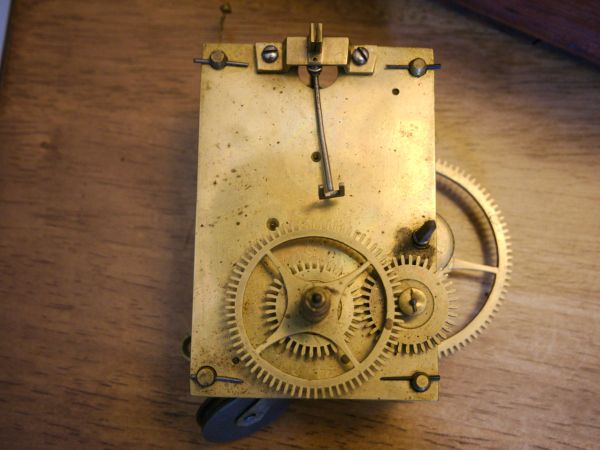
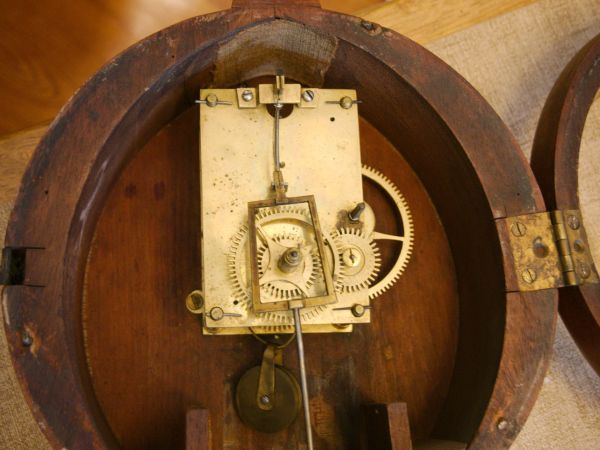
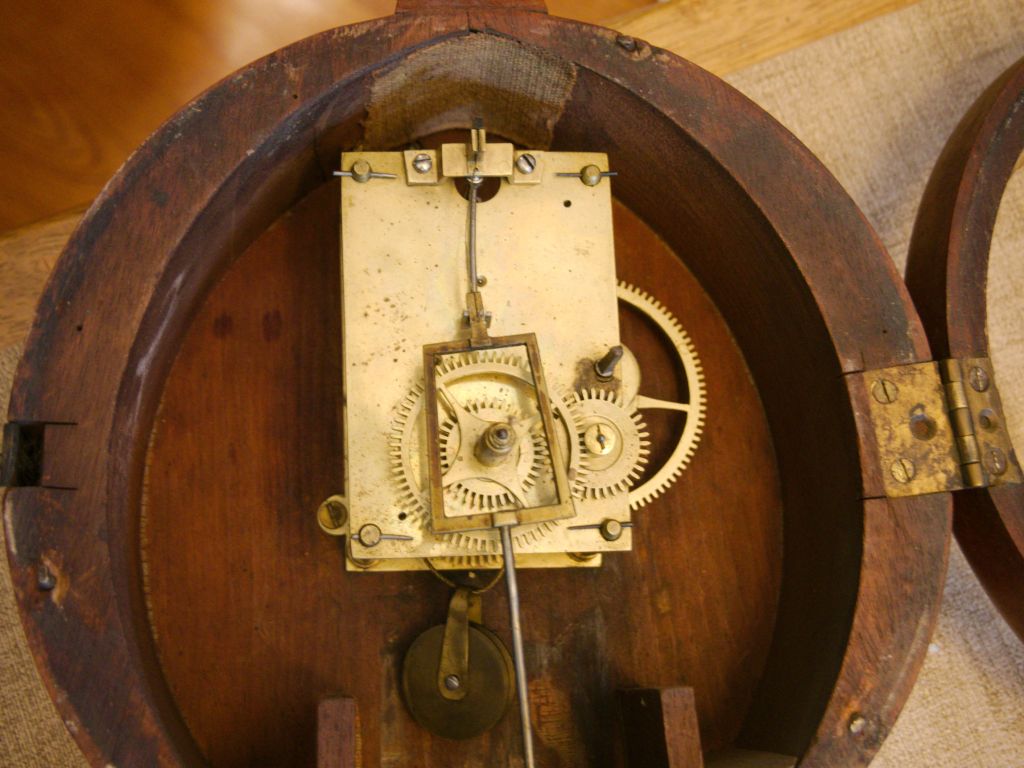
Classic time-only movement

And I was right. Once we brought it home, cleaned it up, and did a little research, we discovered that it was indeed something special—a genuine, 1830s timepiece, a true diamond in the rough.

The clock was surprisingly heavy when I first lifted it, which told me right away that the weight was still inside the case. That was a good sign. Had it been missing, finding a proper replacement would have been a challenge—and there’s really nothing quite like having the original weight that once powered the movement so many decades ago.

It turned out to be a Federal-style banjo clock, housed in a rich mahogany case that bore the quiet dignity of age. The movement was intact, a promising start. At the top sat a graceful acorn finial, original to the clock—a small but telling detail. At first glance, I thought the carved reverse-scrolled side arms and lower base section were missing, but later learned that not all examples from this period included those features; In fact, simplicity was a defining feature of early timepieces.

The original steel hands, shaped in that classic banjo style, were still in place, and the dial face, though worn, retained much of its character. The glass bezel was broken but easily replaced. The case itself was dusty and a bit tired, with a few areas needing veneer work, a split wood bezel, but nothing beyond repair. As I examined it more closely, I discovered the winding crank tucked neatly into the bottom of the case—perhaps placed there by its last owner many years ago.

After some careful study and comparison with other examples online, and with help from a few knowledgeable members of a clock forum, I came to believe that the clock was made in the late 1830s in Boston—possibly by John Sawin. Sawin had apprenticed under Simon Willard and later worked as a journeyman for Aaron Willard, two of the most respected clockmakers of their day and inventors of the original patent timepiece. Unfortunately, there are no identifying marks on the case or movement, leaving its true maker a mystery—but a fascinating one all the same.
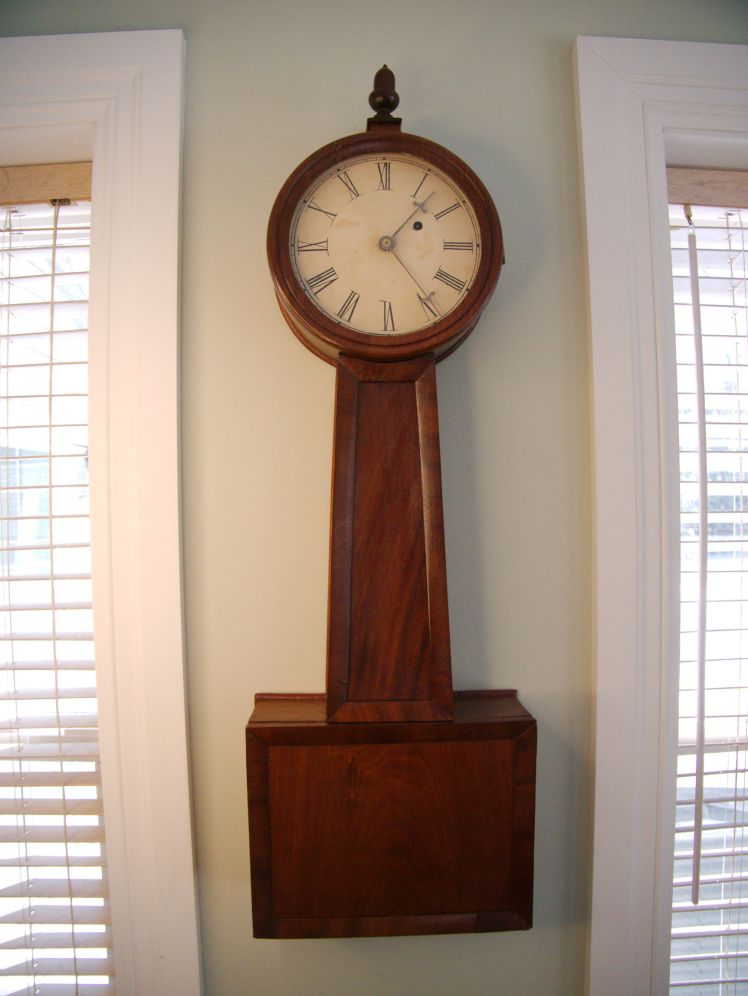
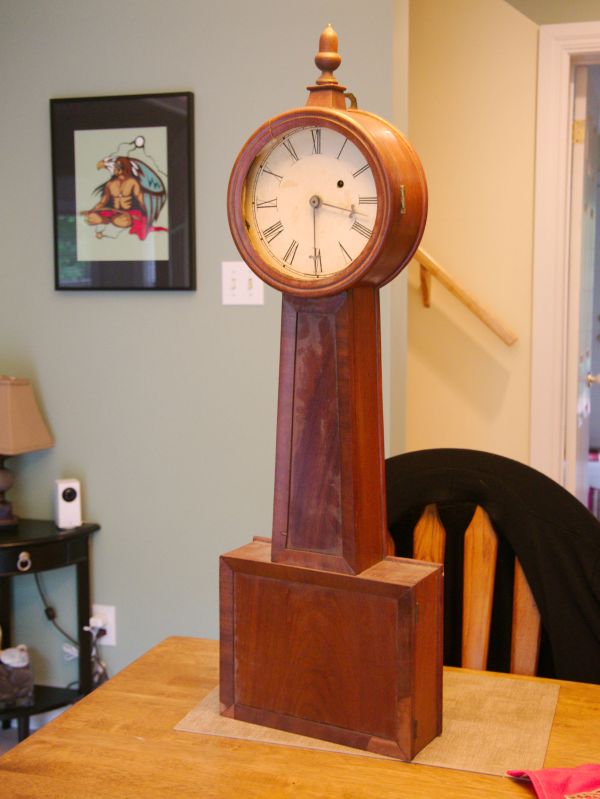
Fully restored clock on display in my home

With that in mind, I decided to give the old clock the attention it deserved. What followed was a careful cleaning, a bit of veneer work, minor repairs, glass bezel replacement, and the satisfaction of seeing history come back to life.
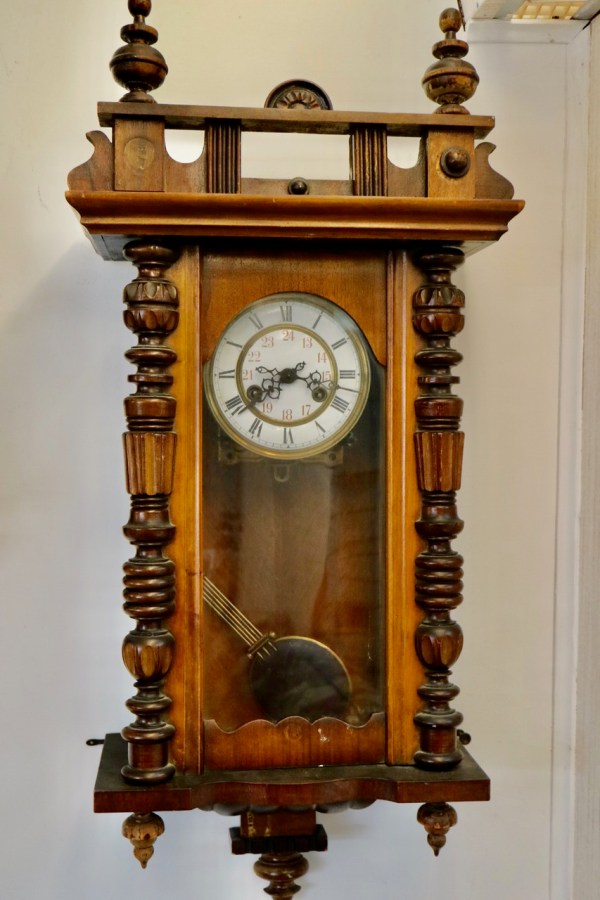
My Antique Wall Clock Collection: A Quick YouTube Tour

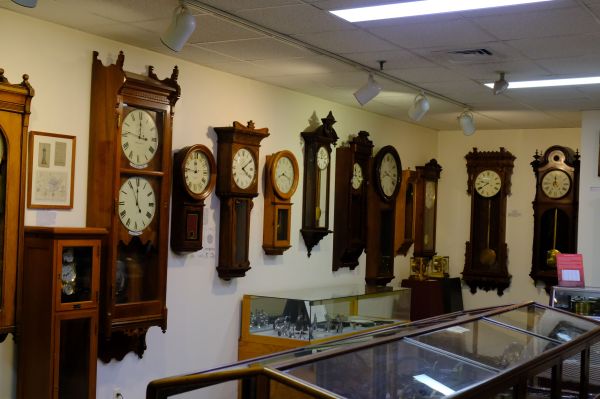
Allow me to take 5 minutes of your time to watch my video of 19 wall clocks in my collection. Each wall clock is identified by its maker, where known. The video features background music throughout, with a brief segment of sound highlighting the winding of a Mauthe wall clock. Otherwise, there is no dialog.

My only requirement is that the clock must be in good working order and have an appealing appearance.

19 wall clocks in my collection

My entire collection consists of 85 clocks. Many are on display in my home, and some are in the process of restoration or repair.

Check out my Pequegnat clock video as well.

Having a ticking clock in a bedroom may be the answer to a restless night

While many might not initially favour the idea of having a ticking mechanical clock in their bedrooms, its presence can actually offer significant benefits. Let me elaborate on why. Before I go further let me say I understand that some individuals may find the ticking sound disruptive to their sleep.

The therapeutic value of having a ticking sound in the bedroom to aid with sleep can vary from person to person. Some individuals find rhythmic sounds like ticking soothing and conducive to relaxation, helping them fall asleep faster. However, others may find it distracting or even irritating, disrupting their sleep. Overall, it largely depends on personal preference and individual sensitivity to sounds during sleep. Nevertheless, for some individuals, opting to tune into off-station frequencies or running a fan for background noise is their preferred method, whereas our method of choice is the mechanical clock.

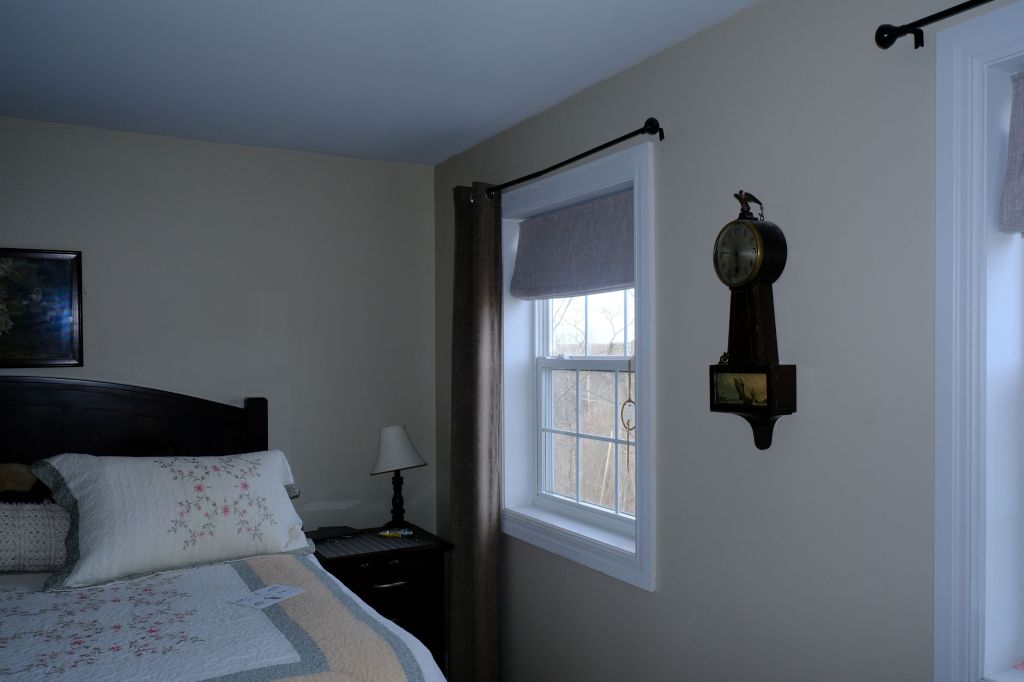
Clock on a wall in a bedroom
Banjo clock hung in the bedroom

In my opinion, having a ticking mechanical clock in a bedroom can be advantageous. Although I have zero evidence to back my claim, it seems beneficial to introduce a rhythmic sound into a room to enhance sleep.

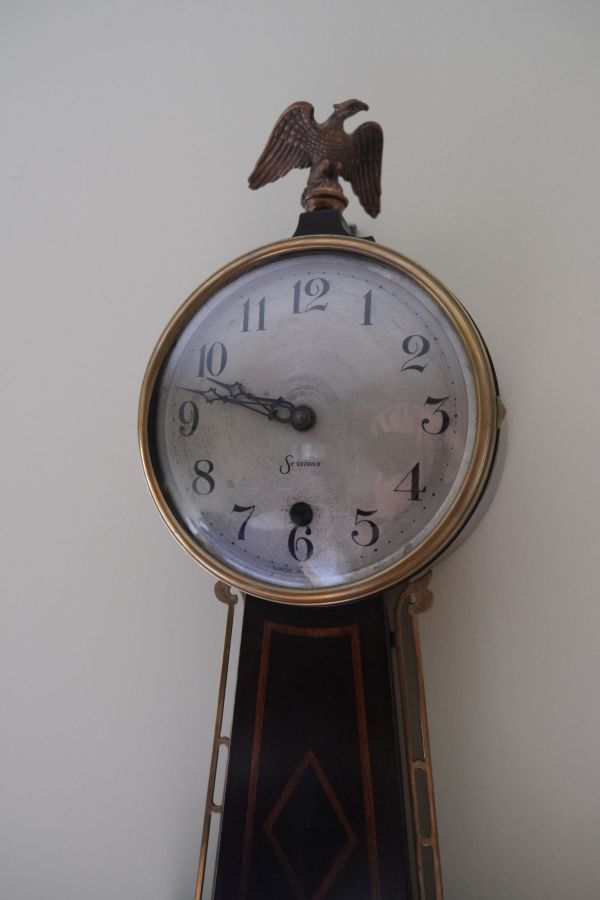
A number of years ago we found a Sessions Lexington banjo clock in an antique store in one of the New England states(USA). Before you conjure images of an expensive banjo clock crafted in Boston or elsewhere, let me clarify that this clock is likely one of the cheapest banjo clocks ever produced. It was made in the late 1920s, and many were sold to those who could not afford the more desirable weight-driven banjo clock, like the one in the next photo.

Sawin weight-driven banjo clock
Sawin banjo clock Ca. 1830

The Lexington may not even keep accurate time, but it excels in its primary function: providing background noise.

Lexington banjo clock CA. 1927
The modest Lexington banjo clock CA. 1927

If you are accustomed to American clocks you will note that they are loud tickers unlike finely crafted French and German clocks that are almost silent in operation. The loud ticking however is an advantage. The loud rhythmic ticking sound acts as white noise, helping some people fall asleep faster and masking other background noises.

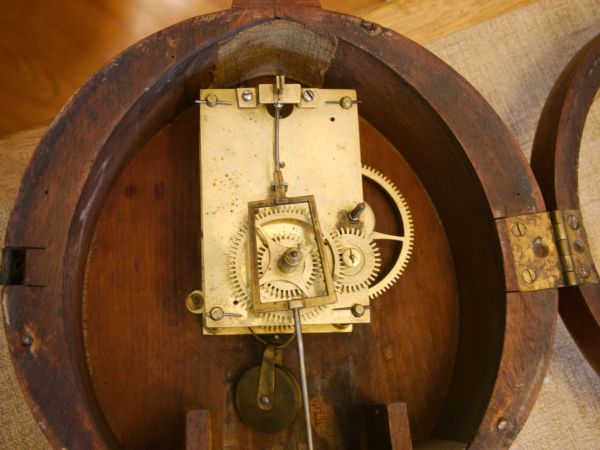
time-only Sessions movement (top plate removed)
A mass produced time-only Sessions movement (top plate removed)

The Lexington is a time-only spring-driven clock that runs about 100 or so beats per minute. Although it may beat too fast for some, we’ve grown accustomed to it. In my belief, a slower beat is preferable, with 80 beats per minute being an acceptable compromise.

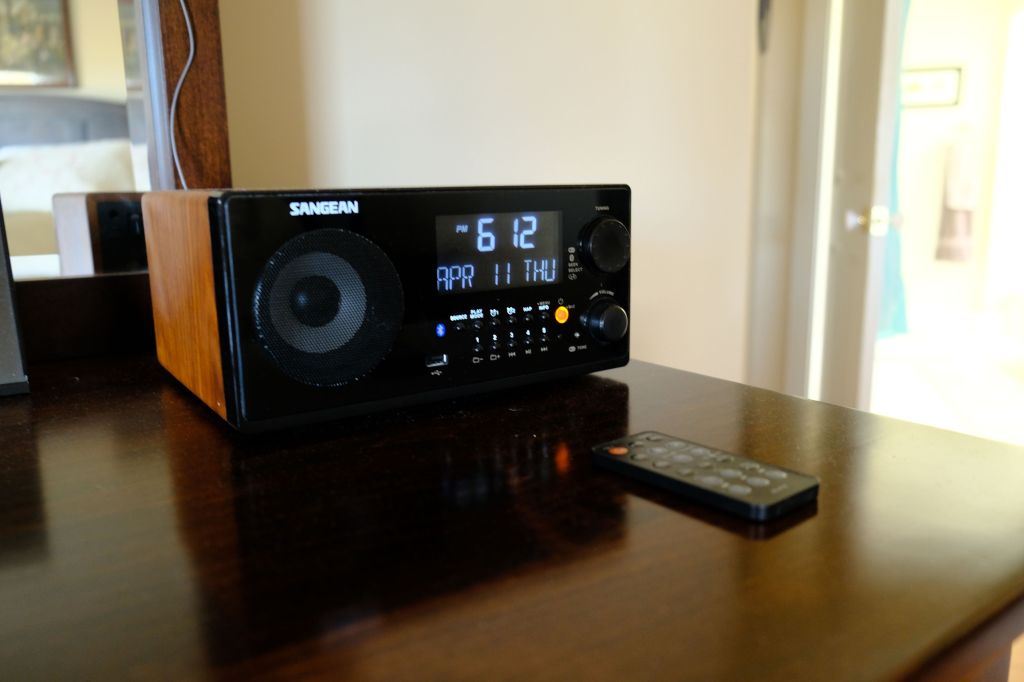
For those accustomed to it, the ticking becomes a comforting part of their bedtime routine. Using a mechanical clock reduces reliance on digital devices, potentially improving sleep quality by reducing screen time. When it comes to digital devices, it’s best to avoid bringing a cell phone into your bedroom. Learn to disconnect from the digital world. The digital world couldn’t care less about your need to get a good night’s sleep. If you need an alarm, consider investing in a high-quality radio alarm clock instead.

Sangean wr-22wl radio
Sangean table radio with alarm function

And lastly, the classic design of mechanical clocks adds aesthetic appeal to the bedroom, and their reliability ensures consistent timekeeping, even during power outages or when batteries die.

Milestones in Horology

The clock is one of man’s greatest achievements. The development of instruments to tell time is the unwavering toil of brilliant minds from many disciplines who, for over 800 years, worked tirelessly to create, innovate, and improve methods for telling the time.

Horology is not only the study of time but the synergy of art, joinery, fashion, design, décor, physics, engineering, metallurgy, and mathematics. Indeed, the study of the mechanical clock is a microcosm of our society.

Banjo clock Ca. 1940
Banjo clock Ca. 1840

While not claiming to be an exhaustive guide, the following dates are noteworthy in the history of the clock and compiled from various sources. The challenges in pinpointing precise dates arise from disparities among sources.

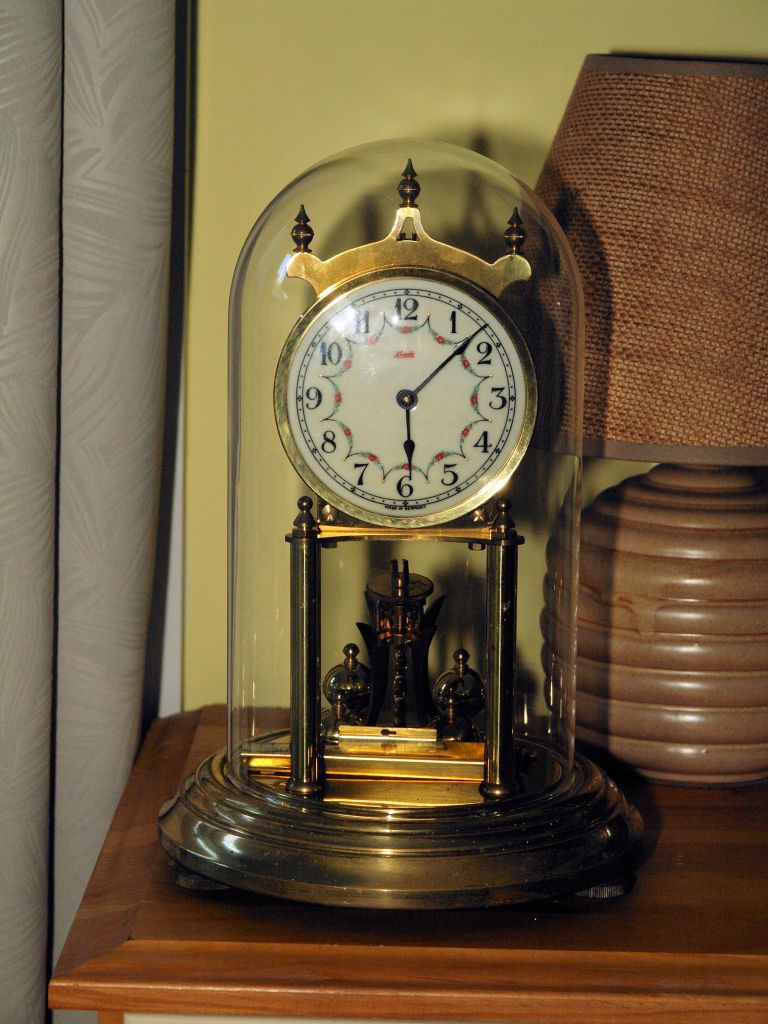
Kundo standard size 400 day clock
Kundo standard size 400-day clock

Advancements in horology preceding the advent of the mechanical clock are omitted. (Clepsydra) and sundial clocks from the Middle Ages, as well as ancient Chinese astronomical clocks, warrant a separate discussion and are not encompassed in this account.

Important Dates in Horological Development

  • Around 1300 – The first mechanical verge clock in Europe
  • 1364 – Astronomical clock idea by Giovanni de Dondi, Italy
  • 1386 – Tower (turret) clock at Salisbury Cathedral, England
  • Around 1400 – Fusee power was invented by Jacobs, Czechoslovakia
  • Around 1450 – A table clock with spring and fusee by Phillip the Good of Burgundy, France
  • Around 1500 – The mainspring was invented in Germany
  • Around 1510 – The watch was invented by Peter Henlein, Germany
  • Around 1560 – A spring-driven portable clock, in Germany
  • Around 1570 – The oldest known clock with a second hand, Orpheus clock, Germany
  • Around 1620 – The production of lantern clocks in Britain increased
  • 1637 – Galileo conceives pendulum control for swinging temple lamp, Italy
  • Around 1650 – The first tower clock in America
  • 1656 – Huygens devises pendulum clock, Holland
  • 1657 – Verge and foliot replaced by pendulum control, Huygens, Holland
  • 1658 – Fromanteel adapts long-case prototype from lantern clock, England
  • 1660 – Hooke conceives balance wheel, England
  • Around 1675 – Richard Towneley invented dead-beat escapement, in England
  • 1675 – Huygens invents the balance wheel with spiral spring, Holland
  • Around 1675 – Hooke and Clement collaborated to invent recoil escapement and crutch, in England
  • 1676 – Barlow develops rack striking, England
  • 1680 -1700 – Notable horologists of this era were Arnold, Earnshaw, East, Graham, Knibb, Compion, and Windmills of England; Berthoud, Breguet, and LeRoy of France
  • 1701 – St Sulpice seminary tower clock (imported from France), Montreal, Canada
  • 1713 – Harrison invents marine chronometer, in England. For more see Dava Sobel’s, Longitude, Harrison’s struggle against the establishment to get recognition for his chronometer.
  • Around 1715 – The break-arch dial introduced
  • 1715 – Graham perfects deadbeat escapement, regarded as the “father” of the dead-beat escapement
  • 1717 – First tower clock in America, Benjamin Bagnall, Boston
  • 1726 – Graham invents Mercurial pendulum (temperature compensating pendulum), in England
  • 1726 – Thomas Bennett makes wall clock, 8-day brass, weight-driven, in America
  • 1736 – Harrison’s marine chronometer tested at sea (accurately ascertaining longitude), in England
  • 1770 – White dials appear in English longcase clocks
  • 1776 – Pouzait invents independent seconds train for the watch, Switzerland
  • 1790 – Vienna regulator-style case emerges in Austria
  • 1790 – American woodworks clocks begin to appear
  • 1802 – Willard patents banjo timepiece, America
  • 1806 – Terry introduces the Pillar and Scroll clock, America
  • 1809 – Martin Cheney sets up a clock-making shop in Montreal, Canada
  • 1810 – Breguet introduces Carriage clock (Pendule De Voyage), France
  • 1818 – Heman Clark makes wrought brass movement for Pillar and Scroll case, America
  • 1825 – Rolled brass production begins in America
  • 1836 – Tempered brass mainsprings introduced in America
  • 1837 – Noble Jerome’s 30-hour brass movement patent approved, America
  • 1840 – American brass movements in mass production
  • 1842 – Chauncey Jerome exports American brass movement clocks to England
  • 1845 – Woodworks movement production ends, America
  • 1847 – Tempered steel mainsprings begin to be manufactured in America
  • 1850 – Lord Grimthorpe designs the Westminster tower clock made by Dent, England
  • Around 1850 – Brocot (pin-wheel) escapement and pendulum suspension were introduced, France
  • Around 1850 – American mass production of watches begins. The Waltham Watch Company leads the charge
  • 1860 – Junghans technicians were sent to America to study American mass production techniques, Germany
  • 1870 – Decline in English long-case clocks
  • 1874 – Mantel and wall clock mass production begins in Whitby, Canada
  • 1900 – American clock production peaks; makers are Ansonia, Ingraham, Gilbert, Howard, New Haven, Seth Thomas, Waterbury, and Welch
  • 1904 – Arthur Pequegnat begins clock production in Berlin, Canada
  • 1906 – The Eureka electric clock was introduced, America
  • 1908 – Big Ben alarm clock enters production, in America; Baby Ben follows in 1910
  • Around 1910 – The torsion pendulum clock (400-day) introduced, in Germany
  • 1920-40 – General decline in American mechanical clock production, increase in electric clock production
  • 1927 – The quartz clock is invented but not in widespread use until the 1970s
  • 1928 – Atmos clock by Jaeger LeCoultre – perpetual motion clock powered by temperature and atmospheric pressure changes
  • 1941 – Arthur Pequegnat ceases production, Kitchener Canada
  • Around 1960-70 – End of mass-produced mechanical clocks, America (cheaper Japanese, Korean & Chinese mechanical clocks flooded North America)
  • Present day – Movement and clockmakers remain but become a fringe market; Howard Miller (Ridgeway), Keininger, Hermle, Chelsea, Jaeger LeCoultre among others
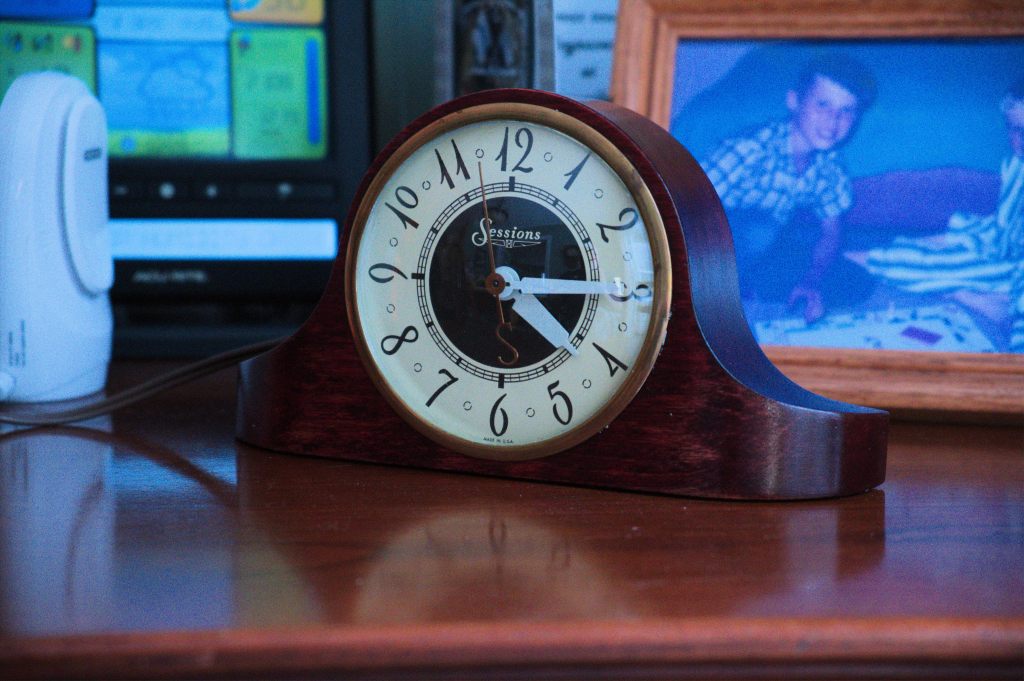
Antique Sessions Electric clock

These milestones highlight our constant quest for accurate timekeeping and showcase the human spirit’s ingenuity.

As we look back, the ticking of the clock is more than just tracking time; it symbolizes our ongoing journey to understand the essence of time. Horology serves as a testament to our commitment to precision and symbolizes our continuous efforts to enhance the quality of our lives.

(Please share any errors or omissions)

Getting a stubborn hand to fit correctly on an hour wheel

Approximately two years ago, I stumbled upon a weight-driven banjo clock listed on Facebook Marketplace. Before finalizing the purchase, I engaged in a conversation with the seller, who appeared to have limited knowledge about the clock’s value. The clock was among several items that the seller’s family was parting with, and it was evident that they didn’t have any sentimental attachment to it, despite it being in their possession for several decades.

To my surprise, the clock was remarkably intact, with only minor veneer issues. Apart from routine servicing of the movement, the clock required repairing the small sections of veneer and mounting it securely on the wall.

Banjo clock attributed to John Sawin of Boston 1840


I only needed to replace one bushing in the movement, and that resolved the only wear issue.

New bushing

However, the hands of the clock posed some challenges on a couple of occasions. Firstly, the minute hand became loose and wouldn’t advance properly. Upon investigation, I discovered that the hand was not securely attached to the minute wheel. I resolved this by using a slightly larger taper pin to tighten it.

Banjo clock

Later on, the hour hand started causing problems as well. It became loose and wouldn’t advance correctly. The minute hand, the hour hand doesn’t have a collar as you would find on a conventional mass-produced American clock and relies on friction to fit onto the top section of the hour pipe. There isn’t much room to work within this area, and it’s either too tight or too loose. Tightening the hour hand requires carefully punching the inside of the hole to make it smaller. Once again, due to the limited space available, this was a challenging task.

The hands stayed in place and now to test the movement for any issues.

Tick Talk Tuesday #43 – Is this a Simon Willard banjo clock?

Tick-Talk Tuesday is about the letters and comments I have received from readers concerning clock issues, challenges faced, a clock you would profiled or advice on your particular clock concern. For those comments and questions that stump even me, I consult within my clock circles for the best possible answer

TM writes, “We have had a banjo clock in our family for multiple generations, and knowing my family’s history it would not surprise me if it was a Simon Willard original. I understand that is a long shot but it is so hard to find information about banjo clocks or reputable people to deal with. It is in relatively good condition, not knowing when my family acquired it exactly, but it is original to us. I am attaching a picture and would greatly appreciate your opinion.”

The family banjo clock

I am not an expert on Willard banjo clocks but have seen and read enough to inform me that Simon Willard clocks have distinctive features that separate his clocks from others.

My reply was, “Hi, and thanks for your email.

It may or may not be a Willard patent banjo. It would have to go through a process of authentication. An expert would identify the classic hallmarks of a Willard clock which would include movement design and construction, distinctive case features, door catch characteristics, construction of the dial, how the movement is mounted, design of the throat and lower tablets, and so on.

However, two things immediately strike me as odd. First, I have never seen a Willard patented timepiece (banjo clock) with an Arabic dial. Secondly, Willard banjo clocks have simple barbed spear hands, none as ornate as the ones on your banjo clock. Your clock could be a variant or the dial and hands could be replacements or the clock could have been crafted by another maker altogether.

Again, an expert in Willard clocks would provide the answer you are looking for.”

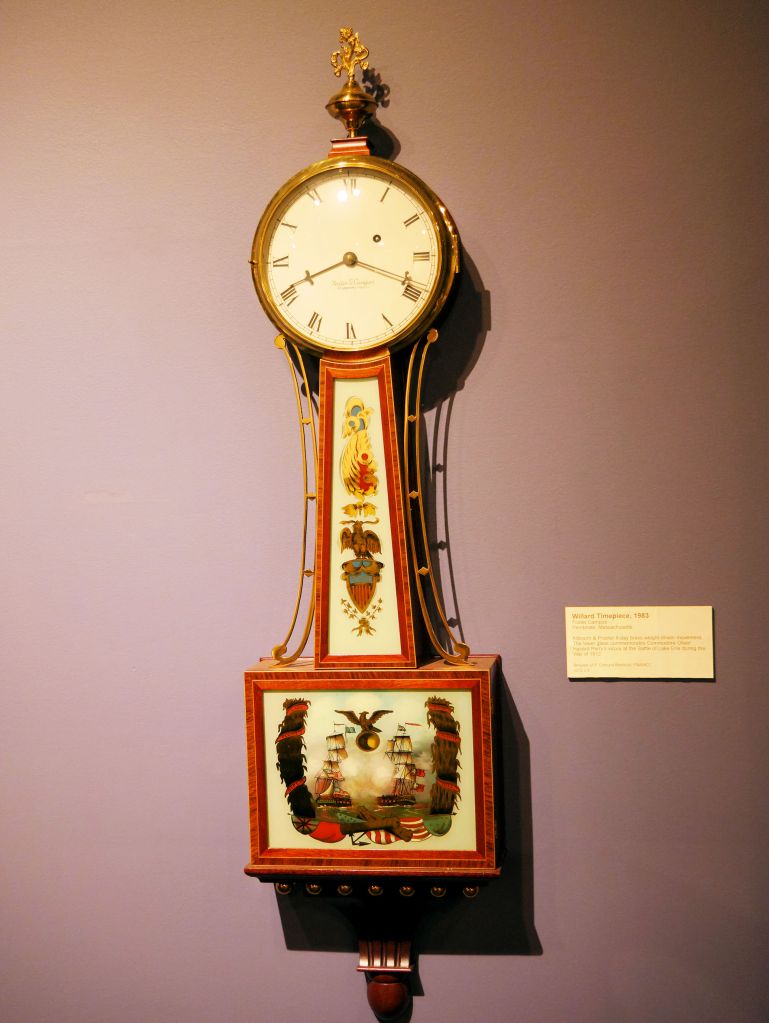
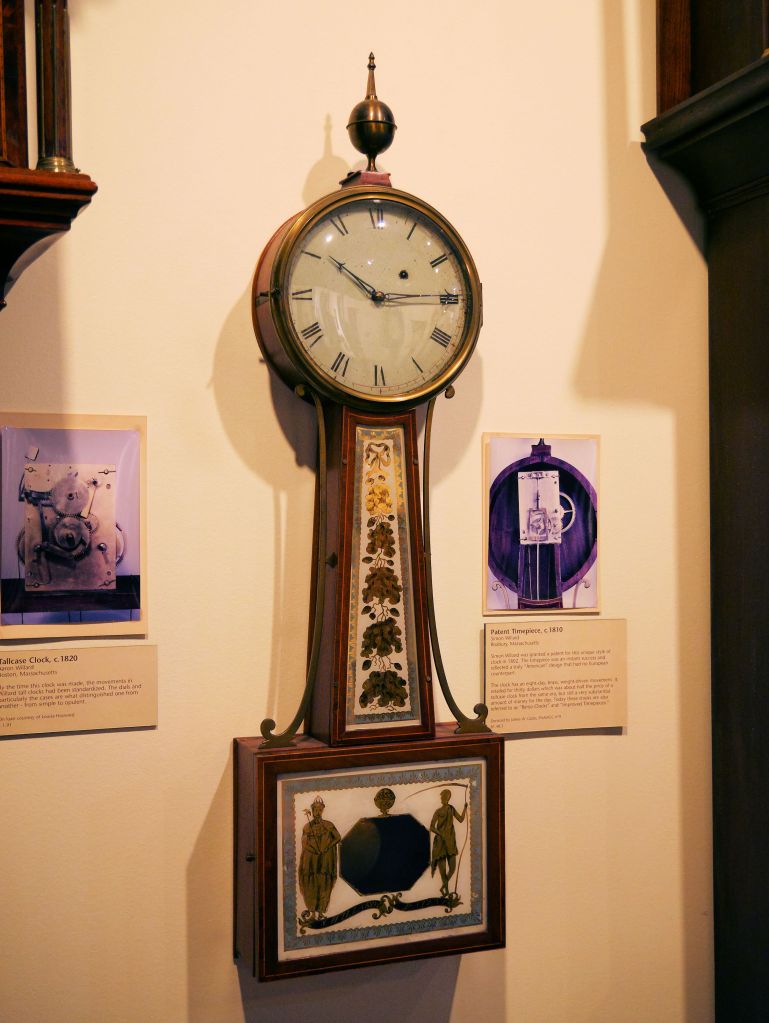
Simon Willard Patented Timepiece, C.1810; photo taken at the Simon Willard Clock museum in 2019

Simon Willard did little to protect his patent and as a result, many copies were made during the Federal period in Boston and in New England. Associates of Willard and apprentices to Simon and his brother Aaron produced clocks by the hundreds. Some of the copies were of high quality though they did not have the desired cache of a Simon Willard clock. And of course, many are fakes.

Willard clock; photo was taken at the American Watch and Clock Museum 2019

According to Robert C. Cheney, executive director and curator of the Willard House and Clock Museum proclaimed that the timepiece is “probably the most faked American clock found today.” Is TM’s clock an original, another maker, or a fake? An expert would immediately determine if it is real.

The photo at the beginning of the article is the only one sent to me and one photo is really not enough to make any kind of definitive judgment but I don’t believe TM has a Simon Willard Patented Timepiece.

Repairing a loose hour hand on a weight-driven banjo

The hour hand is loose on my unmarked circa 1840s banjo clock. It is an unusual problem and I can’t say I have ever come across an issue like this in my years of clock repair. It is supposed to friction fit on the hour pipe but the hand is definitely quite loose.

I have attributed this fine precision-made weight-driven banjo timepiece to John Sawin or one of his apprentices or associates. John Sawin, who apprenticed under Simon Willard, made clocks in the Boston area in the early 1800s and it appears that this clock was made in or around 1840.

It is not the usual ornate clock with reverse-painted tablets, gilt features, and an American eagle finial that one would envision as a classic banjo clock. This mahogany-cased clock is simple with timeless lines.

Back to the hour hand. I posted the issue on an online clock forum site and the consensus seems to be that I must stake the hour hand in several places on the inside so that it would fit tightly on the hour pipe.

The hour hand is on the right

On most American clocks the hour hand has a collet and the hour hand/collect friction fits onto the hour pipe. No so on early banjo clocks.

Collet on the hour hand

The staking went well, the hour hand fits snuggly and I am pleased.

Sawin banjo clock – wood dial bezel fix

This banjo clock project has been an ongoing challenge for nearly a year, a very enjoyable one that has taught me so much.

The movement has been serviced, 4 new bushings installed, the case has been cleaned, veneer issues addressed on the two bottom corners, a new post was made for the final, dial glass has been replaced, the hands rubbed down with steel wool to remove rust, the bottom section of the rails on both sides re-glued, some flat-head screws replaced (with smaller flat-head screws taken from old cases) and the old brass cable was removed and replaced. The dial was left untouched.

There is a simplicity about the case design that I really like.

Veneer missing on two bottom corners

The old and tired suspension spring should be replaced. I cannot source the spring alone but I am reluctant to pay for an entire pendulum assembly. It has been straightened and it works well for now.

The last step is addressing the crack in the wood dial bezel.

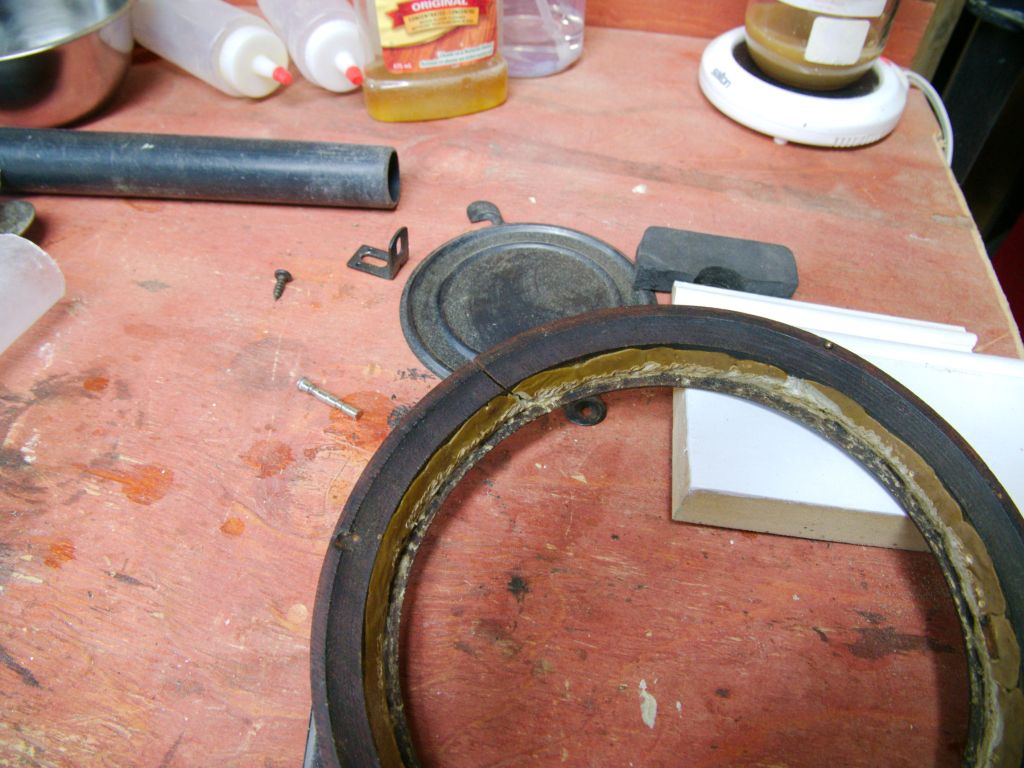
Cracked bezel

The age crack is just above the number eleven on the dial. It was likely cracked long before I bought it.

Hot hide glue was used to close the gap but the repair did not work. The hot hide glue has a low bonding strength and it separated after just a few weeks (a dry house in the winter does not help).

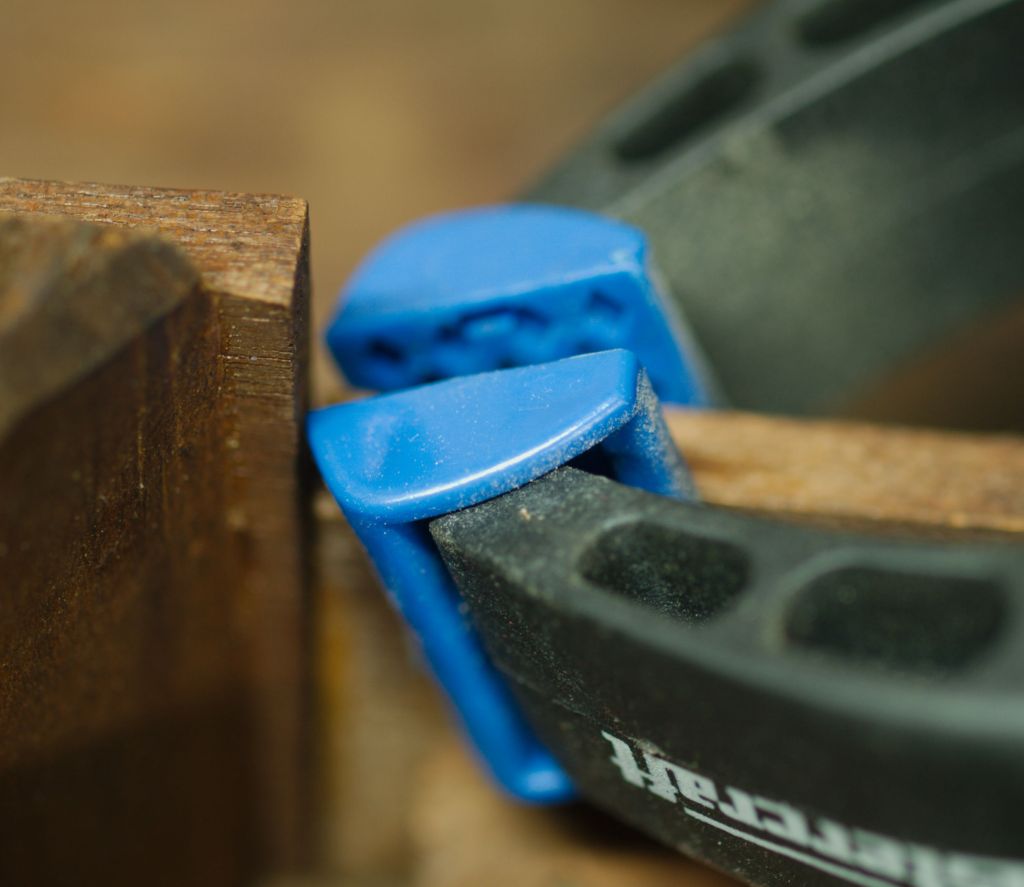
I had difficulty closing the gap with string and ecstatic bands so, I purchased a band clamp designed for furniture repair, so let’s see how that goes.

Clock sans dial bezel

A band clamp might just be the ticket but there is always the risk of the bezel splitting again, perhaps not in the same place. Option two, which I prefer not to exercise at this time, is to fill in the crack and simply live with a slightly larger bezel that may not fit the dial door catch exactly.

There were many choices on Amazon and I selected one of slightly better quality.

When the clamp arrived, rather than apply the glue immediately I clamped it unglued for about a week theorizing that memory in the wood would be retained when glued. Yep, just a theory! In addition, if it were to crack in a different place that would have been the time it would happen.

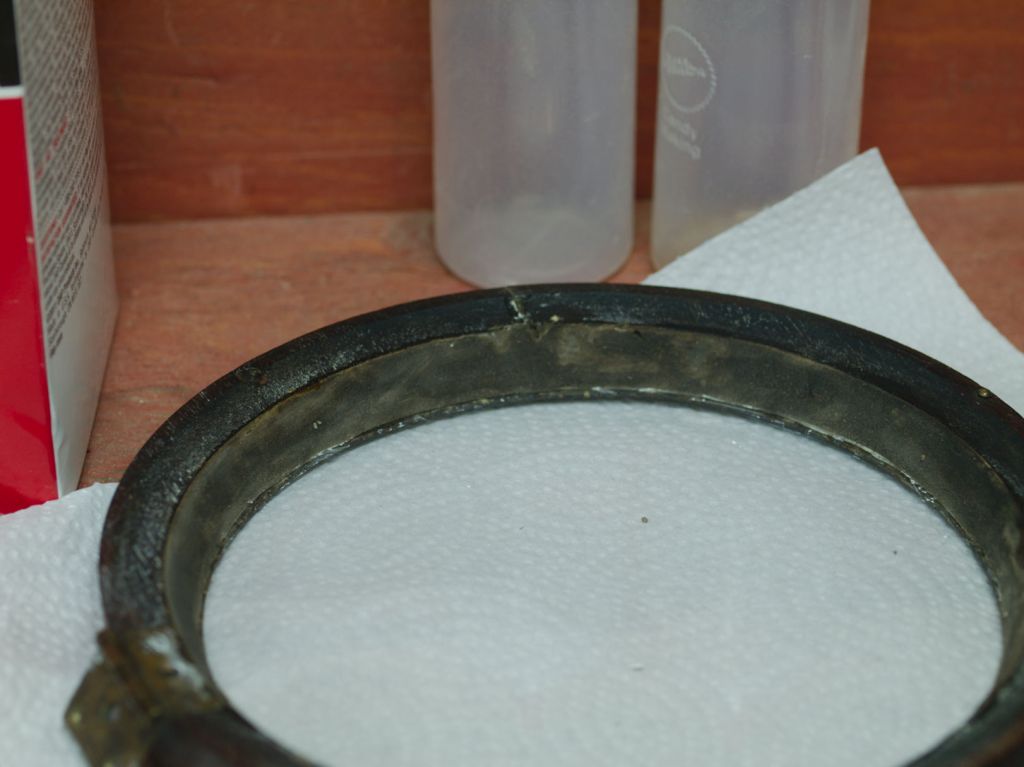
Since hot hide glue was simply not strong enough I used glue with a much higher bonding strength, Gorilla glue, because it will hold. Perhaps hide glue with a higher bonding strength might have worked but I just don’t have that on hand. I am usually a stickler for authentic methods but sometimes a more modern glue is the only option.

Wolfcraft band clamp

Wax paper is used to prevent any residual glue from sticking to the band and the surface the bezel rests on. The curing time is 24 to 36 hours, the reason for the sticky note. It cured for almost 48 hours. Enough time I would think.

Two large flat-head slotted screws for the hinge hold the wood bezel in place and on went the bezel.

Completed project

And the result after 10 months of working in stages, is a complete and functional banjo clock that, in my view, looks absolutely stunning.

Sawin banjo clock – almost done, 3 more items to address

I have written about this clock several times in the past 10 months but I am making good progress which I will detail in this article.

This is how it arrived at my house last spring, dull and lifeless but with good bones and most everything original.

Dirty and dusty and ready for restoration

First, some background information about the clock.

This federal-style banjo clock was made in the 1840s perhaps as early as 1840. I am reasonably certain it was made by John Sawin of Boston, by either himself or one of his apprentices or associates.

The movement and case construction bears a strong resemblance to a Willard timepiece and there is a good reason for this as John Sawin apprenticed under Simon Willard and was a journeyman under Aaron Willard, famous clockmakers of the day and makers of the original patent timepiece.

The movement which is based on the patent timepiece by S. Willard

Unfortunately, there are no identifying markings on the movement or the case but key indicators such as the placement of the movement mounting “ears” and the design of the door and bezel catches tell me that there is a very strong connection to John Sawin, enough to say that he is the clockmaker.

So far…

I have completed repairs on the case aside from the wood bezel mentioned later in this post. The repairs include new veneer pieces, harvested from an old mahogany ogee clock, a new post for the acorn finial, and two applications of traditionally prepared shellac.

The hands are attached to measure timekeeping

The movement has been cleaned, serviced and wear issues addressed.

The glass dial was broken and new flat glass was ordered and installed. The old weight cable was replaced.

The dial, with some stains and discoloring, will be left as-is.

Three issues that have slowed me down

The three issues are a weight cable that is too short, a twisted suspension spring, and a cracked wood bezel.

Weight cable that is too short: The clock stops when the weight is three inches from the bottom of the case and runs six days instead of the usual eight. I have run the clock several times and the clock consistently stops on the 6th day. I believe that the brass cable was frayed from wear and a previous owner shortened the cable rather than buy a new one. I have various sizes of cable and have chosen a slightly thicker brass cable with a nylon core. The nylon core prevents the cable from snarling and coiling plus the more robust cable is more than enough to carry the heavy iron weight.

However, a thicker cable results in a double layer. The cord will wind down from the top layer and the diameter of the drum has been increased due to the first layer. This means that with each turn more length of the cord will be removed from the top layer. Thus, the weight will reach the bottom of the case sooner than intended, reducing the runtime. A thicker cord makes it even worse. I believe I have struck the correct balance between thickness and length as the clock now runs its full 8-day cycle. Had the cable been any thicker the runtime would increase.

Since it had to be taken apart to install the new cable I cleaned the pivots, pegged out the pivot holes, and re-oiled the movement. Problem solved.

The Keystone

Twisted suspension spring: The keystone is the piece between the suspension spring and the pendulum leader. It very nearly hits the large wheel of the motion works on the left side as a result of a twist in the suspension spring. A bent spring is a consequence of leaving the pendulum assembly on the movement during transport.

A weight driven banjo clock must be partially disassembled when transporting and damage could result if the steps are ignored.

Unfortunately, I cannot source the suspension spring as a separate item and must purchase either the keystone and suspension spring together from an American supplier or the entire spring, leader, and stake for about $55.00 from a Canadian supplier. It does not make much sense but in the meantime, I have managed to straighten the suspension spring and it is functioning better than it was. Problem partially solved.

Cracked wood bezel: The crack is just above the number eleven on the dial. It was cracked initially and I used hide glue to close the gap. I now realize that hot hide glue I am using has a low bonding strength because it separated after a few weeks (a dry house in the winter does not help).

Cracked bezel

I have ordered a band clamp designed for furniture repair and will use stronger glue. However, I run the risk of the bezel splitting again and perhaps not in the same place. Another option is to fill it and simply live with a slightly larger bezel that may not fit the dial catch exactly. Problem not solved, yet.

There are three iron pin hooks that hold the dial in place. The hooks are twisted inward to secure the dial.

In the meantime, it is keeping perfect time.

Clock face is installed, missing is the wood door dial bezel

I am in no hurry for this clock. It is worth moving slowly with the repairs and ensuring that everything is completed correctly.

Sawin banjo clock movement servicing – two issues arose later

Weight-driven banjo clocks have simple time-only movements that are very reliable. They can be unadorned like the one I acquired or garish almost to excess like a presentation timepiece. Authenticity can be a challenge since some presentation timepieces started life as simple wooden cases and decorative tablets, finials, sidearms and other items were added later but I love the simplicity of this one.

Presentation banjo clock by Foster Campos

Finding one for $75 is highly unusual but I am convinced the seller had no idea what it was worth. When I picked it up the seller asked me if I was interested in another clock he had for sale, a 30-hour mantel clock. He told me someone valued it at $300. Uh, no, not interested!

This federal-style banjo clock was made in the 1840s. I am reasonably certain it was made by John Sawin of Boston in 1840 or thereabout, by either himself or one of his apprentices or associates. The movement and case construction bares a strong resemblance to a Willard timepiece and there is a good reason for this.

John Sawin apprenticed under Simon Willard and was a journeyman under Aaron Willard, famous clockmakers of the day and makers of the original patent timepiece.

Unfortunately, there are no identifying markings on the movement or the case but there are key indicators, for example, the placement of the movement mounting “ears”, that tell me that this is a Sawin clock.

The case is complete and ready for the movement

Everything is original to the clock, weight, hands, movement, pendulum rod and bob. The dial glass was was broken at some point in the clock’s life. It had convex glass and a good many I have seen with wood bezels had flat glass. Brass bezel clocks, on the other hand, generally had convex glass, so, I have decided to replace it with flat glass.

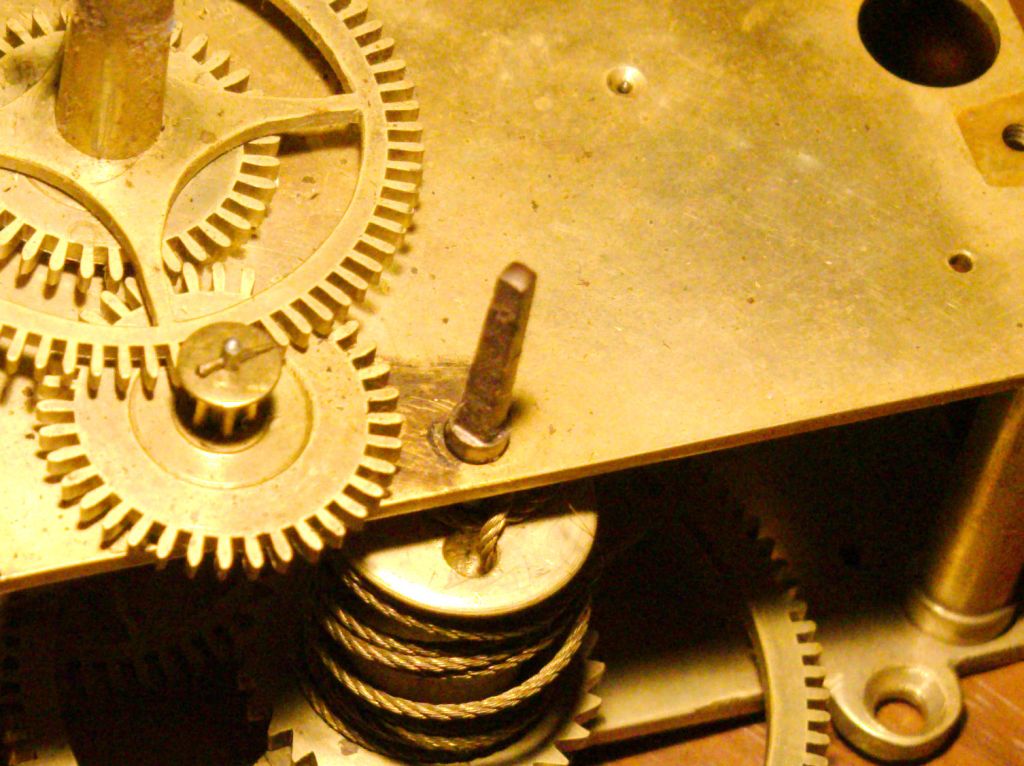
The movement

The gear train is relatively simple and consists of 4 wheels; the main wheel, second wheel, third wheel, and escape wheel. The motion works are on the front plate.

The movement in its case

Assessment of the movement

As expected there is wear but consistent with the age of the clock. The movement looks good overall, the gear teeth and pinions are in very good condition but, there are punch marks around the pivot holes. It is never a good feeling to see punch marks around the pivot holes. Punching effectively closes the pivot holes but in a very crude way. This was an old practice and is not considered acceptable today.

Pivots are required for the main wheel front plate, second wheel back-plate, third wheel, and the escape wheel front plate. The verge may require front and back bushings but I will see how things look when the other bushing work is complete. Three are 2mm wide Bergeon bushings, the fourth is 2.5 and the main wheel bushing is larger. I don’t often work with bushings as small as 2mm and it simply means extra care must be taken to cut and ream as accurately as possible.

Bergeon Bushing Machine
Punch mark, left of winding arbour
New bushing for main wheel arbour

There was a good amount of movement in the main wheel arbour and installing a bushing was necessary to tighten things up. I have bushings that are 1.5 mm and 3mm thick but the plate is 2mm. A 3mm bushing was installed and using a file I reduced the height to 2 mm. Three other bushings were then installed with no issues.

I have decided to leave the verge bushings as-is for now.

The weight cable had no kinks or broken strands, I cleaned it in the ultrasonic and reused it. For brass cable, I generally knot each end and use solder to secure the knot to prevent it from slipping out of its knot.

Two weeks later and two issues

The weight cable is too short. The clock stops when the weight is several inches from the bottom of the case and it will only run six days instead of the usual eight. Why was the cable shortened? Who knows?

The Keystone

A second issue. The keystone is the piece between the suspension spring and the pendulum leader. It comes very close to hitting the large wheel of the motion works on the left side. Since the suspension spring is quite bent the right side of the keystone rubs against the back of the dial face stopping the clock. A bent spring is a consequence of leaving the pendulum assembly on the movement during transport.

Unfortunately, I cannot source a suspension spring alone and must purchase either the keystone and suspension spring together from an American supplier or the entire spring, leader and stake for about $55.00 from a Canadian supplier. In the meantime the movement runs until I put the dial on.

Sawin banjo clock c.1840

I am in no hurry for this one and will continue testing it until I come up with a solution for the bent suspension spring.

Restoration work on a 181 year old weight driven banjo clock

There are basically three types of banjo clocks with mechanical movements. Those with lever escapements which are usually in the $75 to $100 range, spring-driven ones that are generally $100 to around $300 and up but weight-driven banjo clocks occupy the upper end of the range and are normally between $300-$500 in fair condition and upwards of thousands for desirable clocks made by Simon Willard or E. Howard.

When my wife discovered this particular clock on Facebook Marketplace for $100 I suggested she make an offer for $75 and the seller immediately accepted. It is always a risk buying or accepting an offer without first examining it but this, I believe, was an excellent prospect and for the price I was willing to take a chance.

The day it was purchased

It is weight-driven federal style cased banjo clock from the 1840s. I have since learned that the clock was very likely made by John Sawin in 1840 (Boston) by himself or one of his apprentices or associates.

Unfortunately, there are no identifying markings on the movement or the case but there are strong indicators that this is a Sawin clock. John Sawin apprenticed under Simon Willard and was a journeyman under Aaron Willard, famous clockmakers of the day and makers of the original patent timepiece.

Everything is intact except for the dial class which was broken at some point in the clock’s life.
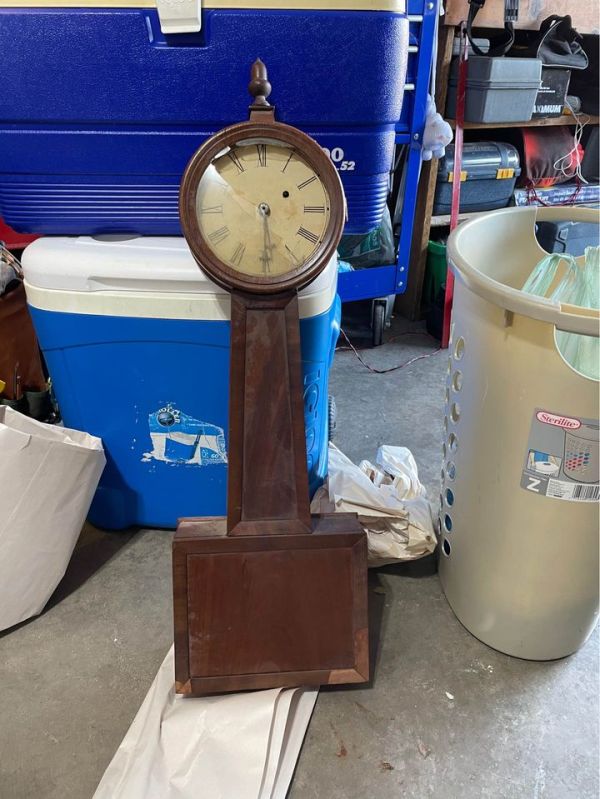
The broken glass is convex which prompts an interesting question. Is the glass a replacement and if so, did these clocks originally come with flat glass?

There is a school of thought among most horologists that simple mahogany cased clocks with wood bezels and an absence of ornamentation that were made in this particular style back in the 1840s had flat glass installed. Presentation timepieces, on the other hand, such as those with gilt accents, sidearms, brass dial bezels, a lower bracket/finial and reverse painted glass tablets had curved glass.

Patent Timepiece 1825 by William Cummens with convex glass

My belief is that this clock originally had flat glass.

So, let’s move on with the various case issues beginning with the missing pieces of veneer.

Veneer

The only section that requires veneer work is the left and right bottom corners on the pendulum. Many repairers attempt to hide the missing veneer with touch-up stain but new veneer is the only way to go.

New veneer pieces

Although the case is made of mahogany I selected rosewood from my collection of harvested veneer. It has the same thickness (modern veneer is much thinner). Although mahogany has a slightly different tonal characteristic and grain, the match was very close. Since I used hot hide glue, the veneer can be easily lifted with heat at a later date but for now my goal is to disguise the missing veneer.
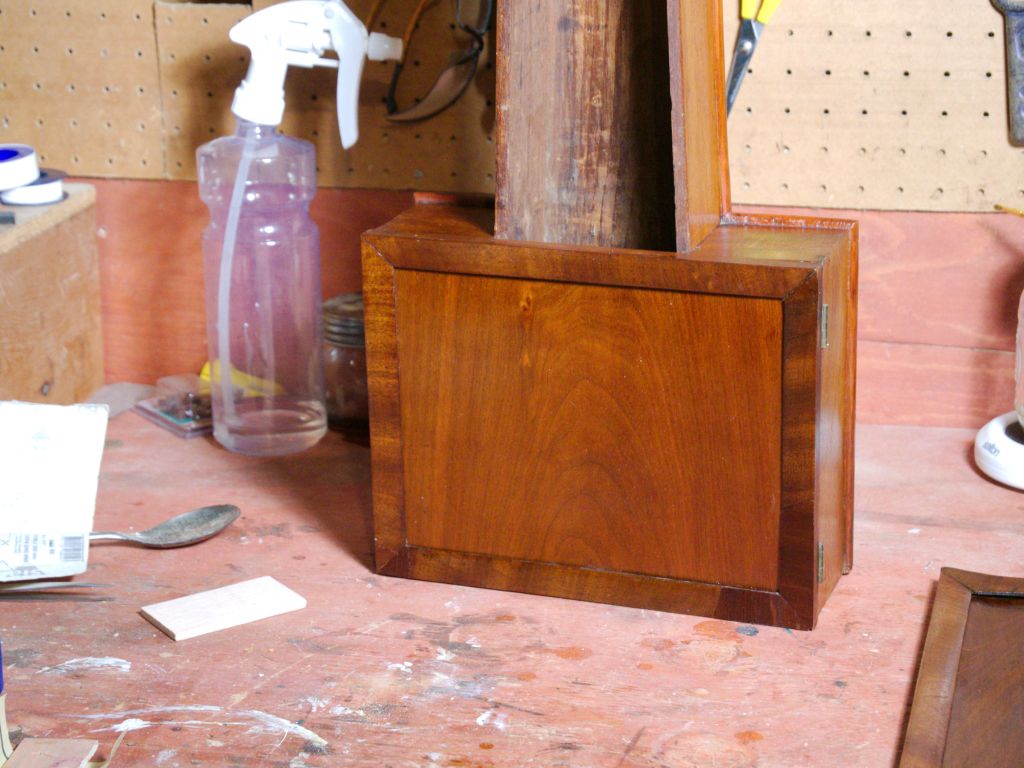
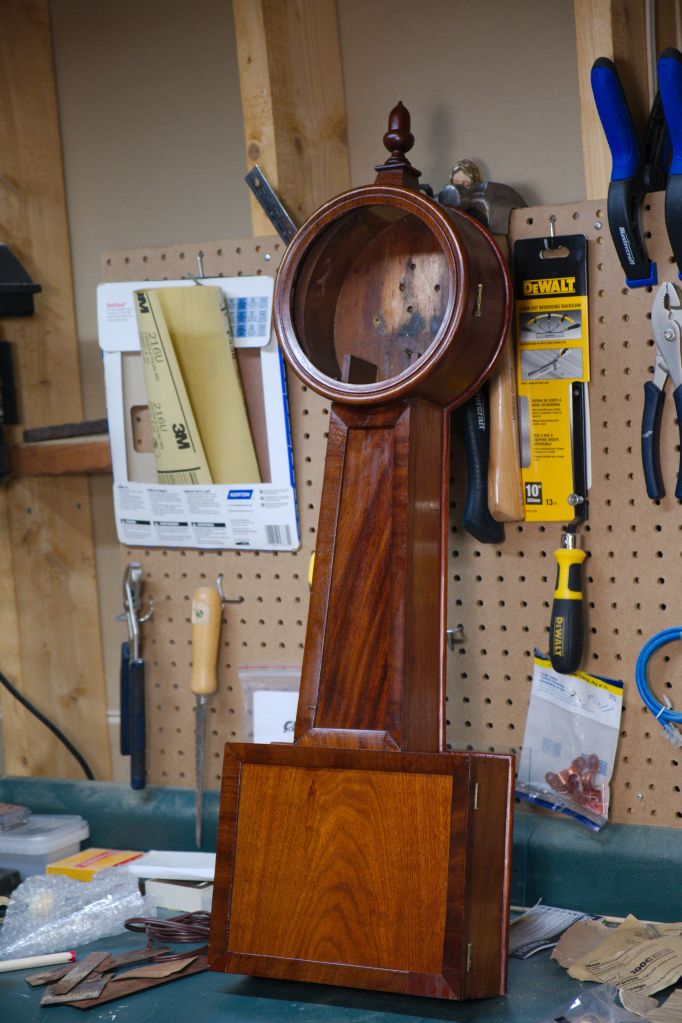
While I was working on the veneer sections I cleaned the case and applied a light coat of shellac. I am not opposed to applying a finishing coat to preserve and improve a clock’s appearance. The added benefit is that it enhances the grains on the case.

In my view there is no clear right or wrong answer and it should be left up to the restorer (and owner) to decide how the clock’s finish should be addressed.

Veneer work is finished

The throat is in perfect condition.

The dial bezel has a crack at the 11 o’clock position which was addressed with hot hide glue. I forced glue into the crack, closed the gap with a number of elastic bands tied together and left it for 24 hours to dry.

Cracked bezel as found
The bezel crack is all but invisible

The glass

Removing the old putty was a little more involved than I had planned. A heat gun would have been too much and I did not want to ruin the wood bezel but a 30W soldering iron was perfect for this job. I picked away and removed just enough putty to install the glass. I ordered 6 13/16 inch flat glass and it was a perfect fit. Wet putty is always an option but Plaster of Paris is easier to work with, does an equally fine job and secures the glass in place.

Enough of the putty is chipped away for the glass to fit

Plaster of Paris dries hard in 30 minutes and is stainable/paintable. I applied the plaster with a putty knife and smoothed it out with a wet finger.

Plaster of Paris is easy to work with and dries hard in 30 minutes

After several hours I applied a dark stain to give the plaster an aged look.

The plaster is stained to give it an aged look

The bezel is now ready to be attached to the case.

The finial

The final was in the pendulum box when I bought the clock. It now requires a new post. The peg was broken and a previous owner attempted to secure the finial with glue and, of course, that failed. The finial would originally have been mounted with a piece of dowel.

New finial peg

Using a piece of 3/8 inch doweling I cut off about 1 1/4 inches. I scraped off as much glue as I could from the bottom of the finial and the plinth and drilled out the old doweling on both the finial and the plinth. Once the dowelling was glued in place it was given a mahogany stain. It fits well and looks great.

Other case repairs

Other case repairs involved closing or filling several holes. For these repairs I used yellow carpenter’s glue for maximum adhesion.

A clamp is used to close a gap
Shavings from old veneer are glued into screw holes

Shavings from old veneer are glued into screw holes for the mounting ears and the case hook to ensure that those screws are secure.

View of face
Mounted on the wall

The case repairs are complete and the last step is servicing the movement.

John Sawin banjo clock CA 1840

John Sawin was a prolific 1840s Boston clockmaker and many of his clocks have survived to this day.

The Key features of the Sawin timepiece share many of the attributes of the original Simon Willard Patented Timepiece. They are:

  • No striking parts reducing the number of wheels to a minimum for simplicity,
  • Making the distance between the plates wider allowing sufficient cord on the barrel allowing it run 8 days,
  • The push-pin catches on the bezel and lower access doors,
  • Placing the pendulum in front of the weight to ease repair and regulation,
  • The weight is reduced and made longer and wider,
  • The pendulum and guide are placed in front of the movement,
  • An oblong space in the pendulum so that it swings clear of the centre pinions and hour and minute collars,
  • The method of mounting the movement to the case. Works are fastened by two “ears”, the top right and bottom left backplate,
  • The calculation of the train in consequence of shortening the pendulum,
  • No method of securing the pendulum when transporting the clock,
  • Acorn top finial and wood dial bezel
  • The shape of the case,

The earliest timepieces from Roxbury had long screws from the front plate into the case in the upper right and lower left. Beginning about 1820 in Boston a single bolt from the back of the case into the movement was used as per Howard & Davis and E. Howard. North Attleboro movements had holes in the backplate in the upper right and lower left for screws into the case.

Upper right mounting “ear”

A John Sawin movement is distinguished by brass ears attached to the movement back plate in the upper right and lower left. Other Boston area clockmakers might have used the same casemakers so their cases probably would look similar to his.

As found

Cases came from one of several casemakers in the Boston area. Case construction is helpful in identifying where the clock was probably made and movement for the maker, however by the 1830’s movement construction had become so generic that was really difficult to identify the maker. It is probable that were many small workshops run by former apprentices and/or journeyman clockmakers that supplied movements to the trade as needed by the existing makers in the various cities so it makes things even more complicated.

The real differences were how the movement was attached to the case and that gives us information on where it was manufactured.

The John Sawin Banjo headpiece is carved out. With the dial off, the headpiece of the case looks like two crescent moons facing each other, thin at the top and bottom and thick in the middle. There is a piece of cloth glued to the inside top of the case to hold the 2 crescent moons together.

Two crescent moons make up the headpiece

Unfortunately this clock has no identifying markings which means that it is quite possible that while it may not have been made by John Sawin himself but one of his associates or one of his apprentices. Still in all, it is a nice-looking clock and looks great on any wall.

Yard sale find – a 181-year-old weight driven banjo clock for less than you think

Seller’s photo

Yes, a weight-driven banjo clock for a surprisingly low price!

There are essentially three types of mechanical banjo clocks. Those with lever escapements are usually in the $75 to $100 range, spring driven ones are $100 to around $200 and up but weight-driven banjo clocks occupy the higher end of the range and normally cost between $300-$500 in fair condition to upwards of thousands for Simon Willard or E. Howard clocks.

My wife discovered this particular clock on Facebook Marketplace for $100. I suggested she offer the seller $75 and the seller immediately accepted. I think they just wanted to get rid of it. However, it is always a risk buying a clock sight unseen but this looked like an excellent prospect and for $75, why not take a chance!

From the photos provided it is a weight-driven federal style mahogany-cased banjo clock from the 1800s. The movement is intact because the seller sent a video showing the pendulum bob moving from side to side.

Looks like the original dial and original hands

It has a top acorn finial which appears to be original to the clock. I thought it was missing the carved reverse scrolled side arms and the bottom base piece but not all of these clocks had bottoms or side arms. 

The original banjo styled steel hands and the painted face appear to be in good condition. The broken glass bezel can be easily replaced. The case is dirty and requires a small amount of veneer work. I also see the winding crank in the bottom of the case.

Could be a diamond in the rough

I picked it up in late June 2021.

The day of the pickup

We arrived at the garage sale and met the sellers. My wife was curious as to the provenance of the clock and we were told that it had been in the family for more than 60 years having spent most of its life in Wolfville, Nova Scotia.

The clock was heavy which meant the weight was inside the case. Had the weight been missing, sourcing one would have been a problem but it is best to have the original weight.

We had few errands to run in the city and did not return home till late in the evening. Minutes after coming through the door I had the clock on the kitchen table and a screwdriver in hand taking it apart.

A Boston made banjo clock

After studying it further and comparing the clock to others online and through my inquires with members of a clock forum site I learned that the clock was very likely made in 1840 in Boston by John Sawin who apprenticed under Simon Willard and was a journeyman under Aaron Willard, famous clockmakers of the day and inventors of the original patent timepiece.

Later, I will profile the clock with detailed images of the movement, dial face and aspects of the case and more information on clockmaker John Sawin.

Is this the find of the year? I certainly believe so!

Sessions Lexington Banjo Clock: 1928

Lexington banjo clock CA. 1927
Lexington banjo clock CA. 1927, as found

Once the Sessions Clock Co acquired E. N. Welch assets in 1902 (for the history of E. N. Welch go here) the company was well on its way to becoming one of the biggest clock producers in America. Production began in 1903 and between that time and 1933 Sessions produced 52 models of mechanical clocks, ranging from Advertisers, large and small clocks with logos of various businesses, to wall, or regulator clocks, and shelf or mantel clocks, designed for the home. Some Session clocks from this period are prized by collectors but most others are of the generic kind that have limited value today.

Continue reading “Sessions Lexington Banjo Clock: 1928”

The quest for an authentic banjo clock

Searching for a weight driven time-only banjo clock can be a challenge and acquiring an authentic example would go a long way to completing my collection. Securing an authentic Willard would certainly be the icing on the cake.

The style was widely copied by other members of the Willard family of clock makers and many others clock-makers

I was fortunate to have seen several Willard banjo clocks during my visit to the Willard Museum in Grafton Mass. in June 2019.

Banjo clock, circa early 1800s, Macdonald Museum, Middleton, Nova Scotia. Notice the location of the winding arbour

Few American clock-makers at the beginning of the 18th century were innovative. One of the most notable achievements was the small 8-day, weight-driven clock developed by Simon Willard. The Willard clock is a uniquely American wall clock with a banjo-shaped case designed and constructed by Simon Willard. Willard was originally of Grafton, Massachusetts, later of Roxbury, Massachusetts, and patented his unique clock in 1802.

The Willard banjo clock has no striking mechanism and indicates time only by its hands and dial. It is correctly defined as a timepiece.

Continue reading “The quest for an authentic banjo clock”

Website Powered by WordPress.com.

Up ↑