Top Reasons Your Mechanical Antique Clock Runs Slow: Tips & Fixes (2025 Ed.)
We are quite accustomed to the accuracy of quartz clocks which lose or gain mere milli-seconds per week. Contrast that with an era when folks were content to accept that their mechanical clock would be a minute fast or slow through the week, and it was a common practice to make small adjustments over the run cycle of a clock.

Clocks generally fall into four categories: quartz, electro-mechanical, electric, and mechanical. In this discussion, we’ll focus on mechanical clocks—whether antique or vintage—as we explore the common reasons why a clock may run slow.

Our discussion on why a clock runs slow should be grounded in a few practical realities. A typical American spring-driven clock, even when properly serviced, may gain or lose a couple of minutes per week—this is considered normal. In contrast, weight-driven mechanical clocks that vary by only a few seconds per week are regarded as highly accurate, with astronomical regulator clocks being among the most precise of all.

That said, how many mechanical devices do you know run perfectly (relatively speaking) after 120 years?

A clock runs slowly for a variety of reasons.

Let’s consider several factors and examine each in detail.

  • Environmental factors
  • The pendulum is too low or too high
  • The pendulum is the incorrect weight
  • Incorrect suspension spring length
  • The suspension spring is not attached correctly
  • Lack of lubrication
  • Gummed-up lubrication (over-oiled)
  • Balance Wheel Requires an Adjustment
  • A weak mainspring
  • Changes or Alterations During Servicing
  • Clock cycle time variance
  • Slipping, Binding and Rubbing
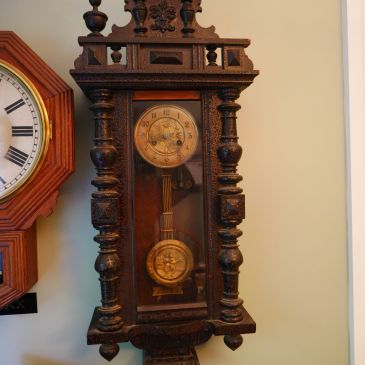
one-weight Vienna wall clock
One-weight wall clock with a large pendulum bob and rate adjustment on the bottom

Environmental Factors

Mechanical clocks are subject to a number of environmental factors that may cause them to gain or lose speed over the course of a year. These factors include heat, cold, and humidity. Increasing the ambient temperature of a clock will slow it down from the expansion and lengthening of the pendulum unless the pendulum is a compensating type using Mercury or dissimilar metal rods. Denser air also causes the pendulum to move more slowly.

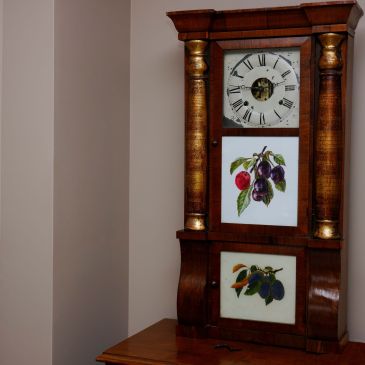
Ogee clock showing replacement pendulum bob
Ogee clock showing replacement 1 oz rate adjusting pendulum bob

Moving a clock from sea level to a higher elevation will affect the speed of the clock.

It is common to make seasonal speed adjustments on a clock that does not have a compensating pendulum.

Numbers on bob correspond with the movement
Pendulum bob with inset rate adjustment

Pendulum Too Low or Too High

The lower the pendulum bob, the slower the clock will run. Many pendulum clocks can be adjusted either by a set screw at the bottom of the pendulum or by an inset screw on the pendulum.

In the absence of an adjustment on the pendulum, there is a regulator on the clock face. Use the small end of a double-sided key and insert it into the dial face of the clock to speed up or slow down the clock.

Shortening the pendulum will speed up the clock. Anything that increases the length of the pendulum will reduce the rate of the pendulum and result in a clock that will run slower.

Parts of the clock related to the pendulum

Pendulum is the Incorrect Weight

If the pendulum is too heavy, it causes the centre of gravity to be too low, consequently, the clock will run slower. Having the correct weight pendulum for your clock ensures smooth running.

Incorrect Suspension Spring Length

Often, when a clock is repaired by a person who has limited knowledge of the effect a replacement spring will have on the running of a clock they will occasionally install an incorrect length or thickness of suspension spring. Choose the suspension spring that is correct for your clock.

Rate adjustment under the 12. Use the small end of the double-sided key to make the adjustment

Suspension Spring Not Attached Correctly, or Bent or Twisted Spring

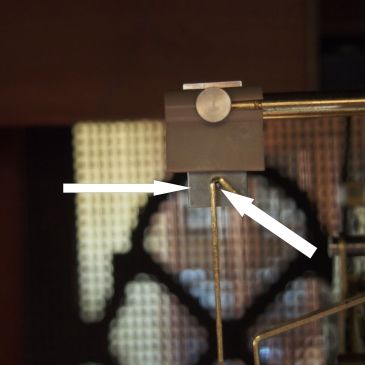
The suspension spring is located at the top of the pendulum rod and serves as the flexible part that allows the pendulum to swing. It connects the top post to the pendulum leader. If it is not installed securely, the pendulum may not swing at all or could wobble, which robs the movement of its energy.

If the spring is bent or twisted, the imperfection will also drain its energy. This imperfection reduces the efficiency of energy transfer to the pendulum, causing it to lose amplitude and making the clock run slow or stop altogether.

Lack of Lubrication

Pivot holes that have dried up mean that there is no lubricating barrier between the pivots and their bearing holes, although the movement may otherwise be very clean.

Small drops of clock oil applied to the dry pivot holes will ensure the clock runs well and will have a long life. Without oil, the steel pivots will wear the brass pivot holes, resulting in wheels that will not mesh properly, eventually stopping the clock.

An approved clock oil must be used, although I have heard that synthetic oil works well too.

Note: a small drop of oil in each bushing hole is all that is required. As they say, Less Is More!

Gummed-up Lubrication

Clock oil loses its viscosity over time. Aging oils also lose their adhesive properties. Oil becomes oxidized, and oxidized oil forms varnish-like residues or gums that can clog pivots and bushings, increasing friction.

When a clock runs slowly, the first instinct is to apply more oil. Old blackened or greenish oil in the pivot holes is a sure sign the clock has been over-oiled or the oil has degraded. The addition of fresh oil produces an almost immediate improvement in the running of the clock, but it will not be long-lasting. In a short time, the clock will begin to run slowly again as the new oil mixes with the dirt and grime in the old oil. When this occurs, the oil becomes an abrasive paste, resulting in exacerbated wear.

The only solution is servicing, which includes disassembly, cleaning of the movement, addressing wear issues, reassembly, and testing.

Balance Wheel Requires an Adjustment

Balance wheels can be adjusted to speed up or slow down a clock.

Regulation of the escapement is done by sliding the two small weights attached to the center of the balance wheel inward to make the clock run faster, and outward to slow it down.

To adjust, simply hold the wheel and push the small adjustment “finger.” Moving the finger to the right will speed up the clock, and moving it to the left will slow it down. Each movement of one dot typically changes the rate by about 10 seconds per day.

The movement usually has a directional indicator guide near the balance wheel, with an “S” for slow and an “F” for fast.

Balance wheel escapement

A Weak Mainspring

Often, the mainspring you will find in your antique clock is the original one(s). The steel used at the time the clock was made was generally of higher quality than the steel used today, with some exceptions. By their very nature, mainsprings become weak over time.

Weak mainsprings are called “set” mainsprings. If “set”, your clock will not run a full cycle, 8 days for eight-day clocks, a full 30 hours for one-day clocks, or whatever the designed cycle. When a spring-driven clock is brought in for a professional repair, the mainsprings are often replaced.

Most properly serviced clocks with their original mainsprings will complete their full cycle, even if the springs are not as powerful as they once were, because cleaning reduces resistance throughout the gear train.

If your clock requires a mainspring replacement, a correctly sized, quality American- or German-made mainspring should provide years of reliable service.

Changes or Alterations During Servicing

Changing or altering the mechanism, such as replacing a gear with an incorrect tooth count, may speed up or slow down a clock. Although movement parts may appear to be similar, manufacturers often made small changes, resulting in parts that may not be interchangeable with the exact movement over the years.

Clock Cycle Time Variance

American spring-driven eight-day clocks typically run slightly faster at the beginning of their cycle because they provide most of their power early on, then run more slowly throughout the week as the mainspring unwinds. A spring-driven clock that is one or two minutes fast at the start of the week may often be a minute or two slow by the end of its cycle. This is considered normal, and no adjustment is necessary.

Occasionally, you will see Geneva Works or stop works on a clock movement. These mechanical additions are designed to compensate for the variance of spring power by utilizing the mechanism to limit the mainspring’s unwinding, ensuring a consistent amount of power is delivered throughout the clock’s running cycle. I have also seen enough of these clocks with the Geneva stops removed. Why? Often, the repairer did not understand how to set them!

The power on a weight-driven clock, on the other hand, is constant, and the loss or gain in time at the beginning of the cycle will be the same at the end, assuming no wear issues are slowing it down.

Slipping, Binding, and Rubbing

If your clock is losing many minutes per day, something in the mechanism is slipping or binding. If your clock is losing minutes per day after all adjustments are made, it is likely that bushing wear or some other worn component, including a weak mainspring, is causing the problem.

Clock repairers often use a term called end shake. End shake allows freedom of lateral movement for each of the wheels between the movement plates. If the plates are tight and there is no end shake, too much resistance will slow a clock. It is why clock repairers always check for sufficient end-shake when servicing the wheels/gears on a movement.

If a wall clock is not mounted correctly, the pendulum might rub against the case. Make sure the clock is not only level and in beat but also properly aligned vertically against the wall. If a clock is not aligned vertically, the pendulum may not swing evenly, causing it to rub against not only the clock case but other parts as well. This uneven motion puts extra stress on a distorted suspension spring.

Final Thoughts

Your situation may be unique, and if it is not covered by this article, I recommend consulting a clock repair expert. If you have little experience and choose to work on an antique or vintage clock yourself, the mistakes you make could be irreversible. For beginners, there are many reputable books and online forums dedicated to clock repair that can provide guidance before attempting any work.

There is also a certain element of risk working with mechanical clocks, as the power contained in the mainsprings may cause serious injury if not handled properly. Always take proper precautions when handling mainsprings or winding mechanisms. If you are unsure or unfamiliar with safe procedures, it’s best to seek assistance from a professional clockmaker to avoid injury and damage to the clock. That said, the safest clocks to work on for beginners are weight-driven ogee clocks or time-only, spring-driven clocks.

Knowing why your clock runs slowly is the first step in diagnosing the problem. Addressing the issue is the next step. Beyond that, periodic maintenance and servicing with quality parts is the key to a long life for your clock.

Common Reasons Your Clock Is Running Slow

There are four general categories of clocks: quartz, electro-mechanical, electric, and mechanical. Mechanical clocks—whether antique or vintage—are the focus of this discussion on why a clock might run slowly.

We’ve become accustomed to the accuracy of quartz clocks, which lose or gain only milliseconds per week. Contrast that with an era when people were content to accept that their mechanical clock might be a minute fast or slow over the course of a week. It was common practice to make small adjustments throughout the run cycle of a clock.

In fact, a typical American spring-driven clock in properly serviced condition may gain or lose a couple of minutes per week as a norm. Weight-driven mechanical clocks that gain or lose only a few seconds per week are considered to be much more accurate.

That said, how many mechanical devices do you know that still run (relatively speaking) perfectly after 120 years?

A clock can run slowly for a variety of reasons.

  • Environmental
  • Pendulum too low or too high
  • Pendulum of incorrect weight
  • Suspension spring length is incorrect
  • Suspension spring is not attached correctly
  • Lack of lubrication
  • Gummed-up lubrication (over-oiled)
  • Balance wheel needs adjustment
  • Weak mainspring
  • Changes or alterations during servicing
  • Clock cycle time variance
  • Slipping or binding
  • Bent gear teeth or arbors

Let’s explore each one of these factors:

Clock parts

Environmental Factors

Mechanical clocks are subject to environmental conditions that may cause them to gain or lose time over the year. These include heat, cold, and humidity. Warmer temperatures can slow down a clock due to the expansion and lengthening of the pendulum, unless it has a compensating pendulum with mercury or dissimilar metal rods. Denser air can also cause the pendulum to swing more slowly.

Even a change in elevation, such as moving a clock from sea level to a higher altitude, can affect the speed of the clock.


Pendulum Too Low or Too High

The lower the pendulum, the slower the clock will run. Many pendulum clocks have an adjustment screw at the bottom or on the bob itself. If not, there is often a regulator on the clock face. You can use the small end of a double-sided key to insert into the dial and adjust the speed.

Shortening the pendulum speeds up the clock. Anything that increases the pendulum’s effective length will slow it down.


Incorrect Pendulum Weight

A pendulum that is too heavy lowers the center of gravity, which causes the clock to run slowly. Using the correct weight for your clock ensures proper and reliable operation.


Incorrect Suspension Spring Length

When someone unfamiliar with the mechanics of a clock replaces a suspension spring with one of the wrong length or thickness, the result is a clock that may run too fast or too slow. Always ensure the spring matches your clock’s specifications.


Suspension Spring Not Attached Correctly or Kinked

The suspension spring connects the top post to the pendulum leader and allows the pendulum to swing. If it’s not installed securely, the pendulum may not swing properly or may wobble, reducing efficiency and affecting the clock’s accuracy.

A kinked or damaged suspension spring will impede the smooth action of the pendulum rod.


Lack of Lubrication

Dry pivot holes mean there is no lubricating barrier between the pivots and the bearing holes—even if the movement appears clean. Apply a small drop of clock oil to each dry pivot hole to ensure smooth running. Without oil, steel pivots will wear the brass holes, eventually causing gear misalignment and stopping the clock.

Note: Only a small drop of oil per bushing hole is needed—no more.


Gummed-Up Lubrication

When a clock runs slowly, the instinct may be to add more oil. But if there’s already old, dirty oil—often blackened or greenish—it will mix with new oil, forming an abrasive paste. Though this may offer a temporary improvement, the clock will soon begin running slowly again.

The only solution is proper servicing: disassembly, thorough cleaning, addressing wear, reassembly, and testing.


Balance Wheel Needs Adjustment

For those clocks that have a balance wheel instead of a conventional escapement arrangement.

The escapement is regulated by sliding the two small weights on the balance wheel. Slide them inward to speed up the clock, outward to slow it down. Use the adjustment “finger”—moving it to the right increases speed, to the left decreases it. One dot of adjustment usually changes the time by about 10 seconds per day.

Look for markings near the balance wheel: “S” for slow, and “F” for fast.


Weak Mainspring

Many antique clocks still have their original mainsprings. These springs were often made from high-quality steel, though they weaken over time—a condition known as becoming “set.” A set mainspring won’t run a full cycle (8 days for eight-day clocks or 30 hours for one-day clocks).

While repair shops often replace mainsprings as standard practice, most properly serviced original mainsprings still perform reliably. If replacement is necessary, use a correct-size, high-quality American or German mainspring for dependable performance. Avoid springs made in India at all costs!


Changes or Alterations During Servicing

Altering a mechanism—such as replacing a gear with one that has the wrong tooth count—can affect timekeeping. Even if parts look identical, manufacturers often made slight variations over the years. Using incorrect parts may lead to a slow or fast clock.


Clock Cycle Time Variance

American spring-driven eight-day clocks typically run a little faster at the beginning of their cycle (when the mainspring is fully wound) and slower as the power diminishes. This is considered normal and usually does not require adjustment.

Weight-driven clocks provide constant power, so any time variance from the beginning to the end of a cycle is more likely due to wear or other issues.


Slipping or Binding

If your clock is losing hours per day, something is slipping or binding inside the movement. If it’s losing minutes per day after all adjustments have been made, worn bushings or components may be the cause.

Clockmakers check for end shake—the slight lateral movement of gears between the movement plates. Without sufficient end shake, gears may bind, slowing the clock. Ensuring proper end shake is a standard part of any professional servicing.


Bent Gear Teeth or Arbours

Bent or slightly out-of-true arbors or gear teeth can cause intermittent resistance, slowing or halting the clock temporarily.

Final Thoughts

Your situation may be unique, and if your clock issue isn’t covered in this article, I recommend consulting a professional clock repairer. If you have limited experience, attempting your own repairs may lead to irreversible damage.

Working with mechanical clocks also involves risk. Mainsprings store a significant amount of energy and can cause serious injury if mishandled.

Understanding why your clock runs slowly is the first step. Addressing the problem is the next. Beyond that, periodic maintenance and the use of quality parts are key to a long and reliable life for your clock.

Pendulum Length Vs. Pendulum Weight in Clocks: What Matters More?

A clock’s pendulum is a swinging component made up of a rod or wire with a weighted bob attached at the end. It is a key part of pendulum clocks, responsible for regulating the movement and ensuring accurate timekeeping.

The pendulum swings back and forth in a precise, periodic motion, controlling the clock’s escapement mechanism and dividing time into equal intervals.

The topic of pendulum weight is a frequent subject of discussion among amateur and professional horologists.

The weight of the pendulum in mechanical clocks is not critical for precise timekeeping but must fall within an acceptable range. Let’s explore why in this article.

Controlling variables

The controlling variable is the length of the entire pendulum assembly (suspension spring, pendulum leader, pendulum bob) from the point where the suspension spring flexes to the center of mass of the entire pendulum assembly. Some clocks will have that length expressed in centimeters or inches stamped on the movement plate.

These numbers 34 and 116 are found on most German antique time and strike clocks
The number 34 refers to the length of the pendulum in centimeters

The weight of a pendulum has a much smaller effect on its timekeeping compared to the length. In an ideal pendulum, the time it takes to complete a swing (the period) is mostly determined by the length of the pendulum and the acceleration due to gravity, and not by the weight.

The weight of the pendulum

In practical mechanical clocks, the weight of the pendulum can affect the clock’s movement in subtle ways. However, the pendulum’s weight must fall within an acceptable range specified by the movement’s design.

pendulum bob with adjuster
Pendulum bob with adjustment screw

Heavier pendulums are less affected by air resistance. A pendulum that is too light may slow down more over time due to friction with the air. Heavier pendulums tend to be more stable in motion and less affected by external forces like small drafts or air currents.

The weight of the pendulum can affect how much power is required from the clock’s escapement mechanism to maintain the pendulum’s motion. A heavier pendulum may need more energy to keep swinging. If the clock’s escapement is designed for a certain weight, using a much heavier or lighter pendulum could affect timekeeping accuracy.

Suspension spring post

On the other hand, heavier bobs tend to overcome mechanical friction more effectively. If the clock’s gears or escapement are under significant load due to weak mainsprings, old grease, or worn pivot holes, a heavier bob helps maintain consistent motion by stabilizing the escapement’s action. If the clock runs better with an overly heavy pendulum bob, it’s a sign of wear, indicating that the movement needs servicing.

Worn Pivot hole
Worn Pivot hole

Additionally, the attachment points (or suspension) of the pendulum and the escapement mechanism may experience increased wear or friction if the pendulum is too heavy. This could cause irregularities in the clock’s timekeeping over time.

In summary

While the length of the pendulum is the primary factor controlling the rate of timekeeping, the weight affects stability, efficiency, and how the clock interacts with the pendulum. However, the length of the pendulum, rather than its weight, is the primary factor in determining a clock’s accuracy.

For a more detailed or technical analysis, horological journals and bulletins delve deeper into the physics of pendulum design and weight. However, I hope this straightforward explanation will be sufficient.

The Quirky Charm of a Vienna Regulator Clock

In this post, I describe an unusual issue when relocating my mini Vienna Regulator clock. Out of all my clocks, this one tends to be the most sensitive when I move it to a different location in my home. I’ve previously shared my experiences with this clock because it’s not the first time I’ve encountered issues.

Medium-sized Vienna Regulator C.1870

Exploring a brief history of Vienna Regulators provides insight into why this clock is a significant milestone in horological evolution.

The Vienna Regulator clock, also known as the Vienna wall clock, is a type of precision pendulum clock that originated in Vienna, Austria.

The style and craftsmanship of Vienna Regulator clocks are often associated with exceptional quality and precision.

The development of the Vienna Regulator clock was influenced by several factors. One of the key factors was the rising demand for accurate timekeeping during the Industrial Revolution. Vienna, as a center of craftsmanship and technological innovation, played a vital role in meeting this demand.

Vienna regulators are distinctive and typically have a slender wooden case, which houses the pendulum and the clock mechanism. This design allowed for a longer pendulum, resulting in greater accuracy. The movement was typically attached to a frame on the backboard of the case by a keyhole design which allowed the movement to be lifted and removed from the case for servicing. The pendulum was often enclosed in a glass door or window, allowing the movement to be admired from the front and side panels while protecting it from dust.

Vienna Regulator dial

The cases, made of various types of wood such as walnut, oak, or mahogany, were often finely crafted with decorative inlays, carvings, or veneers. The clocks featured a white enamel or porcelain dial, usually adorned with Roman numerals and ornate hands.

The movement of the Vienna Regulator clock was powered by weights suspended on cables or cords. The weights (up to three) were typically wound up once a week, providing the necessary power for the clock to run accurately. While the majority of these clocks were designed to operate as 8-day runners, some were specifically engineered to run for 30 days and longer.

During the 19th century, the Vienna Regulator clock underwent several design changes. The earlier models, known as “Vienna Regulators of the Biedermeier period,” were characterized by a simpler and more classical style. Later models, influenced by the emerging Victorian and Rococo revival styles, featured more elaborate ornamentation and decorative elements.

While the popularity of the Vienna Regulator clock declined in the early 20th century with the advent of more modern clocks, it remains valued by collectors and enthusiasts today.

It’s also worth noting that the term “Vienna Regulator” typically denotes a clock style commonly manufactured in Germany and Austria from approximately 1804 to the end of the 19th century, even if it wasn’t necessarily crafted in Vienna.

But let’s go on.

What is making this clock stop?


During an unusually cold winter day, a substantial plumbing problem caused significant leakage from a ceiling pipe in our family room. To address the damage, we had to replace the pipes and patch the ceiling. During the repairs, we decided to refresh the room’s decor, taking the opportunity to make a few changes. As part of the update, we moved our Vienna Regulator clock from upstairs to the family room to showcase its elegance.

After running flawlessly for a few days, the clock stopped. I checked the clock’s beat, adjusted it, and confirmed its proper vertical orientation. This resulted in the clock running for a few hours before encountering another stoppage.

Suspecting a tangled cable issue which could cause a loss of power to the movement, I took the movement out of its case and carefully rewound the cable onto its take-up reel but this did not resolve the issue.

Could the problem be related to wear? I removed the movement from its case and disassembled it, inspecting for any signs of wear including bent arbors, or damaged or worn teeth. However, I found no such issues. In fact, the movement looked very clean, and the oil in the pivots appeared to be in excellent condition.

Vienna regulator movement
Vienna regulator movement, very clean with no issues

After reinstalling the movement into its case and reattaching the weight and pendulum, I noticed a slight wobble in the pendulum, that was not visible from afar.

Out comes the movement which consisted of removing the weight and unhooking it from the frame posts. Upon reexamining the movement, everything appeared to be in proper order. In most clock movements the suspension spring is physically attached to the movement. In clocks of this type, the pendulum rod is attached by the suspension spring to the backboard frame, and there could be a tendency to overlook inspecting the suspension spring as the cause of the stoppage.

This time, the problem was identified as a slightly kinked suspension spring. Lacking a spare, instead of replacing it, I removed the pendulum assembly from its case and used the shaft section of a small screwdriver to smooth out the kink. A temporary fix, to be sure, till I source the correct spring for this clock.

Some clocks can be temperamental and a clock that works fine in one location may not work in another. However, it would appear that moving the clock from one location to another caused a deformity in the suspension spring. So, the fault was mine.

After smoothing out the suspension spring it runs better

My other Vienna Regulator keeps ticking without a hitch, unlike this clock which tends to act up when moved. It’s running fine now and will stay at its new location which is back upstairs.

Anniversary clock repair – a replacement suspension spring

Let me start by saying that opinions on torsion clocks are divided—some people have great success with them, while others absolutely loathe them. Despite their seemingly simple design, they can cause endless frustration, which is why many clock repairers tend to avoid them. Fortunately, I seem to be one of the lucky ones.

Kundo standard size 400 day clock
The Kundo Standard size 400-day clock wound once per year

I gifted this clock to my daughter three years ago. She chose it for its intriguing visible movement and the convenience of running an entire year without winding. Recently, she moved across the country, and during the relocation, the clock “broke.” “Can you fix it, Dad?” she asked. “Leave it with me,” I replied.

400-day clocks, also known as torsion clocks, have been around for over a century. They were first produced in limited numbers in the mid-1890s, but their popularity surged after 1900. Between then and the 1980s, thousands were manufactured, becoming a favorite choice for wedding and retirement gifts—hence the nickname “anniversary clock.”

The Kundo model featured here dates back to the late 1950s or 1960s, during the height of production. However, with the advent of quartz clocks, mechanical versions quickly fell out of favor.

Kundo is a well-known name in the world of anniversary clocks. The name is a combination of Kieninger and Obergfell, a highly respected German company. Today, the company continues as Kieninger, operating as a subsidiary of Howard Miller USA.

Dial face Kundo Clock
Dial face, Kundo Clock

Servicing a 400-day Clock

To service a 400-day clock, I highly recommend using the Horolovar 400-Day Repair Guide as a reference. Can you repair a 400-day clock without it? Yes, but the Horolovar guide eliminates almost all the guesswork.

This particular 400-day clock is a Kundo Standard 53, which requires a .0032″ (0.081mm) Horolovar spring. If you don’t have the time or tools to assemble the suspension units yourself, Horolovar (or most clock suppliers) offers fully assembled units. However, these come at a significantly higher cost.

Section 10 of the Horolovar guide includes templates for various clocks. These templates provide precise patterns for positioning the fork and attaching the upper and lower blocks to the suspension wire, ensuring proper assembly.

suspension spring installed on a Kern
The suspension spring assembly includes the top and bottom block plus the fork

The screws on the suspension assembly are very small, so using a high-quality precision screwdriver is essential to avoid damaging them. The suspension spring is longer than needed and will require trimming to fit. Once the spring is securely attached to the fork and blocks, it’s ready to be reinstalled onto the movement.

Kundo anniversary clock movement

The suspension spring assembly hooks onto the top cock and bottom weights or balls. A threaded thumbscrew on the top base slips into the top block. The bottom block has two pins to which the pendulum hangs. Next are the back spring cover and the locking guard.

Torsion clocks have pendulum locking systems that must be engaged even when the clock is moved just a few feet. Often, the result of an unlocked clock is a broken suspension spring. The locking guard on this clock is an earlier design and looks pretty flimsy in my view but it should work.

Once the spring assembly is installed on the movement it is time to test the beat. The beat should be 8 beats per minute and there should be ample overswing in both directions. A 270-degree rotation is healthy enough.

What makes the 400-day anniversary clock a great addition to a collection?

They are:

  • Relatively inexpensive to buy, although some models like Schatz and Gustav Becker are more sought-after and therefore more expensive.
  • Very quiet in operation.
  • Easy to disassemble, clean, and reassemble due to having few parts.
  • Slow runners, meaning wear is rarely an issue.
  • A fantastic conversation piece.
  • Long runners, with some lasting 400 days or more on a single wind.

What makes them less ideal:

  • Notoriously inaccurate timekeepers.
  • Can be frustrating to fine-tune at times.

Since I had previously serviced this clock, I was able to loosen the tiny screws on the blocks and fork with ease. Sometimes they can be tight and difficult to remove, but on this occasion, everything went smoothly. As of this writing, the clock has been running well for several weeks.

While it’s currently running slightly fast, small adjustments to the regulating dial will slow it down. However, there’s a limit to how much you can adjust, and it’s not a clock I would rely on for precise timekeeping.

A Smiths Enfield mantel clock comes back to life

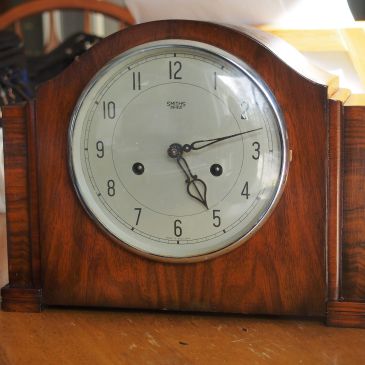
Smiths Enfield mantel clocks are highly regarded by beginning clock collectors due to their popularity, abundance, and durable movements. For amateur clock repairers, they offer relatively few challenges.

I acquired my Smiths Enfield time-and-strike clock in 2013 from a young clock tinkerer in Dartmouth, Nova Scotia, but it was never a reliable runner. It would only run for a few minutes before stopping. Eventually, the clock was set aside and left in a corner of my shop.

Post war English time and strike movement

While not an especially attractive clock it embodies the utilitarian design typical of post-war English clocks from the late 1940s and early 1950s.

After several months and armed with new knowledge of clock repair, it was time to take a second look.

About Smiths Enfield

The Enfield Clock Company (London) Ltd. was established in 1929, with its first clocks sold in 1932.

The company utilized modern assembly line techniques to manufacture and assemble its clock movements, inspired by the American system of automated factories. Initially, clocks were sold wholesale and for export, with the movements supplied to shops that would then assemble the cases themselves. Enfield took pride in producing “British-made” clocks. However, in 1933, facing difficulties competing on price, the company was sold to Smiths Industries, which led to the name change to “Smiths Enfield”.

In 1935-1936, they introduced a striking 14-day clock in a Jacobean Oak case, which helped solidify the company’s position in the market. With the outbreak of war in 1939, the factory shifted to wartime production. While clock production continued, material shortages became a significant challenge.

After the war, American machines were allowed to be kept and production of the 53mm movement re-commenced. Production was later moved to the Smiths factory at Cricklewood and then later to their Welsh factory in about 1955. Under Smith Industries the production line was changed to watches. Ultimately all clock production was phased out and the company closed shortly thereafter.

A New Suspension Spring?

I serviced the clock in 2015, and it needed bushing work. Since the wear wasn’t severe, I thought I could delay it for another two years. However, the clock has not been running since then. At the time, I knew little about the purpose and function of a suspension spring, and since I assumed the one that came with the clock was correct, I thought there must be another issue causing the clock to run poorly.

Suspension spring post

It’s time to revisit the suspension spring to determine if that’s the issue.

Suspension spring location

Over the past four years, I have accumulated an assortment of suspension springs and, through trial and error, found one that is either correct for the movement or very close.

The suspension spring has a mounting hole on one end and a small T-bar on the other where the pendulum hangs. I replaced the old spring with a shorter, more flexible one. As a result, the clock started running. In the first week, it lost about five minutes, but after making minor adjustments to the pendulum length, the timekeeping improved with each change.

The takeaway from this is that the correct suspension spring is crucial to whether a clock runs, and it should be considered as one of the potential reasons when a clock is not working.

Mauthe (FMS) wall clock restoration – Part II – servicing the movement

This is Part II of a three part series on restoring this beautiful German FMS Mauthe (Friedrich Mauthe Schwenningen) wall clock. Part I can be found here. Part III, in a week or so, will cover case repairs and refinishing.

This attractive antique Victorian style German FMS Mauthe wall clock was purchased locally from a family that once lived in the town of Parrsboro. Nova Scotia over 100 years ago.

Why would someone solder the minute hand to the arbour

In this post I will discuss servicing of the time and strike movement.

As I began taking off the dial I noticed that the minute hand had been soldered to the arbour. Not only that, it was in backwards. A taper pin should secure the minute hand, not solder. Using a butane torch I freed the hand. Once the hands are off, removing the dial requires pulling 4 pins from the support posts. Following that, the bottom rail, which is secured by two machine screws, is removed. Now to work on the movement.

Very dirty movement, in need for a good cleaning

Before we do that, let’s look at the numbers on the back plate. 105 is the number of beats per minute, 42 is the length of the pendulum rod in centimeters. The number 55006 is a patent number which was issued to Heinrich Kielmann (Ruhrort/Rhein) in 1890/1 and concerned the method of hanging the pendulum. The number 20934 refers to a production run but I have no idea what date is assigned to that number. The Adler gong has the FMS eagle on the block and from my research the eagle was placed on gongs going forward in 1898. Therefore, the clock is from about 1898 – 1905.

Coiled gong and gong block by Adler

The movement has not been serviced in some time. Expecting to see a significant amount of wear, I was pleased to discover the movement in generally good condition.

The pallets had little or no wear and the escape wheel likewise looked good. The pivots had very little wear and polished up nicely. There were 4 pivot holes that needed some degree of attention. I decided that two on the strike side were not so bad that they could wait but two others were quite worn, the centre wheel, front and the motion works wheel just above it. This is expected as these wheels carry most of the load from the mainsprings.

2 of 3 Bushings were installed for these pivots

The count wheel strike and motion works

After a 30 minute cleaning cycle the solution was quite dirty, in fact so dirty that I disposed of the solution

I take plenty of photos as an aid in helping me relocate the movement parts on reassembly. Sometimes the wheels on the strike and time side look similar. In the case of this movement there was no confusing which side the wheels should go.

I disassembled the movement and placed the parts in my ultrasonic cleaner. After a 30 minute cycle the solution was very dirty, in fact so dirty that I disposed of the solution (it is biodegradable). Reassembly was straightforward as most of the adjustments to the strike side occur outside the plates, unlike a typical American time and strike movement where there a myriad of levers and helper springs that seem to pop out when you you are trying your best to get everything set up between the plates.

As a side note, Mauthe did make time and strike movement with the count wheel located between the plates and with conventional wire levers.

The only critical adjustment is the stop wheel which has to be in the correct position otherwise the strike will not function correctly. Trial and error is needed to get this right but I set it correctly on the first attempt.

Stop pin on the strike train; positioning the stop pin upon reassembly is critical

Unfortunately, I do not have a test stand tall enough for this movement and the case was used to test the movement. The movement slides in and out on a set of rails making it relatively easy to make the necessary adjustments.

Cleaned, reassembled and installed in the case for testing.

One issue, a broken suspension spring. Could have been my handling of the movement or it was already broken. Nevertheless, my order from the supplier arrived and the spring has been replaced. Most clockmakers would agree that it is a good practice to replace the suspension spring as they weaken with age.

During testing the strike side was sluggish and would not engage from time to time. I attributed this to an enlarged pivot hole on the star wheel, back plate one of the two I noticed earlier. The new bushing was a very small #7 Bergeon at 0.80 mm (inside dimension) with very little margin for error. With the new bushing (a total of 3 for the movement) the strike side was still sluggish. After taking the movement apart again I found a slightly bent arbour on the second wheel of the strike side which I fdiscovered when I attached it to my lathe. Using a hollowed punch tool I straightened it out.

Broken suspension spring

The reassembled movement was oiled and mounted in the clock case. The recoil escapement is adjustable and a slight tweaking of the verge corrected the beat. After a few frustrating adjustments exacerbated by a bent arbour, the movement is running well after servicing.

Next, I will cover case refinishing for this fine old clock.

NOTE: After completing this project I designed and built an extension for my movement test stand to allow me to work on movements with long pendulums such as this one.

My antique clock runs slow – why?

There are four general categories of clocks; quartz, electro-mechanical, electric, and mechanical. Mechanical clocks, whether they are antique or vintage are the focus of our discussion on why a clock runs slow.

We are quite accustomed to the accuracy of quartz clocks which lose or gain mere milli-seconds per week. Contrast that with an era when folks were content to accept that their mechanical clock would be a minute fast or slow through the week and it was a common practice to make small adjustments over the run cycle of a clock.

In fact, a typical American spring-driven clock in properly serviced condition may gain or lose a couple of minutes per week as a norm. Weight-driven mechanical clocks that gain or lose several seconds per week are considered to be very accurate.

That said, how many mechanical devices do you know run perfectly (relatively speaking) after 120 years.

A clock runs slow for a variety of reasons.

Let’s look at some factors and examine each one.

  • Environmental
  • Pendulum too low or too high
  • The pendulum is the incorrect weight
  • Suspension spring length is incorrect
  • The suspension spring is not attached correctly
  • Lack of lubrication
  • Gummed-up lubrication (over-oiled)
  • The balance wheel needs adjusting
  • A weak mainspring
  • Changes or alterations when servicing
  • Clock cycle time variance
  • Slipping or binding
one-weight Vienna wall clock
One-weight wall clock with large pendulum bob and rate adjustment on the bottom
Ogee clock showing replacement pendulum bob
Ogee clock showing replacement 1 oz rate adjusting pendulum bob

Environmental 

Mechanical clocks are subject to a number of environmental factors which may cause them to gain or lose speed over the course of a year. These factors include heat, cold, and humidity. Increasing the ambient temperature of a clock will slow it down from the expansion and lengthening of the pendulum unless the pendulum is a compensating type using Mercury or dissimilar metal rods. Denser air also causes the pendulum to move more slowly.

Moving a clock from sea level to a higher elevation will affect the speed of the clock.

Numbers on bob correspond with the movement
Pendulum bob with inset rate adjustment

Pendulum too low or too high: The lower the pendulum the slower the clock will run. Many pendulum clocks can be adjusted either by a set screw at the bottom of the pendulum or by an inset screw on the pendulum. In the absence of an adjustment on the pendulum, there is a regulator on the clock face. Use the small end of a double side key and insert it into the dial face of the clock to speed or slow down the clock.

Shortening the pendulum will speed up the clock. Anything that increases the length of the pendulum will reduce the rate of the pendulum and result in a clock that will run slower.

Parts of the clock related to the pendulum

The pendulum is the incorrect weight: If the pendulum is too heavy it causes the centre of gravity to be too low, consequently the clock will run slower. Having the correct weight pendulum for your clock ensures smooth running.

Suspension spring length: Often, when a clock is repaired by a person who has limited knowledge of the effect a replacement spring will have on the running of a clock they will occasionally install an incorrect length or thickness of suspension spring. Choose the suspension spring that is correct for your clock.

Rate adjustment under the 12. Use the small end of the double-sided key to make the adjustment

Suspension spring not attached correctly: A suspension spring is located at the top of the pendulum rod and is the flexible part that allows the pendulum to swing. It is the connection between the top post and the pendulum leader. If it is not installed securely the pendulum may not swing at all or will wobble, robbing the movement of its energy.

Lack of lubrication: Pivot holes that have dried up means that there is no lubricating barrier between the pivots and their bearing holes although the movement may otherwise be very clean. Small drops of clock oil applied to the dry pivot holes will ensure the clock runs well and will have a long life. Without oil, the steel pivots will wear the brass pivot holes resulting in wheels that will not mesh properly eventually stopping the clock.

Note: a small drop of oil in each bushing hole is all that is required.

Gummed-up lubrication: When a clock runs slowly the first instinct is to apply more oil. Old blackened or greenish oil in the pivot holes is a sure sign the clock has been over-oiled. Although there is an almost immediate improvement in the running of the clock it will not be long-lasting. In no time at all the clock will begin to run slowly again as the new oil mixes with the dirt and grime in the old oil. When this occurs the oil becomes an abrasive paste resulting in exacerbated wear. The only solution is servicing which includes disassembly, cleaning of the movement, addressing wear issues, reassembly, and testing.

Balance wheel needs adjusting: Regulation of the escapement consists of sliding the two-small weights attached to the center of the balance wheel. Inwards for fast and outwards for slow. Hold the wheel and push the small adjustment “finger”. Moving the finger toward your right will be faster and vice versa. Moving the finger one dot represents a change of about 10 seconds per day. The movement will have a directional indicator with an”S” for slow and “F” for fast on the sides adjacent to the balance wheel.

Balance wheel escapement

A weak mainspring: Often the mainspring you will find in your antique clock is the original one(s). The steel used at the time the clock was made was generally of higher quality than the steel used today with some exceptions. By their very nature mainsprings become weak over time.

Weak mainspring are called “set” mainsprings. If “set”, your clock will not run a full cycle, 8 days for eight-day clocks, a full 30 hours for one-day clocks, or the designed cycle. When a spring-driven clock is brought in for a professional repair the mainsprings are often replaced.

Most properly serviced clocks with their original mainsprings will run their full cycle. Should your clock require a mainspring replacement a correct size quality American or German-made mainspring should provide years of reliable service.

Changes or alterations: Changing or altering the mechanism such as replacing a gear with an incorrect teeth count may speed up or slow down a clock. Although movement parts may appear to be similar, manufacturers often made small changes resulting in parts that may not be interchangeable with the exact movement over the years.

Clock cycle time variance: American spring-driven eight-day clocks will run slightly faster at the beginning of their cycle by providing most of their power and run more slowly through the week as the power of the mainspring unloads. A spring-driven clock that is one or two minutes fast at the beginning of the week is often a minute or two slower at the end of its cycle. This is considered normal and no adjustment is necessary. The power on a weight-driven clock, on the other hand, is constant and the loss or gain in time at the beginning of the cycle will be the same at the end assuming no wear issues are slowing it down.

Slipping or binding: If your clock is losing hours per day something in the mechanism is slipping or binding. If your clock is losing minutes per day after all adjustments are made, it is likely bushing wear or some other worn component is causing the problem. Clock repairers have a term called end shake. End shake allows freedom of lateral movement for each of the wheels between the movement plates. If the plates are tight and there is no end shake, too much resistance will slow a clock. It is why clock repairers always check for sufficient end-shake when servicing the wheels on a movement.

Final thoughts

Your situation may be unique and if it is not a clock issue covered by this article I suggest consulting an expert in clock repair. If you have little experience and choose to do your own work on an antique or vintage clock, the mistakes you make may be irreversible.

There is also a certain element of risk working with mechanical clocks as the power contained in the mainsprings may cause serious injury if not handled properly.

Knowing why your clock runs slowly is the first step in diagnosing the problem. Addressing the issue is the next step. Beyond that, periodic maintenance and servicing with quality parts is the key to a long life for your clock.

Website Powered by WordPress.com.

Up ↑