The Empire Gallery Clock: Built to Impress
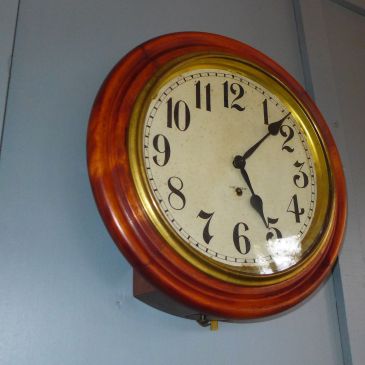
In the spring of 2022, I brought home a handsome gallery clock from an auction—an English-made piece with a 10-inch dial. What caught my attention initially was its clean, industrial look, but once I opened it up, I found it had just as much character on the inside.

I was hoping for a fusee clock, as many English gallery clocks are fusees, but when I saw this one offered at auction, I knew from the price that it probably wasn’t what I had hoped for—but I bought it anyway.

Empire 150 gallery clock

The Company

According to one source, Astral and Empire were originally trademarks of a company called Williamson, known for its high-quality movement, also named Astral. Through a series of mergers and acquisitions, the trademarks eventually came under the ownership of English Clock and Watch Manufacturers Ltd., which was purchased by Smiths in 1932. As a result, Smiths acquired the Astral and Empire trade names.

However, further research led me in a slightly different direction regarding the manufacturer. It appears that the company was not named Empire, but rather Grimshaw, Baxter, and J. J. Elliott.

Empire was actually a model name used by this firm.

So, the clock is from the Empire 150 series.

Grimshaw, Baxter, and J. J. Elliott was an English clockmaking company formed in 1909 when Grimshaw and Elliott merged. The firm produced a variety of clocks and watches until its dissolution in 1921. The name continued to be used until 1958, although I do not know how it was used during that period.

Interestingly, the company made fusee wall clocks as well.

Features of this Clock

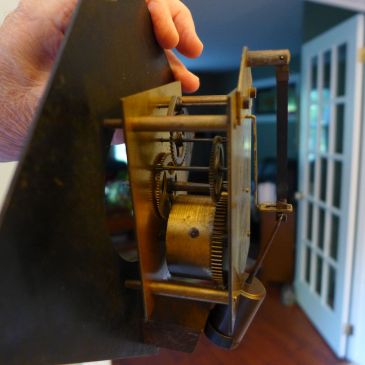
The clock features a classic time-only movement—simple in design, with relatively few wheels to manage during servicing. As with many time-only setups, the minute and hour wheels are located outside the front plate. What sets this one apart is its size: it’s surprisingly large for a time-only movement and impressively robust, likely intended for use in a commercial setting.

The movement is mounted to a heavy steel plate that screws onto its front, and the whole unit fits just beneath the dial. Though the clock is unmistakably English, the layout and engineering give it a distinctly German feel—a nod, perhaps, to cross-European influences in clockmaking during that era.

Accessing the movement is refreshingly straightforward. After removing the hands and three small screws, the dial lifts away easily. Four slotted screws secure the movement to the steel mounting plate.

One particularly interesting feature is the pendulum. It’s a cylindrical style with a large, rotating adjustment screw at the bottom—a practical touch for fine-tuning. Even better, it clips into a clever two-piece caddy system (see below) that makes transporting the clock safe and simple. Push the cylindrical pendulum bob into the caddy and Voilà, it is secured in place! A nice surprise for a piece from the early 1920s.

Grimshaw, Baxter, and J. J. Elliott gallery clock called the Empire

I was also intrigued to find taper pins used to secure the plates—a feature more common in older or higher-quality movements. The mainspring barrel is modest, about the size you’d expect in a typical time-and-strike clock from England or Germany.

A well-made movement designed to last, pendulum is secured in place

The movement had clearly been over-oiled at some point, so before any cleaning could begin, I had to wipe everything down thoroughly. Then it was into the ultrasonic cleaner. While I didn’t expect the plates and wheels to come out gleaming, they cleaned up beautifully. After polishing the pivots and pegging out the pivot holes, it was time to reassemble.

Compared to the American movements I’ve been working on recently, this one has notably finer pivots. This isn’t a movement where you can force the pivots into their respective holes—each pivot needs to be carefully guided into its hole with a steady hand and a bit of patience.

All in all, this Empire gallery clock turned out to be more than just a pretty face. It’s a well-made, thoughtfully designed piece with a few charming quirks. A great example of early 20th-century English clockmaking—and a pleasure to work on.

My Antique Wall Clock Collection: A Quick YouTube Tour

Allow me to take 5 minutes of your time to watch my video of 19 wall clocks in my collection. Each wall clock is identified by its maker, where known. The video features background music throughout, with a brief segment of sound highlighting the winding of a Mauthe wall clock. Otherwise, there is no dialog.

My only requirement is that the clock must be in good working order and have an appealing appearance.

19 wall clocks in my collection

My entire collection consists of 85 clocks. Many are on display in my home, and some are in the process of restoration or repair.

Check out my Pequegnat clock video as well.

A Gilbert Clock joins two other gallery clocks in my collection

Recently, I acquired a gallery clock in exchange for another clock. I favour wall clocks over other types due to their convenient wall placement, eliminating the need for a shelf or mantel. Additionally, they tend to draw more attention compared to other clock varieties.

The clock I traded, a rare Canadian cottage clock, held significant value, but overall, I am content with the exchange.

Gilbert gallery clock

Gallery clocks are often called pub clocks, canteen clocks, or office clocks.

Gallery clocks are often found in public galleries and exhibition spaces, where they serve both functional and decorative purposes. They are usually placed on prominent walls and are designed to be easily visible to visitors. These clocks can vary in style, ranging from antique designs with Roman numerals to more modern and contemporary styles with sleek, minimalist features.

This time-only gallery-style clock made by the Gilbert Company of USA is nondescript and quite ordinary looking. There is nothing special or distinctive about it.

The casing of the clock is relatively light in weight and based on the wood’s coloration, it seems to be made of cherry wood. A previous owner meticulously refinished the case, and while the result is impressive, it appears almost too flawless.

The clock has a 12″ Arabic dial and is 16 1/2″ across with spade hour hand and minute hand with a heavy brass dial bezel. The dial is constructed from paper and lacks a metal backing, clearly indicating a cost-saving measure.

A 12-inch dial is considered the standard size for a gallery clock and a 12-inch dial would have been the maximum size for a domestic environment. I own a smaller 10″ gallery clock, crafted in England, equipped with a conventional spring-driven movement, specifically designed for placement in a compact office setting. Larger 14″ and 16″-inch” gallery clocks on the other hand would have been found in public areas, factories, and post offices.

At first glance, it’s easy to mistake this conventional spring-driven pendulum clock for a fusee clock. Upon closer inspection, however, its features set it apart from the traditional fusee clock, revealing its true identity as an ordinary mass-produced spring-driven time-only American-made clock.

Movement as seen from the trap door

The winding arbour sits just below the central cannon, and above the centre cannon, you’ll find the Gilbert trademark. Interestingly, the winding arbour is positioned in the same location as that of a typical fusee gallery clock.

This specific movement is present in other Gilbert time-only clocks and is almost identical to the one used in the Gilbert Admiral calendar clock.

Time-only movement
Gilbert Admiral with calendar

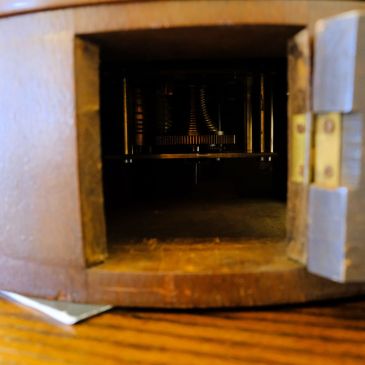
A trap door on the bottom provides access to the pendulum. When the clock is hung on the wall, attaching the pendulum to the pendulum rod is nearly impossible. I discovered that laying the clock on its back, attaching the pendulum bob to the hook, and then carefully mounting the clock on the wall is a slightly easier method.

The trap door opens to reveal the pendulum bob

The previous owner found the clock in Virginia and brought it to Canada. The clock was lacking its original glass, but a replacement was included as part of the exchange deal. In addition, the clock was completely serviced, one bushing hole was found to be enlarged and a new bushing was installed.

Two other gallery clocks

The two other gallery clocks in my collection are a clock with a 10″ dial made by a British maker, Empire, and a 12-inch (dial) fusee clock, maker unknown but likely British.

12 ” Fusee clock
10″ gallery clock made in England by Empire

Given that the Gilbert clock underwent a thorough servicing and the missing glass was replaced, my only task remained to find a suitable spot to display it.

Fusee gallery clock – finally on the wall but who made it?

This unnamed fusee clock was acquired from a friend this past summer and after a few months, I am finally able to hang it on the wall. Unfortunately, after having been involved in the extensive cleanup following the devastating hurricane Fiona here in Nova Scotia, there was little time for clock repair. But, now that the dust has settled it’s time to get back to clock collecting and repair.

Unknown fusee time-only gallery clock

It is the first fusee clock in my collection. I have waited a while but this is an excellent acquisition.

This time-only gallery-style clock with a fusee movement is non-descript and quite ordinary and there is nothing special or distinctive about it. It has a 12″ dial and is 15 1/2″ across with a spade hour hand and spear minute hand with a heavy brass dial bezel.

A 12-inch dial is considered the standard size for a gallery clock and a 12-inch dial would have been the maximum size for a domestic environment. Larger 14″ and 16″-inch” gallery clocks would have been found in public areas, factories, and post offices.

Side view showing the rear box

I am not an expert when it comes to identifying wood types but I would say a solid mahogany bezel surround with veneers on the rear access box.

Although fairly heavy it is designed to be quickly removed from the wall by pulling out 4 wooden pegs (two on each side of the back box), very handy for periodic inspection/maintenance. The pendulum leader literally hangs on a notch on top of the escapement bridge so, disconnecting by means of opening up a side door on the right and reaching in is pretty simple.

It has a conventional anchor escapement, a robust bridge, and a sturdy crutch. The plates are held together with screws but pinned to the back of the dial.

There is a trademark on the movement which I cannot identify. Perhaps a reader might identify this English company. I can make out T, an S, an O, and something else. Atson, AT & Son or something with a “z”?

I posted the question on a popular antique clock forum site and expected a response but got nothing.

A trademark that I cannot identify

Is it an antique (over 100 years old)? Perhaps, but it could be as late as the 1920s. The plates are thick, the gears are machine cut, cut pinions throughout, a hefty pendulum bob, thick but plain movement pillars, and a generally robust feel all around. It was certainly designed for longevity and reliability. The screwed pillars are a good sign that it was made after 1900.

This fusee has a cable drive. It is unknown whether it originally had a chain as most did many years ago or if it was converted to cable as many were when taken in for servicing. Chains are difficult to source and wire/cable is much more cost-effective.

An advantage of a brass cable is that if it should snap there would be less collateral damage than a chain flailing all over the place. When a chain releases very suddenly the potential for taking out gear teeth and other parts is much higher.

The cable is wrapped around the large spring barrel

Fusee advantages

Constant torque and in theory, more accurate timekeeping are its chief advantages. It works like this. As the spring begins to uncoil the cable is on the smallest diameter of the fusee. The pull on the spring drum becomes less as the diameter of the fusee increases. The diameter of the fusee becomes larger giving greater leverage.

The larger radius at the fusee compensates for the weaker force of the spring, keeping the drive torque constant which is why fusee clocks are better timekeepers than conventional spring clocks.

Accuracy cannot be compared to a quartz clock today but keeping time within a minute or two a week in an industrial/office/domestic setting was perfectly acceptable in an age when the exact time was unimportant.

View of fusee cone

The plan

I am not going to tackle this project just yet but fortunately, it has seen servicing. I can identify at least three newer bushings. There does not appear to be significant play in the movement which is always a good sign so, there should not be a problem if the servicing is delayed for a while.

The rear of the movement shows an escapement bridge and crutch

The movement is not particularly dirty so, I oiled the movement, mounted it on the wall, attached the pendulum, and put it in beat.

Taking the movement apart and addressing any wear issues does not concern me but I must learn more about how to set the preload on the mainspring, which has its own winding arbour (not accessible through the dial) before I dive deeper into servicing this movement.

The clock came without a key and I had to order one, a very large #11 key.

In the meantime, the clock is happily ticking away on my office wall.

The fusee movement – just what is it exactly?

A fusee clock movement is a type of mechanical clock mechanism that uses a conical pulley (the fusee) and a chain or cable to provide a more consistent driving force to the clock’s gear train. The fusee mechanism was commonly used in early pocket watches and large clocks to compensate for the decreasing tension of the mainspring as it unwound.

As a typical mainspring winds up, its tension is strongest, which leads to the clock running too fast. As the mainspring unwinds, its tension weakens, causing the clock to run slower. The fusee counteracts this by gradually changing the ratio of the force applied to the gears, ensuring a steady, regulated power supply. This innovation helps the clock maintain accuracy throughout its entire run.

Fusee movements are often considered an important step in the evolution of horology, showcasing the ingenuity of early clockmakers in solving the problem of maintaining consistent timekeeping. Today, they are still highly valued by collectors and horologists for their craftsmanship and historical significance.

Fusee movement in run-down condition

Most fusee movements were equipped with anchor escapements, though some featured lever or deadbeat escapements. Earlier fusee movements often had decorative sculpted pillars and pins to secure the plates, while later models used plain pillars with screws. This difference in design is one way to determine the age of the clock.

Jacob Zech is credited for inventing the fusee in 1525 although drawings of a fusee appear in Leonardo De Vinci’s notebooks.

Fusee in its run-down condition

Parts of a Fusee Movement

a) Spring drum

b) Winding arbour

c) Fusee

d) Main wheel

e) Chain (or gut or wire)

Of course, the above diagram does not show the wheels above the main wheel and merely illustrates the essential components of the fusee section.

A chain-driven fusee is the norm although wire and gut are common. Gut was used at first but around 1650 chains began to be used, which lasted longer.

How does it function?

The spring drum’s axis is parallel to the axis of the fusee. Around the drum is wound a chain that is attached to the fusee at its largest diameter. An attached mainspring is coiled inside the drum that sits next to the fusee.

When the key is inserted into the arbour of the fusee it pulls the chain causing the drum to rotate. Because the inner end of the spring is attached to the drum, the drum rotates until the spring is completely coiled. The spring is then at its maximum tension. At full winding, the chain is completely wound onto the fusee.

8-day time-only Fusee with12-inch (dial) gallery clock

As the spring begins to uncoil the chain is on the smallest diameter of the fusee. The pull on the spring drum becomes less as the diameter of the fusee increases. The diameter of the fusee becomes larger giving greater leverage.

The greater turning moment provided by the larger radius at the fusee compensates for the weaker force of the spring, keeping the drive torque constant and that is why fusee clocks are better timekeepers than conventional spring clocks.

Fusee movements are generally more expensive than conventional spring drive movements. Double and triple fusees add to the cost and complexity.

Disadvantages of fusee movements include their difficulty to adjust. If the fusee chain breaks, the force of the mainspring can send the end whipping around inside the clock, potentially causing damage. Any collateral damage, if present, must be repaired as part of the restoration. Additionally, if a replacement mainspring is needed, it must be an exact match; otherwise, the fusee will need to be adjusted to accommodate the new spring.

Despite their complexity and the challenges involved in servicing them, fusee clocks have maintained their value over the years and continue to be highly sought after by serious collectors.

Second gallery clock bought this year – this one has a fusee movement

Earlier this year I bid on an English-made Empire gallery clock at an online estate auction and won the bid. When I collected the clock I had hoped I had bought a clock with a fusee movement but it turned out to be one with a conventional spring-driven time-only movement. No matter, it was not an expensive clock.

Empire time-only gallery clock

A fusee clock has been on my wish list for several years and now I finally have one. A good friend was trimming his collection and offered me a time-only gallery clock with a fusee movement for a good price.

Time only clock with fusee movement

English fusee gallery clocks, also referred to as dial, school, office, railway, or wall clocks, are a must-have for any serious collector.

The heyday of the English gallery clock was between 1860 and 1930. Gallery clocks were made in the thousands to service the needs of industry and government. The gallery clock was a common sight in schools, offices, hospitals, rail stations, and businesses in the United Kingdom.

Gallery clocks with fusee movements vary greatly in size, style, and in construction. Despite being over 100 years old, they retain their original attributes of good timekeeping and reliability. Fusee movements are rugged in construction, and their success rests with the fusee, a conical-shaped component that evenly regulates the power output of the spring.

Chain-driven fusee movement

The gallery clock came in all sizes but still retained its basic design and shape. The most popular size was 12 inches (diameter of the painted dial). Generally, the smaller the dial, the rarer and more expensive the clock. This clock is among the group of common gallery clocks and has a 12-inch dial. The next smallest size would be a 10-inch dial and then an 8-inch one.

The majority of cases (back box and surround) were manufactured in mahogany; however, oak and rosewood were used. Mahogany examples are the most expensive. Oak cases are generally slightly cheaper. Ebonized cases are cheaper still. My new acquisition appears to be made of oak.

It has all the attributes of a classic gallery clock. Four pegs connect the two constituent parts through “rails” or “cleats.” To inspect a movement, it is just a matter of laying the clock face down and pulling out four wooden pegs, lifting the dial, bezel, and movement out of the rectangular box case. Later clocks were made without pegs with access to the movement via the dial.

The backplate of the fusee movement

However, to remove the movement entirely the hands must be removed and three screws holding the dial are removed as well. There is also a movement pan that is held by pins that must be taken off.

Most movements had anchor escapements, some had lever escapements and some had deadbeat escapements. Later models had plain pillars with screws. This clock has an anchor escapement and plain pillars so, not so old but still an antique.

This clock has a chain-driven fusee although wire and gut are quite common.

The maker is unknown.

Special care must be taken to service a fusee movement so, I will be treading carefully as I service this movement but for now I will run it to see if it lives up to expectations.

English gallery clock by the Empire Clock Co. is not a fusee

When I placed my online bid on this time-only gallery-style clock (local auction house) in June 1922 I had hoped it had a fusee movement since a clock with a fusee movement has always been on my wish list.

A fusee (from the French fusée, wire wound around a spindle) is a cone-shaped pulley with a helical groove around it, wound with a cord or chain which is attached to the mainspring barrel. A fusee movement improves timekeeping by equalizing the power of the mainspring over its rated running cycle. In short, it keeps better time than a conventional spring driven clock throughout its 8-day cycle.

This clock does not have a fusee movement!

Auction photo

It’s still a nice clock, however!

Most would agree that this a gallery clock, but it is also known in some circles as a pub, office, domestic or canteen clock. The dial face is 10 inches across and the case measures 14 inches in diameter. It has Roman Numerals with spade hour hand and a rod minute hand. The wood surround, which is in very good condition, appears to be mahogany. It has a high quality conventional spring driven time-only movement.

Am I disappointed that it is not a fusee? Well, a little! But the price I paid was far less than a fusee would have cost.

The movement is rather large for a time-only movement and is well built. It is attached to a heavy steel plate that is screwed onto the front of the movement. The whole assembly mounts just under the dial. It has a very German look to it, though it is definitely English-made.

Steel plate

To access the movement the dial must be removed which is a relatively simple process of removing the hands and three small screws.

Time-only movement made by Empire

Four slotted screws secure the movement to the steel plate.

An curious feature is a cylindrical pendulum with a large rotating adjustment screw on the bottom. The pendulum clips into a two piece caddy system for easy transport.

Cylinder pendulum and transport caddy

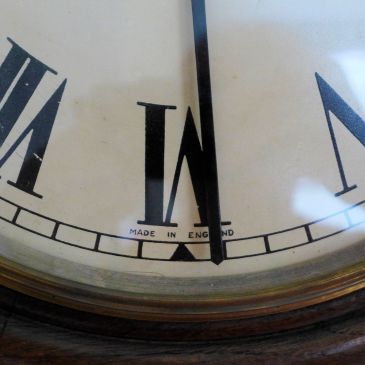
The movement is stamped “Empire” with #6617 and “made in England” at the bottom of the rear plate. The movement plates have an interesting checker-board design not unlike some German clocks of the time.

The Empire brand was introduced by The English Clock & Watch Company (a merger of H Williamson & Grimshaw & Baxter) in 1924. The company was short-lived and purchased by Smiths in 1932. Although Smiths acquired the Empire trade names there is no indication the Empire name continued after 1932.

This catalogue image below describes the clock in various configurations. “GB” refers to Grimshaw & Baxter, J.J.E Ltd, is a mystery to me, a distributor perhaps.

It needs a good cleaning but I’ll run it a week or two first and service the movement.

An English gallery clock that is made to look like a fusee that isn’t!

Website Powered by WordPress.com.

Up ↑