Top 9 Antique Clock Myths Debunked for Collectors
If you’ve been around antique or vintage clocks for any length of time, as I have, you’ve probably heard a few “truths” that get passed along like family recipes. Some have a sprinkle of fact in them, others are pure folklore, and a few can actually cause more harm than good. So, let’s sit down, pour a cup of coffee on this fine Monday morning, and bust a few of the most common myths I hear all the time.

Myth #1 – Overwinding A Clock

Let’s start with the big one: the infamous “over-winding” myth. I can’t tell you how many times I’ve heard, “It was running fine until I over-wound it!” Here’s the reality — you can’t hurt a healthy clock just by winding it all the way. If it stops when fully wound, the culprit is likely dried oil, dirt, or worn parts. Old, dried-up oil can turn into a sticky glue that causes the mainspring coils to cling to each other, thereby stopping a clock.

When I bring home an old spring-wound clock, the very first thing I do is let the springs down completely, give them just a small wind, and then see if the movement runs. If it does, that’s my cue that the springs need a proper cleaning and lubrication, right along with the rest of the movement.

Myth #2 – More Oil Is Better

Then there’s the advice some give to oil a clock every single year. I get it — we want our clocks to run smoothly. But adding fresh oil without cleaning first is like pouring new motor oil into an engine without changing the filter. You’re just mixing clean oil with grime and making an abrasive paste that speeds up wear. Most clocks are perfectly happy with a proper cleaning and oiling every four to five years. The only exception is that, after an inspection at the two-year mark, if it’s clear the pivots are dry and there is no residue around the pivot holes, a light oiling is a prudent step, provided only a small amount of clock oil is applied.

Myth #3 – A pendulum Clock “Adjusted for level” Will Work On Any Surface

Placement is another overlooked detail. I’ve seen pendulum clocks happily ticking away on a sturdy wall, and I’ve seen others struggle just because they’re sitting on a wobbly shelf. Uneven or unstable surfaces throw the clock out of beat and mess with its timing.

When someone says a pendulum clock was “adjusted for level,” it means that during servicing, the clock was placed on a level surface and its beat was adjusted accordingly. If the clock is later moved to an uneven or non-level surface, the beat will need to be readjusted to match the new position.

Get a clock with a floating balance escapement; it will work nicely on just about any uneven surface.

It is easy to place a mantel clock with a floating balance

Myth # 4 – A loud Ticking Clock Is An Unhealthy Clock

And while we’re on the topic of how a clock sounds — louder doesn’t always mean healthier. A good clock doesn’t need to shout; an even, crisp tick is a much better sign than a booming one.

However, keep in mind that some clocks are loud because of case acoustics, or they are located in areas where the sound is amplified, a hallway or a small room with hard surfaces, perhaps. Some surfaces can even act like acoustic amplifiers.

Arthur Pequegant Brandon II
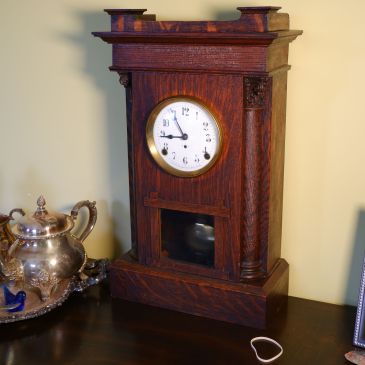
Arthur Pequegant Brandon wall clock, a loud ticker

I also believe that the type of escapement is a factor. Due to their mechanics, recoil escapements are always louder than all others. I have an Arthur Pequegnat Brandon wall clock with a recoil escapement in a room with six other clocks — and which one is the loudest? The Brandon, of course! It’s almost as if it’s saying, “Look at me, I’m the loudest in this room.”

Myth # 5 – WD-40 Works Well As A lubricant

One myth that makes clock repairers wince? WD-40. Yes, it might make a sticky clock run for a little while. But it also strips away proper lubrication and leaves a sticky film that attracts dust like a magnet. It’s the short-term fix that leads to long-term headaches.

What does the WD in WD-40 stand for? WD in WD-40 stands for “Water Displacement.” The product was originally designed to repel water and prevent rust, and the “40” refers to it being the 40th formula the chemists tried before they found one that worked effectively. Who knew?

Now, please don’t tell me it worked for you!

Myth # 6 – The Older the Clock, The More Valuable It Is

And while we’re setting the record straight, let’s talk value. Not every old clock is a gold mine. Age is only part of the story — rarity, maker, originality, and condition matter much more. Old is not gold, as they say. An 1850 Ogee clock might have stood the test of time, but it was made in the thousands, so it’s actually not all that rare.

George H Clark 30-hour Ogee shelf clock, circa 1850, for a ridiculously low price at auction

Of course, there are always exceptions. Well-preserved French clocks, such as a Louis XIV cartel clock of the 17th century, prized for their exquisite craftsmanship, ornate gilt bronze (ormolu) cases, and fine enamel dials, can be quite valuable.

However, many are often surprised to find out that their 100-plus-year-old clock is worth next to nothing.

Myth # 7 – Don’t Assume Black Forest Means “Made in Germany

Also, don’t assume the words “Black Forest” mean German-made. Some Canadian and American makers used the name simply because it sounded exotic and marketable. For example, the Blackforest Clock Company of Toronto (which became the Forestville Clock Company in 1941) produced reliable clocks for the home. While the cases were made in Canada, the movements were sourced from England, France, and, more typically, Germany.

Myth # 8 – It’s Running Fine, So It Doesn’t Need A Service

Another one I hear often: “It’s running fine, so it doesn’t need service.” The truth? Even a clock that’s keeping time can be quietly wearing itself out if it’s running on dry bushings or worn pivots. A thorough inspection should reveal any issues with the clock’s movement.

Myth # 9 – An Antique Clock Should Always Look “Like New”

And please, don’t feel you have to polish away every bit of patina. That gentle wear tells the story of your clock’s journey through the decades.

When we think of antiques, there’s often a temptation to restore them until they look spotless and brand new. But with antique clocks, that shiny, polished look isn’t always the goal, and here’s why.

Patina is the natural aging and mellowing of a clock’s surfaces over time. It’s the soft glow on wood, the subtle tarnish on brass, and the gentle wear marks that tell a story. This “aged finish” is like a fingerprint of the clock’s life, showing decades, sometimes centuries, of use, handling, and care.

Stripping away that patina by over-polishing or refinishing can actually damage the clock’s historical value. Collectors and experts often prize original finishes because they preserve the clock’s authenticity and character. A well-preserved patina connects us directly to the past, making the clock not just a timekeeper but a piece of living history.

Having said all that, I’ll admit I’m certainly guilty of refinishing the odd old clock now and then. After all, I keep many of them for my personal collection, and refinishing is a great way to learn new restoration techniques.

It also allows me to bring out the original beauty that may have been hidden under years of dirt and wear, which I believe is a good thing in certain situations. Plus, sometimes a carefully done refinishing can help stabilize fragile wood or finishes, ensuring the clock can be enjoyed for many more years.

And I will throw in two bonus myths.

Bonus Myth #1 – Serial Numbers Always Tell A Clock’s Date of Manufacture

Lastly, serial numbers. While they can sometimes pinpoint a clock’s date of manufacture, this only works for certain makers with complete records. Unless you can match the serial number to a verified database or understand the dating system the maker used during production, it’s merely an educated guess as to when the clock was made.

Clock company catalogs are an excellent resource for dating an antique clock—if you can find them! For example, if you have a clock made by Junghans of Germany, they offer an excellent catalog archive on their website.

Many of the serial number charts floating around online are best taken as educated guesses, not hard facts.

That said, many movements have no numerical markings beyond the trademark.

Bonus Myth #2 – A Quick Bath Is All A Movement Needs To Run Properly

One common myth I come across is that you can clean a clock simply by dunking the whole movement into a cleaning solution without taking it apart first. It sounds like a quick fix, but in reality, this can cause more harm than good. Clock movements are made up of delicate parts that need to be carefully disassembled, cleaned individually, and then properly lubricated.

Dunking the entire mechanism risks damaging pivots, bushings, and other components, not to mention leaving grime trapped in places you can’t see or reach. Proper cleaning takes time and patience, but it’s the only way to ensure your clock runs smoothly.

Duncan Swish was NOT a famous clockmaker!

At the end of the day, part of the joy of collecting clocks is hearing the stories — and sometimes, debunking them. Myths may be fun to repeat, but knowing the truth will help you keep your clocks in good health and their history intact. After all, a well-cared-for clock doesn’t just tell the time… it tells its own story.

If you know of any other clock myths or stories that deserve a closer look, I’d love to hear them—drop a comment below and let’s keep the conversation ticking!

How to Safely Remove a Clock Movement from Its Case

If you’re new to clock repair or restoration, one of the first hands-on steps you’ll encounter is removing the movement from its case. This process needs to be done with care to avoid damaging delicate components.

Sessions Beveled #2 mantel clock

Start by taking several clear photos of the clock from all angles—front, back, sides, and inside. These images will be your reference when it’s time to reassemble everything. Next, gently remove the pendulum by unhooking it from the suspension spring or leader. Set it aside somewhere safe.

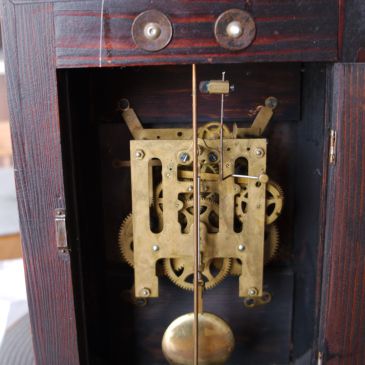
Removing a movement through the rear access door

I highly recommend using small containers to store any clock parts, screws, or retainers removed during disassembly—there’s no greater frustration in clock repair than losing a tiny screw.

Next, remove the hands. Unscrew the hands nut or remove the brass or steel taper pin holding the minute hand in place. There may also be a brass compression spacer attached to the minute hand. Lift and remove it and the minute hand. The hour hand is friction-fit on the hour pipe; simply pull it off.

The movement is removed from the front after taking off the dial and hands

In some designs, such as those requiring the removal of the movement through a rear access door, lay the clock flat to get better access. As a precautionary measure, it is advisable to remove the glass dial in advance, since placing the clock face down while working on the movement may result in the glass cracking (yes, that has happened to me). If the dial is removed, watch for tiny screws, clips, or pins—and keep track of how it was attached.

If the springs are open and relaxed inside the case, it may be difficult to remove the movement. Wind both mainsprings tightly.

Now locate the movement’s mounting hardware. Most movements are secured with case screws—usually at least four, one at each corner. On some clocks, you must remove the strike block before the movement can be taken out. This block is typically held in place by a large screw on the bottom of the case. In German wall and floor clocks, the movement is often mounted to a seat board and secured with two thumb screws. Simply unscrew the thumb screws and slide the movement forward to remove it.

At this point, you should be able to gently slide or lift the movement out of the case. There are times when the access door is so small that the movement must be carefully maneuvered to remove it.

Once everything is removed and stored properly, you’re ready to inspect the movement for cleaning, bushings, or further repair.

If the clock is spring-driven and still wound, always let the power down using a let-down tool set. However, before doing so, wind the springs, insert a clamp, or wrap a wire around the mainspring to secure it. If the spring is housed in a barrel, letting it down allows the mainspring to relax safely within the barrel. This ensures safety during the removal process and prevents damage from a sudden release of tension.

The movement is removed from the case and is ready for inspection

And now you are ready for the next steps.

Taking it slow and staying organized will save you time (and frustration) later on.

How to Arrange Antique Clocks for Maximum Impact

For clock collectors, presentation is just as important as the clocks themselves. A well-arranged collection not only enhances a space but also invites conversation and appreciation. While some collectors prefer to distribute their clocks throughout their home, others opt to showcase them all in one dedicated space. Regardless of your approach, thoughtful arrangement can make a significant difference.

Seth Thomas in an entrance hallway

One general guideline is to avoid clustering too many clocks in one area, allowing each piece to stand out. However, if you prefer to group multiple clocks together, consider organizing them by maker, style, type, era, or country of origin. A collection arranged with a clear theme creates a cohesive and visually appealing display, whereas a more haphazard approach can feel cluttered and overwhelming.

Deciding How Many Clocks to Display

Many collectors set limits on how many clocks are displayed at one time—and how many are actually running. While I keep most of my displayed clocks running, I occasionally let some take a “break.” Changing a clock’s location from time to time can refresh a room’s look, though it’s important to remember that some clocks are sensitive to movement.

Ingraham Huron shelf clock on a Westinghouse floor model radio

For example, in one of my larger rooms, I have four clocks, but they are spaced out so as not to compete for attention. The most striking piece is a 2-weight Gustav Becker Vienna regulator from 1902—at 51 inches tall, it naturally commands the space. On another wall is a Arthur Pequegnat wall clock, an Ingraham shelf clock that sits on an old Westinghouse radio, and a 1996 Ridgeway tall case to complete the arrangement. The layout ensures that each clock is showcased without overwhelming the room.

Gustav Becker and Ridgeway (foreground)

Placement Considerations

Some collectors prefer to dedicate a single room to their clocks, creating a focused display, while others, like myself, enjoy integrating clocks throughout the home. Of course, what works best also depends on what your partner is willing to tolerate!

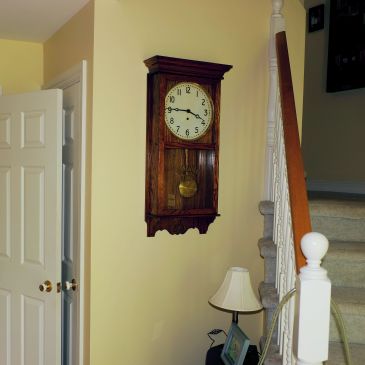
In my entrance hallway, for example, my Seth Thomas Regulator #2 greets the visitor to my home. Also in the hallway is an Arthur Pequegnat Canadian Time wall clock.

On the second floor, a Pequegnat Brandon schoolhouse clock is positioned where it can be admired, but in keeping with a simple household rule—no striking clocks upstairs to ensure a peaceful night’s sleep.

In the dining room, a Gilbert shelf clock sits atop a 1947 Stromberg Carlson console radio, blending vintage charm with functionality.

The Art of Thoughtful Display

Arranging a clock collection takes more than just placing timepieces on a shelf—it requires an eye for balance, harmony, and practicality. A well-considered display not only highlights the beauty of each clock but also enhances the overall aesthetic of your home. Whether you prefer a carefully curated showcase or a more casual arrangement, the key is to strike a balance between functionality and visual appeal.

Our Kitchen clock

How do you display your collection? Do you prefer grouping clocks together, or spreading them throughout your home? Let me know your thoughts!

What is My Clock Worth? | 2025 update

This blog post was first published in 2016, and it’s now time to revisit and update it to reflect the changes in market conditions and prices since then. There are many reasons why clock prices are low and continue to decline, but at the risk of oversimplifying, I will say that the law of supply and demand applies to this area of collecting, as it does to many others. Thousands of clocks were produced in the past, and antique clocks have flooded online marketplaces in recent years.

Every clock owner wants to know the value of their clock, and every seller wants to know the right price to ask. This guide aims to help both buyers and sellers by addressing key factors involved in assessing the value of an antique or vintage clock.

The Unpredictable Clock Market

In today’s unpredictable clock market, determining a clock’s value can be a challenge. What you think your clock is worth might not align with expert opinions or what buyers are willing to pay. Values can shift from day to day and are influenced by many factors. The market can be unpredictable, and the value of a clock may fluctuate significantly over time.

For example, take a typical ad for a mid-1990s Howard Miller grandfather clock on Facebook Marketplace. The seller may have paid $3,000 at the time and think that an asking price of $1,500 is fair. However, if the clock fails to generate interest, it could ultimately sell for much less. I’ve seen these clocks go for as low as $400 and even less. I’ll explain why at the end of this article.

The personal value the owner places on the clock often differs from its market value, leading sellers to either accept a lower price than expected or remove the ad altogether.

Easy to find, difficult to realize more than a few dollars for one on a sale

Even expert appraisals are subjective, based on the condition and collectibility of the clock, and are subject to market shifts. For example, while my Ridgeway grandfather clock is in excellent condition and a standout piece in my home, it has little market value today.

Factors That Influence the Value of a Clock

Is the clock original? Sometimes it is difficult to tell if every part of the clock is original? But a completely original clock in pristine condition holds more value than one that has suffered the ravages of time, neglect, or poor restoration.

Original clocks attract more buyers. If a clock has undergone significant repairs or replacement parts, its value will decrease. Determining originality can be difficult unless an expert inspects the clock. Many “Vienna Regulator” clocks, for instance, have been assembled with mismatched parts or movements, affecting their authenticity and value.

George H. Clark 30 hour Ogee
Many Ogee clocks have replacement movements, dials, hands, weights, tablets, and so on

What type or style of clock is it? While some clocks, like certain American mantel clocks, have little value due to many thousands of them having been produced, other styles such as 18th-century English bracket clocks or ornate French Cartel clocks can fetch high prices due to their rarity and historical significance. Tall-case clocks, despite their age, will often sell for much less than their original value.

Session Seth Thomas mantel clock
Mantel clocks were produced by the thousands and have little to no value

Does the clock have a label, trademark, or prominent name? Clocks with identifiable labels or trademarks tend to be more valuable. Prominent clockmakers’ such as E. Howard or Simon Willard, hold more value than similar, unmarked clocks. Replacement labels or unmarked movements lower the clock’s desirability.

This elegant 1830s banjo clock could have been crafted by a renowned clockmaker but is unmarked and holds minimal value.

Is it from the correct period, or is it a “knock-off” or reproduction? Many clocks, like the reissues of the Seth Thomas Regulator #2 in the 1970s, are less valuable than their original counterparts. Identifying subtle differences between originals and reproductions is key. Japanese and Chinese manufacturers produced “millions” of knock-off wall clocks that might fool the novice buyer.

Cheap and disposable Chinese-made clock, not worth repairing or buying

Does the clock have provenance? The history of a clock can add value. For instance, a clock with a documented history, owned by a famous person, for example, may command a higher price due to its historical significance. Intricately made tall case clocks with special provenance, made by noted clockmakers, for instance, will command high prices.

Ornate clocks such as this one are worth a small fortune

What is the age and condition? Much like antique cars, a clock’s age can contribute to its value, but condition plays a far more significant role. Just as a classic car with rust, missing components, or subpar restorations loses its appeal and worth, a clock with missing parts, poor repairs, or a poorly repainted dial will see its value diminish. Similarly, some clocks, despite their age, may lack desirability due to inferior craftsmanship or limited collector interest, much like certain vintage cars that fail to garner attention despite their years.

180-year-old woodworks clock; worth almost nothing, old is not gold!

Is the clock collectible? Rare or unique clocks are highly collectible. For instance, antique Canadian-made Arthur Pequegnat clocks are highly sought after in Canada, while the same clocks may have limited appeal outside specific regions.

Kienzle World Time clock
For some reason, these Series I Kienzle World Time clocks tend to fetch high prices

What is the mechanism type? Generally, three-train clocks (time, strike, and chime) are more complex and valued higher than two-train clocks (time and strike). Weight-driven clocks tend to be worth more than spring-driven ones. Conversely, some collectors tend to steer clear of complex clocks due to the challenges involved in repairing them.

People Don’t Want Clocks Anymore

The declining interest in antique and vintage clocks stems from several factors. Modern lifestyles prioritize convenience, and digital devices like smartphones and smart home systems have replaced traditional clocks as timekeeping tools. Generally, I find that younger generations do not share the same appreciation for historical craftsmanship, focusing instead on technology or experiences over physical heirlooms.

Modern homes, often compact condominiums with limited space, leave little room for accommodating a clock.

Antique clocks often require maintenance and specialized knowledge to repair, which can deter potential buyers.

Changing interior design trends also play a role, as many people prefer minimalist or contemporary aesthetics that do not accommodate antique and vintage clocks.

In the coming years, the prices of clocks will decline further as Baby Boomers—many of whom have been the primary custodians of antique and vintage clocks—enter retirement, downsize their homes, or pass away. This generational shift often leads to an influx of clocks entering the market as these individuals or their families divest of heirlooms and collectibles, items their own children do not want. With younger generations generally less interested in owning or maintaining such treasures, the supply will far outpace demand. This over-saturation, combined with changing tastes and priorities, will drive prices down even further, making it a buyer’s market for those who appreciate the art and history of antique clocks.

Do Your Research

Research is the key to determining value. Study online auction sites, local sales, reputable clock shops, and message boards to gauge prices. Be aware that clock prices are highly volatile and can change quickly based on supply and demand.

Before buying or selling, also research prices on eBay, reputable auction houses, and through local dealers. Finding clocks similar to yours can give you a price range to gauge your clock’s value—whether for personal interest or if you’re planning to sell.

Understand that clock prices fluctuate, and markets can be unpredictable. Always do your homework, ask questions, and provide honest descriptions if selling. Keep in mind that certain mass-produced clocks, many from China, Korea, and Japan, are not in high demand among collectors. This was true in 2016 and true today.

With the Internet’s impact, many clocks once thought to be rare have flooded the market, which affects prices. The law of supply and demand dictates that as supply increases and demand decreases, prices will drop. However, high-end, collectible clocks continue to retain their value.

Summary

Determining the value of an antique or vintage clock can be challenging, influenced by factors like originality, condition, age, and market demand. While personal sentiment often plays a role in perceived value, the reality of the unpredictable clock market requires thorough research and realistic expectations. Whether you’re buying or selling, understanding what makes a clock desirable and collectible will help you navigate this ever-changing landscape. With patience and knowledge, you can uncover hidden treasures or find the right buyer for your timepiece.

Is now a good time to purchase that special clock? With careful research, you may find bargains, but tread lightly, the clock market can be a minefield.

Assessing Antique and Vintage Clock Values: Key Factors

Every clock owner wants to know what their clock is worth, and every seller hopes to sell for as much as possible. This guide offers a framework to evaluate antique and vintage clocks for both buyers and sellers, starting with insights into the unpredictable clock market.

The Unpredictable Clock Market

Determining the value of a clock is often challenging. The market fluctuates, and what you think your clock is worth today may not align with expert opinions or what buyers are willing to pay. Trends come and go, and the value of clocks can drop or rise unexpectedly.

For example, I once came across a mid-1990s Howard Miller grandfather clock listed on Facebook Marketplace for $3,000. After several days with minimal interest, the seller gradually lowered the price to $1,500, but it still did not sell. In reality, it was only worth around $500 on a good day.

This shows how subjective personal value can be, and the reality is that modern clocks, like many Ridgeway or Howard Miller models, often do not hold their original value. What you believe holds significant value may not align with what potential buyers are willing to pay.

Scottish tall case clock

Even an appraised value is just an educated opinion, reflecting current market conditions, the clock’s condition, and its collectibility. As market trends shift, the value of a clock can change significantly.

Factors in Assessing Clock Value

Is It Original?
Originality significantly impacts value. Clocks with replaced or missing parts tend to lose their appeal to collectors. Many “Vienna Regulators” found online, for example, are hybrids of mismatched cases and movements. In some instances, parts are missing altogether.

Gustav Becker Vienna Regulator

Clocks marketed as “complete and original” by sellers who admit they know little about clocks should be approached with extreme caution. Always verify the clock’s parts with an expert or a reputable auction house to ensure accuracy.

What Type or Style Is It?
The style or type of clock affects value. While common American mantel clocks may be worth little due to their mass production, specific models like the E.N. Welch “Patti” line or Seth Thomas Sonora clocks command high prices.

Wall clocks, especially those from the 19th century made in limited quantities, generally hold a higher value than mantel clocks which were produced in the thousands.

Seth Thomas #2
Seth Thomas #2 wall clock

Grandfather clocks, also known as hall clocks, longcase, or tallcase clocks, can often be acquired for a fraction of their value, despite many that are 150+ years old. Tall clocks are bulky, requiring significant floor space. Many people don’t have the room or the inclination to accommodate such large items, especially in smaller or more modern living spaces.

A Label, Trademark, or Prominent Name adds Value
An intact label, trademark, or known maker adds value. A clock with a visible maker’s mark, such as an E. Howard or an original Willard banjo clock, is often sought after due to their craftsmanship and brand recognition.

A label, trademark, or maker’s mark verifies the clock’s authenticity, confirming that it is an original piece from a recognized manufacturer. This eliminates doubts about whether the clock is a reproduction or a mix of parts, which increases its value to collectors.

Canadian Time label
Pequegnat Canadian Time clock label

A visible maker’s mark or label helps establish the clock’s provenance, providing important information about its origin, manufacturer, and production period. Clocks with clear histories, especially from reputable makers, are more desirable because they can be accurately placed within historical or stylistic contexts.

A clock’s history can boost its value. A story or historical significance attached to a clock, or a clock with a clear and documented background may attract more buyers and command a higher price.

Reproduction labels or unmarked movements raise red flags for serious collectors.

The Correct Period or a Reproduction?
Period authenticity is key. Many reproduction clocks closely resemble originals from the early 1900s but have far less value. For example, Seth Thomas reissued its famous Regulator #2 in the 1970s, but collectors prefer the originals from the late 1800s, which have clearer distinguishing features.

Reproduction clocks are often made with modern manufacturing techniques and less expensive materials, resulting in a lower quality product compared to hand-crafted originals. Collectors and buyers appreciate the craftsmanship of original clocks, which were made with more attention to detail and durability.

Some sellers would pass off this 1970s Jauch clock as an antique

Original clocks from the early 1900s carry historical value due to their connection to a specific time period, reflecting the craftsmanship, design, and technology of that era. Reproduction clocks, even if they mimic the look of the originals, lack this historical significance, making them less valuable to collectors.

Novice collectors are often tempted by reproductions (particularly if the clock is passed off as original), and if they’re uncertain, they should consult a professional for guidance.

Age and Condition
A clock’s condition is crucial to its value. Clocks with missing pieces, broken hands, or poorly repainted dials are worth much less, even if they are from reputable makers. Age alone does not guarantee value—certain styles or makers, despite being centuries old, may not be popular among collectors.

Some buyers are specifically looking for clocks in original, unrestored condition, even with signs of wear. Restoration can eliminate the clock’s patina, which is often considered part of its historical appeal.

A well-functioning clock is more appealing to buyers. Properly repairing the movement restores its functionality, often increasing its resale value, as people are naturally drawn to a working clock.

In some cases, restoring a clock too thoroughly—by polishing, repainting, or replacing parts—can strip away its historical character. Over-restored clocks may look “too new,” which can detract from their antique charm and value.

Arthur Pequegnat fantop
Arthur Pequegnat Maple Leaf fantop restored case

The cost of repairing or refinishing a clock may outweigh the potential increase in resale value. If the clock isn’t particularly rare or valuable, to begin with, investing heavily in restoration may not yield a return in the marketplace. Sellers often do not service their clocks, either because they lack the necessary skills or because the cost of repair doesn’t justify the potential profit.

Is the Clock Collectible?
Desirability can be influenced by rarity and regional interest. For instance, Arthur Pequegnat clocks are highly sought after in Canada but may fetch lower prices outside the country. True Vienna Regulators from the early 19th century are another example of rare clocks that remain valuable, especially when they are original and authentic.

The Mechanism Type
The complexity of a clock’s mechanism can impact its value. Clocks with a three-train mechanism (time, strike, and chime) tend to be more valuable than simpler two-train or one-train models.

Clocks with more complex mechanisms, such as those with three-train movements, demonstrate a higher level of craftsmanship. These mechanisms control multiple functions, like chiming, striking, and keeping time, requiring greater precision and skill in their design and assembly. As a result, clocks with such elaborate mechanisms are often considered superior and more desirable, elevating their market value.

More complex mechanisms, like three-weight Vienna Regulator Grande Sonnerie clocks, are generally rarer than their single- or two-train counterparts. The production of these complex movements required more skill and was often reserved for higher-end models or special commissions, making them less common and more sought after by collectors. Their scarcity in the market can drive up their value, especially when the clock is in good working condition with original parts.

Collectors often prioritize clocks with intricate mechanisms because they showcase the ingenuity and technological advancements of their time. The presence of a three-train mechanism, or a clock with additional complications like chiming or an alarm, indicates a higher level of mechanical achievement. These clocks are often seen as more valuable historical artifacts, and their complexity can make them the centerpiece of a collection.

On the flip side, clocks with more complex mechanisms can be harder and more expensive to repair or maintain, which may deter some buyers. A three-train movement has more moving parts that could potentially break down or require servicing, and specialized knowledge is often needed to repair them. However, collectors willing to invest in these repairs typically appreciate the value of the clock and understand that the effort is worth it.

Do Your Research and Meet the Seller In Person!

Before buying or selling a clock, check eBay listings, reputable auction houses, local buy-and-sell sites, antique shops, and online message boards. Prices can be volatile, and what may have sold for a high price years ago may be worth much less today. For example, some clocks that were once highly valued, are now relatively inexpensive due to oversupply.

Rural Nova Scotia antique shop
Antique shops are potential places for a good buy

As a buyer, ask detailed questions and verify originality before making a purchase. Sellers should provide an honest and clear description of their clock, disclosing any replaced parts or modifications. Keep in mind that while the clock market may seem chaotic, high-end, sought-after clocks tend to retain their value over time.

Meeting the seller face to face is often the best approach. A personal meeting allows buyers to gauge the seller’s honesty and integrity, making them feel more secure in their purchase.

Seeing the clock in person allows the buyer to closely inspect its condition, functionality, and any potential issues that may not be apparent in photos. This firsthand assessment helps buyers make informed decisions about the clock’s value and condition. They can check for labels, trademarks, and other identifying features that may influence the clock’s value. Buyers can also evaluate the quality of craftsmanship and materials up close.

Face-to-face meetings provide a better opportunity for negotiation. Buyers can engage in real-time discussions, express their concerns, and potentially negotiate a fair price based on the clock’s condition and market value. In-person interactions often lead to more flexible negotiations than online communications.

Sellers who are passionate about their clocks can provide detailed information about the piece’s history, repairs, and provenance often enhancing the buying experience and adding value to the transaction.

Photos can be misleading, and details may be overlooked in written descriptions. Meeting the seller face to face reduces the risk of misrepresentation, as buyers can directly address any discrepancies they find during their inspection.

Meeting in person can eliminate the need for shipping, which can be costly and risky for fragile antique clocks. Buyers can transport the clock themselves, ensuring it arrives safely.

If you have any doubts or the answers you’re receiving from the seller seem uncertain, always—without exception—be prepared to walk away.

Now is a good time to buy or sell

Now is an excellent time to buy, as many bargains can be found with careful research. For sellers, patience and realistic expectations are key. Understanding the market, setting fair prices, and presenting items attractively will increase your chances of success. Whether buying or selling, doing your homework is essential to navigating this unpredictable landscape.

Thomas Tompion: The Father of English Clockmaking

Thomas Tompion (baptized July 25, 1639– died, November 20th, 1713) was an English clockmaker and watchmaker, often referred to as the “Father of English Clockmaking.” He is renowned for his exceptional craftsmanship and significant contributions to the development of clockmaking during the late 17th and early 18th centuries.

In fact, Tompion is the most celebrated of all English clockmakers.

Thomas Tompion

Born in Bedfordshire from a family of blacksmiths he moved to London in 1671 and was soon employed by the physicist Robert Hooke. Hooke was credited as one of the first scientists to investigate living organisms at the microscopic level. Hooke introduced him to leading scientists and royalty and as a result, Tompion received commisssions from Charles II, William III, and Queen Anne.

His business was based on Water Lane, Fleet Street, and he built a reputation for quality and ingenuity across Europe.

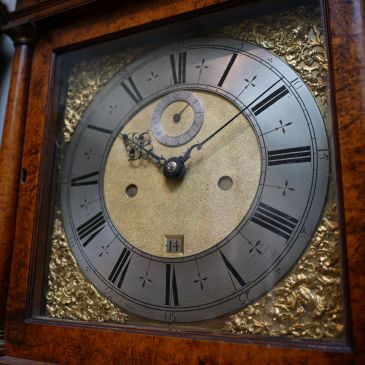
Tompion tall case clock at the Britsh Science museum

Tompion’s clocks and watches were known for their accuracy, elegance, and innovative design. He played a key role in advancing the precision of timekeeping, particularly through his work on escapements and the introduction of the balance spring in watches, which greatly improved their accuracy.

Thomas Tompion time and strike tall case clock – the British Museum

Tompion produced a wide range of timepieces, including table clocks, longcase clocks, bracket clocks, and pocket watches.

His clocks were often highly decorative, featuring intricate engravings and fine materials.

Table or bracket clock made by Tompion for Queen Anne, British Science Museum

He was also a mentor to several important clockmakers, including George Graham, who later became a prominent figure in the field. Graham invented the deadbeat escapement, a crucial improvement over previous escapement designs, allowing for greater accuracy in clocks. Two clocks in my collection, an Arthur Pequegnat Moncton and a Seth Thomas #2 have Graham deadbeat escapments.

Tompion was also Master of the Clockmakers’ Company from 1703 to 1704 (London). He made regulators for Greenwich Royal Observatory – one of the most prestigious commissions of his career.

While visiting the UK this spring, I stopped by Westminster Abbey, where Tompion is laid to rest.

Westminster Abbey

It is fitting that Graham is also buried in the same place.

Located at Westminster Cathedral

Tompion’s work is highly prized by collectors, and many of his clocks are now housed in museums and private collections around the world.

Having a Tompion clock would be a real treasure, but it’s far beyond my budget. The nearest I’ll get to a Tompion clock is seeing one in a museum.

Hamburg Amerikanische Uhrenfabrik: The Clock Company with an Alias

This article traces the historical journey of a significant German clock manufacturer, ultimately absorbed by the Junghans Clock and Watch Company in the late 1920s. After providing a brief overview of its history, the article will delve into the specifics of the clock movement that is next on my workbench.

Among clock collectors and admirers, the Hamburg American Clock Company is a well-known German company. It is otherwise known as Hamburg Amerikanische Uhrenfabrik or HAU and in many parts of the world, it is simply known as HAC or HAU.

The company was formed in Germany in 1873 by Paul Landenberger and Phillipp Lang. Originally called Landenberger and Lang, it became the Hamburg Amerikanische Uhrenfabrik in 1891. The company was very active from 1885 onward, became a cooperative in the mid-1920s, and eventually merged with Junghans, one of the world’s largest clock companies, in 1930.

HAC 14 day time and strike
HAC 14 day time and strike, a relative’s clock

Original investors insisted that “American” be in the company name but “American” also refers to the manufacturing system adopted from America. The name of the company adds confusion to the novice repair person who might assume that what they are working on is an American-made clock.

HAC trademark, crossed arrows
HAC trademark

HAU adopted the cross arrows as their trademark in 1892, and it became synonymous with the brand.


In 1925, a few years before its merger with Junghans, the company had a workforce of 2,200 individuals. Junghans remains a successful and thriving company today, specializing in the production of high-end wristwatches.

Before I embark on servicing a clock from my collection, I make an effort to gather information about the clock’s history. If details about the clock prove elusive, my fallback is to delve into the broader history of the company behind it.

Two Hamburg Amerikanische Uhrenfabrik clocks

The two HAC clocks in my collection are mantel or shelf clocks.

HAC mantel clock
HAC mantel clock

The clock pictured above was acquired several years ago.

HAC clock movement
HAC clock movement, with solid backplate

It has an earlier version of a HAC production movement because of the solid front and backplates. It is quite possible that this clock was made in or around 1900 or a little later.

HAC clock movement with solid front plate

Now, turning our attention to the second HAC clock in my collection, the one I will be working on next. The clock was acquired about two years ago from a clock collector in Ottawa, Ontario. The previous owner knew nothing about the clock but a plaque on the clock case gives a glimpse into the clock’s history.

This clock is a later production model because of the construction of the plates which I will explain further.

HAC clock number #2, model unknown, a later production
HAC clock number #2, model unknown, with a dedication plaque

While the wheel positions, levers, and movement size remain identical, there exists a noticeable difference between the two clock movements as can be seen by the solid front and back plates on the first clock movement and the various cutouts in the front and the back of the second movement.

Open plate, a later production movement

The use of open plates typically indicates a cost-saving decision made by the company. This choice is often driven by the aim to reduce manufacturing expenses by minimizing the amount of brass used in a movement.

HAC clock #2, #36 movement
HAC #2 movement

Aside from the four brass mounting straps and the slight difference in the positioning of one “V” shaped lever springs, HAC movement #2 has all the characteristics of the #36 movement pictured below.

No. 36 HAC time and strike clock movement

The story of two clocks made at different times in the company’s history is both captivating and compelling.

And finally, who is The Rev. J.H. Cox? A search online reveals nothing at this point.

Plaque mounted to the clock case

Before concluding that the clock was manufactured in 1926, it’s important to note that relying solely on plaques for dating may not always be accurate. The clock might have spent time on a retailer’s shelf, or it could have been acquired second-hand, introducing questions as to its actual production date. However, there is a 5,25 number on the upper left of the back plate which might be a date code. HAC was known to have begun dating their movements in the 1920s.

Now, on to servicing the clock movement the details of which will be covered in a forthcoming post.

Dating an antique or vintage clock – Part I

There is no single method of dating an antique or vintage clock but there are some strong clues in some cases and subtle inferences in others that help determine when a clock was manufactured. Occasionally, the exact month and year is displayed somewhere on the case, and in other instances the clock by way of serial numbers, date stamps on the movement, style of hands, spandrels, dial design, case design, and so on, establishes the date to within a certain period.

This is by no means an exhaustive reference but my thoughts on how to date a clock. I will therefore rely on various examples in my collection.

This is the first part of a two-part article. In the second part, I will explore additional clues for determining a clock’s age.

Elisha Manross steeple clock

This Elisha Manross clock is an attractive steeple design. Steeple clocks were made in the thousands from the early 1830s to the end of the century. A steeple clock is a type of mantel or shelf clock characterized by its pointed, spire-like top, which resembles the steeple of a church. These clocks were particularly popular in the mid-19th century and were produced by various American and Canadian clockmakers, including Seth Thomas, Chauncey Jerome, and others.

Elisha Manross steeple clock

Elisha Manross was an important pioneer of the Connecticut clock and lived from 1792 to 1856 and he was the maker of the steeple clock pictured above. A distinctive feature of this particular clock is brass mainsprings.

Brass mainsprings for Manross clock
Brass mainsprings, Manross clock

From 1836 to 1850 brass mainsprings were used in clocks because steel was considered very expensive. It was not until 1847 that the tempered steel mainspring developed for everyday clocks was introduced and with it, the brass mainspring faded into clock history.

This provides an important clue when dating this clock, that it was made before 1850. The second clue is the label located inside the case. Elihu Gere, the printer was in business at 10 State Street Hartford Conn. The printer’s name and address are located on the bottom of the label And this tells us that the printer was at this location until 1847. Armed with these pieces of information one can date the clock from about 1845 to 1847.

Daniel Pratt Jr reverse ogee columns with splat top

Next, is a Daniel Pratt Jr. shelf clock. A distinctive feature of this clock is that it has a woodworks movement. A woodworks movement is a type of clock mechanism/movement made predominantly from wood rather than metal. These movements were commonly produced in the early 19th century, particularly in the United States, during a time when wood was more affordable and readily available than brass or steel. Woodworks movements were very common before 1840 and were considered the first mass-produced clocks.

Daniel Pratt Jr.

Daniel Pratt (1797-1871), Jr., clock-maker, banker, town clerk, and legislator, lived in the town of Reading, Massachusetts, in the 1800s. Pratt did not contribute much to clock-making and was widely regarded as an entrepreneur rather than an innovator.

This particular Daniel Pratt Jr. reverse Ogee shelf clock was made in Reading, Massachusetts, c. 1832-38, within that six-year period. It has a splat-top mahogany case with half reverse Ogee moldings flanking the door, painted wooden Roman numeral dial, mirrored lower tablet, and wood dial face. The mirrored tablet was considered a luxury at the time.

Woodworks movement

McLachlan tall case clock

It is a classic Scottish design from the mid-1800s. The removable bonnet is 23 inches at its widest point, the waist is 15 3/4 inches wide and the base is 20 inches wide. The bonnet has tapered columns on either side. The dial access door which covers the entire bonnet swings to the right. The solid wood access door on the waist measures 9 X 24.

McLachlan Scottish Clock

The well-preserved sheet iron white dial has painted spandrels, each one depicting an ewe with a lamb and a painted arch top showing a man resting on a rock with two working horses directly behind.

English Bell strike movement

The robust movement is made in the Guild style and movements contained in these clocks are commonly called “English bell strikes” with anchor escapements.

McLachlan was not a clock-maker in the true sense of the word but rather an assembler, bringing the dial, clock case, and movement together to assemble into a tall case clock for a particular customer. Signatures on a clock dial may or may not refer to someone other than the clock-maker. 19th-century retailers and distributors often put their own names on clocks in an attempt to ‘brand’ their products. The actual movement may have been made by someone else likely in Birmingham England. 19th-century clock cases were almost always made separately from the movement and are rarely signed.

The name Wm McLachlan, of Newton and Stewart, is inscribed on the dial. In his book, Clock-makers & Watchmakers of Scotland 1453 to 1900 David Whyte lists McLachlan, William, clock & watchmaker in Newton-Stewart, Wigtownshire as a business advertised for sale on 25 May 1852. McLachlan either retired or passed away before the sale date. Newton-Stewart is a former burgh town in the historical county of Wigtownshire in Dumfries and Galloway, southwest Scotland.

This clock was therefore made between 1848 and 1852. The painted dial which originated in or around 1810, the style of the hands, the style of spandrels, the shape of the arched dial, and the shape of the case are other clues that it was made within that period.

Sessions Beveled #2 tambour style mantel clock

This Sessions tambour style clock represents a very popular style of clock sold in the 1920s and 1930s in the USA.

Sessions Beveled #2

It is a fairly attractive mantel clock featuring a toned mahogany finish with faux inlay below the dial face. Faux inlay was an affordable way to enhance a clock’s decorative details and a common feature of clocks of this type in the 1920s.

Label on the inside of the access door

Sometimes, the exact date of manufacture can be pinpointed down to the year and month, making dating straightforward. In this instance, the clock was produced in September 1927.

Arthur Pequegnat kitchen clock

Dating a clock can sometimes be challenging, and unfortunately, this particular clock is difficult to date with precision.

Arthur Pequegnat kichen clock
Arthur Pequegnat kitchen clock

In Canada, the Arthur Pequegnat Clock Company produced clocks from 1903 to 1941. Before the First World War, the company operated in Berlin, Canada. During the war, the city’s name was changed to Kitchener in 1917 due to anti-German sentiment at the time. This small piece of information helps to approximate the date of a Pequegnat clock.

Below the six on the dial is the inscription “The Arthur Pequegnat Clock Co. Berlin, Canada,” but neither the case nor the movement provides any clues to narrow the date beyond the period between 1904 and 1917.

I hope the examples I’ve shared provide some helpful insights into dating a clock. This is the first part of a two-part article; in the second part, I will discuss additional clues for determining a clock’s age.

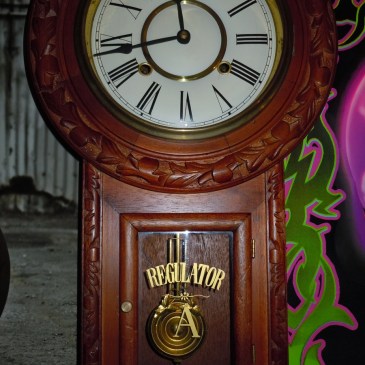
If it says Regulator on your clock it is likely NOT a Regulator?

A century ago, clock manufacturers understood the power of marketing, and the word “Regulator” became a key tool in their strategy to boost sales. By simply labeling a clock with “Regulator,” they could make it appear more precise and desirable, even if it wasn’t a true regulator. But is this a hard-and-fast rule? Let’s take a closer look.

Seth Thomas #2
Seth Thomas #2, typically used as a railroad time clock

By definition, a regulator clock was, and still is, a clock used as a standard for setting other clocks. These clocks were commonly found in businesses, railroad stations, public buildings, and even churches and tower clocks, where townsfolk would adjust their personal timepieces based on the regulator. Early regulator clocks played an essential role in keeping communities synchronized in their daily routines.

For 270 years, pendulum clocks were the world standard for precise timekeeping, until the invention of quartz clocks.

Take, for example, the Gilbert calendar clock shown below. Advertised as a “Regulator,” it does not fit the true definition. With a spring-driven, time-only movement, it is accurate to within a minute or two per week, which is typical for spring-powered clocks. While the calendar feature is useful and the clock is attractive, it lacks the precision of a true regulator and would not be relied upon for setting other clocks.

This Gilbert calendar clock is not a Regulator

Are there exceptions to this rule? As always, there are exceptions. The Welch Spring and Company produced a clock from 1874 to the mid-1880s certified for use in train stations. This double-weight, time-only clock, reminiscent of the well-regarded Seth Thomas Regulator #2, was stenciled with “Regulator” on its access door. Given its constant weight-driven power and deadbeat escapement, it was likely a very accurate timekeeper.

Double-weight time-only Welch clock – is it a regulator?

This particular Welch clock, now a museum piece at the American Watch and Clock Museum in Bristol, Connecticut, has been meticulously restored. When it was received, the lower tablet was missing, leading to questions about whether it originally came with the word “Regulator” on the access door. The answer is yes, some did, and some didn’t—there was a tick box on the order form for this feature.

So, while the use of “Regulator” on a clock often served as a marketing tactic to imply precision, there are instances where it genuinely signified accuracy. As a general rule, though, it’s safe to assume that many clocks labeled “Regulator” were more about selling an image than offering precise timekeeping.

In the world of clocks, the term “Regulator” was often used as a clever marketing strategy to sell more timepieces by suggesting greater accuracy. While some clocks with this label were indeed precise, many were simply designed to look the part. As a buyer, it’s important to look beyond the label and evaluate the clock’s true functionality and history before assuming it lives up to its name.

Top ten blog articles of all time – my blog, of course

Mauthe Mantel clock, circa 1938

Every blogger knows that it takes time to build a popular blog and unless you have a surefire winning formula right off the mark it takes months if not years to build a loyal following.

Many blogs fail within the first few months out of frustration yet patience, determination and some hard work is all it takes to find a rhythm that works.

Daniel Dakota wall clock

With over 130,500 page views since 2015, upwards of 4000 average monthly views and over 900 views per week I recently checked my stats to find the 10 most popular blogs of all time.

The experts are going elsewhere and that is fine with me because this blog was never intended to appeal to those running a repair business or involved in the commerce of antique clocks

Here they are. Click on the links to see what all the fuss is about.

Continue reading “Top ten blog articles of all time – my blog, of course”

Seth Thomas Regulator #2 wall clock

During my travels through Ontario, I acquired a Seth Thomas Regulator #2, one of my newest additions. I discovered this clock in Bloomfield, a quaint village just minutes from Picton, a major hub in Prince Edward County renowned for its many wineries.

I first spotted the clock during a summer visit to the local antique shop and deliberated over the purchase for quite some time before finally deciding to take the plunge in the fall. These clocks are a rare find, and with the price being right and the clock in excellent condition, it felt like an opportunity I couldn’t pass up.

Perhaps best known as one of the most common regulator clocks in America, the Seth Thomas Regulator #2 was a fixture in many railway stations across the country during the last century—a testament to its accuracy and dependability. Robust, precise, well-engineered, and reliable, this timepiece was manufactured by Seth Thomas from 1860 to 1950, an impressive production run of 90 years. Few clocks can boast such longevity. It is an iconic American clock, and every serious clock collector aspires to own one.

Seth Thomas Regulator #2, circa 1922

A classic style, the #2 changed very little over the years. However, certain design characteristics help date the clock. The following identification guide describes dial and case characteristics that will aid in identifying the approximate year the clock was made.

Click here for the larger guide;  http://www.clockguy.com

The most distinctive visible characteristic is the design of the base.

The base of the clock

Aside from the distinctive base, all but the earliest #2s had the pendulum mounted in the rear with “T” hands.

The chart also lists the limited run reissue in 1976. Most Seth Thomas aficionados would agree that while the reissue is a handsome and well-made clock that is a testament to the original it is not in the same realm as an authentic Regulator #2 and the prices for these versions reflect accordingly. However, those who have the reissue seem to be pleased with their acquisition.

ccording to the chart, my clock was made between 1922 and 1929 and features a base reminiscent of the earlier 1860 version of the #2. It has Arabic numerals with spade hands, and the bow-tie connecting the wooden dial bezel to the drop is a single piece (earlier versions featured a three-piece bow-tie). The clock includes a second hand positioned 2 inches above the center cannon; however, it is not a true second hand, as it runs off the escapement and takes 80 beats to complete a “minute.”

Measuring 36 ½ inches in height, the clock is veneered in mahogany. The movement is stamped with “77A” in the bottom right corner, with the letter “K” underneath, but it bears no other markings. While some versions of the 77 movement have lantern pinions, this one is equipped with cut pinions.

Are there issues with this clock? Certainly, it is over 90 years old!  There is minor loss on the dial, no label, a finish that has lost its luster and paint splatter on the top of the case not visible from the front. Is it really so hard removing a clock when painting a room!

Is it Perfect?

I brought this clock from Ontario to Nova Scotia by car. Removing the pendulum for transport is not a particularly simple process but if you are familiar with the pendulum arrangement on a typical weight-driven Vienna Regulator this one is no different. Like Viennas, the pendulum is hung behind the movement.

Both the weight and the pendulum must be removed for transport. There is many a story of broken glass when weight and pendulum are free to move around inside the case. To remove the weight, simply unhook it from the cable wheel.

There are minor issues with the dial-face

To remove the pendulum the movement must be taken out. First, the hands are taken off. In this version, the minute hand is held in place with a nut. Older ones have a pin. There are 8 small screws that hold the dial in place. Once the dial is removed, two larger screws on the wooden second-hand rail are removed. Four cylindrical column posts hold the movement in place. Unscrew these beginning with the bottom two and lift the movement out. Once the movement is out, the pendulum can be unhooked from its suspension spring. The entire process takes less than five minutes.

The trapezoid 77A movement with maintaining power in this clock looks clean. There is evidence of having been worked on in the past as there are 4 punch marks around the winding arbour to close the hole; a common practice in the past to close a pivot hole. Otherwise, the movement looks very good.

Trapezoid 77A movement

Getting the clock to run reliably was a challenge and it took a week or so to sort it out. The clock would run for a few minutes and stop.

Following a process of elimination, I removed the movement, inspected it for wear, found very little, oiled the pivots, and returned the movement to the case. I installed the dial, then the hands. The clock would run for a few minutes and stop. I removed the hands and dial; left the dial off but reinstalled the hands. Still, it would run only a few minutes. I then took the dial and hands off. I ran the movement for four days to eliminate any underlying issues and to convince myself that the problem lay in the positioning of the hands. The problem was definitely with the positioning of the hands.

On day five, I put the dial back on, then the second hand ensuring that there was sufficient clearance between the second hand and the face. Next, I put the hour hand on the pipe and pressed it in far enough to clear both the second hand and the minute hand. I attached the minute hand, inspected it for sufficient clearance, and screwed it in place. I started the clock.

Success at last! Regulating the clock is fairly simple and is achieved by turning the rating nut on the bottom of the pendulum. This clock must be level and in beat to function properly.

I used Murphy’s Soap to clean the grease and grime from the case. I chose to leave the paint splatter intact, as it adds a bit of character to the clock. Additionally, I polished the brass weight and pendulum bob to restore their shine.

The view from our front door

This clock boasts a striking appearance and a rich, illustrious history, making it a perfect addition to the front entrance of our home. Unfortunately, its journey over the past 90+ years remains a mystery.

The question of whether it qualifies as a “true regulator” is a debate for another time.

Website Powered by WordPress.com.

Up ↑